

News
Okere Charges Entrepreneurs on 3 Powers for Success in Business

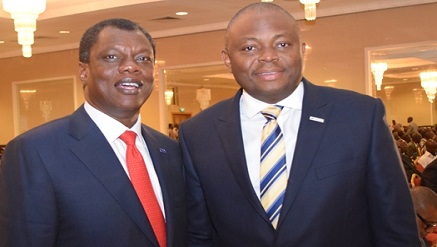
Austin Okere, founder and Chief Executive Officer, Computer Warehouse Group Plc, has charged Small and Medium business owners to ensure that their business visions are driven by the “3 Powers of success”. This, he said, includes the Way power, the Will power and the Wait Power.
He made this known in a panel discussion, with the theme “Leveraging Technology for SME Growth”, at the maiden edition of the Annual Fidelity SMEs conference that was held in Lagos.
The panel featured outstanding entrepreneurs in the ICT sector of the country, including Chief Leo Stan Ekeh, founder of Zinox Technologies; Mr. Nicolas Martin, CEO and co- founder of Jumia ; Mr. Charles Anudu, CEO, SWIFT Networks; Mr. Bankole Cardoso, Founder Easy Taxi; Mr. Opeyemi Awoyemi, Co-Founder Jobberman and Mrs. Funke Opeke, CEO of Main One.
According to Okere, “The three powers are secrets that will keep every entrepreneur going”. He explained further that “Will power is the competence you possess to run your business. The knowledge of how to run the enterprise you want to venture into”.
“Many people will start a business, create solutions then go about looking for the problems. And when people don’t buy it, they become disappointed. You first ought to be finding out peoples’ problems and pain points then create solutions that ameliorate the pain. This is the best way to ensure patronage.” He added.

The will power, according to Mr. Okere is “the resolve to keep going when everyone say give up”.
“Sometimes people close to you will advise you to dump your venture and seek a proper job. But, what should keep you going at such times is your passion. It is the passion of a footballer that makes him complain when he is benched, despite the fact that he will still receive his pay at the end of the day. Your will power makes you go the extra mile, while your passion makes you persist in your venture while waiting for pay day.” He explained.
“Most businesses fail because the proprietors abandon them as soon as they face challenges, because it is not yielding as much as they want. After you have put so much effort into your business, you need to patiently wait for the benefits that will accrue from it. This is the essence of the third power; the wait power, which takes you eventually to light at the end of a dark tunnel.” He concluded.
Speaking on how SMEs can leverage on technology to maximize results, Okere encouraged merchants to explore the opportunities that the CWG 2.0 platform affords.
According to him, “SMERP and Openshopen platforms are designed to meet the peculiar needs of SMEs in Nigeria. Openshopen will give you the visibility your business requires to thrive in this age where businesses are going online, while SMERP will take care of your accounting and generate the records banks like Fidelity will require from you to access loans”.
“Beyond that, they are reliable and affordable, and are available on a subscription basis.” He noted.
According to Okere, the essence of developing the CWG2.0 platform is to democratize the technology that companies such as Jumia and Konga have erstwhile used exclusively to great advantage, and make them available to the over 17.7m MSMEs in Nigeria.
“Seeing the value that this platform shall bring to the SME’s in the country, SMEDAN recently signed an MOU with CWG Plc culminating in a partnership that will address the technology needs of the sector.” Austin concluded.
Nnamdi Okonkwo, managing director, Fidelity Bank Plc, in his opening speech maintained that the bank’s commitment to building Nigerian entrepreneurs is one of its core business focuses.
“We have gathered here today to deliberate on the challenges faced by SMEs in Nigeria and proffer solutions that would guide entrepreneurs to build sustainable businesses.” He explained.
“Our goal is to produce more successful businessmen like Alhaji Aliko Dangote from our entrepreneurs that are in SME category for now. We have watched Dangote transform from a merchant who went into manufacturing and later transformed into an owner of a multinational conglomerate.” He added.
At the end of the conference, Mr. Okere was given a Distinguished Partner Award for his role in the building of Nigerian entrepreneurs by Fidelity Bank plc. In a commemorative statement, the bank appreciated Mr. Okere for sharing his ideas on the panel. “We have continued to receive excellent feedbacks from the audience who are inspired by the insights and knowledge you shared.” It explained.



Atte Ayodeji, a Nigerian computer scientist,has developed an artificial intelligence algorithm capable of detecting, counting, grouping and generating healthy hair follicles during hair transplant procedures, an innovation that earned him the Best Innovative Technology award.

Atte Ayodeji
Ayodeji also graduated with a Distinction in his Master of Science (MSc) in Computer Science from Birmingham City University on Friday, adding another milestone to an impressive academic year.
Beyond his award-winning hair transplant innovation, the Nigerian researcher developed a system and framework on Explainable Artificial Intelligence (XAI) as a professional responsibility in the diagnosis of lung cancer.
His dissertation received a silver award at the PGXPO2026 Winter, further highlighting the impact of his research in applying artificial intelligence to healthcare.
Sunday Dare, special adviser on Media and Public Communication to President Tinubu, celebrated Ayodeji’s achievements in a post on X, recalling how he first met him in 2019 during his National Youth Service.
“In 2019 when I became a Minister of the Republic, I met a young man of medium height, genteel with penetrating eyes: Atte Ayodeji. His words rarely come out and he could easily be passed by unnoticed. But I noticed him especially when my SA Kemi Areola brought him to me asking my approval for him to do his Youth Service in my office. I approved. From then on he was unstoppable. His brilliance shown and he developed skills beyond his frame.”
Highlighting Ayodeji’s recent accomplishments, Dare congratulated him saying, “Congratulations Atte. I am proud of you!”
Mr. Joseph Tegbe, minister of Power, has said that the federal government plans to end power sector subsidies from 2027 and that there are no immediate plans for tariff increases.

Mr. Joseph Tegbe, minister of Power
The minister told journalists during the media interactive session at the weekend that the government has announced plans to phase out electricity subsidy payments from 2027 as part of efforts to address mounting liabilities in the power sector.
He explained that the planned removal forms part of the broader reforms aimed at ensuring the long-term sustainability of the electricity sector, while tackling the financial challenges confronting the industry.
According to the minister, despite the planned subsidy withdrawal, there are no immediate plans to increase electricity tariffs, reassuring consumers that the government is not considering a tariff hike in the short term.


Patience Okala, the National Coordinator and Chief Executive Officer of the Nigeria AfCFTA Coordination Office has urged African countries to stop exporting raw materials and instead focus on adding value to its natural resources if it is to fully harness the opportunities offered by the African Continental Free Trade Area.

She stated this on Thursday at the Streamsowers & Köhn 20th Anniversary Business Forum, where she stressed that value addition and beneficiation are essential to Africa’s industrialisation and long-term economic growth.
According to a statement issued on Friday by the Nigeria AfCFTA Coordination Office, she said the AfCFTA goes beyond the elimination of tariffs, serving as a framework for industrialisation, value addition, and job creation across the continent.
“AfCFTA is not only about tariffs; it is also about value addition. Africa has to stop exporting raw materials. We need to add value and ensure that beneficiation is done on the continent,” she said.
Okala also said Africa’s economic transformation would depend on the effective implementation of the AfCFTA rather than on the signing of trade agreements alone.
“We have moved beyond negotiations. The success of AfCFTA will be measured by the extent to which businesses can access new markets, trade seamlessly across borders, and benefit from the opportunities created by the agreement,” she said.
She noted that Nigeria had intensified efforts to implement the agreement under the leadership of the Minister of Industry, Trade and Investment, Dr Jumoke Oduwole, including the development of simplified AfCFTA guides in six languages to help businesses understand and take advantage of opportunities under the trade pact.
Okala called for stronger collaboration among governments, regulators, and the private sector to eliminate barriers to trade and investment and build a truly integrated African market.
“As we move from policy to implementation, our collective responsibility is to ensure that the opportunities created by AfCFTA become practical realities for businesses, particularly MSMEs, women-owned enterprises, and young entrepreneurs across the continent,” she said.

5 Strategic Communication Moves Every Nigerian Startup Should Implement to Attract Investors

SERAP Asks Tinubu to Probe Alleged N6.79Bn Missing Police Funds, Firearms

FCT Court Awards Ex-Customers N15m against Stanbic IBTC over Data Privacy Breach

CBN Exposes over 13,000 BVNs Tied to Fraud as Banks Tighten Security

Atte, Nigerian Develops AI Algorithm for Hair Transplants

NRC, Ponzi Scheme Collapses Resulting Loss of Billions of Naira

EFCC Busts NIS Visa Overstay Racket, Uncovers N700m in an Account

From Scarcity to Scale: What Africa Can Learn from India’s Agricultural Transformation

BON Establishes Six Ad Hoc Committees to Modernize Broadcasting

Tokenization, Blockchain Technology will Transform Financial Institutions – IMF




 Broadcasting3 days ago
Davido Shares Past Suicidal Thoughts, Drops Oriadé Album

 E-Business3 days ago
How Temu Helped a Madagascan Vanilla Family Business Sell Direct to Consumers Across Europe

 News3 days ago
Cisco Explores AI for Nigeria Farmers

 General News3 days ago
MTN Nigeria Posts N707.5bn H1 Profit, Declares N26 Interim Dividend

 News3 days ago
AfCFTA Urges Africa to Stop Exporting Raw Materials

 E-Business3 days ago
82% of Organizations Concerned about AI Risks Even as Adoption Accelerates – Survey Reveals

 General News3 days ago
Gavi Okays $500m for Vaccines, PHCs in Nigeria

 E-Business3 days ago
FG Must Consider Data Security, Sovereignty in 3MTT Initiative – Stakeholders