

Telecom
Telecom, Great Enabler for Economic Advancement

When the word telecommunications is mentioned, what readily comes to mind of many Nigerians is voice communications. This perception could be explained by the emphasis on voice by most telecom operators as well as voice being the most required of other services on their table.
There are four major services commonly being delivered by operators in the telecommunications sector of any economy, these include, voice, data, internet and video.
Today, these services are playing fundamental role in powering advancement in other sectors of any economy. Some of the sectors include financial, aviation, medical, education, manufacturing among others. In all of these, telecommunications is helping in enhancing effectiveness of the services delivered in the sectors.
Dr. Ernest Ndukwe, executive vice chairman, Nigerian Communications Commission (NCC) explained that telecommunications is an essential infrastructure of the information economy, and that countries that lack sufficient access to modern telecommunications networks, find it difficult to be effectively integrated into the global economy. Against this backdrop, he said that the Nigerian government has, over the past eight years been providing the right environment to attract serious investors and encourage market forces to thrive, all aimed at attracting new sources of capital, accelerating network expansion, improving pricing, enhancing quality of service and introducing new technologies.
“There is no doubt that without ICT a nation or person cannot reach her full potential in today’s world. Two new reports, by the World Bank (Information and Communication for development report, 2006) and World Economic Forum (Global Information Technology report, 2005-2006), underline the fact that economic development depends on overall progress in a country’s ICT sector, and that, without such progress, both economies and companies suffer. Thus the World Banks study finds that firms that use ICT grow faster, and are more productive and profitable than those that do not. Access to broadband has also been identified as key to keeping small businesses competitive in any modern economy” he said.
According to him, “even for the poor and rural population, investments in ICT have been known to help reduce the burden of inadequate infrastructure particularly in the area of transportation. Rural areas, where the vast majority of the world’s population lives, as well as a significant proportion of poor people, tend to be greatly underserved by essential infrastructure. ICT can enable them to save both time and money if they are able to access information and services closer to home. ICT facilities are critical for local producers to coordinate activities, linkage with national and global opportunities as well as being able to withstand competition in their domestic markets”. Survival and growth in these contexts he said increasingly depend upon their innovativeness, capacity to learn and their effectiveness in using and absorbing technology, which is becoming essential factor in production, distribution, marketing and planning processes at all levels.
Even in the case of the “informal sector”, the source of livelihoods for most of the world’s poor and for a large percentage of women, ICT can assist with the delivery of social services, with micro-finance, with strengthening coping strategies and income generation thus contributing to general sustainable development.
Engr. Gbenga Adebayo, chairman, Association of Licensed Telecommunications Operators of Nigeria (Alton) said telecommunication had replaced to a large extent, the need for travels, the need for physical meetings as conferences are held over video teleconference facilities with parties located in different parts of the world.
These advantages, he said, had changed the way people live and the way they do businesses and that Nigeria was on the map of this transformation. The modern day economy, he added, cannot be sustained without commensurate development in telecommunication. He further explained that virtually all industries in the country today depended on telecommunication services in one form or the other, be it manufacturing, oil exploration, production, traffic management and control, security and surveillance systems and the banking and finance sector.
Benefits to Financial sector
Before the liberalization of telecommunications sector in the country’s economy, there was nothing like online banking, where a bank customer can carry out transactions in any branch of the particular bank across the country outside where such account is domicile. Then, Nigerians where forced to carry cash from one city to the other to make purchases because they can not withdraw money from any other branch of the same bank order than where the account is domiciled.
Online banking services are the distance banking services over electronic media from the early ’80s. The term online became popular in the late ’80s and referred to the use of a terminal, keyboard and TV (or monitor) to access the banking system using a phone line.
Aside online banking, the financial sector has also benefited from the telecommunications which facilitated the introduction of electronic payment. Initial efforts in the use of electronic cards to carry out transactions through Automated Teller Machine (ATM) failed because there were no reliable telecommunications services to provide the communications link required for the system to work. A typical e-payment system requires communications link such as General Package Radio Service (GPRS) or cable between the ATM and the bank’s data centre as well as the switching platform. This is provided by telecommunications operators.
Adeyemi Adeyinka, managing partner, Intermac Consulting, an integrated consulting firm with focus on e-business with particular emphasis on e-banking and e-payment intermediation has observed that Nigeria has continued to make steady progress towards ensuring full banking transaction automation with the value of e-payment rising to N360 billion in 2008.
He noted that the increase in the adoption of the electronic model is not only driven by the need for electronic services but also by the love and speedy uptake of new technologies by Nigerians.
According to him, most astonishing, is the fact that the uptake of technology in the country cuts across all strata of society. This is even as artisans, market women and Okada riders make use of the e-payment systems as well as the upwardly mobile professionals. All these are great indications that there is a lot of prospect for electronic payment in Nigeria.
Medicine
Ordinarily, one would argue that medical profession has little or nothing to do with telecommunications, except when a nurse needs attention of the doctor she can call him or her through mobile phone, if he is out of the hospital premises. But, telecommunications goes far beyond this. We hear the word ‘telemedicine’ this system allows doctors to carry out surgery or treatment at remote locations from the city. This system is powered by telecommunications. Without telecommunications there is nothing like telemedicine which is the way forward in the effort to achieve advancement in the primary health care service delivery in the country.
Oil and Gas
Oil and Gas sector of the country’s economy has become the biggest corporate customers of most telecommunications operators providing satellite communications as well as two way radio services. The nature of oil prospecting demands that workers at the rig which are located at creeks which are far from the city need to communicate with their operational base in the city. This is done through effective communications services provided through Very Small Aperture Terminal (Vsat) as well as two radio service that makes use of satellite communications all part of telecommunications services.
Nay, oil and gas companies require satellite communications to monitor their facilities located at creeks to determine point of damage if such facility suffers one.
Education
In Education, the use of information and communication technologies continues to expand exponentially, bringing unprecedented opportunities for achieving greater educational access and success. Given this potential, governments and its agencies have invested substantial resources to providing facilities in schools, colleges and universities around the country, thus increasing access to IT education, improving literacy and improving the quality of education generally. More importantly, distant education programmes are made possible by internet connectivity, where a student in Nigeria can be part of a lecture in an educational institution say, in London or United State America (USA) live as well as make contributions while the lecture is going on.
Aviation
Aviation sector is not left out as one of the sectors that are benefiting from the services of telecommunications. Without missing words, telecommunications is the bedrock of aviation industry as aircrafts flying in the air maintains constant communications link with the control tower without which the plane will immediately crash. This vital link that makes flight possible is provided by telecommunications sector.
The Federal Government as well as the State Governments declared their commitment to positioning Nigeria among the top twenty economies of the world by 2020, and are of necessity, required to be seen to be committed to providing the right policy and regulatory environment that will attract massive investment into the various sectors of the economy. The telecom sector leads the way in this regard and has achieved international recognition for Nigeria as the leading country in Africa and among the top ten in the world as a result of this commitment.
With the growth being experienced in the telecommunications sector and its adoption in different sectors of the economy, it is believed that the hope of the country becoming one of the top twenty economies will be realized if the right policy is put in place to encourage the application of Information and communications technology to our national life.



Association of Licensed Telecom Operators of Nigeria (ALTON), official industry umbrella body and pressure group for major mobile network operators in the country, has faulted claims that foreign direct investments (FDIs) into the sector slumped significantly in quarter one (Q1).

Gbenga Adebayo, Chairman, ALTON
ALTON, said that with N2.13 trillion spent in 2025 on network upgrades and expansion that they would invest an additional N1.86 trillion on network expansion this year.
The body was reacting to the claim by the National Bureau of Statistics (NBS) that FDIs into the sector slumped significantly in quarter one.
The telcos commended the Federal Government for its continued support of the industry, while calling for a more comprehensive framework to track and report investments coming into the sector.
The operators highlighted the importance of accurate data in shaping investor perceptions and guiding policy decisions.
The association noted that while the NBS recently released its Q1 Capital Importation Report, the figures presented do not fully capture the scale of capital deployment within Nigeria’s telecoms industry.
“This disparity between reported foreign capital inflows and actual infrastructure investment highlights a gap in how sectoral capital deployment is currently measured and reported,” the statement read.
ALTON, in the statement, signed by Gbenga Adebayo and Damian Udeh, chairman and publicity secretary, respectively, expressed appreciation to the Federal Government for approving a strategic 50 per cent tariff increase in 2025, describing it as a pivotal intervention that rescued the industry from financial distress.
According to the association, the tariff adjustment restored operational viability, closed critical revenue gaps and enabled operators to reinvest in infrastructure and service quality.
The association emphasised that the policy intervention transformed the sector from a struggling model into a sustainable, growth-focused industry.
“The timely investment enabled operators to transition from financial distress to a sustainable, growth-focused model characterised by significant capital reinvestment,” ALTON stated.
The statement revealed that telecom operators, tower companies, and other players in the sector recorded a total capital expenditure of N2.13 trillion in 2025. For 2026, planned capital expenditure stands at N1.86 trillion, with funds directed towards network infrastructure expansion, technology upgrades, and operational investments critical to maintaining service quality and coverage.
These commitments, ALTON stressed, are fundamental to advancing Nigeria’s digital economy objectives and improving services for millions of subscribers nationwide.
While the NBS report indicated a sharp decline in foreign capital importation into the telecom sector, from $80.78 million in 2025 to just $7.24 million in Q1 2026, ALTON argued that this metric only reflected a portion of the actual investment activity.
The association explained that much of the sector’s capital deployment now comes from domestic sources, including reinvested operational earnings.
These financial mechanisms, ALTON noted, are not fully reflected in conventional foreign capital importation metrics, thereby painting an incomplete picture of the industry’s health.
To address this reporting gap, ALTON proposed a collaborative engagement among the Nigerian Communications Commission (NCC), the NBS, and the Central Bank of Nigeria (CBN).
The goal, according to the association, is to develop a more inclusive and transparent investment-tracking framework that accurately reflects both foreign and domestic capital flows.
ALTON reassured the Nigerian public that telecom operators remain committed to continuous investment in network expansion, modernisation, resilience and service quality improvements.
The association pledged to work closely with regulators and government institutions to ensure that the sector’s contributions to national development are comprehensively documented and appropriately recognised.
With sustained collaboration and government support, ALTON said Nigerians can expect uninterrupted access to digital services that drive economic growth, innovation, financial inclusion, and overall national development.



Princess Emiko
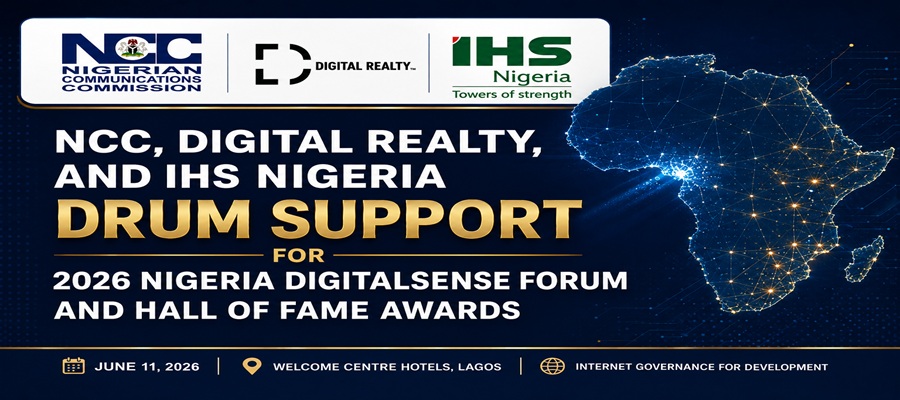
The regulatory and digital infrastructure pillars of Nigeria’s telecommunications ecosystem, led by the Nigerian Communications Commission (NCC), Digital Realty, and IHS Nigeria, have rallied robust support for the upcoming 2026 Nigeria DigitalSENSE Forum (NDSF) on Internet Governance for Development (IG4D) and its prestigious industry awards.

The annual high-level forum is scheduled to hold this Thursday, June 11, 2026, at the prestigious Banquet Hall, Welcome Centre Hotels, Lagos, anchoring its deliberations on the crucial theme: “Sustaining WSIS Vision with Multistakeholder Synergy in Nigeria.”
The Executive Vice Chairman and CEO of the NCC, Dr. Aminu Maida, is set to deliver the Keynote Address, highlighting the regulatory framework required to preserve the World Summit on the Information Society (WSIS) vision through inclusive, multi-stakeholder partnerships.
Joining the regulatory commission in driving this momentum is IHS Nigeria, the nation’s premier digital infrastructure champion boasting a footprint of over 16,000 telecom towers and 15,000km of fiber optic cables across the country. Alongside data center colocation leader Digital Realty, these organizations are heavily backing the forum as part of their commitment to promoting critical national infrastructure and securing Nigeria’s digital possibilities.
Speaking ahead of the event in Lagos, Ogbuefi Remmy Nweke, the Editor-in-Chief of host media organization ITREALMS Media Group, commended the immense institutional support flowing from the public and private sectors.
“Achieving sustainable internet governance and digital trust requires an intentional alignment of regulation and infrastructure,” Nweke remarked. “The active collaboration of the NCC, IHS Nigeria, and Digital Realty ensures that the 2026 forum will move beyond mere dialogue to produce clear, actionable policy recommendations for our digital economy.”
The event will be presided over by Dr. Olusola Teniola (hon), Director, Strategic Business Initiatives, ipNX Nigeria and former President, Association of Telecommunications Companies of Nigeria (ATCON), who will deliver the Chairman’s Opening Speech on the 2026 NDSF blueprint.
Earlier, leading telecommunications, technology, and internet governance stakeholders have thrown their weight behind the 17th milestone edition of the annual Nigeria DigitalSENSE Forum (NDSF) on Internet Governance for Development (IG4D), including ICT infrastructure leader MTN Nigeria; the Association of Licensed Telecoms Operators of Nigeria (ALTON); premier software and DNS infrastructure firm Upperlink Limited; and the Nigeria Internet Registration Association (NiRA), managers of the .NG country code Top Level Domain name.
Media & Event Contact: The Secretariat Nigeria DigitalSENSE Forum (NDSF) / ITREALMS Media Group Banquet Hall, Welcome Centre Hotels, Lagos Website: www.itrealms.com.ng

CBN to Deploy AI in Fight Against Payment Fraud

NDPC, Meta Launch 2-Year M-SIDP after Regulatory Settlement

Report Faults Banks over N91.1 Trillion Sterilised at CBN

Telcos Fault Data of FDI Flow, Claim Investment of N1.86 Trillion on Service Expansion

NRS Accredits Afri Invoice as Access Point Provider to Drive Nigeria’s Mandatory e-invoicing

CBN Extends PoS Geo-Fencing Enforcement Deadline to August 2026

FG to Launch Nationwide Free Digital TV Platform June 17

MTN, Airtel, Glo Under Pressure as FG Demands Better Service Delivery

Jumia Nigeria Records Strong Q1 2026 Growth as Technology-Led Strategy Drives Market Expansion

Metro Digital, Nigerian Firm Accuses Multichoice Of Refusal to Obey Court Judgements




 Telecom2 days ago
Price of Data in Nigerian Mobile among Top Four Cheapest Globally – MTN CEO

 E-Financial2 days ago
BOI Wins Dual Honours @ EMEA Finance Awards for Sustainability and Social Impact Leadership

 E-Business2 days ago
NITDA Okays NiRA’s Annual, Business Report

 E-Financial2 days ago
CBN Imposes N100m Penalty on Dealing Bank Inadequate Processing of Forex Documents

 Telecom2 days ago
NAIFF Returns for 2026, Expands Focus on AI-Powered Storytelling in Africa

 General News1 day ago
SSDC Warns Businesses against Cyber, Election-Related Risks

 General News2 days ago
Moniepoint DreamDevs Bootcamp Graduates Second Cohort to Strengthen Homegrown Talent Pipeline

 Telecom1 day ago
FCCPC Refutes Airtime Market Takeover Claims