

General News
Property Insurance; Agents and Brokers to experience Boost in Building Coverage

Between now and 2013, experts have predicted that agents and brokers may experience an increasing clients demand for building insurance coverage. This projection is hinged on the fact that standard commercial property insurance policies typically do not cover many aspects of green properties, companies that want to reduce their carbon footprint usually face unique insurance requirements.
Whether a company has a green building or would like to take the necessary steps to renew their current business, agents and brokers should counsel their clients to purchase building insurance coverage. To determine the right level of insurance coverage for a property, the first step is to work with clients to place an appropriate value on their buildings. Agents and brokers should align themselves with an insurance company that both performs onsite engineering visits and offers insight on the valuation analysis to assist them with arriving at an accurate assessment for their clients.
Green features that are common with commercial property insurance policy vary from property to property. However the common ones among them are as follows. One of the commonest features in building insurance is the tendency for a recycling especially in a rebuilding process. For companies that want to reduce the amount of materials that end up in local landfills, it is expedient to look for a green policy endorsement that will pay the additional cost to recycle debris, up to the limit of liability, in the event of a covered loss. For example, during a company’s construction project, the contractors may use five dumpsters to separate the various types of waste and send, say 80 percent of the materials back to recycling plants and manufacturers for reuse. The expense of the extra dumpsters, material sorting, and hauling to separate disposal sites may not be covered by a standard commercial property policy.
Another area is building codes. Securing appropriate building codes coverage as an endorsement to a standard property policy or as part of green insurance coverage will help reimburse companies for the costs incurred to rebuild the damaged portion of the covered property to any newly instituted standards. Without this endorsement, a client can be left paying out-of-pocket for new building code compliance that requires construction beyond the scope of the original property.
It is important to note that there could be business interruptions along the line. A few policies or endorsements allow the insured a longer restoration period to procure and/or install green materials. Some may also provide coverage to capture a company’s full revenue stream from both primary operations to any alternative energy operation. Extra expense can be a very valuable coverage feature in helping to restore operations if income streams are more complex due to the greening of the business.
Under a standard property policy, some property insurance have been enlarged to provide for more appropriate coverage for some specialized kind of roofing, especially under the present dispensation where foreign roof types are finding ways into Nigeria.
It is vital that clients with certified buildings have policy endorsements in place to ensure coverage of the re commissioning and recertifying fees that are necessary to bring a building back up to its pre-loss green-certified status. This coverage also often includes mandatory fees necessary for raising the building to desired level. Agents and brokers can also link their clients to an insurer that offers coverage to rebuild to one certification level high.
This policy allows for re imbursement for such refreshing or greening products. For clients interested in refreshing their business after a loss, regardless of whether or not they proceed with the certification process, a green policy endorsement allows them to replace eligible real and personal property with green-certified products up to the percentage and limit shown in the policy. Standard commercial property insurance won’t cover the use of green materials if those products are priced higher than non-green materials, thus forcing the client to pay out-of-pocket for the difference in price.
Some insurers consider underground piping and foundations part of the real property, but not all do. When clients also provide or receive alternative energy, those systems may utilize piping and other property underneath a client’s building or grounds. Agents and brokers should advise their clients to secure a policy that not only provides coverage for foundations and underground property up to 1,000 feet from the covered location, but also allows the insured to capture any business income or interruption exposures from alternative energy sources.
To bridge the gap between builders’ risks and completed property and present clients with a seamless green property insurance policy, agents and brokers should align themselves with insurance companies that are able to start building insurance coverage at the project’s development stage and continue it through to active property management.
All of these green policy needs can be satisfied by working with an insurer that understands building and has the expertise to help agents and brokers educate clients about the benefits of going green. Working together, agents and brokers and insurers can reassure clients that as their green initiatives seek to protect the environment, their insurance coverage will protect their green assets.


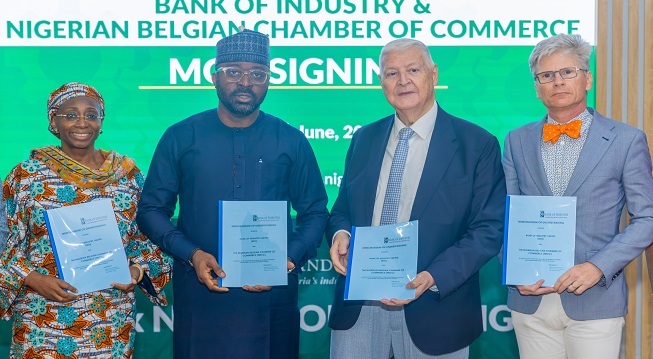
The Bank of Industry (BoI), Nigeria’s foremost Development Finance Institution (DFI), has signed a landmark Memorandum of Understanding (MoU) with the Nigerian Belgian Chamber of Commerce (NBCC), setting the stage for deeper economic cooperation, expanded investment flows, and stronger industrial partnerships between Nigeria and Belgium.

The agreement was signed during a high-level breakfast meeting jointly hosted by BoI and the NBCC under the theme, “Scaling Operations, Expanding Capacity, and Accessing Competitive Finance.” The event convened senior government officials, diplomats, business leaders, development partners, MSMEs, and private sector stakeholders committed to advancing bilateral trade and industrial development.
Speaking on behalf of the Managing Director and Chief Executive Officer of the Bank of Industry, Dr. Olasupo Olusi, the Executive Director, Corporate Finance, Sustainability and Investments, Mr. Rotimi Akinde, described the partnership as a strategic milestone in BoI’s drive to expand global collaborations that accelerate Nigeria’s industrial transformation.
“As Nigeria’s leading Development Finance Institution, the Bank of Industry has consistently recognised that sustainable industrial development is built not only on access to finance but also on enduring strategic partnerships.
“This collaboration with the Nigerian Belgian Chamber of Commerce reflects our commitment to creating stronger international business corridors that unlock investment, facilitate technology transfer, support MSMEs, and strengthen Nigeria’s industrial competitiveness,” he said.
Akinde noted that Belgium remains one of Europe’s most dynamic trading and investment destinations, making the partnership an important platform for promoting co-investment opportunities, export development, enterprise growth, and knowledge exchange between businesses in both countries.
The two-year renewable MoU establishes a framework for joint business forums, investment roadshows, trade missions, business matchmaking, enterprise capacity development, and increased promotion of BoI’s financing solutions to Belgian investors and businesses operating in Nigeria.
The collaboration is also expected to improve access to foreign direct investment, expand export-oriented industrial projects, and create stronger commercial linkages between BoI-supported enterprises and the Belgian business community.
Delivering the welcome address, His Excellency Pieter Leenknegt, Ambassador of the Kingdom of Belgium to Nigeria, commended the growing economic relationship between both countries and expressed optimism that the partnership would create new opportunities for businesses on both sides.
The General Manager of the Nigerian Belgian Chamber of Commerce, Marc Eeckhout, described the agreement as a practical platform for translating business interest into measurable economic outcomes.
“This Memorandum of Understanding represents more than an institutional partnership; it creates a structured bridge between Belgian innovation and Nigerian enterprise. By working closely with the Bank of Industry, we are opening new pathways for investment, technology exchange, and business collaboration that will enable companies from both countries to scale with confidence while contributing to sustainable industrial development,” he said.
The breakfast dialogue featured presentations on business expansion, industrial financing, and competitiveness, with contributions from industry leaders, including Engr. Vincent Adegbotolu, Managing Director/CEO of DWC Engineering, and Mudiaga Okumagba, Managing Director/Chief Executive Officer of Direct Logistics Plus.
The partnership aligns with BoI’s 2025–2027 Corporate Strategy, which prioritises industrialisation, MSME development, youth and skills, women’s economic empowerment, climate finance, digital transformation, infrastructure, and export promotion. With assets valued at over ₦6.8 trillion, the Bank continues to strengthen strategic international partnerships that support the Federal Government’s industrialisation agenda while creating jobs, enhancing productivity, and promoting sustainable economic growth.
Through the collaboration, BoI expects to attract new investment opportunities from the Belgian business ecosystem, increase financing for high-impact industrial projects, strengthen export value chains, and improve the investment readiness of Nigerian enterprises through joint advisory and capacity-building initiatives.
The Bank reaffirmed its commitment to working with global partners to unlock long-term capital, accelerate industrial growth, and position Nigeria as a competitive investment destination within Africa and beyond.


Federal government has announced plans to end the separation between Junior Secondary School (JSS) and Senior Secondary School (SSS) as part of efforts to improve school retention and reduce the high number of pupils dropping out before completing secondary education.

Tunji Alausa, minister of Education
Tunji Alausa, minister of Education, announced the proposal on Tuesday during the inauguration of the Ministerial Implementation and Monitoring Committee of the Universal Basic Education Commission (UBEC) in Abuja.
Alausa said the existing “disarticulation policy,” which requires junior and senior secondary schools to operate independently with separate principals, management structures and facilities, has failed to achieve its intended objectives and has instead worsened access to education.
According to him, the Federal Government will present a proposal to abolish the policy at the next meeting of the National Council on Education (NCE), the country’s highest education policymaking body.
“We have 20 million dropouts from primary school to JSS. Where are those students?” the minister queried.
“We also found we have 80,000 public primary schools and only about 15,000 junior secondary schools. That’s a one-to-eight ratio.”
He explained that the mismatch between the number of primary and junior secondary schools has created severe bottlenecks in the education system, leading to overcrowded classrooms at the junior secondary level while many senior secondary school facilities remain underutilised.
Alausa cited Kaduna and several northern states as examples where the policy has contributed to poor transition rates between basic and secondary education.
“This disarticulation policy has failed. We will phase it out. We can’t be creating positions because we want to create director-level appointments for people while we harm our education system. It’s about doing what is best for every Nigerian child,” he said.
The minister said the proposed reform forms part of broader efforts by the Tinubu administration to improve access to education, increase retention rates and enhance learning outcomes across the country.
He acknowledged previous shortcomings in tackling the out-of-school children crisis but expressed confidence that the current administration would reverse the trend.
“This government will not fail. We are fixing it,” Alausa declared.
At the ceremony, the minister also inaugurated the UBEC Ministerial Implementation and Monitoring Committee, chaired by Prof. Rashid Aderinoye, to supervise the execution of UBEC-funded Smart Schools, Bilingual Schools and Alternative Schools nationwide.
He said the committee had been tasked with ensuring that the projects are completed, handed over to state governments and opened for teaching and learning.
Although UBEC has invested in hundreds of Smart Schools and related educational projects across the country, Alausa lamented that many remain abandoned, unfinished or yet to admit pupils, describing the situation as an unacceptable waste of public resources.
He stressed that improving education requires more than constructing schools, insisting that completed facilities must become fully operational and accessible to learners.

Federal government has said that it plans to establish a National Skills Database as part of efforts to reduce unemployment, address the growing mismatch between available skills and industry needs, and strengthen workforce planning through data-driven policies.

The proposed database, to be developed under a Nigerian Skills Observatory, is expected to provide real-time information on the supply and demand of skills across sectors, enabling better job matching, improved policy formulation and targeted investments.
The plan was unveiled at the second National Skills and Industry Alignment Roundtable Series held in Abuja with the theme, “The Role of Data in Job Creation, Coordination and Linkages.”
Delivering the keynote address, Yemi Kale, group chief economist and managing director of Research and Trade Intelligence, Afreximbank, said Nigeria’s labour market challenge was no longer the absence of data but the inability to convert existing information into actionable intelligence.
“The challenge for us as a nation is not one of data accumulation. It is one of data integration and intelligence,” Kale said.
He explained that although vast amounts of information on education, employment, wages and skills development already exist across government agencies, educational institutions and the private sector, the data remains fragmented, making effective labour market planning difficult.
“Data tells you what exists. Intelligence tells you what is happening, what is likely to happen next and what actions should be taken,” he said.
Kale lamented that while Nigeria produces thousands of graduates annually, employers in critical sectors continue to struggle to recruit qualified workers, even as millions of Nigerians remain unemployed or underemployed.
“The problem is that employers are searching, workers are searching, policymakers are searching and investors are searching independently rather than collectively. Opportunities that should be visible remain hidden because the information needed to connect them is fragmented,” he said.
According to him, the disconnect has created structural inefficiencies that discourage investment, suppress productivity and prevent Nigeria from fully leveraging its youthful population.
He added that countries that successfully transformed their economies deliberately aligned education, skills development and workforce planning with the needs of industry.
Kale urged Nigeria to view its youthful population as an economic asset by ensuring young people acquire skills demanded by modern industries.
Speaking on the proposed National Skills Database, Rimam Nuhu, special assistant to the President on Workforce Development, said the platform would serve as the foundation of the Nigerian Skills Observatory.
“At the most foundational level, the Skills Observatory is to create a database on the demand and supply of skills,” Nuhu said.
He explained that the National Council on Skills, chaired by Vice President Kashim Shettima, would rely on data generated by the observatory to formulate evidence-based policies on workforce development.
“Skills development is an input for job creation. We have a market where there are a lot of skills mismatches. Understanding exactly where those shortages exist will help us plan better and improve workforce planning.
“Ultimately, that contributes to a more productive economy,” he added.
Nuhu acknowledged ongoing debates over whether Nigeria is facing an actual shortage of skilled workers or merely a mismatch between available skills and labour market demand, stressing that the database would provide the evidence needed to guide interventions.
Earlier, Akubo Adegbe, senior special assistant to the President on Coordination and Delivery, said the roundtable was convened to tackle the fragmentation of labour market information across government institutions and the private sector.
He noted that despite huge volumes of workforce data being generated daily, the lack of coordination often leaves policymakers without a comprehensive understanding of labour market realities.
“If our first Roundtable challenged us to better align skills with industry, this second Roundtable challenges us to better align information with action,” Adegbe said.
Also speaking, Massimo De Luca, head of Cooperation at the European Union Delegation to Nigeria and ECOWAS, said the EU would continue supporting Nigeria’s efforts to build a labour market capable of meeting investors’ needs.
“We have a shortage of skilled labour when it comes to big investment projects. On the other hand, we have a lot of untapped talent that is not adequately recognised.
“Those are realities that investors take into account,” De Luca said.
He commended the Office of the Vice President for leading reforms aimed at strengthening Nigeria’s skills development ecosystem.
The Federal Government’s plan comes amid persistent unemployment and skills mismatch in Nigeria, where many graduates remain jobless despite employers reporting shortages of qualified workers in critical sectors.
The National Skills Database will serve as the foundation of the proposed Nigerian Skills Observatory, an initiative designed to provide real-time labour market data to guide workforce planning, skills development and evidence-based job creation policies.

World Bank Okays New $1.25Bn Loan for Nigeria

Xenophobia: MTN Nigeria Belongs to Nigerians, Not Only South Africans — Toriola

SEC Grants Approval to Luno, Other Crypto Firms under Regulatory Sandbox

MTN Nigeria Celebrates Volunteers at Y’ello Care Impact Showcase

Listicle: 10 Essential Meta Safety Tools Every Parent and Teen Should Know

Mobile Internet Gender Gap Widest in Africa – GSMA

FG Targets Alleged N3tn Capital Flight, Opens Airtime Credit Market to Nigerian Fintechs

Nigeria Launches FreeTV Nationwide

UK, Nigeria Launch £15m Growth Programme to Accelerate Economic Transformation

NASENI Moves to Digitize CCB’s 5m Assets Declaration and Operations




 News2 days ago
Court Declares Keystone Bank Staff Wanted over Alleged N35m Fraud

 Telecom2 days ago
OpenAI in Talks to Offer U.S. Government 5% Stake Amid AI Scrutiny

 E-Business2 days ago
Kaspersky Warns of a Large-scale Campaign using Fake Free Software to Deploy a RAT via ScreenConnect

 E-Business2 days ago
NOTAP to Commercialise University Research, Expands Patent Drive

 E-Financial2 days ago
IMF Raises Concerns over N8.83 Trillion Unreported Spending in Nigeria’s Budgets

 E-Business2 days ago
FG Unveils Digital Postcode System for MDAs

 News2 days ago
UK Deepens Digital Partnership with Nigeria to Drive Inclusive Growth

 E-Financial2 days ago
Visa Targets Nigeria, Others in Visa Pay Expansion Drive