

General News
LASG is Pursuing Seamless IM System- Uthman


Rafiu Bolaji Uthman , director general, Lagos State Records and Archives Bureau (LASRAB) is a distinguished information officer, career journalist and Civil Servant par excellence.
Uthman was part of the State Information and Economic Teams researching, documenting and preserving enduring records of the processes and impacts of plans, policies and programmes on the State development and cultural patrimony.
He also served as member of various Government Committees and engaged with development partners bringing to bear his experience and vast knowledge cum understanding of the State development milestone and heritage mosaic to achieve a brighter rewarding future for Lagos State.
Uthman spoke to peter ugwu on what the significances of proper records and information management in governance.
An Overview of LASRAB
LASRAB formally came into legal existence as a Lagos State Government agency pursuant to Law 22 of 2007; the Bureau is under the supervision of the Ministry of Information and Strategy. Administratively, LASRAB took-off on 1st August, 2008 but effective operation began on 1st December, 2008.
It is a public Institution or Agency established by law and mandated to regulate, preserve and disseminate accurate records of enduring value on Lagos state in a professional manner, employing best practices in information and knowledge management.
Our functions extend to regulating, controlling and management of records and archives of Institutions and Establishments operating within Lagos State.
We also concerned with the role of collecting and preservation of historical identities of Lagos State.
LASRAB shoulders the strategic maintenance of modern and credible information warehouse (records and archives institution) that captures full and accurate records on Lagos State that meet the needs and interests of clients.
We also secure global innovative solutions and best practices for continuing management of records/archives; enriching and using records and archives as valuable assets for preserving Lagos State heritage and provide a database for planning and access to information for good governance and research in Lagos State.
LASRAB has also provided the schedule for records management in Lagos State civil service.
We have successfully carried out our statutory responsibilities as aforementioned including undertaking research and disseminate knowledge on the preservation and management of public, private, and historical records and established and implemented procedures for the transfer of public records of enduring value, for preservation and management in the State Archives or such archival repository.
Today, LASRAB is a model on records and information management in Nigeria.
Records Management in Pre-LASRAB Era
Prior to LASRAB establishment, records were managed in a haphazard manner.
There was actually no institution, unit or office so designated as archives within the State and even with Institutions.
In other words, there was no regulatory body to streamline how things should be organized in that sector.
There were evidences of certain valuable documents dumped in cartoons, containers and sometimes in saves that were exposed to rain.
In fact, records were stocked in toilets and staircases. Things were in a disorganized manner.
Proper Records Management and Economic Planning
Of course, the nexus between the two is same with information and proper management.
Information and data are critical resources for planning and management, particularly for allocating or scheduling of resources; for protecting and claiming rights, obligations and for value sharing and cultural collation.
Before now, people did not know much about history of Lagos State. Many said it is a no man’s land; everybody owns Lagos and there are no indigenous Lagosians.
But LASRAB coming into be, harnessing of the facts and making them available, the public are now better informed. Apart from that, Lagos State Government so much relies on data and information to pursue numerous projects we see in places.
The sector is very paramount in development of Lagos State.
One thing we proud ourselves in the State is about proper documentation.
Our documentation process is inclusive-governance-process, where stakeholders’ opinions are sort and conclusions of such engagement are contained in a report which forms part of inputs into budget and programmes.
LASRAB is the stakes custodian of these very important documentations.
They assist government to know what the situation was yesterday and updated version are basically on issues of the moment.
And with the benefits of doubts you can make clear projects about the future.
Nigeria in the Comity of Archive Nations
Well, archives and archives management is endangered and in precarious situation in Nigeria, particularly at the national level.
You find that in Nigeria we have a very low culture as far as preservation of documents is concerned.
Nigerians read very poorly; they read mainly to pass examinations, after that, they throw away the books.
People also read newspapers just to catch time.
\
People don’t actually read in-depth or in-between the lines.
In other countries, people read, especially those who occupy the policy making realms to ask themselves, what was the policy like in the past?
That is why archives provide a filling, framework to judge opinions and to drink from the experiences-the perfections and imperfections in the past.
Archive is a societal memory; a warehouse of accumulated experience for the civilization of the people.
Although archives in Nigeria is in a precarious situation, but then Lagos State Government is charting a new course to see that archives is a critical element in governance and development through this formalized structure; the first of it kind, with its grandeur and opulence.
Today, LASRAB functions not just as media resource, but as a historical site. In a accordance with our vision, LASRAB in the shortest time will be a first class global information repository and data bank on Lagos State.
Employment Generation
There are so many ways we can grow the sector for employment generation.
Through voluntarism people can get to know more about the sector and professionals putting their thoughts on records and information management can lift the industry to an enviable height.
And our undergraduates and graduates alike should develop research skills.
A hallmark of an archive is its ability to create and warehouse as many records as possible.
The current level of students and graduates alike, particularly those in the Social Humanities discipline should take it upon themselves to conduct research on subjects of significant interest to the society.
For instance, today the country is in a very serious security risk. It is affecting the social fabrics and cohesion of the society. So, we need to find out who we are, the things that unite us.
Place of ICT in Archives and Records Management
ICT is a platform for provision of archival services.
It is an instrument for achieving a global information repository. ICT is a critical resort; we are in the world of information.
Such information must be available to the people in the way and manner that are desirable at a reasonable cost effective and efficient manner.
These can be enhanced through the deployment of ICT. For example in Lagos State Government under His Excellence, Mr. Babatunde Fashola is apt in the deployment of ICT for e-governance. At the point of its commissioning, we were provided with a Server that enables us to stand on our own.
Ad progressively we are going to develop our electronic management system. The server has enabled us to do internet service; that is the automation of our work processes.
Government has also procured State-of-the-Art equipment that enables us produce documents in a digital format and convert hard copy records into microfilms called e-archives write-ups.
All strategic sections in the Bureau have ICT elements. These allow for knowledge exchanges.
These are because we function as a knowledge management agency; we try to share knowledge contained in the archives with the public.
In lieu of that, students from Universities, Polytechnics and Collages of Education do come here to reinforce their knowledge on civics studies.
Synergy with Public and Private Institutions
We have been enjoying goodwill from other older archiving institutions, particularly the National Archives of Nigeria (NAN), Ibadan.
They provided us with necessary leverage for us to come into the scene. Meanwhile, we have been able to also influence the National Archives in terms of modernity and transformation.
Organizations like Records and Information Awareness (RIMA) Foundation has been our partner since our take off.
The foundation is a critical stakeholder to us, even as an NGO. For instance with the synergy we were able to host the very first archives day in the annals of Nigeria. And arising out of our modest reforms and innovative sector, other emerging archives have been coming around.
The Nigerian Ports Authority (NPA) team recently visited asking for our assistant for them to get their footings. And we are very ready to share knowledge and expertise with whoever cares. University of Ilorin also visited us in view of their quest to establish an archive centre.
Other states are also paying us visit to borrow a leaf; Lagos remains the first in information management in Nigeria; there is no archives that can compete with us presently in terms of facilities.
Our repository is outstanding. It can compete with any archive in any emerging economy.
Legislation on Retention Period
Talking about legislation, especially the retention period as widely craved for among some practitioners is not such that demands legislation. I think it is a mere legislation that should flow from enabling environment.
Under the law that established LASRAB, we are empowered to make legislation regulating records management in the state and sequel to that we have made concerted effort in that aspect.
Ours in Lagos is working; however, we expect them at the national level to see to the national retention period legislation.
In our public service whenever they have any change, they invite us to do records appraisal, which is the best practice; to determine what to do with disposition or otherwise.
I must also said that there is a need for the national to quickly review the law establishing the national archives to let it be in-tune with modern realities. It has seemed to have become a national archive of old order.
I think that is why they have been trying to add records management to their own too. That will make it a ‘living organism’ and not a backyard of wasted records.


General News
WEBINAR: Techeconomy Business Series Hosts Experts from MTN, Interswitch, BusinessPlus, others this Wednesday


Techeconomy, Africa’s leading technology, business and digital economy publication, has announced an upcoming edition of its Techeconomy Business Series, a virtual webinar.

Techeconomy
This month’s edition focused on “Navigating a Career in Tech Sales”, is scheduled for Wednesday, January 28, 2026, from 5:00 PM to 6:00 PM (WAT)
Register here: https://shorturl.at/mMvLu),
It will bring together seasoned professionals from across Africa’s technology ecosystem to share practical insights, real-life experiences, and career guidance for individuals looking to build or transition into successful careers in tech sales.
“As Africa’s digital economy continues to expand, tech sales has emerged as a critical growth driver, bridging innovation, customer adoption, and revenue generation,” said Joan Aimuengheuwa, managing editor at Techeconomy.
“The session is designed to equip professionals, young talents, and business leaders with a clearer understanding of the skills, mindset, and career pathways required to succeed in this fast-evolving field”, she added.
The panel features accomplished industry experts including, divisional head, Growth Marketing (Enterprise), Interswitch Group; Ekundayo Ayeni, co-founder, BusinessPlus; Adepeju Ajayi, manager, Mobile Advertising, MTN Nigeria; and Bukayo Ewuoso, Business Growth Consultant.
The session will be hosted by Imoh Anselem, an IT Project Manager and Customer Success Specialist.
Participants will gain insights into: Ogechi Okwechime
· Breaking into tech sales and identifying entry opportunities
· Key skills and competencies employers look for
· Career growth strategies within Africa’s digital economy
· Lessons from real-world sales and growth experiences
Webinar Details:
Date: Wednesday, January 28, 2026 | Time: 5:00 PM – 6:00 PM (WAT) | Format: Virtual (Zoom)
Registration/Access Link: https://shorturl.at/mMvLu
Attendance is free, but registration is required.
“The Techeconomy Business Series is part of Techeconomy’s ongoing commitment to fostering informed conversations, capacity building, and talent development across Africa’s technology and business landscape”, the managing editor added.
TAGS: #TechSales, #Techeconomy, #Techeconomy, #TechSales, #CareerInTech, #DigitalEconomy, #BusinessSeries, #AfricaTech, #TBS #TecheconomyBusinessSeries
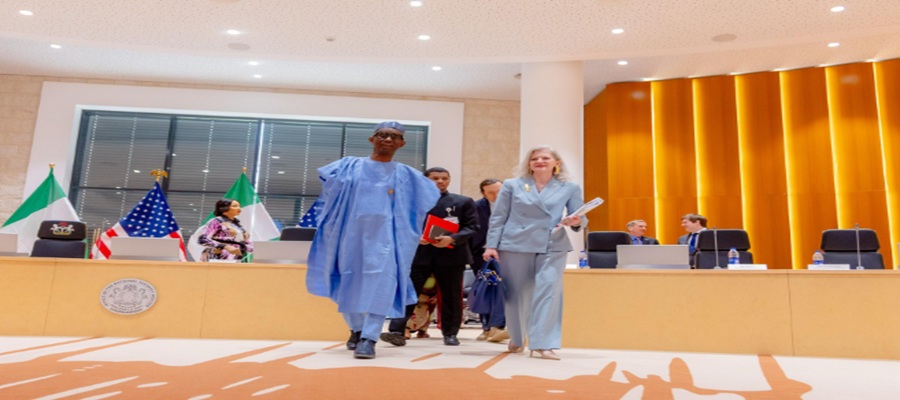
National Security Adviser Nuhu Ribadu has said the federal government considers religious violence an attack on the Nigerian state, stressing that the protection of all citizens, regardless of faith, is non-negotiable.

According to presidential spokesperson Bayo Onanuga, Ribadu made the remarks in Abuja at the close of a US–Nigeria Joint Working Group session.
“Nigeria is a deeply plural society, and the protection of all citizens, Christians, Muslims, and those of other beliefs, is non-negotiable,” Ribadu said.
“Violence framed along religious lines is treated as an attack on the Nigerian state itself.”
In a follow-up post on X, Ribadu said the joint working group has recorded “tangible operational gains” in the fight against terrorism.
The working group was set up following Nigeria’s designation as a Country of Particular Concern (CPC) by US President Donald Trump, a label that often triggers policy actions aimed at ending severe violations of religious freedom.
At the meeting, Ribadu led Nigeria’s delegation, which included representatives from 10 ministries and agencies, while the US delegation, made up of eight federal agencies, was led by Allison Hooker, US under-secretary of state.
Ribadu said Nigeria-US security cooperation has moved from dialogue to action, resulting in the disruption of terrorist networks and transnational criminal groups. He also praised the US for supplying drones, helicopters, platforms, spare parts, and other support systems over the past five years.
Speaking at the session, Hooker said the US was committed to expanding its partnership with Nigeria, particularly on deterring violence against Christian communities.
“Today, we are here to discuss how we can work together to deter violence against Christian communities, prioritising counter-terrorism, insecurity, investigation of attacks, and holding perpetrators accountable,” she said.
She added that efforts would focus on reducing killings, forced displacement, and abductions of Christians, especially in Nigeria’s north-central states

For many Nigerians, fintech apps are judged by one simple question: Can I trust the platform? For Happiness, a young Nigerian entrepreneur, the answer manifested in the most defining moments of her life.

Trust Built Through Everyday Use
In 2025, Happiness relied on PalmPay to run her business, from receiving customer payments, paying vendors, and managing daily transactions. During PalmPay’s Hustle Grant Campaign, she joined thousands of small business owners hoping to win the N500,000 funding.
While she didn’t make the shortlist, the campaign gave her business something just as valuable: visibility. New customers discovered her brand, enquiries increased, and sales followed.
PalmPay didn’t just host a campaign; it created an ecosystem where small businesses could be seen and supported.
Just days later, Happiness’ life changed. On August 30, 2025, she lost her father. With this loss came challenges, especially payments. They tried transferring money through regular banks but were met with declined transactions. Happiness suggested using her PalmPay account and it was successful.
In a moment defined by loss and urgency, PalmPay cut through the chaos, proving that reliability isn’t a feature, it’s a lifeline. Happiness’ relationship with PalmPay didn’t stop at transactions. Through other management tools on the app, she learned to build discipline around her finances.
More Than an App, a Financial Partner
Beyond transactions, PalmPay’s tools helped Happiness build better money habits and financial discipline. Today, the brand continues to reward reliability through initiatives like its ongoing Premier Cool campaign, reinforcing a simple message: consistency should come with value.
The idea is simple: Purchase a bar of soap and stand a chance to get ₦10,000cash and other cash benefits.
It’s PalmPay’s way of saying that smart money habits deserve real value in return.
Why PalmPay Earns Trust
Life doesn’t give warnings before it tests you. When it does, you need a platform that doesn’t just usually work but always works.
For many users, PalmPay proves to be more than a payment app. It is a trusted partner powering ambitions, supporting users through defining life moments, while helping them bank smartly.
When it mattered most, PalmPay worked. To watch the full testimonial visit: @palmpayapp_ng

Tech Executives Double Down on AI, Talent and Adaptive Strategies to Lead in the Intelligence Age

Firm Identifies AI as Common Denominator in Entertainment Industry’s 2026 Security Threats

NIBBS to Boost Financial Inclusion with Offline Payment Solutions

WEBINAR: Techeconomy Business Series Hosts Experts from MTN, Interswitch, BusinessPlus, others this Wednesday

LIRS to Invoke NTAA to Recover Unpaid Taxes from Bank Accounts, Others

19 Nigerian Banks Meet CBN Recapitalization Targets Ahead of March Deadline

Jumia CEO says Black Friday Signals Nigeria’s E-Commerce Maturity

Galaxy Backbone Celebrates the Federal Government’s Paperless Civil Service Milestone

DStv Offers Instant Package Upgrade for Customers from January to February

Banks to Impose N50 Stamp Duty on Transfers of N10,000 and Above from January 1




 News1 day ago
Anambra Cuts Monday Pay to Kill Sit-at-Home

 E-Financial1 day ago
First Asset Management Receives Upgraded Ratings from Agusto &Co and DataPro

 General News1 day ago
Nigeria Treats Religious Violence as Attack on State – NSA Ribadu

 E-Financial1 day ago
CBN Prepares Fresh Debit Card Rules to Improve ATM Services

 E-Financial1 day ago
NIBSS, Others Flag 13,417 Nigerian Fraudsters on Person of Interest Portal
 News1 day ago
LIRS to Invoke NTAA to Recover Unpaid Taxes from Bank Accounts, Others
 E-Financial1 hour ago
NIBBS to Boost Financial Inclusion with Offline Payment Solutions
 General News1 hour ago
WEBINAR: Techeconomy Business Series Hosts Experts from MTN, Interswitch, BusinessPlus, others this Wednesday