

Broadcasting
Telcos Pocketed Majority of Profit from SMS Votes on BBNaija- Ugbe, Multichoice Boss

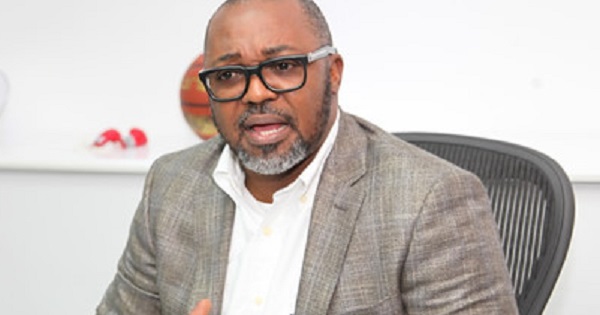
John Ugbe, managing director, Multichoice Nigeria, in an interview with journalists on the sidelines of Digital Dialogue conference in Dubai, talked about the recently-concluded Big Brother Naija, DStv’s charges, the pay-TV model, social responsibility programmes, rain fade which is caused by bad weather, among other issues.
What is your reaction to the assertion that 170 million votes from BBNaija came exclusively from SMS, thereby yielding profit in the billions?
Ugbe: There has been a lot of focus on the figure 170million, but to set the record straight; 170million votes came from 49 African countries, and more than 90% came from online voting. Under 2% of the entire votes came from SMS voting.
Nigeria is the only country that was enabled to vote via SMS. The actual revenue generated from SMS voting could not be further from the much-touted purported figure. Over and above, the administration and platform set up costs, the majority of the profit went directly to the GSM and data service providers.

Is there a way to ensure BBNaiija is domiciled in Nigeria so that all the economics of the hosting and its associated benefits come to Nigeria?
Ugbe: Tinsel is domiciled in Nigeria and shown all over Africa. We just premiered a new epic series in Lagos. For this, we built an entire village from scratch to portray the realities of a village setting.
Our group of channels are called Africa Magic to reflect our African heritage. Nigeria has the biggest movie industry that is why our productions are domiciled in Nigeria.
For Hotel Majestic, we had to take over a hotel in Nigeria for two years as a set. It’s a lot of investment. Big Brother demands a lot of complexities and outfitting a house.
For the Big Brother shows, we set up one facility for Nigeria, Angolan and other editions. It makes sense from a production perspective. It is impractical to replicate sets across our operations in 49 African countries.
We choose the best location for each specific production. Big Brother Naija’s production team is made up of 90% Nigerians even though it wasn’t set in Nigeria – so a good deal of skills transfer occurs. Africa Magic Viewers Choice Awards (AMVCA) comes to Nigeria every year. Speaking as a Nigerian and an advocate of Nigeria, we keep looking at what it will entail to run it locally.
Have you considered implementing a ‘pay as you consume’ model considering that work and life schedules make it difficult to catch shows without steady power?
Ugbe: From a producer’s perspective – we have to buy the movie in full and we have to buy enough content to fill the channel and put it on air.
That’s what the pay-TV model prescribes anywhere in the world. We have to aggregate content for our different packages, this means ensuring there is something for everyone on the package depending on your interest and pocket strength. But there is a good spread of a variety of content across all packages. Everyone thinks of today.
From day one, you have to buy enough movies to make up the channel and sell that package to one person. It’s a risk as you cannot determine if after buying content, only one or ten people will subscribe.
If only one person does, you cut your losses and move on, but you continue to invest in content with the hope that more people will be interested in watching.
Regarding breaking off viewing according to your availability, the challenge is in the model of the business. We don’t know when your decoder is on or off. That makes it impossible to say I want to start billing because this customer has started viewing.
Pay as you go is a mobile network term. The mobile operators have the technical resources to measure what is being used. For pay-Tv on the other hand, it is not the same thing.
Last August, the Mayweather vs. McGregor Boxing match was delayed for close to 3 hours. The reason it was delayed is because of the technicalities of pay-per-view in the US. Pay-per-view for a fight like that would be $99 – that is more than your one-month subscription on Premium – about double.
However, we buy the fight and aggregate it for our Premium subscribers, who were able to record it, even when the live event did not happen on schedule. What we encourage our subscribers to do is download DStv Now, and you can watch all the content on your current subscription on the go, on your phone or tablet. You do not have to be bound by availability of power. Catch Up is there… Get it before the World Cup so it’s right there on your phone and your iPad and your laptop. Those are the innovations we’ll continue to make.
What social responsibility programmes do you invest in as an organisation?
Ugbe: We focus on education, health and youth and economic empowerment. Our MultiChoice Resource Centre project is our
education initiative that we have been active with for over 14 years. What we do here is work with the governments in each state to select beneficiary schools. We then provide audio-visual equipment (which include a dish, decoder with educational channels, TV, generating set, tables, chairs, UPS), to bring learning and the school’s curriculum to life.
We set up our education package in the chosen schools, train the teachers on how to select relevant programs intended to illuminate and animate information that would otherwise have remained theoretical or textbook based.
The MRCs are present in over 400 schools across 33 states in Nigeria, tens of thousands of students have benefitted from these centres since inception. The feedback has been astounding.
The rate of passing school leaving exams has improved. Several beneficiary students have gone on to become medical doctors, lawyers, and a good number are working in several other professions, as a result of this foundation that changed how they learn and retain information.
I have experienced how this centre is used and saw how students responded when they saw how a tsunami actually happens. They saw it happen on our platform and this made it easier for them to imagine how destructive a tsunami could be.
Also in terms of education, we have partnered with Eutelsat for many years to roll out DStv-Eutelsat Star Awards, a satellite-based competition for secondary school students across Africa.
The students are required to answer questions on how satellites can be used to improve processes, the advantages of satellite and so on.
These questions need to be answered through an essay or a poster. Last year, a Nigerian; Emmanuel Ochenjele emerged overall winner from the poster category. He met a real life astronaut – Claudie Haignere, right here in Nigeria, and not long ago, he returned from Paris, as part of his winning prize, where he went to the Eutelsat headquarters to witness how rockets are assembled. This has changed his perspective forever.
We implement our health responsibility by supporting the Sickle Cell Foundation. We have been partners for many years. We support them because the statistics of how sickle cell anaemia affects Nigerians paints a dire picture.
The foundation seeks funds to carry out research, treat and inform sufferers. Their key objective is creating awareness on how to minimize its effects, research on how to avoid and ultimately cure the ailment. On our part, we offer support through creating awareness, which we do on an ongoing basis through educational videos, community outreach programs, fundraising and other initiatives to support them in what they do.
Our GOtv Boxing Next Gen clinics support the growth of boxing, which we brought out of near extinction in Nigeria.
Over and above the boxing matches which provide an avenue for the boxers to earn a living, the clinics provide tips on welfare, training and psychological support to these young ones.
Some of the young boxers were picked from our Next Generation Search (for talented and passionate amateurs), they have now proven themselves in mainstream boxing and have won millions over the years. Ultimately, we train them to go professional, so that one of our boxers can proudly fly the Nigerian flag internationally.
Is it possible to put my subscription on hold when I travel for a month?
Ugbe: Yes we have made it possible for you to do that. You can put your subscription on hold when you travel for up to two weeks each time, twice a year.
One of the things we thrive on is technology. The dual view decoder was first introduced in the world by MultiChoice. Digital Satellite TV (DStv) was only second after the US. When we build the DTT network we had Russians coming to study it. We look to the future for what is possible to do.
Recently, MultiChoice ran a promo asking subscribers to pay for two months and get one month free, but there were complaints from customers who didn’t get the promised month. What is your response to this?
Ugbe: It is true that we ran a retention offer late last year. When we received feedback that some customers did not get the free month on schedule, we identified those customers that were affected and we fixed it. We introduced a new process which helps to identify those who received the offer, and ensure that get the benefit immediately.
Additionally, in terms of improving on technology, we upgrade our decoder software from time to time to improve customer viewing experience. We ran a free swop campaign where we asked customers to bring in obsolete decoders for a free swop.
It’s all in line with always striving to improve our offers to our customers. We also introduced tollfree lines a few years ago. These numbers are available on our website and social media care platforms. On Twitter, the address is @DStvNgCare.
Is the call centre 24 hours? DStv should have a 24-hour call centre.
Ugbe: This is good feedback and something we tested in December. However, there are a few challenges with labour laws. So we’ve been looking at how best our customers can reach us at any time of the day. We will communicate changes and updates in due course.
The strength of your signal is still a problem, especially when it rains. Why is that the case?
Ugbe: To shed some light on that, it is called rainfade. Satellite signal from the KU Band is susceptible to weather.
I have taken pictures of my TV screen when I’ve been in New York or other parts of the world and I experienced interruption as a result of bad weather. It’s not a Nigerian problem. Your DSTV will work even with 40% signal.
There is a need to boost the signal to have less interruption. We also make available quality cables to reduce interference. If rain comes in it will affect the quality.
We recommend getting a certified installer to conduct regular checks to verify signal strength. Also, some dishes have not been checked in up to five years. Regular checks ensure that your dish works optimally, thereby reducing rainfade.
.
Star Trek inspired a lot of Americans to go into science and to the moon. What does Big Brother inspire among Nigerians?
Ugbe: We are in pay TV, we are in entertainment. Entertainment is a mix of fun, inspiration and education. Remember, reality TV is reality.
This is what happens. The fact that they are on TV doesn’t change it. Entertainment can inspire in a variety of ways. A lot of people have come out of Big Brother and have grown into entertainment powerhouses. It’s a platform for exposure and advancement.
Furthermore, we have a lot of educational and kids content. We ask our viewers to set up parental guidance so you can control what your child views.
The parents have and have always had the control. Kids, these days, have smartphones and can download anything, but the blame is often put on TV. You can opt out of a channel or block it completely at any time. We put the power into your hands. And back to Big Brother, we can learn from their interaction in the house. They have tasks that promote nationalism, patriotism. You see those contestants singing the national anthem proudly. When they talk about malaria day, we use it as an opportunity to educate. A lot of the tasks are subtle but meant to inspire and lead.


Mrs. Clementine Wamba, head, Digital Switch Over (DSO) at the National Broadcasting Commission (NBC), has stressed the need for broadcasting stations and practitioners nationwide to work towards meeting the 2028 global deadline for the switch over.

She made the call in her presentation titled, “DSO Big Picture: Free TV Audience Measurement and the Evolving Media Landscape”, at the 2026 NBC South West Summit held in Ibadan.
Wamba harped on the need for practitioners to adopt DSO in the transmission of news and other programmes in order to meet future challenges, stating that any country that fail to align with the DSO by 2028 will be shut out of practice.
This development, according to her, may result in job losses and other consequences that could hinder the growth of the industry in Nigeria, noting that Free TV is tailored towards the DSO, with provision for many channels in contrast to the age-long analogue system.
According to her, “The Digital Switch Over is a technological improvement on the age-long analogue style of broadcasting in the country. With the adoption of the DSO, practitioners will be in tune with global practice of broadcast journalism.
“Also, its benefits include efficient use of spectrum, changing of industry landscape, more access to national development programmes and better viewing experience.”

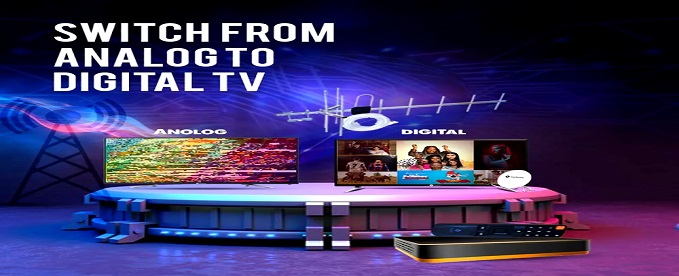
National Broadcasting Commission (NBC) has said that Nigerians will no longer pay annual Digital Access Fees under the renewed Digital Switch Over (DSO) project.

Charles Ebuebu, director-general, NBC, disclosed this in an exclusive interview with the News Agency of Nigeria (NAN) on Wednesday in Abuja,
Ebuebu said viewers only need to purchase an approved decoder and satellite dish which cost below N20,000 to enjoy free television permanently.
“Previously, users paid an annual digital access fee of about N1,500, described as an administrative charge.
“The new system removes that annual fee. It provides free access to free-to-air television channels without any payment.
“Premium channels will be introduced later. Viewers who want those additional channels will be able to access them through paid services.
“Nigerian content on free-to-air channels remains free to watch. Unlike Pay TV, this platform does not require monthly subscriptions for its basic service,” he said
Ebuebu said approved decoders for the FreeTV will cost less than N20,000 and authorised sales outlets will soon be announced.
He urged Nigerians to wait for official information on approved dealers for the DSO decoders, warning that unauthorised sellers are exploiting growing public demand.
He reiterated that people only need a free-to-air decoder, along with a satellite dish instead of the old antenna system to receive the DSO signal.
“Once the equipment is installed, viewers can access all available channels across the country without paying any subscription fees,” he stressed
The DG dismissed claims by some retailers that there are different categories of decoders sold at varying prices, stressing that such sellers are not authorised by the commission.
According to him, the NBC will soon publish the list of approved dealers, official prices, and locations where genuine decoder boxes and accessories can be purchased.
The NBC boss said the DSO project is designed not only to improve television broadcasting but also to stimulate economic growth by creating jobs, attracting investment, and opening up opportunities for businesses that support the broadcasting industry.
Ebuebu noted that content producers and broadcasters stand to benefit significantly from the nationwide reach of the DSO platform.
Unlike the previous system, where many stations had limited regional audiences, he said the new platform will make their channels available to viewers across Nigeria.
He added that the introduction of audience measurement technology will provide scientific and reliable data on television viewership.
Ebuebu added that audience measurement technology will give advertisers greater confidence in placing adverts and enable broadcasters to demonstrate the true size and reach of their audiences nationwide.
Uchenna Mbunabo, Nigerian filmmaker, has raised concerns over the alleged unauthorised broadcast of Nollywood films by some Ghanaian television stations, calling on Ghana’s National Film Authority (NFA) to strengthen the enforcement of copyright laws.

Uchenna Mbunabo, Nigerian filmmaker
Mbunabo made the remarks during a conversation with James Gardiner, deputy CEO of the National Film Authority (NFA) of Ghana.
He questioned whether it was permissible for television stations in Ghana to download Nigerian movies from YouTube and air them without obtaining permission from the producers.
“I noticed that Ghanaian TV stations, the way they are stealing our films and showing them for free with impunity. Is it legalised in your country for TV stations to go on YouTube, download people’s sweat and show it for free?”
According to Mbunabo, some Ghanaian television stations have been downloading newly released Nollywood films from YouTube and broadcasting them without authorisation, depriving producers of revenue generated through the platform.
He also stated that he had not witnessed Nigerian television stations engaging in similar practices and questioned what measures Ghana was taking to protect filmmakers’ intellectual property.
Responding to the concerns, Gardiner acknowledged that the issue exists and said the National Film Authority had begun engaging relevant stakeholders to address it.
He disclosed that the NFA has held discussions with the Ministry of Communications, the National Communications Authority (NCA) and the National Media Commission (NMC) on improving copyright enforcement.
Gardiner explained that while Ghana has copyright laws, enforcement remains challenging because many television stations now operate digitally and may not have physical offices within the country.
“There are copyright laws, but they are not effective because a lot of the TV stations don’t have offices. Most of them are now digital, so they operate from anywhere. They can even have a Ghanaian TV station but be operating from Austria simply because it is digital.”
He added that authorities are considering a new licensing framework that would require broadcasters to undergo a fresh licensing process to improve monitoring and enforcement.
According to Gardiner, television stations found guilty of illegally broadcasting copyrighted content would be required to compensate affected producers through fines.
He added that repeat offenders could face suspension of their broadcasting licences, while a third violation could result in the revocation of their licences.
Although he did not provide a specific timeline, Gardiner said the reforms were already underway and expressed hope that significant progress would be seen next year.
Mbunabo welcomed the proposed measures but urged the National Film Authority to expedite the process, stating that unauthorised broadcasts continue to affect filmmakers’ ability to recover production costs through legitimate distribution channels such as YouTube.
He also stressed that his comments were not directed at Ghana’s film industry, noting that he has worked with several Ghanaian actors over the years and supports collaborations between Nollywood and Ghallywood.

Dangote Refinery’s Private Placement Reportedly Hits $2.5Bn

FG, UNODC Plan National Strategy against Organized Crime

EFCC Busts NIS Visa Overstay Racket, Uncovers N700m in an Account

CBN to Monitor Every Dollar with FXBT, Forex Tracker

NCC, NDLEA Partner to Fight Piracy and Drug Trafficking

NRC, Ponzi Scheme Collapses Resulting Loss of Billions of Naira

NASENI Moves to Digitize CCB’s 5m Assets Declaration and Operations

Lebara Nigeria Launches Lebara Play, Africa’s First Telecom-Owned Micro-Drama Platform

CANAL+ Partners Samsung to Pre-Load DStv Stream on New Samsung TVs In Nigeria, Other African Countries

Tokenization, Blockchain Technology will Transform Financial Institutions – IMF



 News1 day ago
EFCC Busts NIS Visa Overstay Racket, Uncovers N700m in an Account

 Broadcasting3 days ago
NBC Scraps Annual Digital Access Fee on DSO

 Telecom3 days ago
Surge in Fibre Cuts Hobbles Service Provisioning

 General News2 days ago
Nigeria Facing Rising Cybercrime Losses – Report

 Telecom2 days ago
ntel Plays Down Calls and Data Services, Moves to BET Agenda

 Telecom2 days ago
Airtel Delivers Free Employability Training to Young Nigerians @ World Youth Skills Day

 News2 days ago
FAAN to Replace Physical ID Check with V-Pass Biometric Verification

 News2 days ago
CAC Begins Removing 100,000 Companies from Register Over Regulatory Non-Compliance