

News
HURIWA Calls FG Out over NBC’s N2Bn, N500m Bribe @ MTN

Human Rights Writers Association of Nigeria (HURIWA), one of the nation’s foremost pro-democracy and civil Rights organisations has described the recently signed executive order by President Muhammadu Buhari as unconstitutional and saying that the government has been very hypocritical with the fight against corruption.
HURIWA claimed that “under the President’s nose a minister allegedly mismanaged N2 billion from the National Broadcasting Commission for digitisation of broadcasting but till now both the minister of information and DG of NBC are walking the corridors of power free”
Comrade Emmanuel Onwubiko, national coordinator, and the Miss Zainab Yusuf, media Affairs director of the Rights group said that “under the nose of the President An allegation of N500 million bribery made against his chief of staff that he extorted money from MTN was swept under the carpet”
According to HURIWA, “Nigerian National Petroleum Corporation gave out contracts to some ghost companies to the tune of $26 billion without complying with Public procurement Act and when the minister of state for petroleum complained about this monumental heist the President simply asked the NNPC GMD and the minister of state for petroleum to go and work together”
 President Muhammadu Buhari
“The President is the minister for petroleum but under the last three years several billions of dollars remained uncounted for to the extent that the governors of the 36 states of the Federation raised their voices to condemn this broad day light robbery” HURIWA noted.
HURIWA said that it may institute a case at the Federal High Court to seek the nullification of the illegal and outrageously unconstitutional executive order targeted at opposition political office seekers.
The full statement read:
The Executive Order On Suspicious Assets Is Unconstitutional- Huriwa
Human Rights Writers Association of Nigeria (HURIWA), one of the nation’s foremost pro-democracy and civil Rights organisations- has described the recently signed executive order by President Muhammadu Buhari in which the perception or interpretation is being given that the executive arm has the power of law making, as unconstitutional.
Besides, HURIWA gave indication that it may institute a case at the Federal High Court to seek the nullification of the illegal and outrageously unconstitutional executive order targeted at opposition political office seekers.
In a media release endorsed by Comrade Emmanuel Onwubiko, National Coordinator, and the Miss Zainab Yusuf, media Affairs Director, of Rights group wrote as follows:
“Under the constitutional democracy in practice in Nigeria as clearly provided for in the Constitution of the Federal Republic of Nigeria of 1999 as amended, sections 4, 5 and 6 have clearly demarcated the constitutional powers of each arm of government with section 4 ceding the power of law making in the to the National Assembly and state Assemblies.
Section 5 gives the President and the executive arm of government that he heads the power to implement policies and to exercise powers as specified in any legislation passed by the National Assembly and sign by him or if he withhold his assent the National Assembly can apply their power of veto to override the refusal of the executive head of government to sign the legislation and by the veto override the piece of legislation becomes a law of the Federal Republic of Nigeria.
Section 6 gives the judicial powers of the federation on the Courts of competent jurisdiction.
With due respect, the President cannot exercise the powers that is not donated to his office by the Constitution.
Secondly, the so called Executive Order is a total duplication of the Economic and Financial Crimes Commission’s Act which is an Act of parliament which contains several provisions regarding temporary or permanent forfeiture and how the forfeited assets have to be administered transparently but the power to grant such temporary or permanent forfeiture belongs to the Courts of competent jurisdiction because that is the forum for the interpretation of the laws.
The Executive head of government will be committing outrageous illegality if he is allowed to just wake up and sign what he calls executive orders which purports to seize the powers already domiciled in the Constitution or other pieces of legislations that were properly passed.
The executive order is possibly a politically tainted move to crush opposition politicians, take over their assets over nebulous charges and make them financially impotent to confront the incumbent President in the next year’s general election in which the incumbent plans to run.
Besides, the Constitution in section 36(5) clearly stated that a suspect or an accused person is totally innocent in the eyes of the law.
The executive order seeks to overrule this vital section of the Nigerian Constitution. The constitution is clear on what happens to any action of government that contradicts any relevant section of the Constitution.
The executive order on seizures of assets is null, void and of no moment.
I’m optimistic that Nigerians of goodwill will challenge this attempt to institutionalize dictatorship in the competent courts of law.
The Constitution recognises the rights of citizens to own moveable and immovable property in any court of the Country.
The government of Muhammadu Buhari cannot hide under the guise of declaration of state of emergency on corruption and deprive a citizen of his/her protected and guaranteed right.
Only the court has this kind of power and the accused must be guaranteed fair hearing.
The president is simply seeking to exercise tyrannical power to deprive his opponents of their assets to cripple their political activities.
The current administration has been very hypocritical with the fight against corruption.
President Muhammadu Buhari spent 103 days on medical tourism in London at public costs but abused the law on transparency and accountability by failing and refusing to declare the exact amount spent on his health from public treasury.
Even when the Freedom of information Act allows a citizen to know how our funds are spent but President Muhammadu Buhari forced the central bank Governor to refuse the application for release of information on how much of public fund was spent treating the current President.
Under the nose of the current President, Nigerian national Petroleum corporation gave out contracts to some ghost companies to the tune of $26 billion without complying with Public procurement Act and when the minister of state for petroleum complained about this monumental heist the President simply asked the NNPC GMD and the minister of state for petroleum to go and work together.
The President is the minister for petroleum but under the last three years several billions of dollars remained uncounted for to the extent that the governors of the 36 states of the Federation raised their voices to condemn this broad day light robbery.

Under the nose of the President An allegation of N500 million bribery made against his chief of staff that he extorted money from MTN was swept under the carpets.
Under the watch of the President $48 million was found in a flat in Ikoyi but till date no certainty on who owns the cash.
In the Nigerian Intelligence Agency over $250 million was diverted but till date the whereabouts of such huge funds are unknown and the Acting director general of NIA who raised the alarm as good whistleblower was physically harassed out of the place and I’m told he fled into the United States for his life.
Under the watch of this President the minister of communication was accused by his media adviser of corrupt enrichment running into multimillion Naira including purchases of choice housing assets in Abuja and Ibadan and state of the art Printing press but because the minister is campaigning for the re-election of the President that alleged crime had been concealed.
The disgraced SGF and Buhari’s friend embezzled nearly N500 million allegedly from North East reconstruction fund but he is not prosecuted.

Under the President’s nose a minister allegedly mismanaged N2 billion from the National Broadcasting Commission for digitisation of broadcasting but till now both the minister of information and DG of NBC are walking the corridors of power free.
The school feeding programme whereby over N500 bullion was budgeted and released is mired in widespread corrupt practices.
The President should perish the thought of witch-hunting his political opponents and allow the anti graft bodies to work by operating without political interferences. He should rather appoint a good Nigerian who is independent minded and free from corruption to head the Economic and Financial Crimes Commission.
The signing of this illegal executive order shows that the President has lost confidence on the EFCC leadership which had in any case received damaging reports from Department of state services which specifically indicted the Chairman of EFCC of a range of corrupt enrichment allegations.

The EFCC’S acting Chairman has also failed confirmation hearing twice and so can’t continue as head of that agency.
Buhari has influenced EFCC to go after PDP regarding the Presidential campaign fund for 2015 but the APC which spent hugely to beat an incumbent is free from EFCC’S investigations.
The Executive order is therefore DEAD ON ARRIVAL. The National Assembly must not allow the President take over their legislative powers and Nigerians who love democracy and constitutionalism must head to court to quash this manifest illegality of President Muhammadu Buhari.
We recall vividly that President Buhari signed what he termed the executive order on preservation of assets seized in connection with corruption and stated interalia that:
“Like I have said many times, if Nigeria does not kill corruption, corruption will sooner-or later kill Nigeria,’’ President Buhari said while signing Executive Order No.6 to further strengthen institutions on curtailing and restricting illicit activities in the country.
“It has thus become necessary to re-kit and re-tool our arsenal to be able to effectively tackle corruption’s perilous counter-attack against the Nigerian State. Accordingly, the Federal Government of Nigeria has declared a national emergency to deal with that crisis.
“In this regard, the Federal Government of Nigeria in line with its anti-corruption strategy seeks to ensure that justice is not defeated or compromised by persons involved in a case or complaint of corruption,’’ he said.
We can also recall that the President said the viability and continuous well-being of the nation faces enormous threat from corruption, pointing out that, “Whilst there are many reasons why Nigeria has been struggling; regrettably, the most unfortunate cause of great disparity between Nigeria’s wealth and its poverty is endemic corruption.’’
“It is in consequence of this that I have decided to issue the Executive Order No. 6 of 2018 to inter alia restrict dealings in suspicious assets subject to investigation or inquiry bordering on corruption in order to preserve such assets from dissipation, and to deprive alleged criminals of the proceeds of their illicit activities which can otherwise be employed to allure, pervert and/or intimidate the investigative and judicial processes.
“Or for acts of terrorism, financing of terrorism, kidnapping, sponsorship of ethnic or religious violence, economic sabotage and cases of economic and financial crimes, including acts contributing to the economic adversity of the Federal Republic of Nigeria and against the overall interest of justice and the welfare of the Nigerian State,’’ .
We in the Human Rights Writers Association of Nigeria (HURIWA) believe that the executive order is simply an exercise in futility because it’s inherently unconstitutional and is a political gambit to cripple political opponents because of 2019 Election which is only few months away.
*Comrade Emmanuel Onwubiko; is the National coordinator of Human Rights Writers Association of Nigeria (HURIWA).


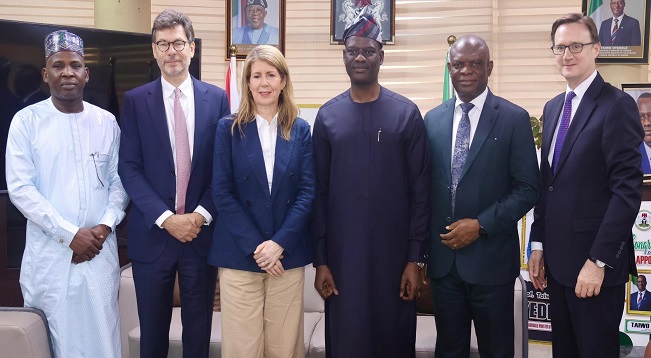
The UK Minister for Africa and International Development, Baroness Jenny Chapman, has concluded a two-day visit to Nigeria, during which she announced a new £15 million Growth Programme, deepened cooperation on digital transformation and health, and visited communities benefiting directly from UK investment on the ground.

The visit, spanning Abuja and Kaduna, underscored the breadth and depth of the UK–Nigeria Strategic Partnership and marked a significant step towards both countries’ shared priorities.
The UK–Nigeria Growth Programme
The centrepiece was the meeting with Nigeria’s Minister of Finance and Coordinating Minister of the Economy, Mr. Taiwo Oyedele. During their meeting, they discussed the new UK–Nigeria Growth Programme. Over three years, it will accelerate economic transformation, unlock private investment and support Nigeria’s transition from macroeconomic stabilisation to sustained, reform-led growth.
Alongside the Growth Programme, the UK announced deeper collaboration on Nigeria’s digital economy through the SPRIRET initiative, delivered under the UK’s Digital Access Programme. SPRIRET will support digital governance reforms across five Nigerian states, reducing regulatory barriers and enabling greater investment and innovation in broadband, digital services and emerging technology.
The Minister of Finance and Coordinating Minister of the Economy, Mr. Taiwo Oyedele said: “We continue to value the UK–Nigeria relationship, one of the most important partnerships for both our countries. Today, that relationship extends beyond traditional ties and now focuses on development, growth, and shared prosperity.
“The UK–Nigeria Growth Programme helps bring this partnership to life—supporting capital market development, technology investment, small businesses, and technical assistance. We look forward to seeing how these opportunities deliver lasting benefits and drive progress for both countries.”
Trade and bilateral ministerial meeting
During the visit, Baroness Chapman met with the Minister of Industry, Trade and Investment, Dr Jumoke Oduwole. Discussions covered progress under the Enhanced Trade and Investment Partnership (ETIP), including boosting exports via the Developing Countries Trading Scheme, fintech and capital markets links.
Kaduna: building on two decades of partnership
In Kaduna, Baroness Chapman met with Governor Uba Sani to take stock of over 20 years of UK–Kaduna partnership and explore how cooperation can deepen shared priorities. She heard from the business community and key institutional investors about their investment aspirations and the role of the UK in supporting investment mobilisation and enabling climate finance.
She met with community animal health workers and livestock breeders to discuss the UK’s support on breeding techniques, animal health and livestock vaccines. She also visited Unguwan Sanusi Primary Health Care Centre, which serves approximately 20,000 people in Kaduna South, hearing directly from patients and frontline health workers about the impact of UK-supported health programmes.
At the end of the visit, the UK Minister for Africa and International Development, Baroness Jenny Chapman, said: “This visit has reinforced everything I believe about the UK–Nigeria partnership.
“That it is deep, it is real, and it is moving in the right direction. From launching our new Growth Programme with Honourable Minister Oyedele, to meeting from frontline health workers in Kaduna — every conversation this week has shown me a country full of ambition and a partnership that is genuinely delivering for both sides.
“Nigeria is a partner that the UK is proud to stand alongside and I leave more convinced than ever that the next chapter of this partnership is its most exciting yet. The UK is here for the long term, and we are ready to grow together.”

More than 810 million women across low- and middle-income countries (LMICs) remain offline, with Sub-Saharan Africa recording one of the world’s widest mobile internet gender gaps.

According to the GSM Association’s (GSMA’s) Mobile Gender Gap Report 2026, released this week, women in LMICs are still 12% less likely to use mobile internet than men, leaving an estimated 200 million fewer women connected than their male counterparts.
This is despite mobile internet becoming the primary gateway to the digital economy, according to new research from the GSMA.
The report reveals that of the 810 million women who remain offline globally, more than two-thirds live in Sub-Saharan Africa and South Asia −regions that continue to experience the widest disparities in digital access.
The findings highlight significant implications for Africa, and the challenges facing governments, mobile operators and development agencies seeking to expand digital inclusion.
The report notes that Sub-Saharan Africa’s mobile internet gender gap stands at 26%, second only to South Asia’s 25%. The divide becomes even more pronounced outside major cities.
“In LMICs, the gender gap in mobile internet adoption tends to be two to three times wider in rural areas than urban areas. In 2025, across all LMICs, the gender gap in mobile internet adoption was more than three times wider in rural areas than in urban areas.
“There is also a difference at the regional level, where the gender gap in mobile internet adoption is wider in rural than urban areas of LMICs in every region except Europe and Central Asia.”
For Africa, the rural challenge is particularly severe, the report warns.
The GSMA found that the gender gap in mobile internet adoption reaches 34% in rural areas of Sub-Saharan Africa, compared to 21% in urban centres.
Device challenge
Smartphone ownership remains a major obstacle to digital inclusion. The report found that women across LMICs are 13% less likely to own a smartphone than men, representing approximately 210 million fewer women with access to internet-enabled devices.
Across Sub-Saharan Africa, only 34% of women own smartphones, with the region recording a smartphone ownership gender gap of 22%, with access to internet-enabled devices remaining one of the most important factors influencing whether women eventually adopt mobile internet services.
“The type of mobile device a person owns matters, as it typically affects whether and how they use the internet. Once someone owns a smartphone, they are much more likely to be aware of mobile internet, adopt it and use it regularly and in a variety of ways. In fact, once women own a smartphone, these metrics more closely resemble those of men,” notes the report.
Barriers persist
Despite growing awareness of mobile internet and its benefits, women continue to face multiple barriers to meaningful participation in the digital economy.
The report identifies affordability, literacy and digital skills as the leading barriers preventing women from getting online.
Even after gaining access, women frequently report safety and security concerns, data costs and connectivity quality as obstacles to broader internet use.
The report notes: “Addressing rural gender gaps is essential to advancing digital inclusion for women overall. In particular, women who live in rural areas tend to have limited physical access to essential services and may have the most to gain from better access to mobile and mobile internet.
“Addressing gender gaps in mobile ownership, particularly of smartphones, and in mobile internet use can help women in rural areas benefit from these digital technologies to the same extent as men.”
Claire Sibthorpe, head of digital inclusion at the GSMA, warns that progress is not happening quickly enough and emerging technologies such as artificial intelligence risk creating new forms of digital exclusion.
“While there has been a slow narrowing of the mobile gender gap since 2022, much more is needed to address the persistent and significant gender gaps in mobile internet adoption and use.
“We live in an increasingly digital world and the proliferation of technologies such as AI are creating greater digital divides and inequities, elevating the need to ensure digital inclusion for all.”
Payaza Africa, a payments infrastructure company, has earned strong credit ratings from four major rating agencies, reinforcing its growing reputation as a resilient and credible player in Africa’s financial services ecosystem.

The payment company recorded upgrades across the board, with DataPro raising its rating from A to AA-, Intelligence Africa assigning it an A- investment-grade rating, Agusto upgrading it from BBB to A-, and GCR, an affiliate of Moody’s, also moving it from BBB to A-.
A credit rating reflects a company’s financial strength and its ability to meet debt obligations, indicating how safe it is for lenders and investors to extend credit.
In a statement on Monday, the company described the achievement as a validation of its disciplined growth trajectory and operational resilience in a dynamic fintech landscape. It added that the upgrades position Payaza as a future-ready brand with increasing relevance not only within Africa but also in the global fintech space.
Commenting on the development, Seyi Ebenezer, the Chief Executive Officer of Payaza Africa, said the ratings reflect years of deliberate effort to build a sustainable and globally competitive institution.
“This milestone is a strong affirmation of the work we have done to build Payaza on a foundation of discipline, trust, and long-term value creation. Receiving these upgraded ratings sends a clear message that Payaza is not only growing, but growing with strength, structure, and sustainability,” he said.
Ebenezer noted that the recognition goes beyond financial performance, highlighting the company’s ability to execute strategically while maintaining strong risk management practices.
“For us, this is bigger than recognition. It reflects our commitment to building a world-class institution that can compete globally while continuing to serve businesses and consumers across the continent with excellence.
“Over time, our ratings journey has reflected more than strong financial performance. It speaks to a business built on disciplined execution, prudent management, and the ability to scale responsibly in a dynamic market. This has helped us stand out not only as an innovator in digital payments, but as a maturing financial institution with the operational depth to compete globally.
“These new ratings are expected to further strengthen Payaza’s standing with investors, regulators, partners, enterprise clients, and the wider financial community. In a sector where trust, resilience, and compliance are increasingly central to long-term success, independent ratings remain a powerful endorsement of a company’s ability to manage risk, meet obligations, and sustain growth,” Ebenezer said.
Payaza Africa provides payment infrastructure solutions focused on collections, payouts, embedded finance, and digital commerce enablement for businesses across Africa.
The company has also continued to expand its product ecosystem with solutions such as Payaza Checkout for payment collections and payouts, Chat and Pay by Payaza for WhatsApp-based transactions, Payaza Give for donations and digital contributions, and Shopaza, its e-commerce platform designed to help businesses sell and receive payments more efficiently.

UK, Nigeria Launch £15 million Growth Programme to Accelerate Economic Transformation

Haleon Introduces New Corporate Identity in Nigeria

NITDA Unveils Ambitious Strategy to Turn Southwest into Nigeria’s Next Innovation Powerhouse

Airtel Africa Foundation Publishes Inaugural Annual Report

Mobile Internet Gender Gap Widest in Africa – GSMA

CBN Extends PoS Geo-Fencing Enforcement Deadline to August 2026

Jumia Nigeria Records Strong Q1 2026 Growth as Technology-Led Strategy Drives Market Expansion

NCC Drafts New Rules for Virtual Mobile Operators

TD Africa, HPE Drive Conversations on the Future of Intelligent Networking

Anthropic Raises $65 Bn to Expand AI Research, Innovation




 E-Business2 days ago
Firm Discovered a New Corporate Phishing Technique using a Popular AI Web Development Platform

 E-Financial3 days ago
Senate Moves to Regulate Crypto Sector, Seeks Investor Protection

 Telecom2 days ago
No More Deleting and Reposting: Instagram Unveils Long-Awaited Profile Update

 General News3 days ago
IMF Warns Nigeria of Risks in $5Bn Swap Deal with First Abu Dhabi Bank

 Telecom2 days ago
Airtel Nigeria Launches Web Data Calculator to Give Customers Greater Visibility into Data Usage

 Telecom2 days ago
All Set for 2026 Nigeria DigitalSENSE Forum and Awards: NLNG, IHS, and others rally support

 Telecom2 days ago
NCC Board Reviews Telecom Sector, Notes Progress in Network Expansion, Consumer Compensation

 Broadcasting3 days ago
MTN Launches One TV with Free-to-View, Pay-as-You-Go