

Telecom
COVID 19: NITDA DG Admonishes Startups To Possess Entrepreneurial Mindset

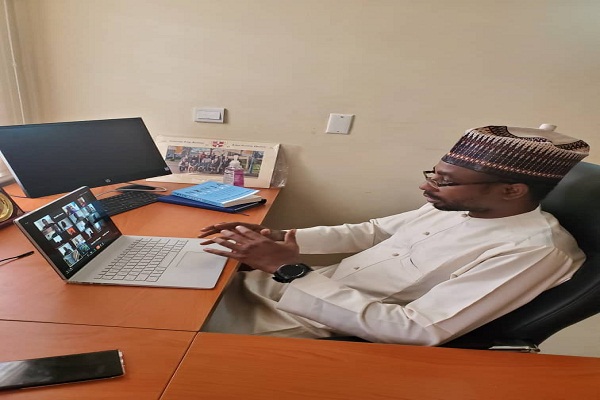
Amidst the uncertainties the novel COVID I9 pandemic is causing globally and indeterminable time the world would come out of it, the National Information Technology Development Agency, (NITDA), has resolved to continue with its planned activities aimed at increasing the capabilities of the startups in the country by leveraging on digital technology.
The agency on Friday, in a closing ceremony of the maiden online edition of Start UP Clinic, Abuja, one of such events already slated at pre-pandemic time, the Director General of the Agency, Mallam Kashifu Inuwa Abdullahi, delivered a motivational speech to 20 startups who have been in virtual booth camp in the last five days.
In his remark, the Director General acknowledged that, “things are not going to be the same after the pandemic and the world economic order is going to change” which he said would lead to closing down of lots of businesses, advised the Startups to possess both the entrepreneurial mindset and entrepreneurial environment capabilities in other to survive during and at the post pandemic world.
The DG stated that, to build these capabilities, the startups need to adjust their tactics, change course, and ignore the conventional wisdom that says; “go to school read hard, pass with flying colors and get a good job.
“No, there is not going to be jobs for you. I think what we need now is; you need to go to school, be a streetwise, hack the problem and be an entrepreneur.”

Mallam Abdullahi noted that by creating an entrepreneurial mindset, they would become successful startups adding that there is a significant difference between people who start their own companies and truly successful entrepreneurs.
“Many people start their own businesses but few people actually achieve the kind of success they dreamed of at the start. What is the difference between people who start up their own business and successful entrepreneurs? The answer is the entrepreneur’s mindset,” he added.
He enjoined the startups to have a mindset of creating businesses for themselves, rather than creating jobs to ensure continuity in case of their absence while the companies are still active.
According to the DG, “this means that you have been able to create a functional entity, not just a job position where you do all of the work. This is the type of mindset you must have if you want to become a truly successful entrepreneur.”
“Creating an entrepreneurial mindset starts at the beginning, before you do anything to start up your company. It means having a grand vision and passion. It means carefully considering all that you want your company to be before it even exists.
“ It means imparting your vision, your dreams and your principles into the company right from outset. You need to ask yourself meaningful questions so that you are able to focus on more than just the day to day functions of running your business. Your business must be built upon your dreams, your passions and your principles. This is the difference between a job and a business.”
He challenged them to leverage on the two capabilities to grow their start up to becoming unicorn businesses which means a privately-owned company that worth at least one billion USD.
While admonishing them on how to attain the feat of becoming a unicorn company, the DG stated that they could become Unicorn companies within short period by following the playbook of successful startups followed which are just three simple rules of beginning with a plan to disrupt an existing industry; injecting capital to grow as rapidly as possible and tolerating high risk in a rush to conquer and dominate the market segment.
Mallam Abdullahi noted that in the region, there are only three Unicorn Companies and while South Africa has two, Nigeria can only boast of one.
He however stated that our country has a competitive advantage to be among countries with many unicorn companies because of her digitally native population and untapped market.
He added that the government is creating an entrepreneurial environment for the start up to thrive.
He listed the government’s efforts to include, the culture, infrastructure and support.
Mr.Nnamidi Nwachuku, one of the participating Startups, in his remarks observed that the Online Start up Clinic as organized by the Office for ICT Innovation and Entrepreneurship (OIIE) has greatly impacted on their knowledge positively.
He noted that the experienced shared by many facilitators at the five days event would provide them the impetus to survive in their respective market segment.
He said, “We have similar experience like the Jigawa edition which was physical. The impact was good as if it was physical. The evaluation form would help us to improve on our innovations. Like me, I have vision to build my business to become a unicorn without looking at the investor and I know it is realistic because I know my capabilities.”
Dr Amina Magaji Sambo, OIIE National Coordinator, urged the participants to adhere to all the guidance availed them during the period and ensure that they keep updating the office of their progresses and challenges.



MTN Nigeria has announced the temporary suspension of its airtime and data advance service, Xtratime, following new regulatory requirements introduced by the Federal Competition and Consumer Protection Commission (FCCPC).

The telecom giant disclosed the development in a filing to the Nigerian Exchange Limited (NGX) on Thursday, stating that the move is necessary to comply with the FCCPC’s Digital, Electronic, Online or Non-Traditional Consumer Lending Regulations, 2025.
Xtratime, widely used by prepaid subscribers, allows customers to borrow airtime or data and repay on their next recharge.
In the disclosure signed by Uto Ukpanah, company secretary, the firm confirmed the halt, noting, “MTN Nigeria Communications PLC hereby notifies the Nigerian Exchange Limited and the investing public that the company has temporarily suspended its airtime and data credit advance service (‘Xtratime’).”
The company explained that the service now falls within the scope of the FCCPC’s expanded regulatory framework, which mandates fresh licensing and stricter compliance procedures for digital credit providers.
“The suspension relates to the implementation of processes under the Digital, Electronic, Online or Non-Traditional Consumer Lending Regulations, 2025, which introduced a new compliance and licensing framework for entities providing digital or non-traditional consumer credit services,” the statement added.
Despite the suspension, MTN reassured subscribers that alternative channels for purchasing airtime and data remain fully operational. It also downplayed the financial impact of the move.
“Given the scale within the revenue mix, we do not expect the temporary suspension to have a material impact,” the company said, adding that it is closely monitoring customer behaviour and will provide further updates in its first-quarter 2026 results.
The FCCPC’s 2025 regulations significantly broaden oversight of Nigeria’s digital lending ecosystem, bringing telecom operators and other providers of short-term credit services under stricter scrutiny. Companies offering such services are now required to register and obtain regulatory approval to continue operations.
The Commission had initially introduced a framework for digital lending in 2022, but expanded it in 2025 amid rising concerns over consumer debt, data privacy and lending practices.

Nokia and Orange are co-developing new strategies to maximise spectral efficiency across existing and future mobile bands, including the upper 6 GHz range, as networks transition toward 6G.

This follows an announcement of a partnership with NVIDIA to develop and evaluate Artificial Intelligence Radio Access Network (AI-RAN) technologies.
The initiative will combine the anyRAN 5G software of Nokia with the AI infrastructure of NVIDIA to improve network performance and energy efficiency.
The collaboration aims to transform service delivery for Orange across Europe, the Middle East, and Africa, says Nokia.
Under a new structured co-innovation framework, the partners will explore how GPU-based radio processors can boost performance via advanced receivers.
The goal is to integrate artificial intelligence (AI) directly into the RAN to automate environments, support sensing services and drive resource utilisation.
“By collaborating with Nokia and NVIDIA, we can better understand how the AI-native architecture enabled by AI-RAN can improve the efficiency of key radio algorithms such as scheduling, beamforming, and power optimisation — enhancing both spectral efficiency and energy performance, while also enabling advanced capabilities like predictive optimisation and radio sensing. This collaboration is an important step in our long-term network strategy,” says Laurent Leboucher, group chief technology officer at Orange.
Pallavi Mahajan, chief technology and AI officer at Nokia, comments: “AI is reshaping how networks are designed, introducing new levels of intelligence and flexibility across the radio layer.
“Through this collaboration with Orange, we are exploring how Nokia and NVIDIA’s AI-RAN solution brings advanced AI and RAN functions together in a unified architecture. This will be instrumental in enabling the industry’s transition toward cognitive, AI native networks.”
Orange is currently the fourth-largest telecoms operator in Africa with 18 markets on the continent. The partnership marks a significant attempt to leverage AI to accelerate digital transformation as the first wave of 6G approaches.
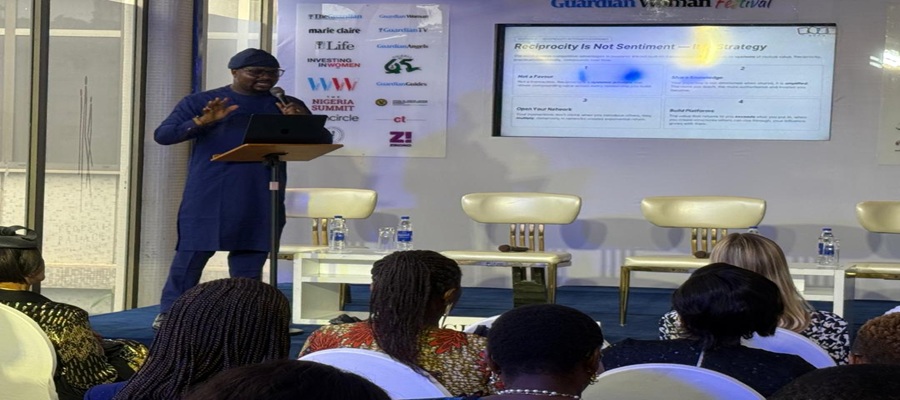
Zoho Nigeria partnered with Guardian Newspapers for the Guardian Woman Festival, a month-long initiative celebrating women’s contributions to business, governance, and social development while promoting digital empowerment for female entrepreneurs.

Kehinde Ogundare
Held at the Federal Palace Hotel in Victoria Island, Lagos, the festival focused on the theme “Reciprocity,” encouraging the exchange of value, networks, and digital innovation to strengthen women-led businesses and foster collaboration.
During the event, Kehinde Ogundare, Country Head of Zoho Nigeria, delivered a keynote address titled “Give Value, Gain Growth: Women Driving Reciprocal Innovation in the Digital Economy”. In his remarks, he highlighted the urgent need to bridge the digital gap for female entrepreneurs.
While Nigeria has the highest concentration of women-owned businesses in Africa, fewer than 30% currently use digital tools to manage or grow their operations. Ogundare noted that technology does not replace the strengths women already bring to business, such as relationship building and community engagement. Instead, it amplifies them, enabling entrepreneurs to reach wider audiences and scale more efficiently.
“The difference is not talent. Not capital. Not ambition. It is digital adoption,” said Ogundare during his keynote. “Smart tools create smart businesses. Smart businesses create strong economies. When women entrepreneurs and leaders have access to the right tools, the possibilities for growth are limitless.”
Zubaida Aliyu, Sales Manager at Zoho Nigeria, also brought her expertise to the festival’s panel session on ‘Women in the Business of Digital Innovation’. She highlighted how women are uniquely positioned to create shared value in digital spaces by building platforms that encourage knowledge sharing, mentorship, and collaboration.
Aliyu also challenged organisations that continue to view women’s digital inclusion primarily as corporate social responsibility rather than a strategic business priority.
“Tech creates a level playing field,” she said, noting that digital platforms remove limitations related to location and infrastructure size. Addressing organisations that overlook the economic value of inclusive digital strategies, she added, “They are leaving money on the table — they need to think of it as a strategy not charity”.
Through its participation in the Guardian Woman Festival, Zoho reaffirmed its commitment to providing affordable and accessible enterprise-grade technology to businesses of all sizes. By helping women transition from manual effort to digital efficiency, Zoho aims to support entrepreneurs build scalable enterprises and ensure their sustained success in Africa’s digital economy.

MTN Suspends Data, Airtime Borrowing Service over New FCCPC Lending Rules

Nigeria Customs Deploys AI to Cover Revenue Leaks

Top 7 Reliable Virtual Cards for Running Ads in Nigeria

Nokia, Orange Partner on AI-native 6G Networks

NDPC Issues Critical Advisory as Hackers Target Nigeria’s Key Digital Systems

Kuda MFB Increases Kuda for Her Business Grants to ₦10 Million

Canal+ to Cut Jobs as Part Sweeping Restructuring

Nigeria tops global rankings for USDT, USDC ownership

NBC Boss Urges Content Ceators to Participate in DSO

NITDA Takes Over National Digital Architecture System




 General News3 days ago
Guinness Nigeria Surpasses ₦1Trillion Market Capitalisation, Signalling Strong Investor Confidence and Sustained Value Creation

 News3 days ago
CISA Asks NDPC, Police to Act on Alleged Data Breach by NIPSS

 Telecom3 days ago
Amazon Satellite to Challenge Starlink in Africa with Globalstar Acquisition

 E-Financial3 days ago
FG Investigates ‘Sharp Sharp’ Loan Operators over Alleged Privacy Violations

 Broadcasting3 days ago
Fela Makes History as First African to be Inducted into Rock and Roll Hall of Fame

 News3 days ago
Kaspersky Reports Online Scam Exposure Remains Widespread Despite High Levels of Self-assurance

 E-Financial3 days ago
Ecobank Delivers Strong Results, Posts $801m in Pre-Tax Profit for 2025

 News3 days ago
Tinubu Tasks NRS to Restore Public Trust Amid Fiscal Changes