

Telecom
Girls in ICT Day: TD Africa Partners Dell Nigeria, IBM to Empower 50 School Girls

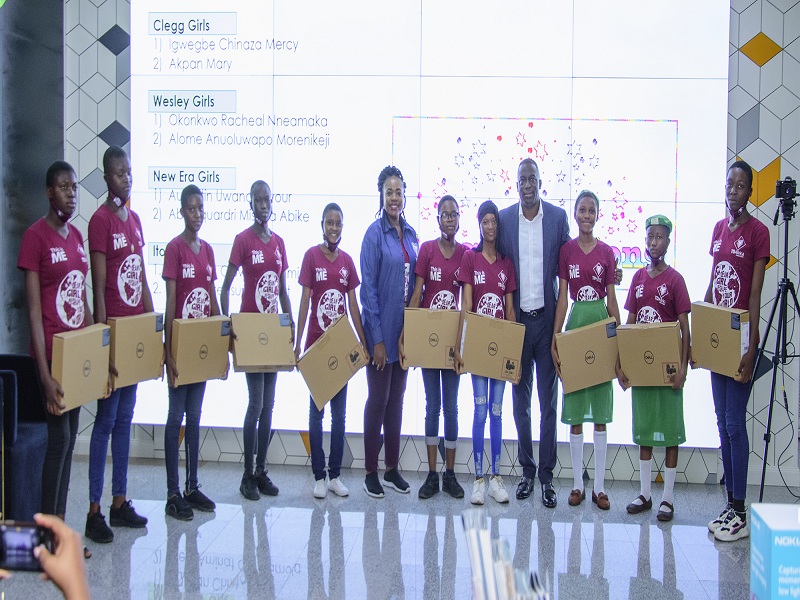
It was a rain of laptops for 50 selected school girls on Thursday, May 27, 2021 as TD Africa, Sub-Saharan Africa’s biggest technology, solutions and lifestyle distributor hosted the beneficiaries to the second edition of its Girls in ICT Day event.

The event, hosted at the Tech Experience Centre, located at the imposing Yudala Heights on Idowu Martins, Victoria Island, Lagos, will go down in history as arguably one of the most potentially life-changing empowerment sessions for the Nigerian girl child.
In addition to the donation of a laptop to each participating school girl, in partnership with the Nigerian team of foremost technology brand, Dell Technologies; 10 exceptional girls from the five participating schools were also selected for enrollment in a digital skill acquisition programme by multinational technology company, International Business Machines Corporation (IBM).The visibly elated girlsexpressed their gratitude to the organizers of the event, with a promise to utilize their new gifts judiciously for personal and professional improvement.
The event was organized under the auspices of This is Me, a Corporate Social Responsibility (CSR) initiative of TD Africa.
Speaking at the event, Chief Executive Officer (CEO), TD Africa, Mrs. Chioma Ekeh, urged the young girls to develop a life-long learning habit, with the aim of making themselves valuable in their immediate environment and to the society.

“Never stop learning. Learning should be part of your routine now and forever. Wherever you find yourself, you must leave a footprint. All through your life, you will come across a few yeses. Be encouraged by those yeses, and be grateful for them. On the other hand, you will also come across lots of noes. However, be challenged by them, with the aim to make yourself a better version of yourself. So, even the noes have their roles. This is because the more noes you tell me, the better I become,’’ Mrs. Ekeh said.
The TD Africa boss further told the girls to be ready to pay the price for a successful life by working hard. Equally important, she counselled them to strive for professional and financial independence, noting that there are no barriers or glass ceilings that can hold back a confident woman. Mrs. Ekeh disclosedthat life would always come with its own challenges, adding that when such challenges come, they should avoid adopting a defeatist approach to solving such problems.
Her advice came as the Country Manager, Apple, Teju Ajani, also encouraged the teenage girls to embrace the STEM disciplines, with a view towards pursuing a career in technology which remains a male-dominated sector.
“It (STEM education) gives you flexibility, it gives you the room to navigate. It empowers you to make decisions that can affect your life and allows you to take your career in your hands, whether as a professional working for others or as an entrepreneur working for yourself.”
On his part, Country Lead, Dell Technologies, Mr. Abimbola Owoeye, encouraged the girls to strive to become value creators, adding that the value they bring to the table will make room for them and break down any discriminatory walls aligned to gender inequality.
Earlier, Coordinating Managing Director (CMD), TD Africa, Mrs. Chioma Chimere, statedthat there were many challenges facing the girl child.
“Our challenges are a bit different from the ones that confront the male children. Ours are more intense and more serious,” Chimere said. “Do you know why that is happening? It is because the girl child is carrying destinies with her. What the girl child is supposed to do goes way beyond her. This is because you are not just fixing things out there in the world; you are also going to shape other people’s destinies.”
She stated that such realization made TD Africa to organize the session, with the aim of empowering young girls to face the future courageously.
“That is why we consider it pertinent to bring together these female children today. This is because of how important they are. The future of your homes, communities, country and the world in general lies in your hands. We have called you here to equip you, open your eyes to those roles, to help you identify them and equip you to face them. If you fail in taking up those challenges and harnessing the available opportunities from those challenges, you would have failed yourselves and your generation,” she said.

While addressing the girls, Ekinadese Osayande, a leading independent university admission counsellor, advised the girls to become more inquisitive about the pervasive influence of technology in contemporary society, even as she noted that the participants also have a role to play in ensuring that less informed parents/wards understand the relevance of empowering the girl child.
Head of the Tech Experience Centre, Chidalu Ekeh, went down memory lane to show the girls how she overcame defeatist advices to take a successful stand on issues that would have defined her negatively. She counselled the students not allow themselves to be consumed by the fear of failure.
“We must fail and find the strength to continue,” she said. “We must dare to dream.”
Also, a University Relations Analyst with IBM, Olufunmilola Olorundare, advised the girls to develop an open mindset. “We can do whatever we want to do, as far as we have an open mindset,” she said.
This is Me, a CSR initiative bankrolled by TD Africa, has consistently engaged vulnerable and under-represented segments of the society, including the girl child, the physically-challenged and children in orphanages, among others.


Airtel Africa Plc has announced a strategic initiative in partnership with Barclays Capital Securities Limited to execute on-market share purchases totaling up to $110 million.

This initiative will be divided into non-discretionary and discretionary segments, marking a proactive step in optimizing the company’s capital structure and enhancing shareholder value.
In a statement released on the Nigerian Exchange and signed by Simon O’Hara, group company secretary, Airtel Africa described this share buyback program as a key component of its broader strategy to return cash to shareholders.
It noted that the program aims to repurchase up to one percent of the company’s issued share capital as of the date of this announcement.
“This decision by the Board reflects the organization’s strong financial position and its commitment to maintaining flexibility while continuing to invest for growth across its markets.
“The initial phase of the program will see Airtel Africa collaborating with Barclays Capital Securities to facilitate the purchase of its ordinary shares,” the statement noted.
According to Airtel Africa, the agreement features two key components operating concurrently: a non-discretionary segment allowing Barclays to purchase up to $60 million of ordinary shares independently of the company, and a discretionary segment where Airtel Africa can guide Barclays in purchasing an additional $50 million, adhering to the regulations set forth by the Market Abuse Regulation (EU) No 596/2014.
“The program is set to commence today and is expected to conclude by November 27, 2026, unless terminated earlier under the agreement’s terms. Airtel Africa has signaled that as the initiative progresses, further tranches may be announced to achieve its objective of repurchasing up to one percent of its issued share capital.
“The primary aim of this buyback program is to streamline the company’s capital. Accordingly, all shares purchased will be cancelled, contributing to a more efficient capital structure. Any transactions will be performed in alignment with pre-defined parameters outlined in the agreement with Barclays and comply with the authority granted by shareholders for share repurchases.”
At the annual general meeting on July 9, 2025, shareholders authorized the company to buy back a maximum of 366.073 million ordinary shares.
Following the previous buyback program, the remaining authority now stands at a maximum of 357.042 million ordinary shares, demonstrating ongoing support from shareholders for these initiatives.

Nigerian Communications Commission (NCC), Nigeria’s telecom regulator has released draft rules for mobile virtual network operators (MVNOs) as authorities seek to organize a market that is still at an early stage.

The NCC published the proposed “Business Rules for Mobile Virtual Network Operations in Nigeria” and opened a consultation process for industry stakeholders.
Comments can be submitted until June 29, while a public consultation is scheduled for July 9.
According to the NCC, the proposed rules define the obligations and responsibilities of both MVNOs and host network operators (HNOs).
The framework also sets conditions for licensing, compliance, interconnection, numbering resources, SIM and eSIM management, and network hosting agreements.
Regulators also seek to guarantee fair access to telecom infrastructure and reduce delays tied to the integration of MVNOs into existing mobile networks.
The text further includes provisions related to service quality, customer protection, network reliability, and data security.
Violations could lead to administrative sanctions or corrective measures under existing telecom laws.
Nigeria officially opened the MVNO market in 2023. That year, the NCC awarded licenses to 25 operators for a combined 5.9 billion naira, or about $4.3 million. Since then, around 40 licenses have been issued, with operators such as Vitel and Visafone already launching services.
Authorities see MVNOs as a way to improve competition in the telecom sector while helping extend services to underserved and unserved populations.
As of March 2026, Nigeria counted 185.7 million mobile subscribers and 153.8 million internet subscribers, according to NCC data.
Despite the size of the market, digital access remains uneven across the country.
Government estimates show that nearly 20 million Nigerians still remain outside the digital ecosystem.
The GSMA estimated that about 120 million Nigerians did not use mobile internet in 2023.
High service costs and inconsistent service quality also remain major concerns in the telecom sector.

An Australian federal court has upheld a fine against social media platform X over failures to comply with child internet safety regulations, bringing to an end a three-year legal dispute between the company and Australian authorities.

The case stemmed from a demand issued in February 2023 by Australia’s online safety regulator, the eSafety Commission, requesting detailed information on how the platform, then known as Twitter, was combating the spread of child sexual abuse material online.
Following the platform’s transition to X under billionaire entrepreneur Elon Musk, regulators accused the company of submitting incomplete responses to repeated requests for information.
A federal court had earlier ruled in October 2024 that X was legally obligated to comply fully with the notice issued by the regulator.
On Thursday, the court ordered the company to pay a fine of 650,000 Australian dollars (approximately 464,900 U.S. dollars).
Federal Justice Michael Wheelahan said the penalty was necessary to ensure compliance by large technology firms.
“A penalty near the maximum is appropriate in the case of the respondent, which is a substantial corporation, so that it operates as a real deterrent and is not simply a cost of doing business,” he said.
Australia has emerged as one of the leading countries advocating stricter regulation of major technology platforms.
The country recently introduced world-first legislation aimed at banning children under the age of 16 from accessing certain social media platforms.
Countries including France, United Kingdom and Canada are reportedly considering similar measures following consultations with Australian authorities.
Reacting to the judgment, eSafety Commissioner Julie Inman Grant said transparency remained essential in holding technology companies accountable.
“Meaningful transparency is critical to holding technology companies to account,” she said.
“This is not only a key part of our work as Australia’s online safety regulator, it also provides the Australian public with important information about how these companies are tackling the worst-of-the-worst content on their platforms,” she added.

WHO Says Ebola Risk Now at Highest Level

Airtel Africa Launches $110m Share Buyback Programme for Capital Efficiency

NCC Drafts New Rules for Virtual Mobile Operators

LG Electronics Showcases Advanced HVAC Solutions at Mega Clima Nigeria 2026

FG Unveils AI Public Services Platform

MTN, VDT, Zoracom, Digital Realty Back 2026 Girls in ICT Campaign

Vitel Wireless Partners Fintechs to Expand Access to Services

Kaspersky Discovers Vulnerability in Qualcomm Snapdragon Chips that can Lead to Data Loss & Device Compromise

Bank Customers to Pay N1,500 for ATM Card Issuance, Replacement – CBN

FG Okays 112 as Toll-Free National Emergency Response Number




 News2 days ago
Elon Musk to Become First World’s Trillionaire with SpaceX Historic IPO

 Telecom2 days ago
MTN to Turn its African Tower Network Into a Distributed AI Compute Grid

 Telecom2 days ago
NCC Begins Review of Nigeria Telecoms Policy after 26 Years
 Telecom1 day ago
NCC Drafts New Rules for Virtual Mobile Operators

 E-Business2 days ago
NITDA Unveils AI-Powered Government System That Tracks Workers, Flags Delays Automatically @ICSC 2026

 E-Business2 days ago
Kaspersky Warns that Scammers are Exploiting World Cup 2026 Travellers

 News2 days ago
Moniepoint Boosts UK Payments Security

 Broadcasting2 days ago
STBMAN Warns of “Broadcasting Crisis”, Urges Tinubu to Halt NBC’s DSO