

General News
AFRICA: A Digital Colony

Look! Africa is fast becoming a digital colony without her realizing it.Am deeply afraidwith the way we are going,that one day if nothing is done, we will wake up and see one smart kid in say China remotely controlling the economies of nations in Africa!Yes,it is as bad as that, if you have keenly followed trends of events happening especially in the cyberspace.And frankly this demands a state of emergency by African Union. In my opinion; this is the new war we need to fight in Africa withcode warriors for digital independence! Africa,one of the largest continents of the world,blessed with great human and material resources no doubt,it becomes unfortunate that even with these abundant resources,our nations are still very poor,underdeveloped and living in the third world. When i look at emerging economiesand the vintage role Africa should play, i say to myself, why is Africa still sleeping. Are we really ready for the coming wealth and power transfer? How are we positioned? We seem to become eternally clueless about technology, its place in African development and what the future holds. My fear is that in thisnew knowledge economy driven by technologies,Africa has started playing the same ignorant and i –dont- care role they played during the Agricultural and industrial age which left us with hunger, poverty and lack. It even took our self esteem away.In this digital age,the consequences cannot be imagined because of the speed associated with digital advancement and if nothing is done now, Africa might never recover from this digital colonisation. I am writing this with the mind that if Africa can realize what she has, find ways to develop the continent using technology as the driving force,we will be the next continent to beat in the global arena of technology competitiveness and overcome this digital enslavement!It isclear that any nation or continent that cannot develop and grow its own technologies has no future and will depend on others.They will hardly regain their freedom. Our over dependency and consumption of technologies(with none made in Africa)have left us as a digital colony while we plough the fields of other smart nations making them Digital giants and singing their songs in Africa. Digital colonization enslaves Africa in her domain making her fully dependent on the global IT savvy nations for all her technology needs, thereby compromising her critical resources and her sovereignty without her knowing. Chris Uwaje in his book-e-Knowledge-Time is running out!aptly captures the entire scenario of a digital colony,he said”some shortsighted nations will wake-up at midnight one day,in the early decades of this century and suddenly realize that they have been digitally colonized. The resultant effect of this will seriously impact on the future generations to come. It simply means that the entire life,culture and sovereignty of a nation and her citizenry have been unknowingly to the people traded off and taken over by IT-smart, powerful and knowledge- centered information force and/or forces on the globe.” The following points to the fact that we have been digitally colonised:Technology Products Consumption in Africa,Technology and Security in Africa,Data storage and management in Africa,Technology Entrepreneurship in Africa. I look around Africa and i see no technology product of African origin that is serving the tech needs of the people ,not to talk of ones for export,still our technology consumption is very high in Africa.Our countries have turned into a digital dumping ground for used and out dated tech stuffs. Right now as you are reading this, if you are in Africa, look around where you are,can you identify any Made in Africa Tech Product?That is how deep the truth of the matter is.From the websites we visit daily to thecars we drive,the computers and laptops,servers, our mobilephones with the sim cards,you name them, to even the smallest of gadgets. They are shipped to us from other nations. None is made in Africa and yet we take so much delight in promoting and associating ourselves with the Global brands of other continents; have you ever given this a thought? It’seven a bigger shame when you find out that most times it is Africans in diaspora that drive those tech developments around the world, why can’t we use our knowledge and experience to develop our Africa viatechnology. I see many African intellectuals all over the world, with PhDswith no invention to their credit, no contribution whatever to the development of Africa. All they do is speak and give speeches at forums without any thought of how to move the continent forward. I see them as academic derelicts of African descent!I began to imagine-What do Africans use their PhDs for?To suppress their brothers and sisters? While others improve the lives of their brothers and sisters in other continents. Yes,i know there are several reasons why no one should live in Africa,from bad government to bad policies but those are the same reasons that keep bringing investors(oyibos) into Africa to explore what the people do not know exist with them. True development in Africa can only be done by Africans. Let’s briefly look at Security and Technology in Africa,since we cannot develop our technologies in Africa;our technology needs for National security and critical information management in Africa like inour central and commercial banks,stock exchanges,Government information system,Military and defenseinformation system, other vital information of the state,who handles them?Whatsoftwarerunsthem? Many interesting questions that can come out of this.These important aspect of security in Africa are always outsourced to India,China, US or other tech savvy nations. For example,Nigeria launched her second satellites with critical information management outsourced to China because we don’t have what it takes to handle such. That has clearly put us at the mercy of China and the government seems not to know the implications of such in time to come.It has very graveconsequences and cracks on thesovereignty and the ability of Africa to really protect,control and manage herterritories. The Governments have failed to make the needed investment to grow her local technology, at last they lose control of their countries and at the end everyone is asking why African nations arewar-torn. I watch with keen interest the controlling effect of technologies in developed economies ,this have made the government of such tech savvy nations fully interested in these technology companies and their well being. They are seen as a national pride and they represent the future of those countries. Their government goes ahead to protect them against international influences, i remember vividly when Google was having issues in China, itwas not only a fight for Google but American government plays key role in that.We have also witnessed theCanadian government throw her full support at RIM/Blackberrry as their national pride.Across the African countries, where lies our national pride in technology?Which brand can we export to the world that can stand as a global brand in technology,that’s what am talking about.We have no pride in Technology all over the world,we are all dependants and that is digital slavary. In recent times following the exponential growth in Mobile related businesses in Africa,We have all agreed that the future of Africa lies in Mobile,yes,I agree but how many African companies will benefit directlyfrom these mobile boom.It is clear that the people that will directly benefit are the equipment manufacturers(like Nokia, Samsung,Blackberry and others), Software and application developers then the network providers.Which among these have Africa entrepreneurs positioned themselves to benefit from? A deeper look into this subject brings us to the question:How is the Internet exchanges in Africa developed?Do we have efficient Internet exchangePoints (IXPs) to route our internet traffic and data carrying our critical resources and information?The Internet Exchange Point is an important infrastructure to be considered in national development. The most worrisome is that this negative effect is handed down from generations to generations;the young generation of African Youthsare the ones to lead the change and make things right despite the daunting challenges. We cannot leave Africa the way we met her,We need to take our destinies in our hands. I applaud several tech based initiatives being powered by Young people across Africa,from Kenya,Ghana,South Africa,Egypt,Nigeria, Zambia,Cameroon to other nations in Africa. In all of these, we should understand where we are now,where we need to be and how to get there. We should also know the type of Start- ups we need in Africa right now to make the needed impact.Startups that can put us in the world map among the comity of nations like Facebook,Google, Twitter etc they are not there to fight their government. I have full conviction that African youths have great potentials that can change the world if harnessed and given the right environment. We need to start encouraging more young people to study Physics, Mathematics, Engineering, Software development, ComputerScience and related courses.We have dearth of competent professionals in these areas. I won’t conclude this without suggesting a few things that we need to do now to avert this perpetual digital enslavement. Africa urgently needs her own technologies,technology companies of global repute and a technology work force to handle all her tech needs. The African Union should see technology as a tool that will leapfrog Africa’s development and therefore develop a pragmatic roadmap for its achievement. The governmet of African nations should develop policies aimed at developing their nations through technology. They should make special preferences for Africa owned technology businesses and give them the support,protection and encouragement to grow into a global brand. Investment in technology development should be a deliberate and conscious effort by all Africans. Our leaders and people in government who have stolen public funds should also have the mind to invest in Africa in the area of technology development rather than stash the money in faraway Swiss boosting other economies. There should be several organisations,government,individuals and businesses who will provide grants,venture funds to young Africans to help them grow their ideas.This is really lacking in Africa.And there lies our furture. And finally our orientation about ourselves should change,we are not inferior in anyway!Viva Africa!!


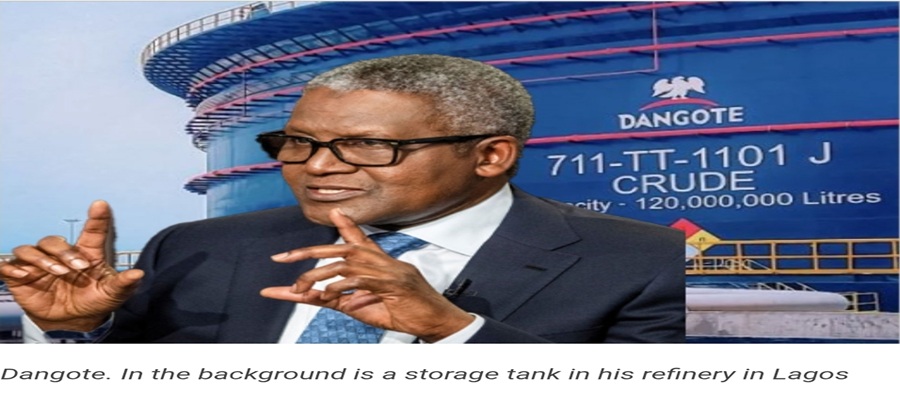
Dangote Petroleum Refinery is reportedly nearing completion of a $2.5 billion private placement that values the company at about $40 billion ahead of its planned public listing.

Private placement is the direct sale of company shares or bonds to pre-selected investors instead of the general public and it is used to raise money quickly while avoiding strict public reporting rules.
People familiar with the transaction said investors acquired as much as 6 per cent of the refinery, according to a BusinessDay report.
The reported terms would value the business at approximately $40 billion.
Neither Dangote Group nor the refinery has publicly announced the final amount raised, the identities of most subscribers or the precise percentage sold.

The figures should therefore be treated as transaction details supplied by unnamed sources rather than confirmed company disclosures.
The reported $2.5 billion total is nevertheless significant as it indicates strong demand for exposure to a privately controlled refinery that has rapidly become central to Nigeria’s fuel supply and an increasingly important exporter of petroleum products.
The placement was said to have attracted more demand than the available shares, allowing the company to secure substantially more than the amount initially associated with the fundraising exercise.
Femi Otedola, chairman, First HoldCo, is the only major participant publicly identified in the report.
He reportedly committed $100 million to the transaction and sold his investment in Geregu Power Plc to finance the acquisition.
Nigeria’s pension industry was also reportedly cleared to participate.
Access to more than $17 billion in retirement assets would broaden the refinery’s potential investor base beyond wealthy individuals and conventional institutional buyers.
Participation by Pension Fund Administrators would, however, require careful attention to valuation, liquidity and portfolio-concentration limits.
Retirement funds must balance the attraction of a large Nigerian industrial asset against their responsibility to protect contributors’ savings.
The implied $40 billion valuation represents investor expectations about the refinery’s future earnings rather than only the physical cost of constructing the facility.
Its ability to process 650,000 barrels of crude daily gives it a central role in supplying Nigeria and other markets, but its commercial performance remains connected to crude availability, product prices, exchange rates and regulation.
The refinery has struggled to obtain all the Nigerian crude it requires under the government’s naira-for-crude arrangement.
It has consequently purchased some feedstock internationally and recently moved local petroleum-product pricing into dollars to align sales revenue more closely with its foreign-currency expenses.
Those constraints will be important during any public offering.
Prospective shareholders will want greater clarity on crude-supply contracts, debt, operating margins, export revenue and the company’s relationship with Nigerian regulators.
It is also unclear whether the private placement involved newly issued shares, a sale by existing owners or a combination of both.
That distinction determines whether the reported $2.5 billion becomes fresh capital for the refinery or proceeds received by selling shareholders.
The transaction could provide a useful price reference for the planned initial public offering.

Federal government will next month launch Nigeria’s first national organized crime strategy to strengthen the country’s response to terrorism, cybercrime, human and drug trafficking, kidnapping, illicit financial flows, and other forms of organized crime.

Major General Adamu Laka, national coordinator of the National Counter Terrorism Centre under the Office of the National Security Adviser, disclosed this in Abuja during the validation of the strategy document.
He said the strategy provides a coordinated national framework for tackling organized crime through improved intelligence sharing, stronger collaboration among security agencies, and closer cooperation with the criminal justice system, civil society organizations, and international partners.
Major General Laka explained that the document was developed through a partnership involving the Federal Government, the United Nations Office on Drugs and Crime (UNODC), the United States Government, and other stakeholders.
Speaking at the event, Cheikh Toure, UNODC representative, said the strategy would strengthen Nigeria’s capacity to combat transnational crimes, including drug trafficking, cybercrime, human trafficking, kidnapping, and illicit financial flows.
Also speaking, Douglas Grane, acting director of the United States Department of State’s Bureau of International Narcotics and Law Enforcement Affairs, reaffirmed the U.S. government’s support for Nigeria’s efforts to tackle organized crime through stronger inter-agency and international cooperation.
Representatives of the National Institute for Strategic Studies, the Nigeria Financial Intelligence Unit, and the National Cyber Security Centre also endorsed the initiative, describing it as a major step towards improving Nigeria’s fight against organized crime.


FATE Foundation, with funding from the Citi Foundation, has launched the Youth Entrepreneurship Incubation Programme to equip young people in Nigeria with financial literacy and entrepreneurship skills.

Delivered through free, safe, and accessible platforms, the programme supports the incubation and scaling of youth-led enterprises, enabling income generation and job creation.
In October 2025, FATE Foundation was selected as a recipient of Citi Foundation’s 2025 Global Innovation Challenge to Accelerate Youth Employability. Joining the cohort of 50 organisations globally, the Foundation will receive $500,000 over two years to advance its youth employability initiative.
“We are excited to be selected for Citi Foundation’s 2025 Global Innovation Challenge,” said Ayomide Akindolie-Igwe, Executive Director of FATE Foundation.
“This support enables us to equip young entrepreneurs in Nigeria with the financial literacy and skills needed to build and scale sustainable businesses.”
The programme addresses youth employability by tackling Africa’s growing jobs crisis. By 2030, the African continent will be home to 40% of the world’s youth, and with one in three under 35 already unemployed, this initiative will support Nigerian youth with a two-phase approach. It begins with financial literacy training before progressing to entrepreneurship development, incubation support, and access to tools needed to build viable, job-creating businesses.
“Through this innovative initiative, FATE Foundation is supporting low-income Nigerian youth to develop essential financial and entrepreneurial skills using accessible platforms.
“This support is not just helping individuals to succeed; it is building a solid foundation for sustainable enterprises that will drive job creation and contribute significantly to our nation’s economic vitality. This initiative is empowering and investing in the future of Nigeria, one youth at a time,” said Nneka Enwereji, MD/CEO Citibank Nigeria Limited.

Dangote Refinery’s Private Placement Reportedly Hits $2.5Bn

FG, UNODC Plan National Strategy against Organized Crime

EFCC Busts NIS Visa Overstay Racket, Uncovers N700m in an Account

CBN to Monitor Every Dollar with FXBT, Forex Tracker

NCC, NDLEA Partner to Fight Piracy and Drug Trafficking

NRC, Ponzi Scheme Collapses Resulting Loss of Billions of Naira

NASENI Moves to Digitize CCB’s 5m Assets Declaration and Operations

Lebara Nigeria Launches Lebara Play, Africa’s First Telecom-Owned Micro-Drama Platform

CANAL+ Partners Samsung to Pre-Load DStv Stream on New Samsung TVs In Nigeria, Other African Countries

Tokenization, Blockchain Technology will Transform Financial Institutions – IMF




 Telecom3 days ago
Helios Towers Secures $29m Facility to Expand Across Africa

 News3 days ago
ValueJet Expands Fleet with Boeing Aircraft, Targets Wider African Network

 E-Financial3 days ago
First Securities Brokers Empowers Nigerians to Trade in the Stock Market with the Launch of FirstInvest App

 Telecom3 days ago
NCC Begins Stakeholder Consultation on MVNO Business Rules

 News3 days ago
Court Orders Final Forfeiture of 48 Properties Linked to Former AGF Abubakar Malami

 Telecom3 days ago
Surge in Fibre Cuts Hobbles Service Provisioning

 Broadcasting2 days ago
NBC Scraps Annual Digital Access Fee on DSO

 News3 days ago
Court Grants Former CCT Chairman Danladi Umar N100m Bail Over EFCC Charges