

Telecom
#AfriTECH2021: Galaxy Backbone Determined to Boost Cloud Infrastructure – Abukakar

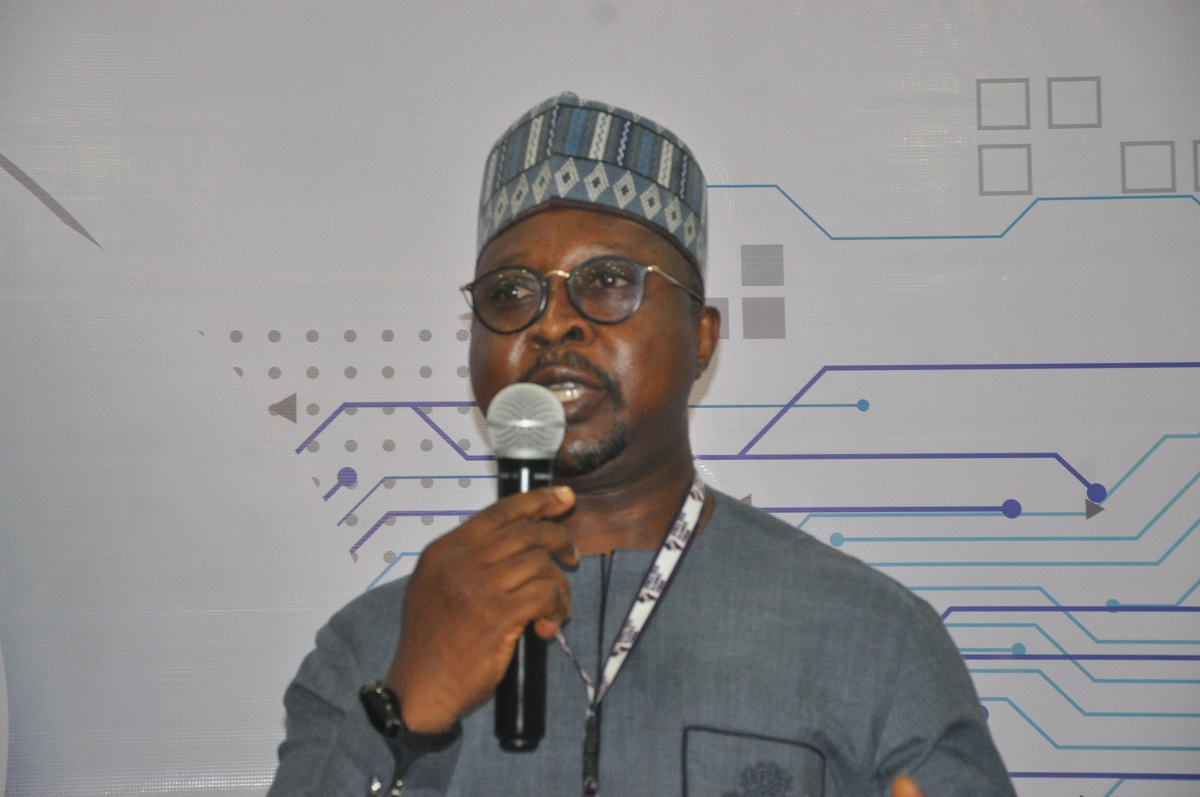
Prof. Muhammed Abukakar, managing Director and CEO, Galaxy Backbone Limited, has expressed the company’s preparedness to provide ICT infrastructure and services to public institutions and the underserved communities in Nigeria.

Timi Fadeyi, head DataCentre at Galaxy Backbone
Galaxy Backbone is a public enterprise of the Federal Government of Nigeria incorporated in 2006 with the primary mandate of setting up and operating a unified Information and Communication Technology (ICT) infrastructure platform that addresses the connectivity, transversal and other technology imperatives for Ministries, Departments and Agencies (MDAs) of the Federal Government.
Abukakar was speaking on ‘Boosting Cloud Infrastructure for Digital Economy via Partnerships’ through a representative, Mr. Timi Fadeyi, head DataCentre at Galaxy Backbone Limited, at the (hybrid) Africa Tech Alliance Forum (AfriTECH2021) organised by TechEconomy.ng in Lagos (Nigeria) recently.
The Managing Director while streamline digitisation aligned with Bill Mcdermott SAP CEO who said: “Complexity is an obstacle to digitisation. To get the most out of the new world of digital business, you have to run SIMPLE.”
The trend of the new world
He said that the trends of the new world include hyper-connectivity, cloud computing, a smarter world and cybersecurity. These can be considered as four pillars necessary to drive digitalisation using infrastructure which will be used to service the community.
The realities of the digital economy as outlined by Abukakar the undeniable facts that digital economy is real and here to stay; “you have to embrace, innovate and thrive through it”.
He told the participants that reimagining your organisation cannot be overemphasised in this era.
“We need to work smarter, faster and simpler – a combination of a hybrid mode of working and harnessing relationships; virtual, physical, both.
“Artificial Intelligence is reshaping value chains, industries, communities, countries and the works entirely. You also need to secure your data; secure your entire digital experience, a combination of technology and you
Accelerators of the digital economy
Continuing, the Galaxy Backbone boss said, “To every action, there’s indeed a reaction. The digital economy keeps growing and transforming”.
Several components influence this growth and Abukakar summarised these thus: “The customer experiment which is driving the changes visible on different platforms; the core business processes on platforms that are smarter, faster and simple; smarter and engaged workforce to prevent different levels of possible disconnections; supplier-partner collaboration has never been this critical for an enhanced digital economy; and cloud harnessed Internet of Things and assets to drive real-time insights and new business initiatives.
He also said that cloud investments must be channeled right to enable an increase in revenue
The cloud and the digital economy
“The cloud is the preferred ‘currency’ for digital transformation and for reducing the initial cost of ICT infrastructure acquisition.
“Cloud computing is gradually reducing the downtime in public service delivery, increasing government and citizen engagement. It enables agility, flexibility, connectedness and the opportunity to scale your business”, he added.
Abubakar noted that with the help of the Ministry of Communities and the Digital Economy led by Prof. Isa Pantami and support from the National Information Technology Development Agency (NITDA) and the National Communications Commission (NCC), Galaxy Backbone is well-positioned to provide ICT infrastructure in a way that both parties — governments, institutions, NDAs among others can benefit.
Meanwhile, he said that the pillars that drive the mission of Galaxy Backbone include; to becoming the leading enabler of digital inclusion in Africa: Provides state of the art digital infrastructure and services for a digital Nigeria; to align its operations with government priorities; promote data sovereignty and security of government data, amongst others.
“Galaxy Backbone improves long-term financial sustainability, customer satisfaction, improve satisfaction, adoption and confidence in digital services
“Enhancing the digital economy through partnership, GBB provides its data services from two major locations including Abuja and Enugu. Data lost at one centre can be recovered at the other. This can be described as a data continuity solution”, he said.
According to Abukakar, data sensitivity determines which data centre to be used. This can be a virtual data centre, computing pool, resource pool; storage resource pool, elastic cloud server, among others.
“Economies of scale is an important factor to be considered that allows you to save a lot while running your own infrastructure,” he concluded.



MTN Nigeria expanded its lead in Nigeria’s fixed broadband market after adding 13,433 subscribers to its fibre-to-the-home service in December 2025. The gains come as smaller providers struggle to retain users amid rising demand for high-speed internet.

Industry data from the Nigerian Communications Commission (NCC) showed sharp subscriber losses among smaller operators.
21st Century Technologies saw its subscriber base fall from 175 in December to 82 in January, a drop of more than 50 percent.
SWIFT Nigeria recorded an even larger decline.
The company lost 11,285 users, with total subscribers falling from 25,484 to 14,199, a 44.3 percent decrease.
The gap between large infrastructure providers and smaller operators is widening as broadband demand grows across Nigeria.
Companies with extensive fibre networks can offer faster speeds and wider coverage, while smaller competitors face higher costs and limited scale.
MTN has accelerated its investment in network infrastructure to maintain its lead.
The company spent ₦1 trillion, or about $715 million, in capital expenditure in 2025, more than double the ₦443.5 billion invested in 2024.
The investment followed a return to profitability, with profit after tax reaching ₦1.1 trillion after losses in 2024 linked to foreign-exchange pressures.
Spending focused on network modernization, 4G expansion, 5G rollout and deeper fibre deployment.
The operator expanded its fibre-to-the-home footprint to about 4 million households, concentrating deployments in Lagos, Abuja, Port Harcourt, Kano and Ibadan as data traffic rose 34 percent.
Network vandalism remains a challenge. MTN recorded 9,218 fibre cuts in 2025, an average of 25 incidents per day, affecting 211 base stations.
Key Takeaways
Nigeria’s broadband market is entering a scale phase where infrastructure investment is becoming the main competitive advantage.
Telecom operators with strong balance sheets are deploying billions of naira into fibre networks to capture demand for high-speed connectivity driven by streaming, remote work, digital payments and cloud services.
Fibre infrastructure also strengthens mobile networks by connecting base stations and improving 4G and 5G performance.
However, the economics of building and maintaining fibre networks remain challenging in emerging markets. Infrastructure vandalism, power supply instability and high deployment costs increase operational risk.
These factors make it difficult for smaller internet service providers to compete with large telecom operators that can spread costs across millions of customers.
As demand for broadband continues to grow in Africa’s largest economy, the sector may see further consolidation, with dominant operators strengthening their market position while regulators face increasing pressure to maintain competition and affordable access to high-speed internet.
credit…. dabafinance.com
Telecom
VDT Communications Achieves Two Prestigious Certifications ISO /IEC 27001:2022, ISO/IEC 27032:2023 Reinforcing its Leadership in Broadband Service Provision

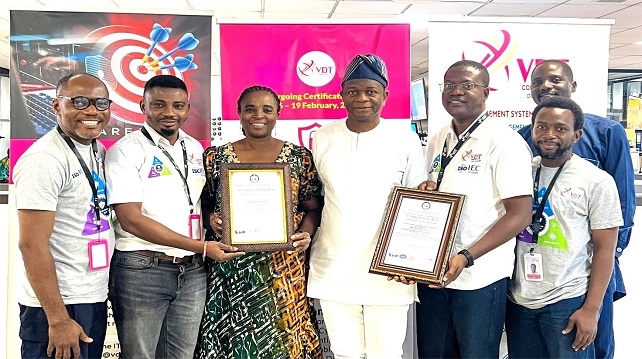
VDT Communications Limited, a provider of Enterprise communication solutions, is proud to announce that it has been awarded the ISO/IEC 27001:2022 Information Security Management System (ISMS) and ISO/IEC 27032:2023 Cybersecurity Management System certifications.

These prestigious certifications demonstrate VDT’s commitment to maintaining the highest standards of information security and cybersecurity, ensuring the protection of sensitive customer data and maintaining the trust of its clients.
These certifications are a testament to VDT’s dedication to implementing robust information security and cybersecurity measures, aligning with international best practices.
The ISO/IEC 27001:2022 certification recognizes VDT’s ability to establish, implement, maintain, and continually improve its ISMS, ensuring the confidentiality, integrity, and availability of customer information. The ISO/IEC 27032:2023 certification highlights its commitment to protecting its customers’ information assets and preventing Cyber threats.
VDT Communications Limited has consistently demonstrated its commitment to excellence, previously earning and maintaining ISO 9001:2015 Quality Management System and ISO 20000-1:2018 IT Service Management certifications. These certifications have enabled the company to deliver high-quality services, ensuring customer satisfaction and loyalty.
“We are thrilled to receive these two prestigious certifications, which reinforce our commitment to information security and cybersecurity. These certifications demonstrate our dedication to implementing robust security measures that ensure confidentiality, integrity and availability of customer data” said Engr. Abiodun Omoniyi, GMD of VDT Communications Limited.
The ISO/IEC 27001:2022 and ISO/IEC 27032:2023 certifications bring numerous benefits to VDT’s customers, including:
- Enhanced information security and cybersecurity posture
- Protection of sensitive customer data
- Compliance with international standards and regulations
- Improved risk management and incident response
- Increased trust and confidence in VDT’s services
“We are proud to serve our customers with the highest level of security and quality,” Bimbo Ikumariegbe, Chief Operating Officer (COO) of VDT. “These certifications demonstrate our commitment to excellence and our dedication to delivering innovative communication solutions that meet the evolving needs of our customers” – Olufemi Akinola, Head, Information Technology.
Nigeria Data Protection Commission (NDPC) has issued a stern warning to content creators filming and sharing videos of unsuspecting citizens on social media, describing such practices as direct violations of citizens’ rights to informational self-determination.

NDPC
The Commission drew attention to individuals capturing pictures and footage of the general public without consent, breaching Section 37 of the 1999 Constitution of the Federal Republic of Nigeria (as amended) and the Nigeria Data Protection Act, 2023 (NDP Act).
NDPC specifically flagged a content creator in Lagos State who films unsuspecting passersby at roadsides for a “reality show”. The Commission stressed that processing personal images in this manner demands explicit consent or a justifiable lawful basis under the NDP Act.
Preliminary investigations revealed no public or legitimate interest served by this “wilful invasion of privacy”. Data subjects, the Commission noted, have no reasonable expectation that their images would be captured and broadcast globally by an unknown individual.
National Commissioner/CEO Dr Vincent Olatunji has instructed social media platform owners—including TikTok, X (formerly Twitter), and Meta—to intensify enforcement of community guidelines to prevent harm from unlawful and unfair personal data processing.
Platforms failing to act promptly face sanctions under the NDP Act. Individual creators remain personally liable for violations, potentially facing criminal prosecution for infringing citizens’ and data subjects’ privacy rights.
The advisory was signed by Babatunde Bamigboye, Esq. CDPRP, Head of Legal, Enforcement and Regulations.
NDPC emphasised that abuse of rights under the guise of entertainment will not be tolerated, urging compliance to safeguard Nigerians’ data privacy in the digital age.

Tech Expert Unveils BAT-BOT AI App to Curb Fake News ahead of 2027 Elections

MTN Nigeria Races Ahead in Fibre Broadband Market

CBN Tightens BVN Rules to Curb Fraudulent Banking Transactions

Nova Bank Appoints Jude Anele as Managing Director/CEO

CBN Rolls Out New Rules for Safer Instant Payments, More Customer Control

Kaspersky Discovers New Phishing Campaign Exploiting Google Tasks Notifications to Steal Corporate Credentials

esentry 2025 Report Shows Healthcare, Financial Services and Telecoms as Staging Grounds for Increased Cyberattacks in Africa

AfDB, UNDP Launch $10Bn AI Initiative for Africa

Mutual Benefits Assurance Settles ₦5.9bn Claims in January 2026

Pheelz Shares His Journey on Glo-Sponsored African Voices




 General News3 days ago
Interswitch Advocates Trust-Driven Infrastructure as Cornerstones of Africa’s Cross-Border Capital Future

 News3 days ago
NLNG Advances Media Excellence with Change Your Story Workshop

 E-Business3 days ago
Why JustMarkets Is a Strong Choice for Gold Trading

 E-Financial3 days ago
CBN Orders Banks to Restrict Access to Banking Services for Loan Defaulters

 E-Financial3 days ago
UBA Business Series Celebrates ‘Gen.W: The Evolved Woman’ in Push for Female Empowerment

 Telecom3 days ago
NDPC Warns Content Creators Against Privacy Violations in Viral Videos

 General News3 days ago
FCCPC Launches Fuel Price Surveillance, Probes Airline Price Gouging, Resolves N10bn Complaints

 Telecom2 days ago
VDT Communications Achieves Two Prestigious Certifications ISO /IEC 27001:2022, ISO/IEC 27032:2023 Reinforcing its Leadership in Broadband Service Provision