

E-Business
#AIT2015: NCS Ogun Passionate about Applied Computing Knowledge- Onashoga

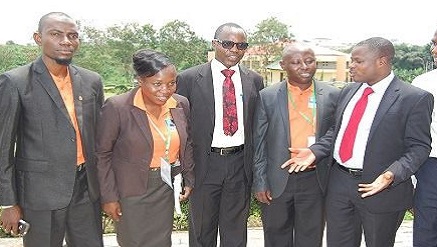
Dr Bukola Onashoga, chairperson, Nigeria Computer Society (NCS), Ogun State Chapter, has reiterated the Chapter’s interest in promoting applied computing knowledge in the country.
She made the remark at the first international conference on Applied Information Technology (AIT), hosted by the duo of Nigerian computer society Ogun State chapter and the department of Computer Science FUNAAB.
Onashoga said that, NCS Ogun State chapter is the only recognized chapter that sets the pace for others to follow and highly committed to actively enabling the environment with the knowledge of information technology.
“Our vision has always been to impact the knowledge in all sectors. The department of Computer Science at FUNAAB is also known for building standard in the academic world of computing. The department is recognized for research-oriented focus that contributes positively to the growth of industry. The result of the combination of these two bodies is what we witnessing here today.
On the conference tagged AIT 2015, she said, was met to educate participants on the utilizing advance information technology to make better decision in education, health, government, business etc. “just to mention few as well as discuss the expanding needs and technological opportunities in industries. The main focus of this gathering is to allow both professionals and academics to focus on the high valued benefits of information technology”.
She said that the Conference focused on research works on chosen fields meant the major objectives to gather together high potentials researchers that deliberate on the solution of information technology.
“We will not sit here to be burdened by theoretical constructions in computing but to have a sense of conversion of theory to application with full concentration on the emerging technologies for these application.
“This year theme, ‘Emerging trend in Applied Computing’ is dedicated to facilitating increase opportunities for cross fertilization across computer science and other discipline. Increasingly, computer science is the driving force for advances and breakthrough in other fields. Virtually all sub-fields of applied computing involve the use of computer science methods as building block to solve problems in different application domains. So, we cannot overrule these methods in most of the researches in applied computing”.
On his part, Professor Adio Akinwale, chairman, Local Organizing Committee, recalled that the event was the culmination of an enormous collective effort which has begun at the beginning of 2014/15 academic session
“When Dr Simon Adesina Sodiya, former Acting Head of the Computer Science Department and Dr. Mrs Adebukola Onashoga, the present Chairman of Ogun State Chapter of the Nigeria Computer Society brought the idea to the department.
“From that moment, staff members of the two units have been contributing in one form or another towards the organization of this conference”.
Akinwale described the conference as timely and very relevant in the present state of the nation’s information technologies.
“Moreso, the entire world is more closely linked together by the means of information technologies…This interaction among computer scientists is a clear vision for this conference and the interaction of computer scientists with other disciplines is now largely accepted as a mean of developing of information technologies. Our presence lies primarily on the fact that the theme of the conference is emerging trends in applied computing which has been respected as “gateway to information technology”.
“We need to work hard as computer scientists to keep pace with the development of information technology and strive to make greater contribution to its progress”.
Earlier in an address, Prof. O. B. Oyewole, vice-chancellor, Federal University of Agriculture, Abeokuta, noted that FUNAAB is known for knowledge for development and the focus of AIT 2015 is emerging Trends in Applied Computing was apt.
He called on participants to explore the rich components of the “AIT 2015 Conference” and the necessary positive contributions towards the success of the nation’s academic and economic development.
Oyewole further charged IT experts to develop strategies to uncover issues within the particular input areas like especially Tele-Medicine and e-health, Educational technologies, E-Government, etc.
“We need not over emphasize the innovative use of information technology to provide low-cost solutions that have gone a long way to support strategies in different areas and helped in advancing the world economy. The “AIT 2015 Conference” has opened a window for researchers within and outside computing to adapt to this paradigm”.


Nigerian Data Protection Commission (NDPC), has expressed its commitment to balance information around data privacy and protection.

Dr. Vincent Olatunji, national commissioner, NDPC, stated this in Abuja, at the National Data Privacy Summit with the theme, “Privacy in the Era of Emerging Technologies,” organised by the commission.
Olatunji said the NDPC, at the moment, was looking at balancing information around data privacy and protection.
“What we are doing is just to look at how to balance information around privacy and protection, which is really important, because as we are innovating, at the same time, we have to consider issues around privacy and protection,” he stated.
He added that the commission has been very bold in taking risks that would bring about growth.
“Our starting point is growing at a very alarming rate, and we are not afraid of anything. We can take risks. And that is why a lot is happening in Nigeria, and this is the level of clarity,” he explained.
In his address, Dr. Aminu Maida, executive vice chairman (EVC) of the Nigerian Communications Commission (NCC), stated that Internet of Things holds promise for Nigeria’s economy.
The EVC, who was represented by Abraham Oshadami, executive commissioner, Technical Services (ECTS), noted that, “in an era in which digital assets, Internet of Things, future digital computing and other transformative technologies are key, and both a cornerstone of building trust for the adoption and a prerequisite for sustainable progress.
“Emerging technologies hold immense promise for Nigeria’s grand economy, but they also introduce complex risks to personal and individual rights.
“So, balancing innovation through post-ethical safeguards and public trust is the first step to ensuring that global digital advancement benefits all Nigerians without compromising their privacy or their security,” he added.
“As we just heard from the Nigeria Police, telecom operators have a vast amount of sensitive historical information daily, including connectivity apps and collaboration on privacy, security, and number protection, both to their and their inheritors,” he said.
Dr. Bako Shurkuk, commissioner for Science, Technology and Innovation, Plateau State, who represented Caleb Mutfwang, Governor of Plateau State, said, emerging technologies can be harnessed to attain sustainable growth.
E-Business
OADC Lagos Reinforces Commitment to Local Data Hosting and Digital Transformation @ NDPC’s National Privacy Week Summit

Open Access Data Centres (OADC) Lagos has reaffirmed its commitment to Nigeria’s data protection and digital transformation agenda through its sponsorship and active participation in the Nigeria Data Protection Commission’s (NDPC) National Privacy Week Summit.

The National Privacy Week Summit, organised by the NDPC, convened policymakers, regulators, technology providers, and industry stakeholders to promote data privacy awareness, strengthen compliance with the Nigeria Data Protection Act (NDPA), and advance conversations around data security, sovereignty, and responsible data governance.
As a sponsor of the event, OADC Lagos demonstrated its continued support for the Federal Government’s drive toward local data hosting and data domiciliation, which are increasingly critical to safeguarding sensitive information, enhancing regulatory compliance, and building trust in Nigeria’s digital economy.
Through its carrier-neutral, Tier III Design certified data centre in Lekki, Lagos, OADC provides secure, resilient, and compliant infrastructure that enables government institutions and private sector organisations to host and manage data locally while meeting international best practices.
Commenting on the engagement, Adesola Adesugba, Country Marketing Manager, Open Access Data Centres Nigeria, said: “We are proud to have supported the Nigeria Data Protection Commission through the National Privacy Week Summit and to stand alongside the government in advancing Nigeria’s digital transformation objectives.
“Strengthening local data hosting and domiciliation is fundamental to national data sovereignty, improved security, and sustainable digital growth, and OADC Lagos remains committed to enabling this future.”
OADC’s participation at National Privacy Week Summit underscores its role as a trusted digital infrastructure partner to government and enterprise, supporting secure cloud connectivity, regulatory compliance, and the long-term development of Nigeria’s digital ecosystem.
Open Access Data Centres is part of the WIOCC Group and operates open-access, world-class data centres across Africa, serving cloud providers, network operators, enterprises, and public sector institutions.

Kaspersky’s new online tool has been specially developed for industrial organisations to assess the potential costs associated with insufficient operational technology (OT) security.

By offering detailed financial forecasts, the calculator empowers senior management to make well-informed decisions regarding security investments.
Industrial organisations increasingly depend on interconnected systems, elevating cybersecurity to a critical factor in business resilience and profitability.
According to VDC Research, over 60% of industrial companies last year reported that cybersecurity breaches had led to significant costs. Despite this, a persistent disconnect remains between security teams and executive leadership as security professionals focus on minimising risk, while executives must balance cybersecurity concerns with broader business objectives. This misalignment often results in competing priorities and underfunded security initiatives.
To bridge this gap, Kaspersky has launched the OT Cybersecurity Savings Calculator, an innovative online tool designed specifically for industrial organisations to assess the potential costs of inadequate operational technology (OT) security¹.
The primary aim of this tool is to translate cyber risks into tangible financial metrics and support strategic discussions around priorities and budget allocation. By entering details such as their sector, sub-sector, region, company size, breach history, and existing cybersecurity measures, organisations can estimate their potential cost savings and receive customised, actionable recommendations.
The calculator benchmarks performance against industry peers and highlights the company’s position within the current threat landscape.
“We believe this calculator is a powerful resource for transforming complex cyber risk data into straightforward financial insights. It enables OT leaders, security professionals, and executive teams to develop clear, data-driven business cases and recognise the value of cybersecurity investments. With actionable guidance, it promotes a comprehensive approach to resource management and strengthens overall organisational resilience,” comments Andrey Strelkov, Head of Industrial Cybersecurity Product line at Kaspersky.

Majority of Nigerians do not Trust Govt with Tax Revenue – SBM

NDPC Commits to Balancing Data Privacy, Protection Information

Why FirstBank Wrote off N748Bn Bad Loan – Otedola

Unity Bank Unwraps Mobile App to Deepen Digital Banking Experience

FG Partners World Bank, AfDB on Climate Action

19 Nigerian Banks Meet CBN Recapitalization Targets Ahead of March Deadline

Youth Talent Takes Center Stage as T2 Ignites High-Octane Rap Battles @ Carnival Calabar

Aig-Imoukhuede Foundation Wrapped Up 2025 with Real Change in Governance, Health, Media Across Africa

Showmax Unlocks Easier Payments for Nigerian Subscribers via Baxi

Nigerian Terra Industries Secures $11.8m for Expansion




 E-Financial2 days ago
Accidental Billionaire Opts for Jail Instead of Returning Money Credited Him by Mistake

 News2 days ago
US Set to Deport 79 Nigerians on Criminal List

 News2 days ago
Ungoverned AI is Quietly Scaling Risk in Nigeria – Dr. Naiho

 E-Financial2 days ago
SEC Warns of Potential Ponzi-style Risks in AURUM BOT, ModMount

 Telecom2 days ago
Airtel Nigeria Commits to Boosting Nigeria’s Digital Infrastructure

 E-Business1 day ago
OADC Lagos Reinforces Commitment to Local Data Hosting and Digital Transformation @ NDPC’s National Privacy Week Summit

 Telecom2 days ago
Google, African Partners Launch WAXAL to Empower 100m Africans in AI Era

 News2 days ago
First Lady Commissions Dream Centre @ OAU