

Broadcasting
AMAA-StarTimes Short Film Festival Empowers Local Filmmakers


This year the African Movie Academy Awards (AMAA) has partnered with StarTimes, the biggest pay-tv company in Nigeria, hosted the AMAA-StarTimes Short Film Festival (The Shorts).

The Event is organized to motivate young and promising filmmakers on the African continent by providing a bigger platform for talented young people to succeed.
The festival has shortlisted over 200 short films. Selected from over 500 entries across Africa, the short films were aired daily on the ST Nollywood Plus channel on StarTimes at 8 pm. The pay-tv company has also added the films on the StarTimes-ON mobile app to run throughout the festival period.
Recently in June, StarTimes, in partnership with The Africa Movie Academy Awards (AMAA), rewarded outstanding short filmmakers across Africa. Held in Lagos, the award ceremony had industry experts in attendance, including Femi Odugbemi, Tunde Kelani, Peace Anyiam-Osigwe of AMAA, Femi Adebayo, alongside StarTimes team led by CEO, Alex Jian, and content Director, Viki Liu.
Edmond Tawale from Uganda emerged winner of the special prize for a documentary with the movie titled Ateker. Edmond got prize money of $1000.

The outstanding short film winners are Frank Abasiekong from Nigeria as 2nd runner-up for his short film titled Room 10; Frank Dzikonu from Ghana as 1st runner-up for his animation movie titled Sad Story of Kojo; while Enobong Nkanta from Nigeria emerged as the winner for his short film titled Mama’s Song. The 2nd runner-up got $1000, the 1st runner-up got $2000 and a mobile phone; while the winner got $3000 and a laptop.
Speaking at the Award ceremony, Peace Anyiam-Osigwe, Founder of AMAA said, “I’m delighted with this initiative to reward our young filmmaker and happy with the synergy StarTimes is having with the movie industry. Filmmakers need to understand the process of filmmaking.
We approached StarTimes for partnership and StarTimes is willing to help us nurture these resourceful people. We have to clear the stage for young and upcoming filmmakers. If we catch them young and structure them properly, it will help the growth of having better films being made along the way.”
Also speaking, the CEO of StarTimes, Alex Jian said, “We are here to award excellence, creativity, hard work, and originality. It’s our goal to provide a bigger platform for talented young people to succeed on their dream roads. StarTimes has been deeply engaged with Nollywood since last year, starting with the production of Ile Alayo Season 1, a great work directed by our friend and ambassador Femi Adebayo.
During the process, we noticed the great potential of the whole industry, and we are surprised by many young content creators. They are passionate, hardworking, and full of inspiration.
As a Pay-TV platform rooted in Africa, StarTimes aims at providing the best content to its audience. And we are very willing to support content creators in all kinds of ways because when they grow, the industry grows; if they succeed, we succeed.”


National Broadcasting Commission (NBC) and the Independent National Electoral Commission (INEC) are set to introduce a joint broadcast monitoring framework ahead of the 2027 general elections as part of efforts to curb unethical broadcasting and promote responsible election coverage.

Charles Ebuebu, director-general, NBC, who disclosed the plan recently, said the collaboration would strengthen election monitoring through the deployment of advanced technology and closer coordination between regulatory agencies.
According to him, the increasing influence of digital and online platforms has made it imperative for regulators to work together rather than operate independently.
“We have written to INEC, and we are going to have a joint monitoring outlook over the elections. Gone are the days when agencies work in silos. When we coordinate, we’re able to monitor more effectively,” Ebuebu said.
He explained that the partnership would enable both agencies to jointly identify and address violations of broadcasting regulations during the election period instead of handling such issues separately.
Beyond INEC, Ebuebu said the NBC is also partnering with other key regulators to strengthen oversight of election-related content across digital platforms.
According to him, the commission is finalising agreements with the Nigerian Communications Commission (NCC) and the National Information Technology Development Agency (NITDA) ahead of the polls to reinforce its monitoring capabilities.
“We are calling in other stakeholders to reinforce the election monitoring. We are signing agreements with the Nigerian Communications Commission and the National Information Technology Development Agency before the elections,” he said.
Ebuebu also revealed that the NBC is upgrading its monitoring infrastructure with artificial intelligence (AI)-powered tools to keep pace with the rapidly expanding media landscape.
He noted that the proliferation of online platforms has made traditional monitoring methods inadequate.
“With online platforms, there are thousands of them. You need more than staff; you need AI monitoring facilities,” he said.
The NBC chief added that the commission has significantly improved its monitoring capacity and can currently track nearly 50 broadcast channels from its monitoring centre in Abuja.
He said additional monitoring facilities would be established across the country in line with evolving broadcasting technologies.As part of preparations for the 2027 elections, Ebuebu announced plans for a sensitisation workshop in Ibadan that will bring together broadcasters, INEC officials, security agencies and other stakeholders.
He said the engagement had become necessary as political discussions surrounding elections continue to grow more heated, including on television, stressing the need for broadcasters to adhere to professional standards.
Ebuebu noted that the commission has had to issue several warnings to broadcast stations for violating the broadcasting code during election periods.
“We have had to write several of them because they simply forget what the code says,” he said
Mrs. Clementine Wamba, head, Digital Switch Over (DSO) at the National Broadcasting Commission (NBC), has stressed the need for broadcasting stations and practitioners nationwide to work towards meeting the 2028 global deadline for the switch over.

She made the call in her presentation titled, “DSO Big Picture: Free TV Audience Measurement and the Evolving Media Landscape”, at the 2026 NBC South West Summit held in Ibadan.
Wamba harped on the need for practitioners to adopt DSO in the transmission of news and other programmes in order to meet future challenges, stating that any country that fail to align with the DSO by 2028 will be shut out of practice.
This development, according to her, may result in job losses and other consequences that could hinder the growth of the industry in Nigeria, noting that Free TV is tailored towards the DSO, with provision for many channels in contrast to the age-long analogue system.
According to her, “The Digital Switch Over is a technological improvement on the age-long analogue style of broadcasting in the country. With the adoption of the DSO, practitioners will be in tune with global practice of broadcast journalism.
“Also, its benefits include efficient use of spectrum, changing of industry landscape, more access to national development programmes and better viewing experience.”
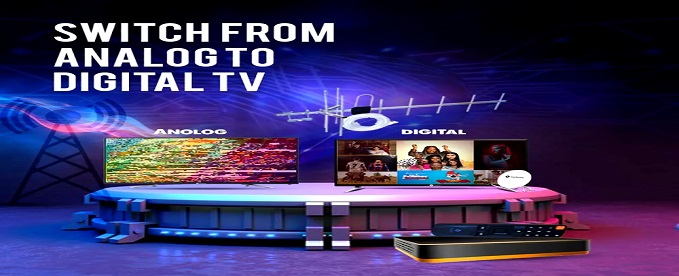
National Broadcasting Commission (NBC) has said that Nigerians will no longer pay annual Digital Access Fees under the renewed Digital Switch Over (DSO) project.

Charles Ebuebu, director-general, NBC, disclosed this in an exclusive interview with the News Agency of Nigeria (NAN) on Wednesday in Abuja,
Ebuebu said viewers only need to purchase an approved decoder and satellite dish which cost below N20,000 to enjoy free television permanently.
“Previously, users paid an annual digital access fee of about N1,500, described as an administrative charge.
“The new system removes that annual fee. It provides free access to free-to-air television channels without any payment.
“Premium channels will be introduced later. Viewers who want those additional channels will be able to access them through paid services.
“Nigerian content on free-to-air channels remains free to watch. Unlike Pay TV, this platform does not require monthly subscriptions for its basic service,” he said
Ebuebu said approved decoders for the FreeTV will cost less than N20,000 and authorised sales outlets will soon be announced.
He urged Nigerians to wait for official information on approved dealers for the DSO decoders, warning that unauthorised sellers are exploiting growing public demand.
He reiterated that people only need a free-to-air decoder, along with a satellite dish instead of the old antenna system to receive the DSO signal.
“Once the equipment is installed, viewers can access all available channels across the country without paying any subscription fees,” he stressed
The DG dismissed claims by some retailers that there are different categories of decoders sold at varying prices, stressing that such sellers are not authorised by the commission.
According to him, the NBC will soon publish the list of approved dealers, official prices, and locations where genuine decoder boxes and accessories can be purchased.
The NBC boss said the DSO project is designed not only to improve television broadcasting but also to stimulate economic growth by creating jobs, attracting investment, and opening up opportunities for businesses that support the broadcasting industry.
Ebuebu noted that content producers and broadcasters stand to benefit significantly from the nationwide reach of the DSO platform.
Unlike the previous system, where many stations had limited regional audiences, he said the new platform will make their channels available to viewers across Nigeria.
He added that the introduction of audience measurement technology will provide scientific and reliable data on television viewership.
Ebuebu added that audience measurement technology will give advertisers greater confidence in placing adverts and enable broadcasters to demonstrate the true size and reach of their audiences nationwide.

NPC Opens Nationwide Digital Birth, Death Registration Platform

FG Launches C.L.I.C.K.D., Consumer Credit Scheme for Tech Devices

Airtel Nigeria Expands Retail Footprint to Strengthen Customer Access Nationwide

Ovaloop Technologies Unveils Digital Tools to Formalize SMEs Operations Across Africa

Kaspersky Survey Highlights the Need for Smartphone Security

NRC, Ponzi Scheme Collapses Resulting Loss of Billions of Naira

NASENI Moves to Digitize CCB’s 5m Assets Declaration and Operations

Lebara Nigeria Launches Lebara Play, Africa’s First Telecom-Owned Micro-Drama Platform

CANAL+ Partners Samsung to Pre-Load DStv Stream on New Samsung TVs In Nigeria, Other African Countries

Tokenization, Blockchain Technology will Transform Financial Institutions – IMF




 E-Financial2 days ago
Access Holdings Sells 7.44% Stake in Ghana Unit

 News2 days ago
Adebutu, PDP Chieftain Accuses Nigerian Governors of Embezzling LG Allocations

 E-Financial2 days ago
NDIC Urges Youths to Shun Ponzi Schemes, Embrace Savings

 News2 days ago
NIMASA Unveils Accelerator Scheme to Drive Innovation, Sustainable Growth

 E-Financial2 days ago
NRS Issues July 31 Deadline for e-Invoicing Compliance

 E-Business2 days ago
SERAP to Sue NASS over Bill Empowering NDPC to Regulate Social Media

 News2 days ago
eBusinessLife Advocates Greater Support for Girls in ICT as Students Showcase AI Innovations

 News2 days ago
ICPC Secures Final Forfeiture of N941m Linked to IPPIS Fraud