

/home/kenneth/web/nigeriacommunicationsweek.com.ng/public_html/wp-content/themes/zox-news/parts/post-single.php on line 153
">
Warning: Undefined array key 0 in /home/kenneth/web/nigeriacommunicationsweek.com.ng/public_html/wp-content/themes/zox-news/parts/post-single.php on line 153
Warning: Attempt to read property "cat_name" on null in /home/kenneth/web/nigeriacommunicationsweek.com.ng/public_html/wp-content/themes/zox-news/parts/post-single.php on line 153
Big Data: Fraud, Finances

Financial institutions have been working hard to implement technologies which better protect them and their customers.
Innovations such as chip and PIN have made cards more secure, while the introduction of two-factor authentication has also greatly helped.
However, none of these systems are perfect and fraud levels continue to rise in many countries.
Fortunately this is an area where big data can make a significant difference.
Fraud detection relies upon the use of both relational data and non-relational data – structured and unstructured data.
Banks know where our home branch is and they know within a standard range of incidences how often we take out money or use our cards.
They know where we work and the types of transactions we make most commonly. These known quantities form part of the fraud detection process.
The unpredictability of humans….
But the nature of human beings is that we do not always stick to the path most travelled. Consider a man buying an engagement ring. This is a perfect example of something which many people may only ever do once in their lives.
Looked at in terms of that data point it appears to be an entirely random act.
A man on the hunt for an engagement ring may never even have set foot in a jewellers shop in his life.
He will almost certainly have never spent a month’s wages on a single item of jewellery. In the world of data analysis such screaming anomalies should be cause for concern.
So why are more people not challenged when making this kind of transaction? Because it is incumbent upon banks not to leave us frustrated or without cash in our hour of need.
The man buying an engagement ring may have enough on his mind without having his card declined at the point of sale. For every transaction, a bank or a card issuer is dynamically analysing data and weighing up the risk of fraud.
The key lies of course in big data.
There are many types of data, unrelated even to the individual which can quickly be referenced – in split seconds thanks to the power with which big data is processed – from data relevant to that individual, such as past travel habits, to data relevant to the nature of the suspect transaction.
Patterns of where fraud has been conducted and past behaviours of the rightful card owner are a key element in detecting and predicting fraud, to the extent that diverse frauds can be traced quickly back to specific businesses where a rogue employee may be stealing card numbers or cloning cards.
Banks now have that reservoir of data related to fraudulent activity and quickly assess the likelihood of transactions being suspect.
Back to our hopeful man shopping for an engagement ring, he may go unchallenged because that reservoir of data shows that very few fraudsters try to conduct card fraud in jewellery shops. This may be because of high levels of CCTV coverage in such shops.
…is actually quite predictable
Believe it or not, the apparently unusual purchase of engagement rings is actually fairly predictable. Somebody may never have bought an engagement ring before, but his card issuer may see from his profile that he fits the bill of somebody due to.
A recent mortgage, an increased focus on saving, a second name appearing on a credit card, an expensive holiday in contrast to the budget breaks or golf holidays he has been on with his friends in the past, regular outlay on home furniture which suggests he is setting up home with somebody, a move from a sporadic expenditure on food to a more structured approach which suggests more nights in at home, less time spent in bars, more time in restaurants.
These are all behaviours which become powerful data points in the overall modelling of customer profiles.
He may think his purchase of an engagement ring is extraordinary and a huge step but his bank – or at least the data it holds – may have been able to tell it was coming for some time.
Ultimately, data has the ability to look at us dispassionately and non-judgmentally. We may think it outrageous that we celebrate a birthday once a year by spending over the odds on dinner at a fancy restaurant we’d never normally visit on any other day of the year.
But if this is something we only do once a year then the data barely needs to be sweated to find an answer as to whether this is fraudulent behaviour.
Once per year may seem occasional to us, or even out of character, because it is at odds to the way we behave on the other 364 days of the year, but the data sees a creature of habit.
It knows it’s our birthday – not least because our date of birth is among the relational data held about us. That fact can easily be linked to any spike in spending on that date.
Even our one-off purchases are almost certainly not as one-off as we think. Most people exercise a degree of financial caution and display behaviours our banks will be able to understand from the data they collect and analyse.
We may only buy one engagement ring in our lives but the money spent on that engagement ring will almost certainly be within a predictable parameter based on our salary, our regular outgoings and the value of our mean and median purchases and the statistical outliers we will have created with purchases such as a car or a house.
All of this means that the vast majority of our spending is reassuringly predictable.
The insights into our behaviour that big data analysis brings about provides a clear benchmark against which fraudulent activity can be rapidly identified and shut down.
Adebayo Sanni is country director at Oracle


Warning: Undefined array key 0 in /home/kenneth/web/nigeriacommunicationsweek.com.ng/public_html/wp-content/themes/zox-news/parts/post-single.php on line 493
Warning: Attempt to read property "cat_ID" on null in /home/kenneth/web/nigeriacommunicationsweek.com.ng/public_html/wp-content/themes/zox-news/parts/post-single.php on line 493


LG Electronics has reinforced its commitment to gender inclusion and women’s empowerment with the successful hosting of its 2026 Women’s Month event, themed “Women Who Power Progress,” at its Lagos office.

The event brought together accomplished women from diverse industries for a thought‑provoking panel discussion that explored their personal journeys, career-defining moments, and the inspiration behind their success in traditionally male-dominated and highly competitive fields.
The distinguished panel featured award‑winning filmmaker Mrs. Biodun Stephen, Mechanical Engineer Engr. Adeola A. Adeleke, Interior Design Leader Dr. Jennifer Chukwujekwe, and MEP Engineer Engr. Moyosore Onabolu. The session was expertly moderated by actress and entrepreneur Blessing Obasi‑Nze, who guided candid conversations around ambition, resilience, and purpose.
Throughout the discussion, panelists shared compelling stories of perseverance, the challenges they overcame, and the values that shaped their professional paths. They also offered practical advice to women navigating their careers, emphasizing the importance of resilience, continuous learning, self-belief, and mentorship as key drivers of long-term success.
A major highlight of the event was the keynote address delivered by Engr. Dr. Funmilade Akingbagbohun, the first female National Chairman of the Nigerian Institution of Mechanical Engineers (NIMechE), Mechanical Engineer, and STEM Advocate. Her keynote address tagged “Women Building, Fixing, Innovating, and Powering the Future of Technology,” delivered a compelling call to action for women, organisations, and society at large.
“Women are building, fixing, innovating, and powering the future of technology. As we mark International Women’s Day, my call to action is simple but urgent: rise, build, break barriers, and lift others along the way,” she said.
“To organisations like LG Electronics, continue to foster inclusive environments where women can thrive, lead, and innovate. To every woman here, be bold, pursue excellence, and never underestimate your potential. To the next generation, embrace STEM careers with confidence and courage. And to all of us, support one another because success is more meaningful when it is shared.”
“While we celebrate progress, we must acknowledge the challenges that still exist, from gender stereotypes and underrepresentation in leadership to the pressure of balancing multiple roles. Yet today’s woman is competent, resilient, and visionary. We are no longer waiting for opportunities; we are creating them, claiming them, and excelling in them. When women rise, organisations grow, and society progresses. There is no limit to what we, as women, can accomplish.”
Speaking at the event, the Managing Director of LG Electronics, Mr. Hyoung Sub Ji, underscored the company’s belief in the transformative power of inclusion.
“At LG Electronics, we believe that empowering women is not just a social responsibility, it is a catalyst for innovation, growth, and sustainable progress. Creating platforms where women’s voices and experiences are celebrated is essential to building a more inclusive future,” he said.
Held in a vibrant and engaging atmosphere, the event also provided a valuable networking platform for attendees to connect, celebrate achievements, and exchange ideas in a relaxed and inspiring environment.
In line with the broader International Women’s Day theme, “Give to Gain,” LG Electronics used the occasion to reaffirm its belief that investing in women strengthens communities, organisations, and society at large.
Through initiatives like “Women Who Power Progress,” LG Electronics continues to champion diversity and inclusion, celebrating women who are not only breaking barriers but actively shaping the future and powering progress across industries.

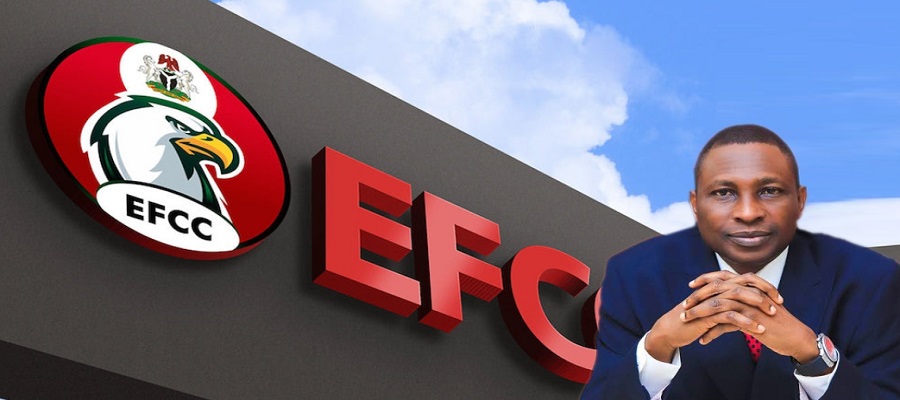
Economic and Financial Crimes Commission (EFCC) has warned of rising cryptocurrency-related crimes, revealing that illicit digital currency transactions exceeded $160 billion globally in 2025.

Ola Olukoyede, chairman, raised the concern during the inauguration of the United Nations Office on Drugs and Crime Country Programme for Nigeria (2026–2030) in Abuja.
Olukoyede, warned that digital currencies such as Bitcoin are increasingly being exploited by criminal networks to move funds across borders undetected.
According to him, advances in technology, weak regulatory frameworks, and gaps in global financial systems have created fertile ground for cyber-enabled financial crimes.
The anti-graft agency boss stressed that tackling cryptocurrency crime required coordinated national strategies, stronger institutions, and intelligence-driven enforcement.
According to him, the new UNODC programme comes at a critical time when Nigeria and the global community are facing growing threats from organised crime, cybercrime, and illicit financial flows.
Olukoyede described the initiative as a strategic platform to strengthen the rule of law, improve the criminal justice system, and protect citizens from financial and violent crimes.
Musa Aliyu, chairman of the Independent Corrupt Practices and Other Related Offences Commission (ICPC), in his comments, called for stronger inter-agency cooperation.
Aliyu said Nigeria faced interconnected threats, including violent extremism, smuggling, organised crime, and illicit financial flows, warning that no single agency could address them alone.

Dangote Petroleum Refinery and Petrochemicals (DPRP) has debunked recent circulation of unauthorised information regarding a potential Initial Public Offering (IPO).

In a statement, DPRP noted that several online platforms and unofficial sources have published unverified, and in some instances inaccurate, information relating to a potential offering.
“Such reports do not originate from DPRP and should be treated with caution. All official updates regarding any potential transaction will be communicated strictly through DPRP’s formal public disclosures and announcements issued by its appointed advisers, in line with applicable laws and regulatory requirements.
“Accordingly, the public, investors, and all market participants are strongly advised to disregard speculative commentary and rely solely on verified information formally issued by DPRP or its authorised representatives,” the statement said.
The firm assured stakeholders that, when appropriate, comprehensive, and accurate details regarding any proposed transaction will be made available through official channels, including regulatory filings, authorised press releases, and coordinated communications by the Enterprise and its appointed advisers.

LG Electronics Celebrates Women Who Power Progress @ 2026 Women’s Month Event

EFCC Waxes Worriedly over $160Bn Crypto Crime Losses

Dangote Refinery Debunks Speculations on IPO

FG Awards N50m Each to 45 Students under S-VCG

NGX REGCO Fines 5 Firms N291m for Market Manipulation

Spotify’s Loud & Clear Report Reveals Over ₦60Bn Revenue for Nigerian Artists in 2025

Madonna University Taps Tech Guru Adote for Strategic Board Role

China Threatens to Shut Nigeria’s Satellite Over $11.44m Unpaid Debt

Jumia Tech Week 2026 Begins with Tech Deals on Smartphones, Electronics, and Everyday Technology

FCCPC Bans Lagos ‘No Refund’ Policy, Vows Fines and Shutdowns for Traders




 E-Financial2 days ago
CBN bars large‑ticket loan defaulters from banking services in tough new crackdown

 General News2 days ago
ARN Rejects Medical Bill over Attempt to ‘Scrap’ Profession

 Telecom2 days ago
NIGCOMSAT Supports Startups Growth with the Launch of Accelerator 3.0

 News2 days ago
Meningitis Kills a Quarter Million People a Year -Study

 Telecom2 days ago
FG Unveils Digital Economy Research Fund Scheme

 News2 days ago
Stakeholder says AI is Crucial to Nigerian Data Centres Amid Persistent Grid Collapse
- General News2 days ago
Nigeria Advances Digital Governance as NITDA takes over NGEA Portal

 General News2 days ago
Zarttech Reflects on Its Role in Changing Global Perceptions of Africa