

General News
Buhari Rules out Amnesty for Boko Haram


Major General Muhammadu Buhari, All Progressives Congress (APC) presidential candidate, vowed yesterday to ensure that Boko Haram members face justice for their atrocities committed against Nigeria and its people, if he wins the March 28 presidential election.
Buhari said in London that rather than grant amnesty to the insurgents his administration would make those arrested answer for their crime by prosecuting them.
Speaking after delivering a paper titled: “Prospects for Democratic Consolidation in Africa: Nigeria’s Transition,” at the Royal Institute of International Affairs, popularly known as Chatham House, the former head of state said he would restore Nigeria’s lost glory if elected.
“On amnesty for Boko Haram, I think I wouldn’t go to that office with such a promise. I mentioned in my address how thousands of Nigerians have been killed by Boko Haram, how millions of them have been displaced and are being camped in different places as internally displaced persons; schools are closed and there is so much disruptions to life. People are not able to farm, and where they farm, they couldn’t harvest.
So, for me, I think I will be unfair to the system if I say I am going to grant amnesty to Boko Haram. We want to secure Nigeria, so we must ensure through intelligence that those who are caught are given the chance to be properly prosecuted.” While debunking insinuations that he once referred to attack on Boko Haram as an attack on the North, he said those attributing such a statement to him were ill-informed.
He also dismissed claims that he is not fit to run Nigeria’s affairs on account of his age.
According to Buhari, at 72, he is as fit as a fiddle even after touring 35 out of 36 states for his campaign.
He stated further that his stance on graft has not changed, vowing not to engage any corrupt individual in his administration, if elected.
The one-hour interactive session, which was chaired by a former British High Commissioner to Nigeria, Sir Richard Gozney, was also attended by prominent APC leaders, Senator Bola Tinubu, Rivers State Governor, Mr. Chibuike Amaechi, and former Ekiti State Governor, Dr. Kayode Fayemi, among other supporters of the party and Nigerians residing abroad. Justifying his no-amnesty- for-Boko Haram stance, Buhari said it would be unfair to thousands of people killed and maimed by the terror group for the Federal Government to pardon them as it did with Niger Delta militants.
He added that it would be erroneous to believe that a region with more than 12,000 of the about 13,000 casualties suffered by the country would regard an attack on the insurgents as an assault on them.
“I think this is an uninformed opinion. Out of those 13,000 casualties, I believe more than 12,000 are Northerners. So how can Northerners feel that an attack on Boko Haram is an attack on them? The schools that were vandalised, the children killed, and particularly the Chibok girls, more than 200 of them, and most of them are Northerners.
So I think one has to examine reasons for believing or disbelieving allegations against any part of the country. It is just like saying that the stealing of about 400,000 barrels of crude oil per day is by the people of Sokoto or Maiduguri, where most of them have never even see a sea. But I assure you that people in their own way are already fighting insurgency by passing relevant information to security agencies and that is to tell you that they are the biggest casualties,” he stated.
On his health status, the APC candidate said: “I am very happy that I have been able to go to 35 states out of 36 and I haven’t broken down. Somebody announced me dead yesterday. I had a call from Maiduguri yesterday (Wednesday) that somebody rushed to a friend’s house that Buhari has died in a hospital in London.
So, the person called me and I laughed my head off. Certainly, I will be expecting too much if I don’t expect that people are wishing me dead. But I am fit. Doctors have declared me fit and I am going back with a renewed onslaught.”
Buhari also warned against postponing the general elections, saying that he will go to court to challenge any fresh vote delay. Asked what his disposition would be to the ‘fat salaries’ of legislators, Buhari said: “I really won’t like to touch their salaries now and I don’t know if I will be constrained to touch it when I become the president.”
On his stance on Sharia, Buhari said: “Sharia is limited by our constitution. So, anybody who wants to change the Sharia will have to change the constitution.” Buhari, in his lecture, described the present administration as a wasteful government.
According to him, the two major problems of the Peoples Democratic Party – led government are corruption and waste.
“Let me assure you that if I am elected president, the world will have no cause to worry about Nigeria as it has had to recently, that Nigeria will return to its stabilising role in West Africa, and that no inch of Nigerian territory will ever be lost to the enemy because we will pay special attention to the welfare of our soldiers in and out of service; we will give them adequate and modern arms and ammunition to work with.
We will improve intelligence gathering to choke Boko Haram’s financial and equipment channels; we will be tough on terrorism and tough on its root causes by initiating a comprehensive economic development plan promoting infrastructural development, job creation, agriculture and industry in the affected areas.
“We will always act on time and not allow problems to irresponsibly fester, and I, General Muhammadu Buhari, will always lead from the front and return Nigeria to its leadership role in regional and international efforts to combat terrorism.” On corruption, he said: “First and foremost, we will plug the holes in the budgetary process. Revenue producing entities such as Nigerian National Petroleum Corporation (NNPC) and Customs and Excise will have one set of books only. Their revenues will be publicly disclosed and regularly audited.
The institutions of state dedicated to fighting corruption will be given independence and prosecutorial authority without political interference. But I must emphasise that any war waged on corruption should not be misconstrued as settling old scores or a witch-hunt.
I’m running for president to lead Nigeria to prosperity and not adversity.” Buhari also stated that he accepted responsibility for his actions as a military ruler, adding that dictatorship is sine qua non to military rule. He said: “I have heard and read references to me as a former dictator in many respected British newspapers including the well regarded The Economist. Let me say without sounding defensive that dictatorship goes with military rule, though some might be less dictatorial than others.
“I take responsibility for whatever happened under my watch. I cannot change the past. But I can change the present and the future. So before you is a former military ruler and a converted democrat who is ready to operate under democratic norms and is subjecting himself to the rigours of democratic elections for the fourth time.” The PDP, however, faulted Buhari’s lecture, saying his appearance at Chatham House will not stop his defeat on March 28. The party’s Presidential Campaign Organisation also queried Buhari’s decision to honour the Chatham House invitation while refusing to participate in presidential debate.


Economic and Financial Crimes Commission (EFCC) has warned of rising cryptocurrency-related crimes, revealing that illicit digital currency transactions exceeded $160 billion globally in 2025.

Ola Olukoyede, chairman, raised the concern during the inauguration of the United Nations Office on Drugs and Crime Country Programme for Nigeria (2026–2030) in Abuja.
Olukoyede, warned that digital currencies such as Bitcoin are increasingly being exploited by criminal networks to move funds across borders undetected.
According to him, advances in technology, weak regulatory frameworks, and gaps in global financial systems have created fertile ground for cyber-enabled financial crimes.
The anti-graft agency boss stressed that tackling cryptocurrency crime required coordinated national strategies, stronger institutions, and intelligence-driven enforcement.
According to him, the new UNODC programme comes at a critical time when Nigeria and the global community are facing growing threats from organised crime, cybercrime, and illicit financial flows.
Olukoyede described the initiative as a strategic platform to strengthen the rule of law, improve the criminal justice system, and protect citizens from financial and violent crimes.
Musa Aliyu, chairman of the Independent Corrupt Practices and Other Related Offences Commission (ICPC), in his comments, called for stronger inter-agency cooperation.
Aliyu said Nigeria faced interconnected threats, including violent extremism, smuggling, organised crime, and illicit financial flows, warning that no single agency could address them alone.
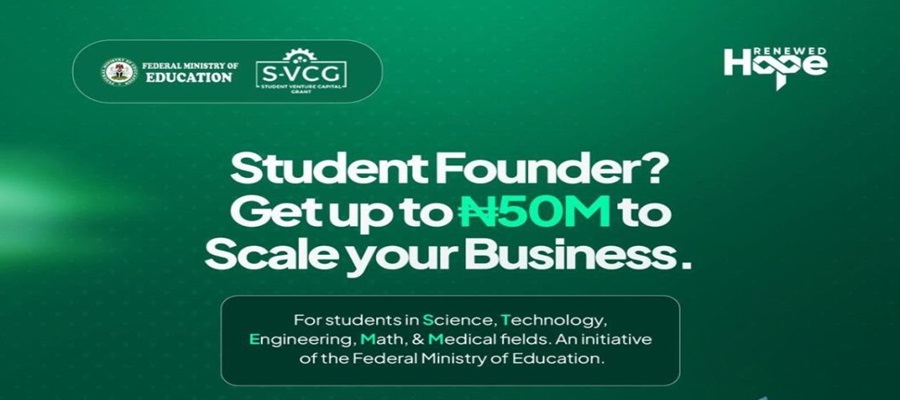
Federal government has awarded N50 million each to 45 students selected from 65 finalists drawn from public and private tertiary institutions nationwide under the Student Venture Capital Grant (S-VCG).

Tunji Alausa, minister of Education, unveiled the initiative at the weekend at the United Nations Development Programme Innovation Hub in Ikoyi, Lagos, describing it as a bold step toward positioning Nigerian youth as drivers of global innovation.
Alausa said the programme marked a significant shift in education policy, aimed at empowering students through innovation, entrepreneurship, and skills development. He noted that the grant offers equity-free funding, mentorship, incubation, and access to digital tools.
He explained that the beneficiaries emerged after a rigorous selection process involving over 30,000 applicants from more than 400 tertiary institutions across the country, culminating in a three-day bootcamp and pitch session before industry experts.
According to the minister, the initiative is designed to transform tertiary institutions into hubs of innovation and economic development, enabling students to move from ideation to commercialisation and become job creators.
“Today is not just another programme event. We are activating a new future for Nigerian students where great ideas are nurtured into impactful solutions,” he said.
Also speaking, Suwaiba Ahmad, minister of State for Education, described student entrepreneurship as a critical national strategy for job creation and economic growth. She emphasised the need for institutions to move beyond theory and support students in translating ideas into viable enterprises.
Similarly, Bosun Tijani, minister of Communications and Digital Economy, commended the initiative, urging beneficiaries to focus on building sustainable and impactful solutions rather than pursuing short-term gains.
He advised students to adopt consistency and long-term thinking, noting that small, sustained efforts could lead to meaningful innovation and societal impact.
In her goodwill message, Elsie Attafuah reaffirmed the commitment of the United Nations to supporting Nigeria’s innovation ecosystem.
She encouraged beneficiaries to refine their ideas, respond to market needs, and contribute meaningfully to national development through innovative solutions.
The minister acknowledged key partners, including the UNDP, Google, and the Bank of Industry, for their support in implementing the initiative and expanding opportunities for young innovators across Nigeria.

The Federal Government has launched the ‘Cross-Border Digital Payments and Identity in Nigeria under the AfCFTA’ report, urging stakeholders to unlock trade opportunities for Micro, Small and Medium Enterprises (MSMEs) to access the $3.5 trillion African Continental Free Trade Area (AfCFTA) market.

The high-level report, hosted by the Office of the Vice-President in collaboration with ODI Global under the Supporting Investment and Trade in Africa (SITA) programme, was unveiled on Monday by the Deputy Chief of Staff to the President, Ibrahim Hassan Hadejia, in Abuja.
Hadejia described the research as both timely and strategic, noting the strong coordination by the Office of the Vice-President and the leadership of the Federal Ministry of Industry, Trade and Investment.
He revealed that the cross-border payments report followed earlier milestones, including the development and launch of Nigeria’s Digital Trade Strategy and a capacity-building programme for subnational leaders.
According to him, Nigeria is increasingly assuming a leading role in shaping the digital trade agenda across the African continent, necessitating that the country remains at the forefront of AfCFTA implementation.
He noted that deepening engagement with AfCFTA and enabling businesses, particularly SMEs, to conduct seamless cross-border transactions will be critical to unlocking trade, fostering growth, and creating jobs.
He further stated that efficient cross-border payments, supported by trusted digital identity systems as recommended in the report, will be key to realising President Bola Ahmed Tinubu’s Renewed Hope vision for Nigerian MSMEs.
Hadejia also observed that while the report identifies the Pan-African Payment and Settlement System as a critical platform for cross-border digital payments, Nigerian fintech firms such as PalmPay and Moniepoint, which have some of the largest and most active user bases, will play a pivotal role in driving adoption.
He assured the audience that the Federal Government remains committed to strengthening critical infrastructure, regulatory frameworks, and partnerships to ensure Nigeria is not only ready for digital trade but continues to lead.
“I appreciate the efforts of all stakeholders and urge us to move AfCFTA beyond a continental agreement to a $3.5 trillion trade juggernaut that will reinvigorate our industries, unlock intra-African trade, and domesticate African prosperity,” he added.
Hadejia stated that intra-African trade will be driven not only by large corporations but by small businesses empowered through digital trade and e-commerce, while noting that issues of trust, identity and logistics, as highlighted in the report, must be addressed.
Commenting on the report, the Special Adviser to the President on Job Creation and MSMEs, Temitola Adekunle-Johnson, said the report – developed under the purview of the Office of the Vice-President – would significantly strengthen the MSME ecosystem.
He explained that cross-border payments in Nigeria and across Africa have historically been largely informal and inefficient but noted that the emergence of the Bank Verification Number (BVN) and National Identification Number (NIN) systems is changing the landscape.
Adekunle-Johnson expressed optimism that the report’s findings and recommendations would enable Nigerian SMEs to achieve seamless access to continental markets.
Earlier, the Special Assistant to the President on ICT Policy, Office of the Vice-President, Salihu Dasuki, disclosed that the office, in partnership with development partners, has developed a framework to fast-track seamless cross-border payments for MSMEs.
He added that a key pillar of President Tinubu’s Renewed Hope Agenda is enabling Nigerians to access digital trade, which informed the capacity-building programme conducted for subnational governments last year.
Also speaking, Special Assistant to the President on Project Support, Office of the Vice-President, Shuda Ahmed, commended ODI Global for leading the research underpinning the report.
She noted that without seamless and affordable cross-border payment systems, MSMEs across the continent would be unable to scale beyond their domestic markets.
The event was attended by officials of ODI Global, representatives of AfCFTA, the National Information Technology Development Agency (NITDA), National Identity Management Commission (NIMC), Nigerian Petroleum Development Company (NPDC), Federal Competition and Consumer Protection Commission (FCCPC), and MSMEs, among other key stakeholders.

EFCC Waxes Worriedly over $160Bn Crypto Crime Losses

Dangote Refinery Debunks Speculations on IPO

FG Awards N50m Each to 45 Students under S-VCG

NGX REGCO Fines 5 Firms N291m for Market Manipulation

FG Launches Cross-Border Digital Payments Report

Spotify’s Loud & Clear Report Reveals Over ₦60Bn Revenue for Nigerian Artists in 2025

Madonna University Taps Tech Guru Adote for Strategic Board Role

China Threatens to Shut Nigeria’s Satellite Over $11.44m Unpaid Debt

Jumia Tech Week 2026 Begins with Tech Deals on Smartphones, Electronics, and Everyday Technology

FCCPC Bans Lagos ‘No Refund’ Policy, Vows Fines and Shutdowns for Traders



 General News3 days ago
Anti Graft Agencies Raise Alarm over Rising Crypto-Linked Financial Crimes

 E-Business3 days ago
NITDA Takes Over National Digital Architecture System

 E-Financial1 day ago
CBN bars large‑ticket loan defaulters from banking services in tough new crackdown

 General News1 day ago
ARN Rejects Medical Bill over Attempt to ‘Scrap’ Profession

 Telecom1 day ago
NIGCOMSAT Supports Startups Growth with the Launch of Accelerator 3.0

 News1 day ago
Stakeholder says AI is Crucial to Nigerian Data Centres Amid Persistent Grid Collapse

 Telecom1 day ago
FG Unveils Digital Economy Research Fund Scheme

 News1 day ago
Meningitis Kills a Quarter Million People a Year -Study