

News
Africa’s Female Fund Managers Receive Boost with Launch of a Multi-Million Dollar Fund


African leaders are putting women front and center of efforts to drive the continent’s economic growth through a game-changing fund that invests in women fund managers and also provides technical assistance.
The launch of the African Women Leadership Fund (AWLF) will provide capital to both first time and experienced fund managers in support of UN Sustainable Development Goals 5 (Gender Equality) and 8 (Decent Work and Economic Growth), and African Union Agenda 2063.
The ground-breaking partnership, formally signed at the weekend in Addis Ababa between the United Nations Economic Commission of Africa (ECA) and Standard Bank Group, will be transformational in breaking down structural barriers to inclusive investing in Africa.
Over $20 million was raised for the fund on Saturday that has a current goal of $100 million. President Paul Kagame of Rwanda was instrumental in leading the way, pledging $500,000. Senegal’s President Macky Sall committed $500,000. South African President Cyril Ramaphosa also pledged to contribute to the fund. The private sector participants pledged the rest.
Prime Minister Justin Trudeau of Canada pledged $10 million to the African Union to boost gender parity. Norway Prime Minister Erna Solberg pledged $8 million to AU initiatives. A portion of these resources will be earmarked for the women’s initiative.
Among the world leaders who witnessed the official launch of this innovative impact investment fund were UN Secretary-General, Antonio Gutteres, African Union Commission Chairperson, Moussa Faki Mahamat, Ethiopian President Sahle-Work Zewde. Former Liberian President Ellen Johnson Sirleaf was also in attendance, as were a number of former African heads of state.
“We are turning the tables and making women the decision-makers of investable money in Africa. We want women to be on the supply side of money, not only on the demand side,” said Dr. Vera Songwe, UN Under-Secretary General and Executive Secretary of ECA. A key goal of the fund is to empower women financial leaders who will drive economic growth, job creation, and create prosperity.
In Africa women-owned funds and businesses struggle due largely to lack of successful fundraising, insufficient exposure to systems and procedures, and lack of track records, among others. They also contend with gender-based social expectation, resistance to women in leadership roles and lack of a support network. The fund will empower Africa’s women by giving them access to financial resources and investment management expertise.
Sola David-Borha, Chief Executive of Africa Regions at Standard Bank Group, says the fund aligns with the Bank’s purpose to drive Africa’s growth and “presents an opportunity for Standard Bank to leverage our footprint and expertise on the continent, and the relevant experience of our asset management arms, Melville Douglas and STANLIB Multi-Managers, to build Africa’s economies. Africa is our home, we drive her growth”.
Women fund managers will receive a deployment of capital, and subsequently invest in majority female-owned businesses. Even though the fund is sector agnostic, priority sectors will be education, manufacturing, healthcare, clean energy and agriculture. Additionally, technical assistance for fund managers and entrepreneurs will be offered through the initiative. This ranges from building capacity, direct mentoring to leveraging technology in health and education.
Songwe emphasized “The goal here is to give women-led financial investment activities a huge injection of jet fuel to bear out the proven positive correlation between gender balance, higher financial returns and developmental impact.”
In his remarks, Secretary-General Gutteres said, “power is not usually given, it must be taken.”



African technology start-ups will receive a $46 million (€40 million) commitment from EIB Global, the development arm of the European Investment Bank (EIB).

The funds will be deployed through the first Africa-focused investment vehicle from European venture capital (VC) firm Speedinvest.
The Speedinvest Africa Fund, which has a total target size of €200 million, targets companies across innovation hubs in Egypt, Morocco, Nigeria, Kenya, and South Africa.
It also invests in high-potential markets, including Ghana, Côte d’Ivoire, Cameroon, the Democratic Republic of Congo, Tunisia, Tanzania, and Uganda.
The investment strengthens EU–Africa ties, supports digital transformation, and promotes inclusive economic growth, says the EIB.
The strategy is designed to improve digital and financial inclusion while enabling start-ups to scale across borders by strengthening linkages between African and European ecosystems. Technology has the power to turn good ideas into real impact, says Karl Nehammer, vice-president of the EIB.
By backing this vehicle, it is enabling African innovators to scale, access new markets, and build sustainable businesses, says Nehammer.
The fund focuses on technology-enabled and mobile-based services across payments, healthcare, mobility, and education.
This aligns with the EU’s Global Gateway priorities and is expected to deliver social benefits, including job creation for youth and expanded access to digital banking for underserved communities.
At least 30% of the vehicle’s capital will support companies advancing gender equality, including those with women as founders, employees, or consumers.
With EIB Global support, the firm is deepening its long-term commitment to backing founders across Africa while strengthening enduring bridges between Africa and Europe, says Oliver Holle, CEO and managing partner of Speedinvest.
Speedinvest has previously backed African growth-stage companies, including mobility fintech Moove and digital bank FairMoney.
By combining a local presence with a European network of operators, sector expertise, and follow-on capital, the firm aims to help founders scale regionally and internationally, says Holle.
The fund will be managed by partners Deepali Nangia and Rana Abdel Latif, with a new African office planned to support its local operations.

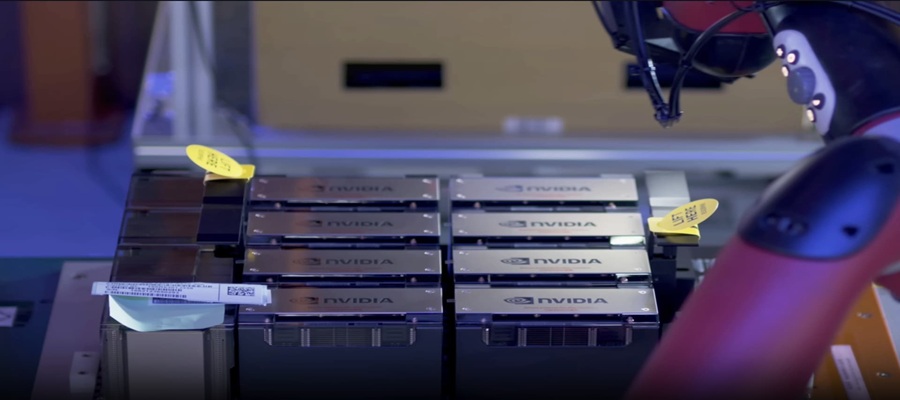
Three individuals connected to a US tech firm have been indicted by the United States Department of Justice (DOJ) for their alleged role in a massive scheme to smuggle billions of dollars worth of restricted Nvidia AI chips to China, bypassing strict export controls.

Nvidia Chip
Prosecutors accuse the suspects of using fake documents, dummy equipment, and even hair dryers to tamper with labels in a bid to dodge compliance checks.
The plot centred on high-performance semiconductors from Nvidia, which are tightly regulated by the US due to fears they could boost China’s military and AI capabilities.
Yih-Shyan “Wally” Liaw, a US citizen and co-founder of California-based Super Micro Computer (a server maker), has been charged alongside two Taiwanese nationals: Ting-Wei “Willy” Sun and Ruei-Tsang “Steven” Chang (who remains at large).
The group reportedly partnered with a Southeast Asian firm to order servers packed with banned chips. They falsified records claiming the gear would stay in Asia, but repackaged and shipped it covertly to China.
Tactics included deploying thousands of fake “dummy” servers for audits, while real restricted tech was diverted. Sun allegedly used household hair dryers to swap serial numbers and labels.
Super Micro Computer confirmed the suspects’ links but stressed it faces no charges and is aiding the probe.
The DOJ estimates the intermediary bought $2.5 billion in equipment, illegally funneling vast amounts of controlled AI tech to China without licences.
This case underscores escalating US-China tech rivalry, where advanced chips are viewed as vital for national security and economic edge.
In a parallel probe, two Chinese nationals were earlier charged for rerouting chips via Malaysia, Singapore, Hong Kong, and mainland China. US authorities warn of tough penalties for evasion.
This development signals intensified global scrutiny on tech supply chains amid superpower tensions.
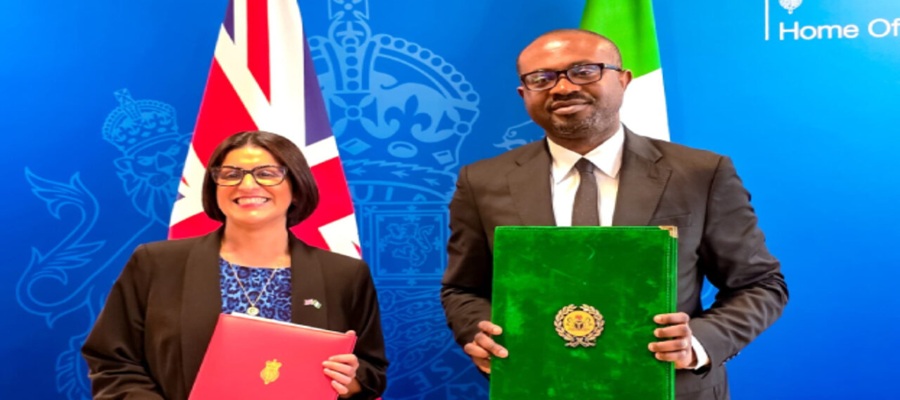
United Kingdom and Nigeria have agreed on a three-year strategic plan to tackle organised immigration crime and strengthen border security cooperation.

The initiative was announced in a joint statement by the UK Home Office following the state visit of Bola Ahmed Tinubu to the UK.
The agreement was signed by UK Home Secretary Shabana Mahmood and Nigeria’s Minister of Interior, Olubunmi Tunji-Ojo.
According to the statement, the framework focuses on combating visa fraud, improving border management systems, and enhancing legal cooperation between both countries.
Under the plan, Nigeria is expected to review its legal framework to impose stricter penalties on immigration-related offences, particularly those involving forged or fraudulent travel documents.
Both countries also pledged to strengthen laws and enforcement mechanisms governing visa processing and travel documentation.
A key component of the agreement is the expansion of the UK–Nigeria Organised Immigration Crime Unit, with new memoranda of understanding centred on intelligence sharing and joint operations.
The UK government will further support Nigerian border agencies through training programmes and capacity-building initiatives.
The partnership also places emphasis on the protection of vulnerable migrants, particularly women and children, while enhancing research, document verification systems, and migration monitoring processes through the UK–Nigeria Migration, Justice and Home Affairs Dialogue.
Both governments described the agreement as a reflection of their shared commitment to tackling transnational crime and improving migration management through closer collaboration.
The deal forms part of broader engagements during Tinubu’s visit, which focused on strengthening bilateral relations across security, migration, and economic development.

Court Jails ‘Colonel’, ‘Major’ of Global Money-Laundering Ring

Court Bans Kenyan Telcos from Recycling SIM Cards

Providus Bank Fully Meets CBN Capital Requirement, Sets Record Straight

African Tech Start-ups to Receive $46m of Speedinvest Africa Fund

U.S. Charges Three in $2.5 Billion Plot to Smuggle Nvidia AI Chips to China

Kaspersky Discovers New Phishing Campaign Exploiting Google Tasks Notifications to Steal Corporate Credentials

esentry 2025 Report Shows Healthcare, Financial Services and Telecoms as Staging Grounds for Increased Cyberattacks in Africa

AfDB, UNDP Launch $10Bn AI Initiative for Africa

Mutual Benefits Assurance Settles ₦5.9bn Claims in January 2026

MultiChoice Suspends Yearly DStv Price Hike as Canal+ Pushes Growth




 E-Financial2 days ago
CBN Introduces Stricter BVN Rules to Curb Fraudulent Transactions

 E-Financial2 days ago
Binance is Missing from Ghana’s Crypto Sandbox

 E-Financial2 days ago
World Bank Debars 3 PwC Subsidiaries for 21 Months over Alleged Project Fraud

 News2 days ago
Nigeria, UK Sign £746M Landmark Ports Deal

 E-Financial2 days ago
Quest Merchant Bank Named Transaction Advisor for Nigeria’s Landmark Project BRIDGE Digital Infrastructure Initiative

 Broadcasting2 days ago
Canal+ to Cut Jobs as Part Sweeping Restructuring

 General News2 days ago
Gartner Forecasts Surge in AI-powered Public Services

 E-Business2 days ago
Study Reveals 83% of Employees Stay Connected to Work During Time Off, Fuelling Digital Anxiety