

E-Financial
CBN to Sack Bank Chiefs over Bad Loans


A new Code of Corporate Governance approved by the Central Bank of Nigeria (CBN) has stipulated that bank directors with non-performing loans (NPLs) are to either quit or be sacked.
Adedapo Adeleke, director, Bank Examination Department at the Nigeria Deposit Insurance Corporation (NDIC), said the new code was instituted to address the rising cases of insider bad loans, which not only represent a conflict of interest, but are against the prudential guidelines for the industry.

Adeleke described corporate governance as an essential pillar in financial system stability.
He said: “Banks’ assets have depreciated in the last three years, with provisions for NPLs hitting N856.9 billion, due to the drop in crude oil prices. A large part of these bad loans is owed by bank directors and are in most cases unsecured.
“Besides, the economic recession showed that the financial industry still harbours weaknesses in governance, as seen in insider non-performing loans, unreported losses, huge exit packages for directors, over-domineering executive management, contravention of regulatory/prudential guidelines and lending limits, poorly appraised credits and weakening of shareholders’ funds, among others.
“The Corporate Governance Code for Bank Directors is signed by all bank directors at the point of their appointment, and has a section that empowers the banks’ boards to remove any director with insider non-performing loans.
“That section says: ‘If you are having non-performing loans, you will be removed. It is already being enforced except that the regulators are not being dramatic in publishing the names of affected directors,’” Adeleke said.
He added that delay or non-payment of workers’ salaries by government and private companies is worsening the level of non-performing loans in the industry.
Adeleke further lamented the rate of non-performing loans saying, “NPLs are in excess of 20 per cent as against the five per cent regulatory threshold.”
The NDIC director said when salaries are delayed, workers who have borrowed from banks, especially through consumer loans, always find it difficult to pay back. “If the economy is improving, and government can help to fulfill its responsibilities, including prompt payment of salaries, the level of non-performing loans in the industry will drop,” he said.
“If people working in companies that are troubled borrowed from banks, it is important that the loans be provided for when their employers can no longer pay salaries,” he said.
He, however, expressed confidence that the current rise in crude oil prices will impact positively on the banking industry and businesses and help reduce the rising cases of bad loans in the industry.


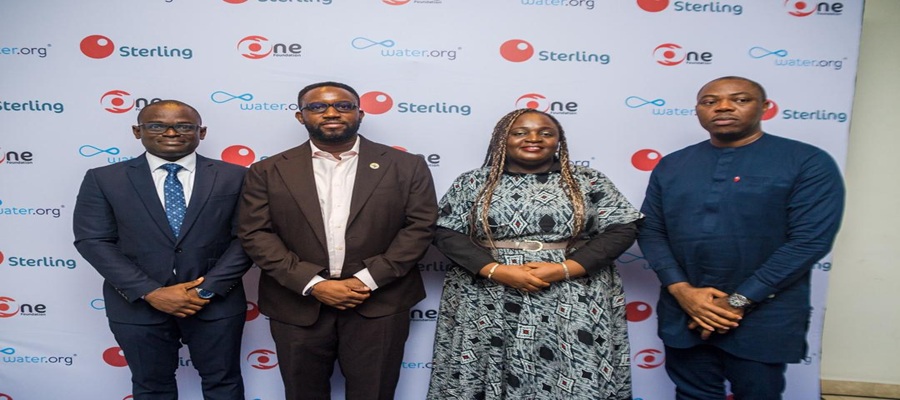
Sterling Bank, in partnership with nonprofit Water.org and Sterling One Foundation, has launched the Sterling WASH Business Loan to empower WASH businesses and scale sustainable access to safe water and sanitation for millions of Nigerians.

L-R: Gilbert Okpono, Snr. Partnership Account Manager, Water.org; Engr. Mukhtaar Temitope Tijani, Managing Director, Lagos State Water Corporation; Mrs. Olapeju Ibekwe, CEO, Sterling One Foundation; Akporee Idenedo, Divisional Head Commercial Banking, Sterling Bank, at the Sterling Bank Water Credit Proposition held in Lagos recently.
The catalytic financing solution addresses daily struggles with clean water and safe sanitation, which impact health, livelihoods, and well-being, while strengthening delivery systems for WASH solutions.
Launched on Monday, November 24, 2025, at The Wheatbaker Hotel, Ikoyi, Lagos, the initiative signals a shared commitment to tackling one of Nigeria’s most pressing development challenges.
Abubakar Suleiman, Managing Director of Sterling Bank, said sustainable development hinges on collaboration and targeted investment in frontline businesses and people.
“By providing accessible financing to entrepreneurs in this critical social sector, we ensure progress reaches communities that need it most. This product aligns with our HEART strategy and commitment to improving quality of life through impact-driven initiatives,” Suleiman stated.
Gilbert Okpono, Nigeria Senior Partnership Account Manager at Water.org, stressed the transformative power of financing WASH businesses.
“Financial inclusion is critical to solving the global water and sanitation crisis. By expanding access to affordable financing, we enable households and WASH entrepreneurs to improve services, reach more communities, and transform lives,” Okpono said.
He added that the partnership reflects a belief in rippling benefits across health, education, and economic opportunity, marking a major step toward sustainable scaling.
The loan supports WASH entrepreneurs, small business owners, and community service providers with flexible financing to expand operations, boost health, livelihoods, and educational outcomes.
Olapeju Ibekwe, CEO of Sterling One Foundation, linked the initiative to the foundation’s mission of catalysing lasting social impact across Africa.
“Our Foundation catalyses initiatives that deliver real, lasting change. Access to safe water and sanitation is one of the most powerful investments in community well-being. We are proud to partner with Water.org and Sterling Bank for inclusive, scalable, and sustainable solutions,” Ibekwe affirmed.
The launch event gathered development partners, WASH entrepreneurs, media, policymakers, and community organisations to discuss coordinated financing, supportive policies, and market-driven solutions to close Nigeria’s WASH access gap.
Interested beneficiaries can visit the initiative’s website for more details.


Access Holdings Plc has received the approval of its shareholders to raise additional capital of up to N40 billion or such other amount or their equivalent in foreign currencies, via private placement.

The shareholders gave the approval as part of the special resolutions at Access Holdings Plc Extraordinary General Meeting (EGM) held on Thursday December 18.
In a notice to the Nigerian Exchange Limited (NGX), Access Holdings said the new ordinary shares created in connection with the private placement, will be allotted at a price of N20.25 to one or more investors in such tranches and on such terms and conditions as shall be determined by the Board.
Access Holdings Plc Board of Directors is authorised to consider, negotiate, approve, and finalise the list of potential private placement investors; determine the structure, valuation, modalities, and timeline for the private placement.
The Board was also authorised to consider, negotiate, approve and finalise the list of potential private placement investors; determine the structure, valuation, modalities and timeline for the private placement.
The shareholders also approved for the issued share capital of Access Holdings Plc to be increased from N26 658 billion to N27.646 billion by the creation and addition of 1,975,308,641 ordinary shares of 50 kobo each ranking pari-passu with the existing ordinary shares of the Company.

Nigeria Customs Service (NCS) has imposed a three per cent surcharge on Deposit Money Banks (DMBs) over delays in the remittance of Customs revenue by designated banks.

The development was disclosed by Abdullahi Maiwada, national public relations officer of the Service, in a statement titled “Nigeria Customs Service Commences Enforcement of Penalties Against Designated Banks for Delayed Remittance of Customs Revenue.”
The agency stated that delays in remitting collected Customs revenue constitute a breach of remittance obligations and negatively impact the efficiency, transparency and integrity of government revenue administration.
Maiwada explained that any Designated Bank that fails to remit collected Customs revenue within the prescribed period will be liable to penalty interest, adding that affected banks will receive formal notifications detailing the delayed amount, applicable penalty and the timeline for settlement.
“The NCS has noted instances of delayed remittance of Customs revenue by some Designated Banks following reconciliation of collections processed through the B’Odogwu platform. Such delays constitute a breach of remittance obligations and negatively impact the efficiency, transparency and integrity of government revenue administration.
“In line with the provisions of the Service Level Agreement (SLA) executed between the Nigeria Customs Service and Designated Banks, the Service hereby notifies stakeholders of the commencement of enforcement actions against banks found to be in default of agreed remittance timelines.
“Accordingly, any Designated Bank that fails to remit collected Customs revenue within the prescribed period shall be liable to penalty interest calculated at three per cent above the prevailing Nigerian Interbank Offered Rate for the duration of the delay. Affected banks will receive formal notifications indicating the delayed amount, applicable penalty and the timeline for settlement.”
Maiwada further advised Designated Banks to strengthen their internal controls, ensure strict adherence to remittance timelines and comply fully with the provisions of the SLA.
He reiterated that the Service remains committed to enforcing accountability, safeguarding government revenue and promoting a transparent and predictable financial system in support of national economic development.
“The Service further notes that persistent or repeated non-compliance with the terms of the SLA may attract additional sanctions, including regulatory and administrative measures, as provided under the Agreement and relevant laws guiding Customs revenue collection.
“The NCS reiterates that prompt, accurate and complete remittance of Customs revenue is a fundamental obligation of Designated Banks. Any payment of collected revenue into unauthorised accounts, whether deliberate or erroneous, will be treated as a serious violation and addressed in accordance with the SLA and applicable legal frameworks.
“Designated Banks are therefore advised to strengthen internal controls, ensure strict adherence to remittance timelines and comply fully with the provisions of the SLA. The Service remains committed to enforcing accountability, safeguarding government revenue and promoting a transparent and predictable financial system in support of national economic development,” he added.

US Okays $2.1Bn for Christian Healthcare in Nigeria

Leo Stan Ekeh: A “Rare Avis”, an Unconquerable Entrepreneur

SERAP Asks Tinubu to Release CTC of Tax Bill

Tim Akano Recounts 20-Year Growth, Media Support at NITRA End-of-Year Meet

Sterling Bank, Water.org, Sterling One Foundation Partner on WASH Loan for Millions

Nigeria Records Highest Weekly Cyberattacks in Africa — Report

Cyber Tsunami Hits Nigeria as Breaches Surge 1,047%, esentry Q3 Report Reveals

GenAI Adoption Among African workers Outpace Global Peers

Jumia’s Data Shows Nigerians Turning to Digital Retail to Navigate Inflation Pressures

Minister Claims Bandits Exploit Poor Network, Bounce Calls Off Multiple Towers




 General News3 days ago
Jumia Kicks Off December Holiday Sale, Bringing Festive Deals to Shoppers Nationwide

 E-Financial3 days ago
Access Holdings Shareholders Approved to Raise N40bn Capital Through Private Placement

 Broadcasting3 days ago
NIMC rolls out Pre-Enrolment Portal for seamless NIN registration

 General News3 days ago
Dangote, Monopoly Power, and Political Economy of Failure

 General News3 days ago
OAU, Baptist Day School Oluponna honour Akano with Distinguished Alumnus Awards

 General News19 hours ago
The Mood Market to Light Up Lagos with a Rooftop Gifting, Food & Lifestyle Fair this Christmas
 News13 hours ago
US Okays $2.1Bn for Christian Healthcare in Nigeria
 E-Financial13 hours ago
Sterling Bank, Water.org, Sterling One Foundation Partner on WASH Loan for Millions