

E-Business
Cisco sets $1Bn Investment for Global Cloud Computing Network


Cisco Systems will invest $1 billion over two years to expand its cloud offerings, the company said on Monday, linking hundreds of data centers and cloud providers around the world in a network with more than 30 partners.
The network, called Intercloud, will help businesses process and manage data generated from billions of devices and applications around the world, Cisco said.
Businesses in the network aim to bridge the gap between public and private cloud computing and will share cloud infrastructure the same way mobile telecommunications companies have roaming agreements.
With partners including Deutsche Telekom, BT group and Equinix Inc, Cisco said it will add 250 data centers in 50 countries to its cloud network.
Intercloud will also allow companies to direct data traffic through specific clouds and data centers. This will help international businesses deal with foreign regulations requiring companies to house data collected from its citizens in local data centers.

The company also hopes the offering will address security and reliability concerns that have prevented businesses from accessing the cloud through public Internet connections.
Its partnership with Equinix, a data center provider that offers interconnection solutions, will provide customers a protected access path to public cloud networks.
Telecom provider BT will use Cisco technology to interconnect public and private clouds into the Intercloud, allowing their customers to securely move workloads between BT data centers and different clouds.
Cisco is also offering a hybrid cloud bundle that will allow customers currently using a private cloud to tap into the network.



Jumia Nigeria has reaffirmed its role as one of the leading forces driving the adoption of e-commerce in Nigeria, saying sustained investment in consumer trust, local logistics and digital infrastructure has helped expand online shopping while laying the foundation for Africa’s broader digital commerce ecosystem.

Speaking during a panel discussion at the AfCFTA Digital Trade Forum 2026, the Chief Executive Officer of Jumia Nigeria, Temidayo Ojo, said the company’s experience over the years shows that building consumer confidence remains the single most important factor in accelerating e-commerce adoption across the continent.
According to him, while millions of Nigerians have embraced online shopping, significant opportunities still exist to bring many more consumers into the digital marketplace through stronger consumer protection, seamless payment systems and supportive public policies.
Ojo noted that Jumia’s growth has mirrored the increasing acceptance of e-commerce in Nigeria, with the company consistently investing in technologies, logistics capabilities and customer experience initiatives that have made online shopping more accessible, convenient and reliable for consumers.
He explained that one of the biggest challenges facing digital commerce remains consumer trust, particularly among first-time online shoppers who are unable to physically inspect products before making purchases. To address this, Jumia has continuously strengthened its customer experience through reliable delivery, transparent order tracking, quality assurance and responsive dispute resolution processes that encourage repeat purchases and long-term confidence in online retail.
“Trust is the currency of digital commerce,” Ojo said, adding that stronger consumer protection frameworks across African markets would further accelerate the growth of the sector by giving consumers greater confidence whenever issues such as payment disputes, delayed deliveries or product quality concerns arise.
Beyond consumer confidence, Ojo identified fragmented payment systems as one of the major obstacles limiting intra-African digital trade. Despite significant innovation within Africa’s fintech ecosystem, varying regulations and limited interoperability continue to make cross-border transactions more complex than necessary.
He called for greater harmonisation of payment frameworks across the continent, noting that seamless digital payments would make it easier for businesses to scale beyond their domestic markets while allowing consumers to transact effortlessly across borders.
Ojo also emphasised the importance of stronger collaboration between governments and the private sector in creating an enabling environment for digital businesses. According to him, coordinated policies and regulatory certainty would accelerate investment, encourage innovation and strengthen confidence in Africa’s digital economy.
As one of Africa’s largest e-commerce platforms, Jumia sees regional integration as a significant growth opportunity. The company already connects tens of thousands of merchants with consumers across several African markets and believes improved cross-border trade policies would enable many more local businesses to reach new customers beyond their national boundaries.
Such integration, he said, has the potential to unlock access to a combined consumer market of more than 500 million people, creating new opportunities for African enterprises to trade with one another and strengthen the continent’s digital economy.
He added that while many first-time shoppers initially prefer cash-on-delivery because of perceived risks, their confidence in digital payments increases significantly after experiencing reliable service, quality products and efficient deliveries.
According to Ojo, Jumia’s journey reflects the broader evolution of e-commerce in Nigeria, one driven by sustained investments in trust, technology and local partnerships. He maintained that with stronger consumer protection, harmonised regulations and deeper collaboration between governments and the private sector, Africa is well positioned to unlock the next phase of digital commerce growth.

By Blaise Udunze
It is considered that in every organized society, the home is supposed to be a place of security. It should be where families find peace after a hard day’s work, where children grow, where dreams are nurtured, and where the pressures of life temporarily fade away. This narrative comes with keen interest, having witnessed that for millions of Nigerians, home has become the country’s newest economic battlefield. This is fast becoming the experience for the vast majority of Nigerians.

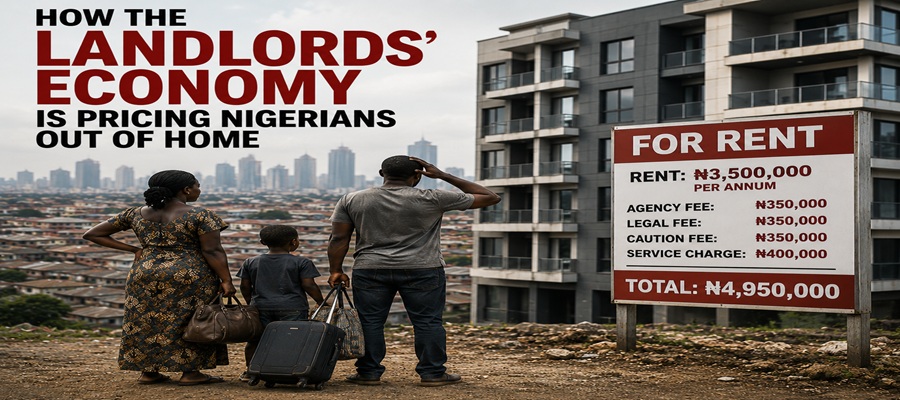
Across the length and breadth of Nigeria, citizens are deeply lamenting the skyrocketing rent. Regrettably, this has become one of the fastest-rising costs of living. An unexpected trend which has become a huge concern is that currently apartments that were rented for N700,000 or N1 million just a few years ago are now advertised for N3 million, N5 million or even higher. Amidst this bizarre development, do you know that they are often without significant improvements to the property itself? One key troubling development is that recent estimates suggest that house rents in many Nigerian cities have surged by between 100 and 300 percent over the last two years, a pace that far exceeds the country’s official inflation rate and has placed unprecedented pressure on households already struggling with rising food, transportation and energy costs.
Landlords, through estate agents, increasingly demand one or two years’ rent upfront. Tenants are expected to pay 10 percent of the principal rent toward agency fees, legal fees, agreement charges, caution deposits, and, in most cases, the service charge (which appears to be higher), security levies, and utility-related costs before receiving the keys. In many cases, these additional charges add hundreds of thousands or even millions of naira to the advertised rent, making the total cost of securing accommodation far beyond the reach of average-income earners. Equally disturbing is the unchecked exploitation by agent marauders, who prey on desperate house seekers by imposing outrageous and often illegal fees that further deepen Nigeria’s housing crisis. What should ordinarily be a routine life event has become a financial ordeal.
Nigeria’s housing crisis is no longer simply a property story. It has evolved into an economic emergency with profound implications for families, businesses, public health and national development.
The Federal Government’s National Housing Data Technical Committee estimates that Nigeria faces a housing deficit of approximately 15 to 20million homes. At the same time, millions of existing houses are considered structurally inadequate and lack access to essential infrastructure. If this figure is something to consider, anyone would know that these figures reveal two overlapping crises. First, this shows that millions of Nigerians cannot find decent accommodation, whilst millions more live in overcrowded, unsafe or poorly serviced housing.
At the same time, Nigeria’s population continues to expand rapidly, with cities absorbing hundreds of thousands of new residents every year.
One of the challenges is that urbanisation has consistently outpaced housing development, widening the gap between supply and demand while predictably, rents continue to rise and affordability continues to decline.
Remarkably, housing experts generally recommend that households should spend no more than 30 percent of their income on accommodation. For many Nigerian families, that recommendation has become almost impossible to achieve.
Teachers, nurses, journalists, police officers, civil servants, young bankers, entrepreneurs, artisans and other middle-income earners increasingly devote more than half of their annual income to rent alone. For many, housing has become the single largest financial obligation, leaving very little for every other necessity of life.
After paying landlords, food budgets shrink. Healthcare is postponed. Children are transferred to less expensive schools. Retirement savings disappear. Business investments are suspended. Vacations become unimaginable luxuries. The rent bill has become the first expense families think about and the last financial burden they can escape.
The effects extend far beyond individual households. This is totally outrageous, as financial analysts have long observed that when accommodation consumes a disproportionate share of disposable income, consumer spending across the economy inevitably weakens.
Families postpone replacing household appliances. Vehicle purchases are delayed. Furniture sales decline. Restaurants receive fewer customers. Clothing retailers experience lower patronage. Small businesses lose purchasing power from consumers whose earnings are now tied up in rent. The result is a vicious economic cycle in which rising housing costs suppress consumption, reduce business activity and ultimately slow economic growth.
Behind every rent increase lies a deeply personal story. Consider a fictional but representative family whose experience mirrors that of countless Nigerians. The aspect of receiving notice that the annual rent for their modest two-bedroom apartment would rise from N1.2 million to N3 million comes with uneasiness. At this point, the Blessings’ family had spent months desperately searching for an alternative.
Unable to afford the increase and harassment from the landlord, they eventually relocated nearly 30 kilometres away from their former neighbourhood. The consequences were immediate. Their children had to change schools. The family’s daily commuting time doubled. Transportation costs rose sharply. Family time disappeared.
The father now leaves home before sunrise and returns late at night. The mother spends more each month commuting than she once spent on groceries. Their financial burden has not disappeared. It has merely shifted from rent to transportation and also deals with other issues like epileptic power supply and flooding, especially during this rainy season.
Unfortunately, such stories are no longer exceptional. They have become increasingly common across Nigeria’s major cities. Perhaps no demographic feels this pressure more acutely than young professionals.
Come to think of graduates entering the workforce quickly discover that entry-level salaries cannot support decent accommodation close to their workplaces. You would also see many remaining with their parents far longer than anticipated. Other effects include seeing them share apartments with several unrelated adults to reduce costs whilst some endure daily commutes lasting three or four hours because affordable housing exists only in distant suburbs.
The fact is that the consequences extend beyond inconvenience because long commuting hours reduce productivity, increase fatigue, heighten stress levels and significantly diminish quality of life. Another aspect of this and which is discouraging is that for many talented young Nigerians, financial independence, home ownership and family formation are becoming increasingly distant aspirations. Several interconnected forces explain why rents continue to climb so aggressively.
Inflation has significantly increased the cost of cement, steel, roofing sheets and virtually every construction material required to build houses. The depreciation of the naira has made imported building materials substantially more expensive. No doubt, from recent findings, there are clear indications that there is a significant increase in the prices of building materials. Let us see the period between 2024 to 2026, Cement: N6,500 – N13,000; blocks: N600 – N1100; 30T of sand: N165,000 – N250,000; 30T of granite: N530,000 – N780,000; rebars (iron) ton: N850,000 – N1,150,000 amongst others. To be fair, it is a known fact that high interest rates have increased borrowing costs for developers, while land acquisition remains prohibitively expensive in many urban centres. The very question at heart is, how has this recent development significantly impacted the apartments built five years ago and beyond?
The government has made it difficult to the point that obtaining development approvals can be slow and costly. Developers also contend with multiple taxes, infrastructure levies and rising labour costs before construction even begins. No doubt, these expenses inevitably find their way into rental prices. But one question keeps running through the minds of many, which is, how do these directly impact apartments built many years back? The truth is that market realities alone do not explain every increase.
In many locations, speculative pricing has taken hold. Some landlords have raised rents far beyond what can reasonably be attributed to maintenance or inflation, taking advantage of overwhelming demand and the severe shortage of available accommodation.
The inability of many Nigerians to purchase homes has further intensified the pressure on the rental market. Inflation, high mortgage rates and limited access to long-term housing finance have pushed home ownership beyond the reach of millions, forcing them to remain tenants for much longer than planned. This should be blamed on the government of the day, as more people compete for a limited supply of rental properties, landlords possess even greater leverage to increase prices.
Housing insecurity is also producing a less visible but equally damaging consequence for deteriorating mental health.
The constant fear of eviction, the uncertainty surrounding annual rent reviews and the enormous pressure of raising large lump sums every one or two years create persistent psychological stress.
Think of the impact of parents’ worry about disrupting their children’s education. Young couples postpone marriage because they cannot afford accommodation. Family disagreements increasingly revolve around financial pressures. Consider the part of many Nigerians who quietly or secretly or unknowingly battle anxiety, emotional exhaustion and depression arising from the struggle to secure decent housing.
None of these psychological costs clearly appear in official economic statistics, but the truth is that they profoundly affect productivity, family stability and overall well-being. It is equally obvious that the crisis is also affecting employers and businesses.
Workers forced to travel long distances arrive at work exhausted. Traffic congestion consumes valuable productive hours each day. It turns out that companies increasingly struggle to retain staff who relocate in search of affordable accommodation. Also, know that many employers face mounting pressure to increase housing allowances simply to remain competitive.
All these call for a balancing as employees demand higher wages to offset escalating living costs, further increasing operating expenses for businesses already contending with inflation, unstable exchange rates and rising energy prices.
Housing affordability is therefore no longer merely a social concern. It has become a business and national competitiveness issue.
Though Nigeria is not alone in confronting housing affordability challenges, its recent trend calls for attention. Across Africa, rapid urbanisation continues to outpace housing supply.
For this reason, Kenya has introduced ambitious affordable housing programmes aimed at expanding supply, although implementation challenges remain; this can’t be compared to Nigeria’s current situation. Ghana is not left out of the equation as it continues to battle a significant housing deficit. Ghana is also grappling with the irony of completed homes that remain unaffordable for many citizens. South Africa, despite possessing a relatively more developed mortgage market, continues to experience severe affordability pressures in cities such as Johannesburg and Cape Town.
Nigeria’s situation, however, is intensified by its enormous population, rapid urban expansion, limited mortgage penetration and one of Africa’s largest housing deficits.
Nigeria has witnessed successive governments introducing affordable housing initiatives, mortgage schemes and public-private partnerships which fails before implementation. While these programmes represent positive intentions, delivery has consistently fallen far behind growing demand.
Housing experts argue that meaningful reform requires far more than constructing a limited number of housing estates.
Nigeria must simplify land acquisition processes, reduce infrastructure costs, expand mortgage accessibility, improve planning approvals, encourage private-sector investment in affordable housing and strengthen incentives for developers willing to build homes for middle- and low-income earners.
Improving housing data is important, but accurate statistics alone cannot reduce rents. Effective implementation remains the country’s greatest policy challenge.
Let’s consider some of these salient points proffered by urban planners who insist that Nigeria’s housing crisis cannot be solved exclusively through market forces. According to them, governments at all levels must invest strategically in infrastructure and create financing mechanisms that reduce development costs. To further help reduce the housing gap, they encourage the construction of affordable rental housing rather than focusing disproportionately on luxury developments.
The truth is that if housing continues to consume an ever-growing share of household income, consumer spending, investment and long-term economic growth will ever remain constrained. Another key barrier that must be addressed quickly, as highlighted by researchers, are inflation, limited housing finance, weak regulatory enforcement and inconsistent policy implementation, which happen to be major bottlenecks to affordable housing delivery.
One key question that yearns for answers is whether it is not obvious to the government and other stakeholders that housing is far more than concrete walls, roofing sheets and painted ceilings? The fact is that shelter as the meaning implies, shapes educational outcomes, influences public health, determines productivity, strengthens families, supports social mobility and contributes directly to national competitiveness.
At this stage, it is a complete shame and at the same time an irony that a nation where hardworking teachers, nurses, journalists, entrepreneurs, artisans, security personnel and civil servants cannot comfortably afford decent shelter risks weakening its middle class, widening inequality and undermining sustainable economic growth.
If the truth must be told, Nigeria’s rent crisis is therefore not merely about landlords and tenants. For a fact, it is about the future of work, family stability, economic opportunity and social justice. Clearly, it is about whether millions of hardworking citizens can enjoy the dignity that comes with secure and affordable housing.
The mistake all along, which must be eschewed, is that a country’s progress is being measured solely by the number of luxury estates it builds or the height of its skyscrapers. More importantly, it should also be measured by whether ordinary citizens can afford a safe place to call home without sacrificing their children’s education, healthcare, savings or future aspirations.
If this is not adequately addressed, this rent trap will persist until affordable housing becomes a genuine national priority backed by bold reforms and sustained implementation; millions of Nigerians will continue facing an impossible choice, which would invariably lead them to surrender their financial future to keep a roof over their heads or abandon the comfort, security and dignity that every family deserves.
Concerned stakeholders shouldn’t continue to believe that the true cost of Nigeria’s rent crisis is therefore measured only in naira. It is measured in postponed dreams, delayed marriages, fractured families, declining productivity, abandoned ambitions, struggling businesses and the quiet erosion of hope among citizens who work tirelessly every day but find the simple promise of a decent home slipping further beyond their reach.
Blaise, a journalist and PR professional, writes from Lagos and can be reached via: [email protected]

Africa’s leading technology distributor Powerhouse, TD Africa, has reaffirmed its commitment to advancing cybersecurity awareness and digital resilience by sponsoring the 3rd Annual Secure 360 Summit Nigeria 2026, hosted by global cybersecurity leader Check Point Software Technologies, as Gold Sponsor.

Chioma Chimere, Coordinating Managing Director, TD Africa
This year’s summit was held in Abuja and Lagos, bringing together key stakeholders from across Nigeria’s technology ecosystem.
Now in its third edition, the Secure 360 Summit has evolved into one of Nigeria’s premier cybersecurity forums, bringing together Chief Information Security Officers (CISOs), Chief Information Officers (CIOs), IT Directors, and senior technology leaders from the financial services, telecommunications, enterprise, energy, and public sectors to address today’s rapidly evolving cyber threat landscape.
Speaking on the significance of the summit, Kingsley Oseghale, Country Manager, Check Point Nigeria, emphasized the need for stronger collaboration in tackling emerging cyber risks. “Cybersecurity has become a business priority rather than just an IT concern.
“Through the Secure 360 Summit, we continue to provide a platform for industry leaders to exchange insights, strengthen partnerships, and explore innovative approaches to securing today’s digital economy.
“We are pleased to have TD Africa as a valued partner in driving cybersecurity awareness across Nigeria.”
In her remarks, Chioma Chimere, Coordinating Managing Director, TD Africa, applauded Check Point for creating a platform that addresses one of the most critical challenges facing businesses and individuals. “Cybersecurity is everyone’s business. We owe it to ourselves, our organisations, and our communities to remain security-conscious in an increasingly connected world.
“At TD Africa, innovation drives everything we do, and innovation can only thrive in a secure environment.
“This is why we are proud to support initiatives like the Secure 360 Summit that promote knowledge sharing and strengthen our collective cyber resilience.”
The summit featured expert-led sessions on emerging cyber threats, artificial intelligence, cloud security, ransomware, and strategies for building resilient digital infrastructures, equipping participants with practical insights to navigate today’s cybersecurity landscape.
Through its continued partnership with global technology leaders like Check Point, TD Africa remains committed to empowering businesses across Africa with world-class cybersecurity solutions, fostering industry collaboration, and driving the continent’s secure digital transformation.

FAAN to Replace Physical ID Check with V-Pass Biometric Verification

World Bank Says 79 Percent of Nigerians Still Trapped in Poverty despite Reforms

SEC Begins Drive to Recover Unclaimed Dividends

ntel Plays Down Calls and Data Services, Moves to BET Agenda

Nigeria Facing Rising Cybercrime Losses – Report

NRC, Ponzi Scheme Collapses Resulting Loss of Billions of Naira

Nigeria Launches FreeTV Nationwide

NASENI Moves to Digitize CCB’s 5m Assets Declaration and Operations

Lebara Nigeria Launches Lebara Play, Africa’s First Telecom-Owned Micro-Drama Platform

CANAL+ Partners Samsung to Pre-Load DStv Stream on New Samsung TVs In Nigeria, Other African Countries




 E-Business3 days ago
TD Africa Sponsors Check Point Secure 360 Summit to Boost Cybersecurity in Nigeria

 Telecom3 days ago
MTN Foundation, MUSON Celebrate Emerging Music Talents at 2026 Graduation Ceremony

 Telecom3 days ago
NITDA Calls for Digital Infrastructure Expansion to Drive Nigeria’s Industrialisation

 News3 days ago
Guinness Rolls Out Nationwide Consumer Rewards Promotion

 E-Financial3 days ago
Next Currency Crisis May Turn $300Bn in Stablecoins into National Currencies

 E-Financial3 days ago
Gigbanc Nigerian Fintech Startup Closes Shop after 3 Years

 General News3 days ago
First Trustees Advocates Estate Planning as an Essential Tool in Every Wealth Creation Strategy

 Broadcasting3 days ago
Mbunabo, Nigerian Filmmaker Accuses Ghana TV Stations of Pirating Nollywood Films