

General News
EFCC Swoops on Ex-Govs over Allegations of Fraud

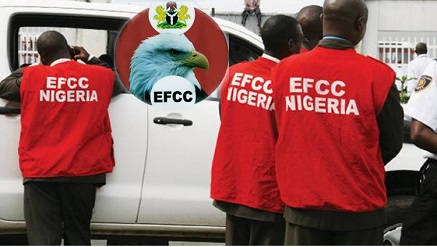
Economic and Financial Crimes Commission (EFCC), may have decided to swoop on some immediate past governors in the country, with their constitutional immunity stripped, according to National Mirror.
Some of the state chief executives could not be touched while in office because they enjoyed constitutional immunity from prosecution despite the myriads of allegations levelled against them.
Already, the commission has commenced investigation against the administration of Ibrahim Shema in Kaduna State, Martin Elechi, Ebonyi State and Sule Lamido of Jigawa State.
In Katsina State, the EFCC has invited four top officials who served under the Shema-led administration for questioning over some financial transactions.
Those invited include the state’s accountant general; permanent secretary, Ministry of Agriculture; his Works counterpart, and the general manager of the State Road Maintenance Agency, KASROMA.
Their invitation by the commission was contained in a two-page letter signed by one Aminudeen Muhammad on behalf of its chairman, and addressed to the Secretary to the Katsina State government.
The letter, which was obtained by National Mirror yesterday, indicated that the four officials would appear before the commission today (Wednesday) and tomorrow (Thursday).
According to the letter, the officials were directed to appear before the anti-graft agency with documents detailing financial transactions in their respective ministries and departments.
The state’s accountant general, who is billed to appear today, was directed to appear with statutory budgets of the state from 2011-2015 and details of all allocations made to the state from the federation account from 2011 to May 2015.
When appearing, he is also to present details of all allocations made to the 34 local government areas of the state from the federation account from 2011 to May 2015 as well as fund releases made to KASROMA, Ministries of Works, Agriculture and Sports from 2011 to May 2015.
The KASROMA boss, permanent secretaries of the Agriculture and Works ministries are scheduled to appear on Thursday and, were directed to appear with records of all contracts awarded, yearly budget, actual fund released and actual expenditure from 2011-2015.
According to the letter, the commission is investigating a case in which there is need to obtain certain clarification from the officials.
It was gathered that the commission’s invite may not be unconnected with investigations carried out by the present administration in the state at the committee level, on financial dealings by the past government.
Our correspondent reports that the last time the EFCC quizzed state government officials was some three years ago, when it reportedly questioned officials under the Shema-led government on financial dealings worth billions belonging to the local government areas.
EFCC also, yesterday, quizzed Elechi over an alleged financial mismanagement.
A reliable source told National Mirror that the ex-governor, who came to honour the invitation, arrived the commission’s head office in Abuja at about 10:a.m.
According to him, no sooner had Elechi arrived than a team of EFCC operatives commenced his investigation.
He said he was being drilled to give account of his stewardship as two-term governor of the state christened the ‘Salt of the Nation.’
It could not be confirmed whether the ex-governor would be granted administrative bail or be remanded by the commission.
However, as at the time of filing this report, Elechi was still being investigated.
When contacted, EFCC spokesman, Wilson Uwujaren, confirmed the arrest of the ex-governor, saying that he was being questioned over pending issue pertaining to an alleged financial recklessness.
He however declined to confirm whether the erstwhile governor would be remanded at the commission’s custody.
Wilson said: “I can confirm to you that the ex-governor is with us. He is being investigated to give account of his stewardship during his reign.
“He arrived our commission’s office at about 10:a.m and as I speak investigation is still ongoing.”
On January 29, the EFCC also invited the former governor’s son, Nnanna Elechi, for interrogation.
The agency has also turned its searchlight on Lamido, who on returning to Nigeria from abroad last week, said he would honour an invitation today over an ongoing investigation which allegedly implicated him.
He stated that because the EFCC is government’s anti-graft agency commissioned by law, there was no reason he would decline the invitation. Lamido is willing to honour the invitation and claims he would have also done so if he was still a governor with immunity.
Another former governor that may get an invite from the commission is Babangida Aliyu of Niger State.
The state’s current Governor, Abubakar Sani Bello, last week accused top functionaries of the Aliyu’s government of pocketing N2.9bn on the eve of their departure.
Governor Bello said his predecessor took a loan on the eve of his departure and did nothing with the money.
And, since his assumption of office, Governor Mohammed Abubakar of Bauchi State has been at loggerhead with his predecessor, Isa Yuguda, over the state’s finances.
Abubakar had accused Yuguda of leaving empty treasury, while the state allegedly received N837bn as allocation from the Federal Government in eight years.
He has threatened to invite the EFCC to investigate the administration over what he called financial recklessness.


NigComSat-1R, a Nigerian geostationary communications satellite will outlive its usefulness this year, meaning that the satellite will expire anytime now.

NigComSat-1R was launched by China Great Wall Industry Corporation (CGWIC) for Nigeria on December 19, 2011, as a replacement for the failed NigComSat-1.
NigComSat-1 which was put in the orbit in May 2007, was de-orbited in November 2008 following the development of power fault.
It was replaced with NigComSat-1R by the same company and has a lifespan of 15 years.
Positioned at 42.5°E, it provides C, Ku, Ka, and L-band services across Africa, Europe, and parts of Asia for broadcasting and internet.
Should the satellite fail, support for television broadcasting, internet connectivity, and secure communications for government and private sectors, may be affected.
The satellite is currently been controlled from China since 2019 following technical issues with the Abuja control station.
NigComSat-1R is currently the only active communications satellite managed by NIGCOMSAT Limited, though it operates alongside other Nigerian observation satellites.

Federal government has declared Thursday, March 19, and Friday, March 20, as public holidays to mark this year’s Eid-ul-Fitr celebration.

Consequently, banks, schools and offices nationwide will be shut for the two days.
The declaration was made by Olubunmi Tunji-Ojo, minister of Interior, on behalf of the government, according to a statement issued on Tuesday, by Magdalene Ajani, permanent secretary of the ministry.
Eid-el-Fitr, meaning ‘festival of breaking the fast,’ is one of the most important feasts in Islam.
The festival marks the end of Ramadan, a sacred month of fasting, prayer, and spiritual reflection observed by Muslims worldwide.
During Ramadan, Muslims fast from dawn to sunset, abstaining from food, drink, and other physical needs as an act of devotion to Allah.
Eid-el-Fitr is a time of joy and gratitude, beginning with a special congregational prayer at mosques and open prayer grounds.
It is also marked by feasting, gift-giving, and charitable acts, particularly the giving of Zakat al-Fitr, a mandatory charity given to the less privileged before the Eid prayer.
Congratulating Muslim faithful on the successful completion of Ramadan, Tunji-Ojo urged them to sustain the virtues of love, generosity, peace, tolerance, and sacrifice imbibed during the period.
He also called on Nigerians to use the festive season to pray for the peace, unity, and continued development of the country.
The minister further encouraged citizens to celebrate responsibly and extend acts of kindness to the less privileged, in line with the spirit of the season.
He reiterated the Federal Government’s commitment to promoting national unity and peaceful coexistence among all Nigerians.


Residents of Akute and surrounding communities now have direct access to world-class technology training following the launch of a new retail center by New Horizons Nigeria.

Mr. Tim Akano
The newly commissioned center, strategically located in Akute, is expected to serve learners and professionals across Alagbado, Ajuwon, Matogun, Lambe, Ojodu-Berger, Isheri, Giwa, Iju-Ishaga, Ishasi, and Oke-Aro.
This initiative has brought internationally recognized ICT training closer to thousands of young people and working adults. For years, distance and accessibility have limited many aspiring tech professionals from enrolling in structured, global-standard programs. With this expansion, residents no longer need to travel long distances to acquire in-demand digital skills.
New Horizons Nigeria, widely recognized as Africa’s largest ICT training organization, continues to strengthen its footprint in Nigeria’s digital education sector.
In 2025, the institution received the prestigious Best ICT Training Company award from CompTIA in South Africa. This further reinforce its leadership position within the continent’s technology training ecosystem.
As a franchise of New Horizons International, which operates in over 90 countries across six continents, the organization has consistently aligned with global best practices while addressing local capacity gaps.
The organization currently provides ICT training services to more than 30 universities and nearly 200 high schools nationwide.
The center would be used for the training of high-end technical courses like Cyber Security, Web Development, Artificial intelligence, Full Stack, Graphics and CompTIA courses like Hardware, Network and Security Plus.
New Horizons trains over 100,000 students yearly across 27 universities and 150 secondary schools, as well as corporate organizations, government agencies and retail offices.
Students trained by New Horizons Nigeria are always well-sought after in the labour market after graduation and the certificate they obtain are recognized in all the 90 countries where New Horizons have offices.
Speaking on the broader vision behind the expansion, the Founder and Chief Executive Officer, Mr. Tim Akano, emphasized that the future of the nation’s economy depends largely on accessible and practical tech education.
He noted that in today’s digital economy, virtually 100 percent of jobs require some level of IT skill, regardless of one’s field of study. From finance and healthcare to agriculture, media, engineering and public administration, technology now drives productivity and competitiveness.
He further stated that IT has evolved from being a specialized field to becoming a foundational requirement for career growth and wealth creation. Acquiring digital skills, he stressed, remains one of the most strategic pathways to higher earning potential and long-term financial stability.
Furthermore, he stated that young Nigerians considering relocation abroad need to prioritize acquiring IT skills before traveling.
He asserted that obtaining internationally relevant technology training outside Nigeria is significantly more expensive than enrolling locally.
By gaining these skills locally, individuals position themselves for better opportunities overseas. Rather than struggling to survive in low-paying or unrelated jobs, they can compete as skilled professionals in global labour markets.
Also, holding a globally recognized certifications from New Horizons Nigeria gives candidates a competitive edge, and enhances their credibility and employability abroad.
As of January 2026, New Horizons Nigeria and its CEO have collectively received over 320 national, continental, and international awards, making them one of the most decorated institutions and individuals in Nigeria’s technology, entrepreneurship, and youth empowerment space.
The launch of the Akute retail center signals more than physical expansion; it represents a deliberate effort to democratize access to technology education at the grassroots level. With increasing demand for skills in cybersecurity, cloud computing, artificial intelligence, software development, and digital business solutions, the new center is positioned to become a hub for digital transformation within Ogun State and its border communities.

SEC Shuts Over 400 Fraudulent Investment Schemes, Arrests Operators

NigComSat-1R, Nigeria’s Only Satellite to Expire this Year

Nigeria, Ghana Trigger Stunning 45 Percent Surge in MTN Dividends

Banks, Offices to Close for Thursday and Friday for Eid-el-Fitr

ATCIS Urges FG to Ensure Safety of Consumers Data

Kaspersky Discovers New Phishing Campaign Exploiting Google Tasks Notifications to Steal Corporate Credentials

esentry 2025 Report Shows Healthcare, Financial Services and Telecoms as Staging Grounds for Increased Cyberattacks in Africa

AfDB, UNDP Launch $10Bn AI Initiative for Africa

Mutual Benefits Assurance Settles ₦5.9bn Claims in January 2026

MultiChoice Suspends Yearly DStv Price Hike as Canal+ Pushes Growth




 E-Financial3 days ago
CBN Rolls Out New Rules for Safer Instant Payments, More Customer Control

 News3 days ago
NIMMME Inaugurates Engr. Michael Orekyeh as 13th National Chairman in Abuja

 E-Financial3 days ago
CBN Tightens BVN Rules to Curb Fraudulent Banking Transactions

 Telecom3 days ago
MTN Nigeria Races Ahead in Fibre Broadband Market

 E-Financial3 days ago
Nova Bank Appoints Jude Anele as Managing Director/CEO

 Broadcasting2 days ago
Spotify’s Loud & Clear Report Reveals Over ₦60Bn Revenue for Nigerian Artists in 2025

 E-Business3 days ago
Tech Expert Unveils BAT-BOT AI App to Curb Fake News ahead of 2027 Elections

 Telecom2 days ago
PwC Warns Nigeria Telcos of AI Fraud Risks