

News
EFCC to Arraign Emefiele for Allegedly Printing N684.5m Notes with N18.96Bn Wednesday


Economic and Financial Crimes Commission (EFCC) will arraign Godwin Emefiele, former governor of the Central Bank of Nigeria (CBN) on Wednesday for allegedly approving the printing of N684.5m at the rate of N18.96bn.

The arraignment was originally scheduled for April 30, 2024, but was rescheduled following the agreement of the court and the parties.
In the four-count charge filed against him, the EFCC alleged that Emefiele disobeyed the direction of law with intent to cause injury to the public during his implementation of the naira swap policy of the administration of former President Muhammadu Buhari.
The anti-graft agency also accused Emefiele of unlawfully approving the withdrawal of N124.8 billion from the Consolidated Revenue Fund of the Federation.
The former CBN governor will be arraigned on these counts before Justice Maryann Anenih of the FCT High Court, Abuja.
This arraignment will bring to three the number of charges pending against the former CBN governor.
On Nov. 17, 2023, Emefiele was arraigned before Justice Hamza Muazu on a six-count charge of procurement fraud to which he pleaded not guilty.
He was also accused of abusing his office by approving a contract for the acquisition of 43 vehicles totalling N1.2 billion from 2018 to 2020.
On April 8, 2024, the EFCC also arraigned the former banker alongside one Henry Omoile before Justice Rahman Oshodi of the Special Offences Court sitting in Ikeja, Lagos for an alleged $4.5bn and N2.8bn fraud.
He’s also pleaded not guilty to the charge.
The new charge, dated April 2, 2024, was filed by the EFFC prosecutor Rotimi Oyedepo (SAN) alongside eight other lawyers acting on behalf of the Attorney General of the Federation.
Counts one to four of the charge, reads, “STATEMENT OF OFFENCE: Public Servant disobeying direction of law with intent to cause injury to the public contrary to and punishable under Section 123 of the Penal Code Law, Cap. 89 Laws of the Federation, 1990.
“PARTICULARS OF THE OFFENCE: That you GODWIN IFEANYI EMEFIELE between the 19th day of October 2022 and 5th March 2023 in Abuja, knowingly disobeyed the direction of Section 19 of the CBN Act, 2007, by approving the printing of N375,520,000.00 pieces of colour swapped N1, 000, at the total cost of N11,052, 068,062 without the recommendation of the Board of Central Bank and the strict approval of the President, Federal Republic of Nigeria which conduct of yours caused injury to the public and you thereby committed an offence.”
COUNT 2: “That you, GODWIN IFEANYI EMEFIELE, between the 19th of October 2022 and 5th March 2023 in Abuja, knowingly disobeyed the direction of Section 19 of the Central Bank of Nigeria Act, 2007, by approving the printing of 172,000,000 pieces of colour swapped N500 (Five Hundred Naira) Notes, at the total cost of N4, 471,066,040 without the recommendation of the Board of Central Bank and the strict approval of the President, Federal Republic of Nigeria which conduct of yours caused injury to the public and you thereby committed an offence.
COUNT 3: “That you GODWIN IFEANYI EMEFIELE between the 19th day of October 2022 and 5th March 2023 in Abuja, knowingly disobeyed the direction of Section 19 of the CBN Act, 2007, by approving the printing of 137,070,000 pieces of colour swapped N200 (Two Hundred Naira) Note, at the total cost of N3, 441, 005, 280 without the recommendation of the Board of Central Bank and the strict approval of the President, Federal Republic of Nigeria which conduct of yours caused injury to the public and you thereby committed an offence.”
COUNT 4: “That you, GODWIN IFEANYI EMEFIELE, on or about the 7th day of October 2020, in Abuja, within the jurisdiction of this Honorable Court, knowingly disobeyed the direction of Section 80 of the Constitution of the Federal Republic of Nigeria, 1999 (As Amended), by approving the withdrawal of the total sum of N124, 860, 227, 865.16 from the Consolidated Revenue Fund of the Federation in a manner not prescribed by the National Assembly, which conduct of yours caused injury to the public and you thereby committed an offence.”



National Agency for Food and Drug Administration and Control (NAFDAC) has alerted Nigerians on counterfeit and unregistered Cerelac Mixed Fruits and Wheat products being sold in Lagos.

NAFDAC said Nestle Nigeria, the genuine Marketing Authorisation Holder of the product, received a complaint of suspected counterfeit purportedly manufactured by Nestlé Spain, bearing Batch Code 308002910.
It said that Nestle Nigeria reported that the complainant described that the counterfeit product emitted an odour suggestive of possible contact with fuel.
NAFDAC said that preliminary review of the product by Nestle Nigeria indicated that it had expired, in spite of the container displaying an expiry date of 10-2026, which suggested that the date coding had been tampered with (revalidated).
Nestle Cerelac Mixed Fruits and Wheat is a nutritious infant cereal, designed to be a delicious first food for infants.
NAFDAC said that its post-marketing surveillance’s directorate officers in Lagos conducted a surveillance visit to Maxland Shopping Centre, 193 Ago Palace, Okota, where the product was purchased by the complainant.
It added that the suspected counterfeit and unregistered Cerelac were found on sale at the premises and subsequently mopped up, while Nestle assisted in identifying the distinguishing features between registered and unregistered product.
According to the regulatory agency, Nestle revealed that the unregistered product used a hyphen (-) to separate the day from the year, while the registered product used a slash (/) to separate the day from the year.
“It is important to note that Nestle Nigeria is not aware of the channels through which the products are supplied into the country.
“Healthcare professionals and consumers are advised to report any suspicion of the sale of substandard and falsified regulated products to the nearest NAFDAC office, call 0800-162-3322, or send an email to [email protected],” NAFDAC said.
The agency warned that counterfeit formula often lacked essential nutrients, vitamins and minerals, leading to stunted growth or developmental issues.
It said that such formula might also contain contaminants that might lead to severe health consequences to infants or even death.
NAFDAC reiterated its commitment to safeguarding public health adding that it would continue surveillance activities to ensure the quality, safety, and efficacy of all NAFDAC-regulated products circulating in Nigeria.
It said that all zonal directors of the agency and state coordinators had been directed to carry out surveillance and mop up the revalidated product, if found within the zones and states.
The agency urged distributors, retailers, healthcare professionals, and caregivers to exercise caution and vigilance within the supply chain, to avoid the distribution, sale, and use of fake products.

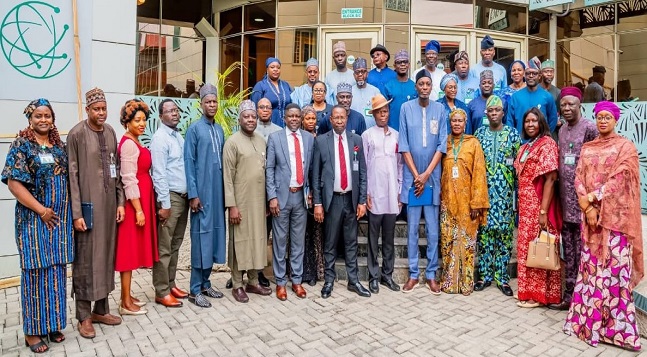
The National Information Technology Development Agency (NITDA) has reinforced its commitment to advancing Nigeria’s digital transformation agenda through strengthened collaboration with key strategic institutions, as it hosted the Director General of the National Institute for Policy and Strategic Studies (NIPSS), Professor Ayo Omotayo, alongside participants of the Senior Executive Course (SEC) 48, 2026.

The visit, which builds on an earlier strategic study tour, provided a platform for in-depth engagement on the role of digital innovation in driving sustainable economic growth, with particular focus on the Orange Economy.
Representing the Director General of NITDA, Kashifu Inuwa CCIE, the Director of Stakeholder Management and Partnerships, Dr Aristotle Onumo, highlighted the Agency’s commitment to fostering a vibrant digital ecosystem through inclusive policies, strategic partnerships, and capacity development initiatives.
“NITDA is committed to creating an enabling environment where innovation can thrive by bringing together government, private sector, academia, and creatives to drive Nigeria’s digital economy,” he stated.
Inuwa underscored the growing importance of the Orange Economy, describing it as a critical driver of innovation and economic value through intellectual property. He identified sectors such as digital content creation, film, animation, and digital art as key contributors to national development.
“The Orange Economy represents a powerful opportunity to transform our rich cultural heritage and creativity into sustainable economic growth,” he noted.
He further highlighted Nigeria’s unique advantage, particularly its youthful and creative population, while calling for stronger collaboration among stakeholders to fully harness the sector’s potential.
“With our youthful population and rich cultural assets, Nigeria is well-positioned to become a global leader in the Orange Economy if we deepen collaboration and investment across the ecosystem,” he added.
During the engagement, NITDA also presented its strategic initiatives aimed at supporting the digital and creative sectors, including digital infrastructure development, promotion of digital literacy, and implementation of policies that enable startups and innovators to scale.
Addressing challenges facing the sector, Inuwa pointed to issues such as limited access to funding, infrastructure gaps, weak intellectual property protection, and ecosystem fragmentation, while emphasising the need for coordinated action.
“Addressing challenges such as funding gaps, infrastructure deficits, and intellectual property protection is critical to unlocking the full potential of Nigeria’s creative economy,” he said.
The Agency reiterated its target of achieving 70 per cent digital literacy by 2027, noting that ongoing programmes are equipping millions of Nigerians with essential digital skills, including those in underserved and informal sectors.
In his remark, Professor Omotayo described the visit as an important opportunity to deepen understanding of how digital technologies are reshaping economic sectors, particularly the creative industry. He noted that the insights gathered would contribute significantly to policy recommendations aimed at strengthening Nigeria’s economic framework.
Participants of the SEC 48 programme engaged actively during the session, raising questions on capacity development, access to tools, and frameworks for protecting digital content. NITDA highlighted its ongoing collaborations with industry stakeholders to provide training, innovation hubs, and access to digital tools for young Nigerians.
The engagement concluded with a renewed commitment from both NITDA and NIPSS to strengthen collaboration in research, policy development, and capacity building, aimed at positioning Nigeria as a globally competitive force in the digital and creative economy.

Nigeria Revenue Service (NRS) has assumed responsibility for collecting mineral royalties from mining operators nationwide, following new tax laws effective January 1, 2026.

NRS
The shift emerged from a Thursday meeting between Solid Minerals Development Minister Dele Alake and NRS Chairman Dr. Zacch Adedeji. Their joint statement, endorsed by both, confirms NRS now administers all federally collectible revenues, including royalties.
Enacted by President Bola Tinubu on June 26, 2025, the Nigeria Tax Laws 2025 empower this transition. The Ministry of Solid Minerals Development remains a key partner, supplying pricing data, geological insights, and sector coordination.
NRS Special Adviser Dare Adekanmbi’s statement outlines collaborative steps: a nationwide sensitization program for operators on filing and payments; development of a digital royalty system; and regular joint technical sessions to address issues.
Both agencies pledge orderly, transparent implementation to boost the mining sector. Operators must comply with obligations and join upcoming programs.
The move aims to streamline revenue collection while fostering mining growth.

Offset Communications Slams N50m Suit against Qore Technologies for Alleged Copyright Infringement

Compensation for Poor Service Quality is Automatic- NCC

SERAP Sues CCB over Electoral Act, New Tax law

Tinubu Approves N3.3 Trillion Payment Plan to Boost Power Supply

FG to Strengthen Cybersecurity Coordination as NDPC Probes Alleged Data Breach

Spotify’s Loud & Clear Report Reveals Over ₦60Bn Revenue for Nigerian Artists in 2025

Madonna University Taps Tech Guru Adote for Strategic Board Role

China Threatens to Shut Nigeria’s Satellite Over $11.44m Unpaid Debt

Healthcare Under Attack: Why Cybersecurity is Now Critical Care

Why JustMarkets Is a Strong Choice for Gold Trading




 General News3 days ago
FG, Others Say Nigeria Wastes 38m Tonnes of Food Annually

 E-Financial3 days ago
CBN, Banks, Fintechs Launch PSPC to Boost Nigeria’s Payment System

 News3 days ago
NITDA Strengthens Collaboration with NIPSS to Drive Digital Innovation, Orange Economy Growth

 E-Financial2 days ago
N4.65 Trillion in the Vault, but is the Real Economy Locked Out?

 E-Financial3 days ago
CycleFlow, IFC Launch Supply Chain Finance Platform in Nigeria

 General News2 days ago
Union Bank Looted: How Former Directors Gambled with Billions and Nearly Destroyed a National Bank

 E-Financial3 days ago
Anchor Gets Nigerian, Canadian Licences as Transactions Crosses $2.5Bn

 E-Financial3 days ago
Ecobank Assures of Seamless Easter Banking Services