

Special Reports
Facts, Fiction in CBN Fine on MTN Nigeria


The Central Bank of Nigeria on Wednesday, 28th August 2018, announced that it is imposing sanctions on four (4) banks for facilitating the ‘illegal’ repatriation of capital from Nigeria on behalf of MTN Nigeria and its shareholders.
This surreptitiously followed the publication of an ‘exclusive’ on Sahara Reporters alleging that the Central Bank Governor, Godwin Emefiele, was reluctant to fine unspecified individuals, corporate bodies and other entities for unlawful conduct in respect of repatriation of dividends to offshore shareholders of MTN Communications Nigeria Limited.
This follows in the heels of a N330 billion fine that was imposed on the Information and Communications Technology (ICT) company by Nigeria’s telecommunication regulator, Nigerian Communications Commission (NCC) in October 2015.
The hefty fine has since resulted in a very significant fall in MTN Nigeria’s share price and the timing of the fining, coupled with continuously rising red flags has developed intense speculation as to the veracity of the allegations that have been made.
This has brought to the fore certain issues that require answers: The National Assembly investigations were completed in 2017, what has spurred on the CBN to act at this moment?

If the Central Bank of Nigeria has approved the accounts of these (Standard Chartered, Stanbic, Citibank and Diamond)banks for the last ten years and continued to approve the repatriation of funds by MTN, then could it have knowingly approved transactions it believed to be fraudulent?
When did the CBN determine that MTN and the banks were culpable of such ‘illegal conducts’ and what has caused the CBN to allow MTN to repatriate funds since 2015?
Why do these infractions cover only the period 2007 to 2015? What conditions changed in 2015? Does this allude to the fact that all MTN dividend and capital repatriation payments since 2015 will be deemed illegitimate or fraudulent? If so, how will that be possible, with the same CCIs issued?
These niggling questions need to be answered as soon as possible as investor confidence in Nigeria is quickly depleting as a result of the recent actions of CBN.


Special Reports
IFC, Standard Chartered Partner on Supply Chain Finance to Support African Businesses

The World Bank Group, through its private sector arm – the International Finance Corporation (IFC) – and Standard Chartered today announced a new risk sharing facility aimed at strengthening supply chains and boosting business growth across Africa.

This partnership will introduce supply chain finance solutions in eight markets – Côte d’Ivoire, Egypt, Ghana, Kenya, Nigeria, South Africa, Tanzania, and Zambia – supporting companies in key sectors such as agriculture, healthcare, and manufacturing. By doing so, the facility will help ensure their suppliers get faster payments, freeing up the working capital they need to improve production, pay wages, and hire.
The risk-sharing facility will cover up to $300 million in supply chain and trade finance assets originated by Standard Chartered in Africa. It comprises a range of underlying supply chain financing instruments – such as payables finance, receivables discounting, and pre-shipment finance programs – which can help smaller businesses get paid earlier, reduce the cost of working capital, and invest in growth. This strengthens linkages between buyers and suppliers, improves delivery reliability, and ultimately supports job creation throughout the value chain.
IFC will provide guarantees for up to $150 million from its own account, with $100 million committed as the first tranche under the program, to support transactions in both U.S. dollars and selected local currencies.
Over the next three years, the partnership is projected to enable about $1.9 billion in supply chain finance transactions, providing access to finance for businesses across Africa. It aims to support more than 500 suppliers, including small and medium enterprises (SMEs), in both domestic and global value chains, with the potential to indirectly benefit over 1 million farmers.
“Supply chain finance is among the fastest ways to narrow the growing finance gap that businesses, particularly small and medium enterprises, are facing in emerging economies,” said Mohamed Gouled, IFC’s Vice President, Products & Clients. “By partnering with Standard Chartered to support companies at the center of strategic value chains, we can unlock much-needed working capital at scale for businesses across Africa, including smaller firms and farmers, making supply chains more competitive and boosting job creation.”
Dalu Ajene, Chief Executive and Head of Coverage, Standard Chartered Africa, said: “This $300 million facility with IFC underscores our shared commitment to strengthening Africa’s supply chains and enabling sustainable business growth.
“As a super-connector bank with deep expertise across key trade corridors linking Africa to Europe, Asia, the Middle East and the Americas, we are uniquely positioned to channel capital and innovation into the real economy.
By expanding access to supply chain finance, we are helping African companies unlock liquidity, manage risk, and invest with confidence. Our collaboration unites Standard Chartered’s cross-border expertise with IFC’s development mandate to empower businesses – from major corporations to smaller local suppliers – to engage more actively in regional and global trade, fostering job creation and promoting inclusive growth.”
Global demand for supply chain finance has surged – in 2025, the estimated volume reached about $2.7 trillion, showing an 8% increase year-on-year. Yet supply chain finance has not scaled at the same pace in emerging markets, especially in lower income and fragile contexts, largely because commercial banks tend to focus on developed markets. This facility aims to mitigate risk in portfolios of short-term trade and supply chain assets, expanding access in markets where capital is scarce.
This is IFC’s first project under the Global Supply Chain Finance Program and the Africa Trade and Supply Chain Recovery Initiative supported by the International Development Association (IDA) Private Sector Window Blended Finance Facility.

Tizeti, West Africa’s pioneer solar-based internet service provider, is set to host technology enthusiasts, IT innovators, startup executives, corporate business leaders, and digital thought leaders at the second edition of its futuristic Tizeti NeXTGEN conference themed “The Next Frontier”.

Tizeti’s NeXTGEN conference, which coincides with its 10th anniversary, will feature an exciting array of speakers, over 500 physical and virtual attendees and conversations on Africa’s digital environment, highlighting the role of digital transformation in empowering more Nigerians, stimulating economic activity, and providing a foundation for a robust and thriving ecosystem to enable digital leadership for Africa in, the 4.0 world.
Speaking ahead of the conference, Kendall Ananyi, founder and Chief Executive Officer of Tizeti, said Tizeti’s NeXTGEN conference will announce new digital innovations and products, explore new partnerships, and articulate strategies to accelerate Africa’s digitization.
According to him, the edition’s theme, ‘The Next Frontier’ reflects the company’s belief that the next source of digital growth in Africa, given the continent’s market of over 1 billion people, its vibrant entrepreneurial ecosystem, and the flurry of initiatives and investments launched to connect Africans to the internet.
“This NeXTGEN conference is particularly memorable for us because it’s our second event and coincides with our 10th anniversary.
“In 10 years, Nigeria has done significantly well in the tech space by attracting over $4b investments, building global brands, and emerging as the unicorn capital of Africa, all these with less than 40% internet penetration.
“With more connected states, improved broadband access, and strategic partnerships, Nigeria and Africa can accelerate tech development, empower more people, stimulate the economy, and widen the broadband envelope in Africa”, Ananyi said.
Ananyi notes that the technology conference will feature product launches on Tizeti’s plans around Next Generation Unlimited Wi-Fi and Customer Service, and expanding access to unlimited internet in Africa.
Tizeti’s NeXTGEN, which will hold on August 5, 2022, will provide an opportunity for stakeholders in African telecommunications, technology, and business communities to share their ambitions for Africa’s next frontier, while networking, discovering new opportunities and discussing breakthrough trends in the global and African telecoms and technology ecosystem.
Special Reports
All You Need to Know About Paradigm Initiative’s 3-day Digital Policy Workshop in Tanzania
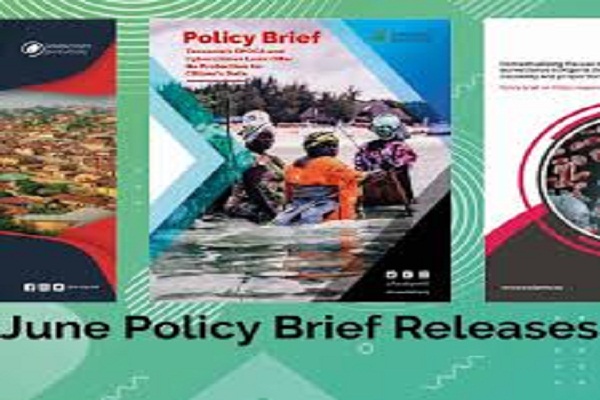
Paradigm Initiative, a pan-African social enterprise working to advance digital rights and inclusion in Africa, has concluded a 3-day Digital Policy Workshop for Tanzanian Digital Rights Stakeholders from 7th-9th July 2020.
Over 100 people applied to attend the workshop with over 65 persons selected to participate.
The workshop was officially opened by Nnenna Paul-Ugochukwu, chief operating officer, Paradigm Initiative and took place over the course of three days, introducing participants to the basic concepts of digital rights and the existing policy, legal and institutional framework in Tanzania.
The workshop specifically examined Tanzania’s Cybercrimes Act and the Electronic and Postal Communications Act (EPOCA).
According to Ekai Nabenyo, program officer at Paradigm Initiative, “It is evident that there is an urgent need to create an empowered civil society and digital rights community for the Republic of Tanzania to be able to safeguard its citizens’ digital rights”.
“The civil society should be empowered to shape and dictate digital policy in the country,” Ekai further states.
Participants urged the government of Tanzania to respect the rights of its citizens and to provide the necessary platform for civil society to oversee government adherence to its human rights obligations as election dates draw closer.
They also expressed concerns that the current digital policy environment provides a fertile platform for human rights violations and a tendency for impunity on the part of state officials.
“As a digital rights advocacy organization, we endeavor to continue to closely monitor the state of digital rights in Tanzania.
“We shall continue to work with other stakeholders to build the capacity of civil society groups to be able to competently influence, protect and safeguard digital rights in Tanzania and in the region, through similar interventions” says Adeboye Adegoke, senior program manager at Paradigm Initiative.
The end goal of the workshop is to ensure that stakeholders in Tanzania that already understand and follow current trends in digital rights, Tanzania civil society groups, and others can leverage the expertise of Paradigm Initiative and its partners to be able to work together with the regulatory authority and the parliament in Tanzania towards improving the state of digital rights in the country.
Participants agreed to work together in order to present a united and formidable force in its advocacy engagements in Tanzania.

YEDC Warns Customers, Says 20 Percent Electricity Bonus is Scam

FG to Support 12 Tech Startups with N482m under iDICE

NBC, INEC, Plan Joint Broadcast Monitoring Framework ahead of 2027 Elections

No Going Back on July 31 Deadline for Insurance Firms’ Recapitalisation – NAICOM

Court Affirms FCCPC’s Power to Regulate Digital Lending

NRC, Ponzi Scheme Collapses Resulting Loss of Billions of Naira

NASENI Moves to Digitize CCB’s 5m Assets Declaration and Operations

Lebara Nigeria Launches Lebara Play, Africa’s First Telecom-Owned Micro-Drama Platform

CANAL+ Partners Samsung to Pre-Load DStv Stream on New Samsung TVs In Nigeria, Other African Countries

Tokenization, Blockchain Technology will Transform Financial Institutions – IMF




 E-Financial2 days ago
Access Holdings Sells 7.44% Stake in Ghana Unit

 E-Financial2 days ago
NDIC Urges Youths to Shun Ponzi Schemes, Embrace Savings

 News2 days ago
Adebutu, PDP Chieftain Accuses Nigerian Governors of Embezzling LG Allocations

 News2 days ago
NIMASA Unveils Accelerator Scheme to Drive Innovation, Sustainable Growth

 E-Financial2 days ago
NRS Issues July 31 Deadline for e-Invoicing Compliance

 E-Business2 days ago
SERAP to Sue NASS over Bill Empowering NDPC to Regulate Social Media

 News2 days ago
ICPC Secures Final Forfeiture of N941m Linked to IPPIS Fraud

 News2 days ago
eBusinessLife Advocates Greater Support for Girls in ICT as Students Showcase AI Innovations