

News
FG Drags UK’s NCA to Court over £150m Abacha Loot


Nigerian government is locked in a court battle with Britain’s National Crime Agency (NCA) over control of €180 million (£150 million) that was stashed abroad by late Gen. Sani Abacha, Nigeria’s former head of State.

Late Gen. Sani Abacha
By yesterday’s official exchange rate of the British Pounds Sterling at N563, as seen on the website of the Central Bank of Nigeria (CBN), the money in contention is about N84.5 billion.
The United Kingdom’s The Telegraph reported that the case was again poised to spark fresh questions about dirty money flowing through the City of London.
In the latest legal tussle over the money, generally known in Nigeria as “Abacha loot”, the report stated that Nigeria wanted the crime-fighting agency, NCA, to release funds that it froze at the request of US authorities.
In May 2020, the federal government confirmed the receipt of $311 million looted by a late dictator, Abacha, repatriated from the United States and Island of Jersey.
According to Abubakar Malami, attorney general of the federation and minister of Justice, “The amount increased significantly from over $308 million to over $311 million because of the interest that accrued from February 3, 2020, to 28th April, 2020, when the fund was transferred to the CBN.”
It came after the recovery of $322 million from Switzerland in 2018.
At the time, Malami noted that the government had committed that the asset would support and assist in expediting the construction of three major infrastructure projects across Nigeria, namely, Lagos – Ibadan Expressway, Abuja – Kano Road, and Second Niger Bridge.
It was estimated that from 2007 to 2020, about $1.5 billion had been returned to Nigeria from different parts of the world.
According to the latest report, American prosecutors said the money could be traced back to a suspected $2.2 billion (£1.6 billion) or more that was plundered by Abacha and his associates during the dictator’s five-year reign.
In the complex issues surrounding the repatriation of the funds, the authorities in the US sought to return the money to “the people of Nigeria”, under the so-called Kleptocracy Initiative.
But the Nigerian government was said have sought to “sidestep” the process and obtain the funds directly through an application to the High Court, in a move opposed by UK and US authorities, documents seen by The Telegraph and SourceMaterial showed.
Although Abacha died more than 20 years ago, the piles of treasure he looted from Nigerian coffers have kept cropping up, with at least $2 billion being thought to have stolen during his five years in power.
The former dictator’s spoils have been linked to dozens of offshore bank accounts over the years, as investigators unravel the intricate web he and his associates spun across the globe.
British and American authorities have been locked in talks over tens of millions of pounds of cash that investigators say can be traced to Abacha’s plundering, the investigation found.
The case, which involves a serving Nigerian politician who was one of Abacha’s top henchmen, includes cash in British bank accounts that has been frozen by the National Crime Agency.
However, the Nigerian government has brought its own legal action against the NCA in a bid to end the tussle, it has emerged.
The report stated, “It is a complicated story with many twists and turns. But the on-going struggle for ‘Abacha’s loot’ reveals the difficulty in recovering stolen funds, the frustrations of law enforcement, and the way people accused of corruption have relied on respectable law firms to argue their cases in court.”
On the modus operandi used by Abachi to execute the looting, the report stated that after seizing power in a 1993 coup, Abacha set about using his position as Nigeria’s head of state to place himself above the law and skim vast sums of money from the oil-rich nation.
In perhaps the most brazen example, he would tell advisers to make spurious requests to him for money to deal with national “emergencies”, according to US court documents.
Signed letters would then be sent to the CBN, which would provide cash, travellers’ cheques or arrange a wire transfer.
The report added, “Money was stuffed into boxes or bags and transported to Abacha’s house, before associates arranged for it to be sent abroad.
“At least $2 billion is thought to have been stolen this way, using more than 60 letters to the central bank.
“Abacha also arranged for the government to sell bonds to a company controlled by his allies before buying them back at vastly inflated prices, generating an illicit windfall of $282 million.”
Separately, the report stated that Abacha and his associates extorted French engineering firm, Dumez Group, of $97 million and used his spoils to live a luxurious lifestyle.
“Inside his many sprawling homes, he kept piles of glittering jewellery, including gold necklaces and rings, and at one stage as much as $100 million in cash,” the report noted.
However, the money Abacha and his associates plundered became the subject of an international search after the dictator’s sudden death in 1998, aged 54.
The report stated that weeks after his death, Abacha’s widow was caught trying to flee the country with 38 suitcases packed with money and his family later forfeited nearly $1 billion.
“Yet the only clues hinting at where other stashes of money could be found were a few details of secret offshore bank accounts discovered by authorities,” it said.
“Since then, the Nigerians have sought foreign help to recover as much as possible, with more than $1 billion eventually returned from Switzerland alone,” it added.
The effort has been hampered by the sheer complexity of Abacha’s dealings as well as marathon legal battles that have dragged on for years, some involving former associates.
One of the remaining cases, brought by US prosecutors, aims to recover more than $480 million, the report stressed. In just one example of the web of transactions criss-crossing the globe, they outlined in court filings how money was laundered by Abacha and his associates through bank accounts in Lagos, London, New York, Paris, Zurich, and Geneva.
The assets were stashed in banks, including Deutsche Bank, HSBC, and Banque SBA, according to the lawsuit, although there was no suggestion that the banks were involved in any wrongdoing.
The Telegraph stated, “This legal action eventually resulted in a 2020 deal to repatriate about $321 million, which had been laundered through the US banking system and then held in accounts in Jersey under the name of Doraville Properties Corporation, a British Virgin Islands company, and Abacha’s son, Mohammed.”
Meanwhile, the new development comes as Britain fights claims that it has been very tolerant of dirty money flowing through the City of London.
US officials said last month that they were concerned that deep links between the UK and several Russian oligarchs meant that sanctions issued against Moscow if it invades Ukraine could be rendered ineffective.
Last Sunday, British Labour MP David Lammy accused ministers of doing too little to deal with corruption in Britain.
Lammy said, “We have to fix the dirty money problem we have, this huge problem of money laundering in London, of corruption and fraud.
“There’s so much that (ministers) are not doing. Joe Biden knows it and he’s concerned.”
But simultaneously, another court tussle in the UK is happening in parallel. At stake is more than €90 million, some of which came from Abacha’s security votes fraud, according to a High Court judgement issued in 2014.
The money is said to be controlled by a Singapore-based trust set up for the benefit of the family of Abubakar Bagudu, the serving governor of Kebbi State, who is accused of playing an “instrumental role” in many of Abacha’s corrupt schemes by US prosecutors.
Bagudu has always denied any wrongdoing. His office did not respond to a request for comment, the report said.
His brother, Ibrahim, is a director of two companies known as Blue Holdings that are owned by the Singapore trust.
According to the Pandora Papers, a leaked cache of documents obtained by the International Consortium of Investigative Journalists last year, the Bagudu brothers enlisted Farrer & Co, an elite London law firm that has advised the Queen, to help them set up these businesses.
They moved €98 million from a British Virgin Islands trust to a new structure spanning Singapore and the Cook Islands.
Farrer & Co said it carried out “extensive due diligence” on Bagudu and that it obtained approval from the Serious Organised Crime Agency (SOCA), the precursor to the NCA, to move the funds.
According to sources familiar with the case, the amount controlled by the Singapore trust may now have grown to as much as €180 million. It is kept in accounts at Waverton Investment Management and James Hambro & Partners, both based in London.
The NCA has been working with American authorities in a bid to confiscate the funds and return them to “the people of Nigeria,” the report stated.
However, the Nigerian government wants them to be returned directly to the country and the parties, including lawyers for Bagudu, have been holding negotiations about a possible settlement, court filings in the US show.
Bagudu struck a deal with the Nigerian government in 2003, in which he agreed to return a sum of money but made no admission of wrongdoing, and the agreement was reaffirmed by Nigerian President Muhammadu Buhari in 2018. What this means, according to the report, is that almost 70 per cent of the UK money could be handed to Bagudu if returned.
Court filings showed the Nigerian government subsequently sought to unlock the funds and repatriate them in legal action against the NCA – a move that was opposed by the UK and US.
The country hired Kingsley Napley, the London law firm famed for representing a host of celebrities, including Rebekah Vardy, to represent it. The firm and the NCA both declined to comment, the report noted.
The report quoted Spotlight on Corruption, a non-profit campaign group, as saying that the case raises questions about whether, “law enforcement is being paid and resourced enough to get its act together”.
It accused the NCA of having effectively “cleaned” the money by approving the transfer to Singapore and warned against returning cash to Bagudu.
However, Jonathan Benton, a former NCA senior detective who now runs consultancy Intelligent Sanctuary, said the case also underlined the sheer complexity of efforts to reclaim Abacha’s loot.
Benton stated, “I care passionately about tackling corruption and it is important we hold people to account.
“But it can be a challenging and drawn-out process and sometimes you have to be pragmatic. In those situations, the law allows you to negotiate. It is repugnant. But Nigeria desperately needs the money that Abacha stole.”



EFCC


The African Development Bank Group last week approved an investment of €6.5 million in the Saviu II fund in order to support technology start-ups through their seed phase and first institutional fundraising, mainly in French-speaking Central and West Africa.

The Bank will invest €4.5 million as equity and €2 million as a first-loss hedging tranche on behalf of the European Commission, under the Boost Africa Programme.
This participation of the Bank Group will enable the Saviu II fund to give priority to companies with a strong technological or digital component.
Saviu II, the second investment vehicle of Saviu Partners, plans to invest between €500,000 and €3 million in about 20 technology or technology-oriented business-to-business start-ups in the seed phase or carrying out first institutional fundraising.
The Saviu II venture capital fund aims to make at least 60% of its commitments in the French-speaking countries of West and Central Africa: Côte d ‘Ivoire, Cameroon, Benin, Senegal, Togo, Burkina Faso and Mali.
The fund can also co-invest in promising technology companies in East Africa that have a strong team and business model, and whose strategy includes entering the market in French-speaking West African countries and establishing a strong presence there.
In addition, the fund will devote a dedicated envelope to pre-seed investments, focusing on minority equity investments, usually in co-investment with studios, incubators or other ecosystem partners.
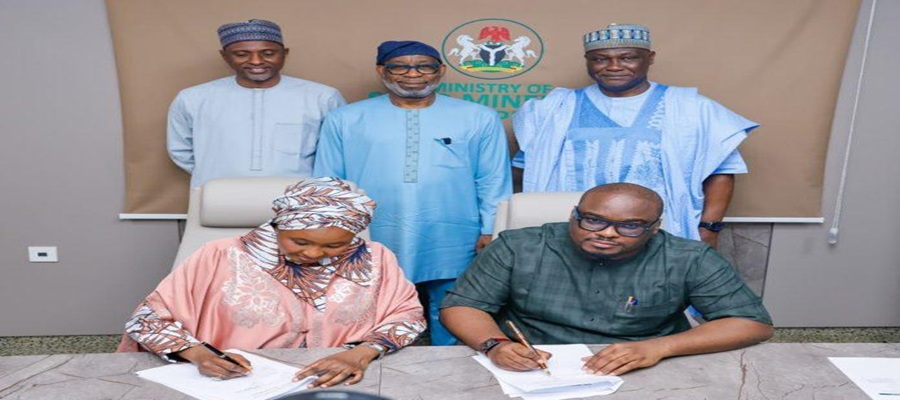
Nigerian Government has signed a $1.3 billion Memorandum of Understanding (MoU) with Africa Finance Corporation (AFC) via the Solid Minerals Development Fund (SMDF) to fund an alumina refinery, national geoscience mapping, and a strategic investment vehicle for mining growth.

Special Assistant to the Minister of Solid Minerals Development, Segun Tomori, said the refinery will process one million tonnes of bauxite yearly using a modern Bayer process, powered by an on-site gas-fired cogeneration plant.
Minister Dele Alake called it a transformative milestone boosting GDP, aligning with reforms that improve investment climate, regulations, and licensing to attract private capital. He directed agencies to fast-track permits.
The 20-year project at 95% utilization eyes 19 million tonnes total output, $1.2 billion annual GDP addition, $25 billion economic impact, and $8 billion forex earnings, per feasibility studies.
SMDF Executive Secretary Fatima Shinkafi termed it the agency’s biggest funding deal, supporting value-addition policy.
The partnership extends to geoscience mapping for mineral data, de-risking exploration, and a joint vehicle for mining assets.
Permanent Secretary Engr. Farouk Yabo praised the reforms. Shinkafi signed for government; AFC’s Franklin Edochie for the corporation, witnessed by AFC CEO Samaila Zubairu.
Tomori positioned it as Nigeria’s largest private mining investment and FDI magnet.

SEC Revokes Registration of Kensington Agro Trading Limited

NCDC Raises Alarm over Lassa Fever Ravaging 18 States in Nigeria

Lagos Deploys Drones, AI to Boost Traffic Response

Purple Woman 3.0 Is Back, to Empower Women in Tech this IWD 2026

NRS Targets N40trillion in Tax, Royalty Revenue in 2026

Accidental Billionaire Opts for Jail Instead of Returning Money Credited Him by Mistake

Kaspersky Brings more Transparency to Threat Detection with New Hunt Hub

Dr. Cairo Ojougboh Foundation Bolsters Nigeria’s Education Drive with ₦2.7m Student Support

NDPC Commits to Balancing Data Privacy, Protection Information

OADC Lagos Reinforces Commitment to Local Data Hosting and Digital Transformation @ NDPC’s National Privacy Week Summit




 E-Financial3 days ago
Iran-Israel-US Conflict and CBN’s FX Gains: A Stress Test for Nigeria’s Monetary Stability

 E-Financial3 days ago
Mutual Benefits Assurance Reaffirms Full Regulatory Compliance, Enhanced Governance

 General News3 days ago
JAMB Uncovers AI-Driven Fraud Targeting UTME Candidates, Warns Parents

 General News3 days ago
SERAP Asks FCCPC to Investigate Google, Meta, Others over Alleged Rights Abuses

 Telecom2 days ago
Sunil Bharti Mittal Conferred GSMA Lifetime Achievement Award for Transforming Global Telecommunications

 News3 days ago
TeamApt, Awabah Partner to Boost Pension Drive for Nigerians

 News3 days ago
FlashChange CEO, Bidemi Oke, Urges Startups to Build Strong Governance Structures Early

 Telecom2 days ago
Why Digital Trust Matters: Secure, Responsible AI for African SMEs?