

E-Business
FG Taps SecureID to Manufacture AfriGo Card, First National Domestic Card Scheme

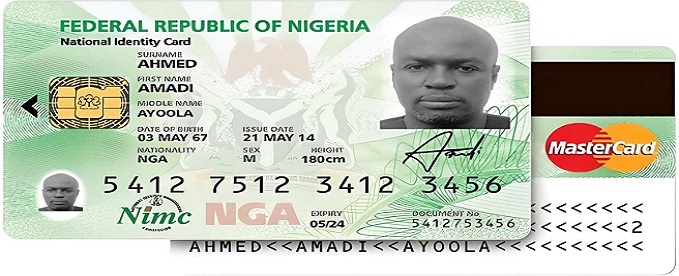
National Identity Management Commission (NIMC) has appointed SecureID, a Lagos-based company as first manufacturer of AfriGo Card, the national domestic card scheme, an innovative identity solution with payment functionality for all types of social and financial services.

The appointment is in collaboration with the Central Bank of Nigeria (CBN) and the Nigeria Inter-bank Settlement System (NIBSS).
A statement signed by Kayode Adegoke, head of Corporate Communications at NIMC, said the National ID card, layered with verifiable national Identity features, is backed by the NIMC Act No. 23 of 2007, which mandates NIMC to enroll and issue a General Multipurpose Card (GMPC) to Nigerians and legal residents.
AfriGo, according to the statement, will address the demand for physical identification enabling cardholders to prove their identity, access government and private social services, facilitate financial inclusion for disenfranchised Nigerians, empower citizens, as well as encourage increased participation in nation-building.
Adegoke said, “Only registered citizens and legal residents with the National Identification Number (NIN) will be eligible to request the card.
“The card, which will be produced according to ICAO standards, is positioned as the country’s default national identity card. In addition to this functionality, cardholders will also be able to use the cards as debit or prepaid cards by linking the same to bank accounts of their choice.
“The card shall enable eligible persons, especially those financially excluded from social and financial services, to have access to multiple government intervention programs.
“In line with data protection regulation and public interest, NIMC remains committed to protecting cardholders’ personal data and will ensure compliance with international standards on data security protocols as security features that protect the confidentiality and safety of users’ information.
“Key features will include: Machine-readable Zone (MRZ) in conformation with ICAO for e-passport information
Identity card Issue Date and document number in line with ICAO standard.
“Additional features include travel, health insurance information, microloans, agriculture, food stamps, transport, and energy subsidies, etc.
“Nigeria’s quick response code (NQR) containing the national identification number
“Biometric authentication, such as fingerprint and pictures, as the primary medium for identity verification through the data on the card chip
“Offline capability that allows transactions in areas with limited network coverage or zero infrastructure connectivity
“Functionality as a debit and prepaid card catering to both banked and unbanked individuals
“Requests for cards by registered citizens and legal residents will be made available online, at any commercial bank, various agencies or agents participating in multiple programs and/or any NIMC offices nationwide.”



Federal Government has unveiled plans to establish a National Cybersecurity Coordination Council, signaling a shift toward a more unified, intelligence-driven approach to defending the country’s rapidly expanding digital economy.

Conceived as a non-statutory, multi-stakeholder body, the proposed Council will enhance coordination, enable trusted information sharing, and guide government strategy on cybersecurity, risk management, and national response amid increasingly complex cyber threats.
The initiative, championed by Bosun Tijani, minister of communications, innovation and digital economy, is designed to bring together government institutions, private sector players and technical experts into a single collaborative platform to strengthen the country’s cyber resilience.
Tijani noted that this initiative comes in response to a wave of recent cyber incidents that have disrupted operations across key private institutions and public sector.
In recent times, Nigeria’s financial system has faced mounting cyber pressure, reflecting global trends as cybercrime is projected to cost the world over $10.5 trillion annually, according to Cybersecurity Ventures.
Analysts say these attacks are increasingly coordinated and sophisticated, prompting the government to recognise that fragmented, institution-specific approaches can no longer manage systemic cyber risks effectively.
Under the new framework, the government aims to promote a “collective defence” model, an approach widely adopted in advanced digital economies where threat intelligence is shared in real time across institutions.
The Council is expected to include chief information security officers, cybersecurity associations, the Nigerian Computer Society, global technology providers, researchers, law enforcement agencies and civil society groups, ensuring a broad-based and technically grounded response architecture.
Key priorities will include developing national threat intelligence-sharing systems, harmonised cyber defence protocols, and coordinated incident response, while strengthening capacity to close Nigeria’s cybersecurity talent gap.


Oracle, US-based technology giant, has initiated a sweeping round of layoffs affecting thousands of employees globally, with India among the worst-hit regions, according to multiple reports.

The job cuts, which began on March 31, are part of a broader restructuring exercise that could impact between 20,000 and 30,000 employees worldwide, making it one of the largest workforce reductions in the company’s history.
While the exact number remains unconfirmed, multiple reports suggest that around 12,000 employees in India have been affected,
Employees across several geographies, including India, the United States, Canada, and Mexico, reported receiving termination emails early in the morning, informing them that their roles had been eliminated with immediate effect.
“Today is your last working day,” the email stated, citing “organisational change” as the reason for the decision. Access to company systems, including email and internal platforms, was revoked shortly thereafter.
The communication, according to Business Insider, described the move as part of a broader “reduction in force and other terminations,” and said affected employees would be eligible for severance benefits subject to company policy.
The email also instructed employees to share personal contact details to receive separation documents.
In India, impacted employees have reportedly been offered severance packages that include 15 days’ salary for each completed year of service, notice period pay, leave encashment, gratuity where applicable, and an additional two-month salary top-up in cases of voluntary separation.
The layoffs are linked to Oracle’s strategic shift towards artificial intelligence (AI) and cloud infrastructure.
The company has announced plans to invest approximately USD 50 billion in AI infrastructure and has reportedly raised an equivalent amount in debt to fund its expansion.
In a recent regulatory filing, Oracle said it expects restructuring costs for fiscal 2026 to reach up to USD 2.1 billion, largely driven by severance payouts and related expenses.
The move comes as Oracle looks to strengthen its position against global cloud competitors such as Amazon and Alphabet.
Uncertainty continues to loom over employees, with reports indicating that another round of layoffs could follow in the coming weeks. Employees who were affected described the layoffs as abrupt, with little prior indication.
Some former staff members have taken to social media to share their experiences.
Tricia S Marsh, a former Senior Principal at Oracle, said the layoffs marked the end of an important chapter in her career while urging affected colleagues to remain hopeful.
As of May 2025, Oracle had around 162,000 full-time employees globally.

Kaspersky Global Research & Analysis Team (GReAT) has uncovered an active malicious campaign distributing a previously undocumented RAT with a very broad feature set. Beyond the standard remote access trojan functionality, it combines stealer, keylogger, clipper, and spyware capabilities.

Cybercriminals are selling it to third parties as MaaS (malware-as-a-service) promoting it on YouTube and Telegram, increasing the likelihood of its use across a wider range of actors, including less-skilled operators.
Due to its stealer functionality, the malware can collect a wide range of data about its victim: it gathers system information, extracts credentials for Steam, Discord and Telegram, and also harvests data from web browsers. It also poses a threat to cryptocurrency users, as it includes a browser-based clipper that replaces crypto wallet addresses.
Beyond data theft, CrystalX RAT is capable of full-scale surveillance, with the ability to take screenshots, record audio from the microphone, and capture video from both the webcam and the victim’s screen.
Particularly notable is the CrystalX RAT “playful” Prankware feature set, which is actively promoted by the developers. These capabilities allow operators to visibly interfere with the victim’s system by shaking the mouse cursor, setting wallpapers on the victim’s screen, changing screen orientation, hiding desktop icons, forcing system shut downs, and even delivering real-time pop-up notifications and messages to the victim.
While seemingly trivial, these features introduce a disruptive and psychological dimension to the attack, making the attack both visible and distressing for the victim.
Kaspersky reports attacks targeting users in Russia, but the trojan has the potential to spread to other countries due to its sales and distribution model.
“Such a diverse feature set effectively enables a 360-degree compromise of the victim and a complete loss of privacy. Beyond gaining access to account credentials, the stolen data could potentially be used for blackmail.
“At the moment, the initial infection vector is not precisely known, but it is already affecting dozens of victims. Our telemetry is already detecting new versions of the implants, indicating that this malware is still actively developed and maintained.
“We expect the number of victims to grow significantly and its geographic spread to expand in the near future,” says Leonid Bezvershenko, senior security researcher at Kaspersky GReAT.

UBA Beefs Up Mobile App Security to Stop Fraudulent Debits, Withdrawals

Bharti Airtel Crosses 650m Users

FG Orders Installation of 5000 CCTV Cameras for Surveillance in Plateau

CBN Plans New Payment Systems Vision

Ghana Makes History as First African Country to Integrate Payment National Identity Card

Spotify’s Loud & Clear Report Reveals Over ₦60Bn Revenue for Nigerian Artists in 2025

Madonna University Taps Tech Guru Adote for Strategic Board Role

China Threatens to Shut Nigeria’s Satellite Over $11.44m Unpaid Debt

FCCPC Bans Lagos ‘No Refund’ Policy, Vows Fines and Shutdowns for Traders

Healthcare Under Attack: Why Cybersecurity is Now Critical Care




 News2 days ago
Microsoft Revamps Copilot in Workplace AI Push

 E-Business2 days ago
Kaspersky Warns of a New Phishing Technique Leveraging Bubble, a no-code AI Platform

 Telecom2 days ago
How Recycled SIM Card Linked to N50m Kidnapping Nearly Landed me in Jail – Businesswoman

 E-Financial2 days ago
CBN Directs Banks, Fintechs to Complete Cybersecurity Audit Tool

 Telecom2 days ago
Ouranos Technologies Strengthens Board with Key Leadership Appointments

 General News2 days ago
Senate Gives Tinubu Nod to Borrow Fresh $6Bn

 E-Financial1 day ago
CBN Says 33 Banks Raise Fresh N4.65 Trillion in Recapitalisation Exercise

 E-Business1 day ago
Cybersecurity Firm Uncovers CrystalX RAT which Steals Data, Mocks its Victims