

E-Financial
Fidelity Bank Approves 22 Kobo Dividend Per Share For FY2020

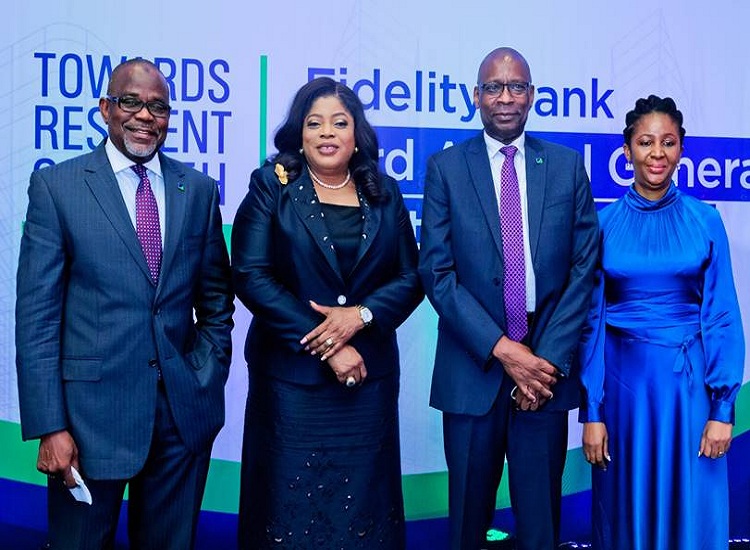
The shareholders of Fidelity Bank Plc have unanimously endorsed the payment of a cash dividend of 22 kobo per share to all Shareholders whose names appear in the Register of Members at the close of business on April 16, 2021. This translates to a dividend yield of 9.2%, making it the 4th most rewarding Bank to investors in the Nigerian Capital Market. This announcement was made at the 33rd Annual General Meeting (AGM) held in Lagos on April 30, 2021.

L-R: Non- Executive Director, Fidelity Bank Plc, Alhaji Isa Inuwa; Managing Director / Chief Executive Officer, Fidelity Bank Plc, Nneka Onyeali – Ikpe; Chairman, Board of Directors, Fidelity Bank Plc, Mustapha Chike- Obi; Company Secretary, Fidelity Bank Plc, Ezinwa Unuigboje at the 33rd Annual General Meeting 2020 FYof Fidelity Bank in Lagos, recently.
Shareholders who spoke at the event praised the Board of Directors and the management team for the 38.7 percent increase in total customer deposits, which rose from N1,225.2 billion in 2019FY to N1.699.0billion and was driven by strong double-digit growth in both local and foreign currency deposits.
Mustapha Chike-Obi, Chairman of the Board of Directors of Fidelity Bank, reassured shareholders at the AGM that the board and management of the bank would maintain the high corporate governance standard synonymous with Fidelity Bank and also ensure the bank continued in its growth trajectory in the years ahead.
“We will continue to strengthen our enterprise risk management capabilities to ensure the sustainability of our business, while modeling our governance practices to align with international best practice”, said Chike-Obi.
Mrs. Nneka Onyeali-Ikpe, Fidelity Bank CEO echoed the Chairman’s sentiments, stating that the bank’s financial performance for the period reflected the resilience of its business model in a challenging operating environment.
Mrs. Ikpe revealed that local currency deposits grew by 49.6 percent to N1,400.8 billion and constitutes 82.5 percent of total customer deposits while foreign currency deposits grew by 3.3 percent to N298.2 billion and now accounts for 17.5 percent of total deposits.
She further highlighted that the bank’s retail banking push continued to deliver impressive results as total savings deposits increased by 54.2 percent to N424.4 billion, making it the 8th consecutive year of recording double-digit growth in savings deposits. Total savings deposits now account for about 25.0 percent of total deposits, an attestation of the Bank’s increasing market share in the retail market segment.
Speaking on the strategy for the current financial year, Mrs. Onyeali-Ikpe, said, “We will continue to focus on redesigning our systems and processes to enhance service delivery, deepen our cost optimization initiatives to reduce operating expenses, and enhance our overall risk monitoring capabilities to ensure both internal and external risks are identified and mitigated. Our growth aspirations will be sustained while we continue to identify new opportunities in the new normal.
“On the back of the evolving dynamics in the economy, we will continue to increase the adoption and migration of customers to our digital platforms and increase our retail banking market share through innovative products and services”, she concluded.
The shareholders expressed their continued confidence in the Bank for its 2020 performance which saw a 50.9 percent increase in core operating profit to N44.9 billion. The share price also rallied 22.9 per cent, outperforming the Nigerian Stock Exchange (NSE) Index, which only gained 10.1 percent. According to Mrs. Onyeali-Ikpe, the Bank showed “strong resilience to the adversities the global economy witnessed in 2020”.
Speaking at the meeting, Dr Farouk Umar, President, Association for the Advancement of the Rights of Nigeria Shareholders, commended the bank for posting encouraging performance in 2020 despite the challenges of the COVID-19 pandemic.
Umar appreciated the bank for paying dividend the same day of the Annual General Meeting unlike their peers in the industry that pay dividends a day after the AGM. Also speaking, Mrs Bisi Bakare, National Coordinator, Pragmatic Shareholders Association of Nigeria, commended the bank for declaring dividend in spite of unfriendly economic environment and the COVID-19 pandemic challenges. Bakare who welcomed Mrs. Onyeali-Ikpe and Mr. Chike- Obi, urged them to sustain the growth and ensure higher dividend in the years ahead.
In compliance with the guidelines of the Corporate Affairs Commission’s (CAC), the meeting was held by proxy and had in attendance very few shareholders because of the COVID-19 precautionary measures.
Onyeali-Ikpe thanked the shareholders and the members of the Board for their continued confidence in the management team and specially appreciated Fidelity Bank customers for their patronage and loyalty.
Fidelity Bank began the year on a positive note having recorded a strong financial performance in the first quarter of 2021, posting appreciable growth in profit for the period ended March 31, 2021.
Details of the unaudited results showed that its profit before tax (PBT) grew by 53.9 per cent from N6.6 billion in the corresponding period in 2020 to N10.1 billion in the period under review. Similarly, net revenue in the period increased by 13.4 per cent from N30.3 billion in the first quarter (Q1) 2020, to N34.4 billion at the end of March 2021. The bank also recorded growth in other performance indices.



There’s something uniquely agonising about having your cryptocurrency stolen. All transactions are recorded in a digital ledger, known as a blockchain, so even if someone takes your money and puts it in their own crypto wallet, it remains visible online.

“You can see your money there on the public blockchain, but there’s nothing you can do to get it back,” says Helen, who lost around $315,000 (£250,000) to thieves.
She likens it to watching a burglar pile up your prized possessions on the other side of an impassable chasm.
For seven years, Helen and her husband Richard (not his real name), both UK residents, had been buying and stacking up crypto coins called Cardano.
They liked the idea of investing in a digital asset that had the potential to rise dramatically in value, unlike funds saved in more conventional ways. They knew it was riskier, but they were careful to keep their digital keys safe.
But somehow hackers got into their cloud storage account, where they kept information about their crypto wallets and how to access them.
In February 2024, after a small test transfer, the criminals swiftly and silently transferred all the couple’s coins to their own digital wallets.
The couple then watched for months as their money was moved from one wallet to another, powerless to do anything. (The inherent contradiction with cryptocurrency is that all transactions are publicly trackable, but users can be publicly untraceable if they choose.)
Helen and Richard are not wealthy. She is a personal assistant, he is a composer, and they had high hopes for their Cardano investments.
“We’d been buying these coins for so long… We used every scrap of money we could find to buy more,” says Richard. “Aside from my parents’ deaths, this theft is the worst thing to happen to me.”
Ever since, Helen has been on a mission to recover their money. She obtained detailed reports from various police forces and the Cardano developers. Now, even though she has the criminals’ wallet addresses, there is nothing anyone can do to unmask them.
Their plan is to save up enough to engage private investigators to try to trace the hackers.
“It leaves you with a feeling of helplessness,” she says, “but I am going to keep trying.
An explosion in crypto crime
A survey carried out for the Financial Conduct Authority (FCA) in August 2024, suggested that approximately 12% of British adults owned crypto-assets – equivalent to about seven million people.
Globally, it has been estimated that 560 million people are now crypto owners. But as ownership rose, so did theft. The pandemic ushered in a surge in the value of crypto coins and, with it, an explosion in attacks on the industry.
And 2025 was another bumper year for crypto criminals, with total thefts standing at more than $3.4bn (£2.5bn), according to investigators at blockchain analysis firm Chainalysis. The annual figure has remained in the same ballpark since 2020.
Most of the money is being stolen through massive cyberattacks on crypto companies. For example, North Korean hackers swiped $1.5bn (£1.1bn) from crypto exchange Bybit in February 2025.
The losses in this case and the vast majority of others are covered by the deep-pocketed crypto firms, with little impact on individuals. But 2025 also saw an increase in the number of attacks on individual crypto investors.
Chainalysis research says these individual attacks rose from 40,000 in 2022 to 80,000 last year.
Hacking, scamming or coercing of individuals accounted for an estimated 20% of all crypto value stolen – estimated at $713m (£532m).
But the company adds that the number could be far higher, as not all victims will choose to report thefts publicly. When this happens, you could be left on your own.
Many thefts or scams in traditional finance are covered by banks or card companies. In the UK, you can complain to the Financial Ombudsman Service and may be compensated by the Financial Services Compensation Scheme.
“Crypto remains largely unregulated in the UK and high-risk,” says the FCA. “If something goes wrong, it is unlikely you will be protected so you should be prepared to lose all your money.”
A stark reminder of this comes if you search online for “Binance account hacked” – Binance is the world’s largest crypto exchange with a reported 1.4m UK users – but the page on its website offering advice to victims of theft is blocked in the UK.
The company has not been accepting new UK clients since 2023 because it is not authorised by the FCA to operate. Yet criminals don’t care where victims are, and people are being targeted all over the world indiscriminately.
Chainalysis has described these attacks on individuals as the “under-documented frontier for crypto crime”.
They put the volume of crimes down to the number of people entering the crypto world as investors, as the value of coins has risen, and argue that improved security practices at major services could have pushed “attackers toward individuals perceived as easier targets”.
Then there is the fact that the more crypto you hold and the more public you are about it, the more likely you are to be targeted – small-time holders (or hodlers, as the community calls them) are far less likely to be affected.
Burglaries, muggings and ‘wrench attacks’
As for the thieves, they could be anywhere.
In October, blockchain researchers from Elliptic, a crypto analysis company, warned that North Korean state-sponsored hackers are increasingly targeting wealthy cryptocurrency owners. There are plenty of young scammers and hackers from other countries, too.
In December in the US, 22-year-old Evan Tangeman pleaded guilty to being part of a group of crypto thieves calling themselves the Social Engineering Enterprise, who are accused of stealing more than $260m (£194m) between October 2023 and May 2025.
Prosecutors allege they targeted the crypto-rich using hacked databases, tricking victims into thinking they were cryptocurrency exchanges, and persuading them to transfer coins.
Members of the gang, who were all young men mostly in the US, are said to have spent the stolen coins on private jets, expensive cars and luxury handbags that they would give away at nightclubs.
In some cases, prosecutors say, the gang organised home break-ins to steal hardware containing the keys to crypto stashes.
Burglaries and muggings have become so common that there is now a term for them in the crypto community – “wrench attacks” – so called because criminals have been known to threaten victims with spanners.
Last April, crypto criminals in Spain tried to force a man and woman to part with their cryptocurrency.
Spanish police said the man was shot in the leg and he, along with his partner, were held captive for several hours while the criminals tried to access their crypto wallets. Eventually, the woman was released, but her partner remained missing, with his body later found in woodland.
Five people were arrested in Spain in connection with the case, while four others in Denmark were charged.
There have been several similar cases in France, including one when an attempted kidnap was captured on video.
Source.. BBC

Despite lingering regulatory uncertainty, Nigeria processed an estimated $92.1 billion in cryptocurrency transactions between July 2024 and June 2025, reaffirming its position as Sub-Saharan Africa’s largest crypto market, according to PricewaterhouseCoopers (PwC).

The figure, published in PwC’s Nigeria Economic Outlook 2026 titled “Turning Macroeconomic Stability into Sustainable Growth”, shows that Nigeria received nearly three times the crypto transaction value recorded in South Africa over the same period.
PwC attributed Nigeria’s dominance to its large population, youthful and digitally savvy users, persistent inflation, and continued foreign exchange (FX) access constraints, which have pushed many individuals and businesses toward crypto and stablecoins as alternative financial channels.
The report noted that crypto adoption in Nigeria reflects both economic necessity and structural transformation in financial behaviour.
PwC said Bitcoin continues to dominate fiat-to-crypto purchases in Sub-Saharan Africa, accounting for 89 per cent of transactions in Nigeria and 74 per cent in South Africa, underscoring its role as a default hedge and entry asset in volatile or constrained financial environments.
It added that stablecoin usage is structurally higher in Nigeria, signalling reliance on crypto rails as an informal FX market and dollar-substitute channel.
However, PwC cautioned that the data reflects only centralised exchange activity and excludes peer-to-peer transactions and informal flows, suggesting that actual volumes may be significantly higher.
PwC projected that Nigeria is likely to retain its position as the region’s largest crypto market in 2026, driven by FX access challenges, inflation sensitivity, and sustained demand for stablecoins as a store of value and settlement mechanism.
The firm also noted that Nigeria had earlier processed about $59 billion in crypto transactions, largely driven by young, tech-savvy users, highlighting deepening adoption momentum.
“The rising usage of crypto, especially among Nigeria’s youth, underscores the urgent need to accelerate regulatory cohesion in the near term,” the report stated.
PwC identified several key issues that will shape Nigeria’s crypto landscape in 2026, including industry adoption and compliance challenges, licensing and regulatory frameworks, a structural shift in crypto taxation, capital flow management, and market surveillance.
On licensing and regulation, PwC observed that progress remains slow, with only two exchanges granted provisional approval so far.
This, it said, highlights capacity and sequencing challenges within the regulatory framework. The firm warned that the planned rollout of crypto-asset taxation could outpace supervisory readiness, raising concerns about effective enforcement without a fully operational licensing regime.
In terms of taxation, PwC disclosed that the new Tax and Tax Administration Acts, effective from 2026, will treat crypto profits as income taxed up to 25 per cent, replacing the previous 10 per cent capital gains tax.
This represents a significant increase in tax burden and complexity for crypto users. It also noted that Virtual Asset Service Providers (VASPs) will face higher compliance and reporting obligations, raising operating costs for licensed platforms and potentially pushing more activity into informal or offshore channels

Dr. John C. Nwabueze, tax ombudsman/CEO, has stated that Nigerian taxpayers can now save on the cost of arbitration while still obtaining justice by resolving their tax complaints through the Office.

Dr. Nwabueze in a statement described the Office as a fair and efficient mediator between tax authorities and taxpayers.
Speaking after a strategic meeting with Taiwo Oyedele, chairman of the Presidential Fiscal Policy and Tax Reforms Committee (PFPTRC), Nwabueze emphasized that the Office of the Tax Ombud serves as a mediation safety net for small and medium enterprises as well as multinational companies.
He said the Office receives and resolves issues related to taxes, levies, charges, customs duties, and other related matters, adding that it is partnering to enhance taxpayers’ trust and compliance through transparent mediation and accountability.
Commenting on the partnership, Oyedele noted that the meeting was part of ongoing efforts to support the effective implementation of tax reforms.
He explained that the Office of the Tax Ombud is an independent and impartial body established under the new tax laws to protect taxpayer rights, resolve complaints quickly and fairly, and build trust in the tax system through mediation and advocacy.
“Our engagement focused on collaboration with the Tax Ombud, given his critical role in ensuring that the reforms deliver not just better tax systems, but a fairer and more responsive tax administration for taxpayers.”

How Crypto Criminals Stole $700m from People – often Using Age-Old Tricks

Lebara Launches Agent Registration Portal

Nigeria Processed $92.1Bn Crypto Transactions in 12 Months — PwC

Tax Ombudsman will Save Nigerians Money, Time – CEO

Elon Musk Seeks $134Bn from OpenAI, Microsoft for ‘Wrongful Gains’

Banks quietly move to enforce new ₦50 transfer levy from Jan. 1

FIRS says NIN, CAC Numbers to Serve as Tax IDs from 2026

FIRS Declares NIN, CAC Numbers as Tax IDs from 2026

US Begins Partial Visa Ban on Nigerians January 1

Galaxy Backbone Tops FG’s Website Performance Ranking




 E-Financial3 days ago
SEC Hikes Minimum Capital Requirements for Market Operators After a Decade

 Telecom3 days ago
Study Shows Blocks in Telegram are Pushing the Underground Out

 News3 days ago
Nigeria Off EU High-Risk Money Laundering List in Major Financial Win

 News3 days ago
NGX Unveils Net-Zero Plan for Greener Capital Market

 Telecom3 days ago
Vodacom Crowned Africa’s Top Employer 3rd Year Running on Innovation, Ethical AI

 Telecom3 days ago
Galaxy Backbone Marks Two Decades of Powering Nigeria’s Digital Evolution

 Telecom3 days ago
Galaxy Backbone Marks 20 Years, Tops FG Website Scorecard

 E-Financial12 hours ago
Here Are Nigerian Banks That Have Secured Their Licences