

E-Financial
Fidelity Bank Reaffirms Commitment to Indigenous Oil & Gas Growth

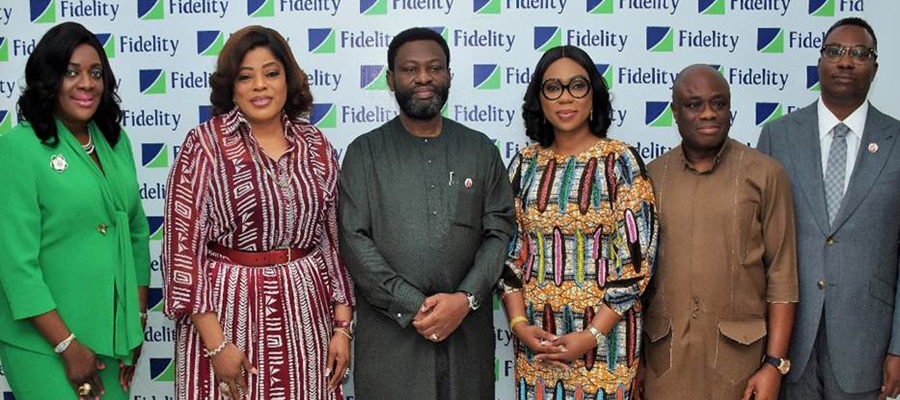
Fidelity Bank Plc has restated its commitment to advancing Nigeria’s oil and gas industry, with a strong focus on supporting indigenous operators. This was highlighted by the bank’s Managing Director and Chief Executive Officer, Dr. Nneka Onyeali-Ikpe,OON, during a first oil presentation event for Emadeb Energy at Fidelity Place, the bank’s corporate headquarters in Lagos.

L – R: Executive Director -South, Mrs. Pamela Shodipo; Managing Director/Chief Executive Officer, Dr. Nneka Onyeali-Ikpe,OON (both of Fidelity Bank Plc); Group Managing Director/Chief Executive Officer, Mr. Adebowale Olujimi; Group Executive Director, Mrs. Olugbesoye Olujimi (both of Emadeb Energy); Executive Director -Lagos and South West, Fidelity Bank Plc, Dr. Ken Opara; and Group Executive Director, Finance/Strategy, Emadeb Energy, Mr. Tosin Adewuyi; at the First Oil presentation event by Emadeb Energy at the Fidelity Bank headoffice in Lagos recently.
At the event, Emadeb Energy’s Group Managing Director and Chief Executive Officer, Mr. Adebowale Olujimi, expressed appreciation for the bank’s role in enabling the company’s progress.
“What makes Fidelity Bank unique is its willingness to take calculated risks. Many banks prefer to work with companies only after they have achieved first oil because they want already-established customers. Fidelity Bank reviewed our proposal thoroughly, including legal, technical, financial and character assessments. We met these requirements and that is why they supported us,” Olujimi said.
Dr. Onyeali-Ikpe congratulated Emadeb Energy on its milestone and reaffirmed Fidelity Bank’s commitment to strengthening Nigeria’s energy sector.
“At Fidelity Bank, we are dedicated to supporting indigenous companies in developing oil and gas assets that enhance energy security and promote sustainable growth. Our interventions include financing Nigeria’s first privately built and operated onshore crude export terminal in over fifty years at the Otakikpo Marginal Field in Rivers State.
“We also led funding for the Pinnacle Oil and Gas Terminal in Lekki, Lagos, which improves petroleum product distribution and reduces costs. In addition, we part-financed the production of a 23,000-cubic-meter Liquefied Petroleum Gas carrier for Temile Development Company Limited, which supports cleaner energy use and strengthens local maritime participation,” she said.
Emadeb Petroleum Exploration and Production Company Limited, operator of Petroleum Prospecting License (PPL) 236, recently achieved first oil from the Ibom Field, a milestone regarded as a significant breakthrough in Nigeria’s upstream sector.
“Our next phase will be exciting. We plan to drill two additional wells and increase production to 12,000 barrels per day by the end of 2026. After that, we aim to expand our gas business and raise oil output to 30,000 barrels per day,” Olujimi added.


Nigeria Deposit Insurance Corporation (NDIC) said that it has commenced the process of liquidating 89 closed Microfinance Banks (MFBs) and Primary Mortgage Banks (PMBs).

This followed their successful acquisition by new owners under the Purchase and Assumption (P&A) resolution model executed by the Corporation.
The corporation disclosed this in a statement on Wednesday, signed by Hawwau Gambo, head of Communication and Public Affairs.
It explained that the affected institutions were part of the 179 MFBs and four PMBs whose licences were revoked by the Central Bank of Nigeria (CBN), on May 22 and 23, 2023.
According to the corporation, under the P&A arrangement, 89 new eligible institutions were subsequently licensed by the CBN to assume the assets and liabilities of the defunct banks.
It noted that the new banks had since commenced operations under different names.
“To legally conclude the liquidation process, the NDIC, in its capacity as liquidator, will file applications at various divisions of the Federal High Court for orders of dissolution of the closed banks and its discharge as liquidator,” the statement said.
NDIC added that the move was in line with provisions of its enabling Act and other relevant laws guiding bank resolution in the country.
The corporation said the exercise would ensure proper closure of the defunct institutions while safeguarding financial system stability.
It reiterated its commitment to protecting depositors and sustaining public confidence in the banking sector.
The affected banks were located across several states, including Lagos, Anambra, Oyo, Kaduna, Kano and the Federal Capital Territory.

Nigeria’s economy is projected to grow at 4.1 per cent in 2026 and strengthen slightly to 4.3 per cent in 2027, even as the International Monetary Fund (IMF) warned that the ongoing Middle East conflict is clouding the global outlook.

The projections, contained in the IMF’s April 2026 World Economic Outlook released at the ongoing IMF/World Bank Spring Meetings in Washington DC, the United States, show a relatively stable trajectory for Nigeria despite rising external risks, particularly from energy market disruptions triggered by the war.
The IMF had earlier projected stronger growth of about 4.4 per cent in early January before the latest global shock, reflecting the impact of domestic reforms and improving macroeconomic conditions.
While Nigeria’s growth outlook remains steady, the IMF warned that countries like Nigeria face growing vulnerability from higher global energy prices, inflation pressures and tighter financial conditions.
The war, which has disrupted oil supply routes and pushed up fuel costs, is already feeding into domestic inflation and cost-of-living pressures.
Recent data show petrol and diesel prices have surged sharply since the conflict began, straining households and businesses.
Although higher crude prices may support government revenues, the broader macroeconomic impact remains mixed, with inflation and exchange rate pressures posing downside risks.
The IMF also cut global growth to 3.1 per cent in 2026, with only a modest recovery to 3.2 per cent in 2027 as the Middle East conflict disrupts trade and energy markets.
Emerging markets and developing economies, including Nigeria, are expected to grow at 3.9 per cent this year before recovering to 4.2 per cent in 2027, reflecting the uneven impact of the shock across regions.
Sub-Saharan Africa is projected to expand by 4.3 per cent in 2026 and 4.4 per cent in 2027, placing Nigeria slightly below the regional average but still among the stronger performers.
South Africa, the continent’s largest economy, continues to lag with growth forecast at one per cent in 2026, rising modestly to 1.3 per cent in 2027.
Among major economies, the U.S. is projected to grow by 2.3 per cent in 2026 before easing to 2.1 per cent in 2027, while China is projected to grow by 4.4 per cent and four per cent respectively.
India remains the fastest-growing major economy at 6.5 per cent through 2027, while the Euro Area continues to struggle with weak growth, particularly in Germany and France.
The IMF warned that many developing economies, particularly energy importers, remain vulnerable to rising costs and external shocks.
The IMF urged central banks to prioritise price stability, warning against easing policy prematurely in response to supply shocks. It stressed the need for clear communication and strong institutional independence.
On fiscal policy, the Fund cautioned against broad-based energy subsidies, describing them as costly and inefficient. It recommended a targeted and temporary support for vulnerable households, funded within existing budgets.
The IMF also warned against the use of trade restrictions to address external imbalances, noting that such measures tend to weaken output without resolving underlying issues. It called instead for coordinated global action to stabilise trade and restore energy supply chains.

Securities and Exchange Commission (SEC) has proposed new rules for Public Offering of securities by a Free Trade Zone Entity (FTZE). Free Trade Zone Entity means a free zone enterprise, established in a free trade zone and licensed by a Free Zone Authority.

The SEC has set a N7.5 billion minimum capital requirement specifically for such entities that intend to undertake a Public Offering. SEC noted that no shares of an FTZE may be issued or offered to the public, without the approval of the Commission in accordance with the provisions of the new rules.
SEC said the rule, which is being proposed pursuant to s. 95(1)(f) of the ISA 2025, is to provide eligibility requirements and conditions for free trade zone entities seeking to conduct public offering of securities in the capital market.
In addition to this requirement, SEC also noted that registration requirements for shares offered by FTZEs shall include among others the statement of the issuer’s minimum paid up capital, the holders thereof and their respective holdings, certified or verified by the Free trade Zone Authority or other authorised custodian of the register of shareholders.
Also required for the registration of the shares offered by the FTZE include: information on the current composition of the issuer’s board of directors, certified or verified by the free trade zone authority; a “No Objection” letter for the offering and listing of the issuer’s shares, issued by its free trade zone authority; and a mandatory disclosure to list the shares to be offered on a registered securities exchange.
In addition to the N7.5billion minimum paid up share capital required by the SEC in the proposed new rule, an FTZE seeking to offer or issue its shares under the Rules shall: Be duly licensed by a free zone authority established under an enabling law; have at least three (3) years track record of operation immediately preceding the offering application, during which time the entity or its subsidiary has been engaged in an independent activity for at least 2 years in a free trade zone; and have a senior management that has sufficient competencies and experiences related to its activities.

CAC Urges Users to Secure Accounts after Cyberattack Scare

NCDC Predicts Cholera Outbreak in 10 States as Heavy Rains Loom

NDIC Seeks Court Nods to Liquidate 89 Failed Banks

IMF Downgrades Nigeria’s GDP Outlook, Warns of Rising Risks

Building Systems that Outlive Founders

Kuda MFB Increases Kuda for Her Business Grants to ₦10 Million

Canal+ to Cut Jobs as Part Sweeping Restructuring

Nigeria tops global rankings for USDT, USDC ownership

NBC Boss Urges Content Ceators to Participate in DSO

NITDA Takes Over National Digital Architecture System




 E-Financial2 days ago
Fidelity Surges Ahead in Recapitalisation Drive with ₦564bn Capital

 General News1 day ago
Guinness Nigeria Surpasses ₦1Trillion Market Capitalisation, Signalling Strong Investor Confidence and Sustained Value Creation

 Telecom2 days ago
Qualcomm Unveils Startup Selection for Qualcomm Make in Africa 2026

 Telecom2 days ago
AfDB Grants Project BRIDGE $200m Facility for Nationwide Internet Access

 E-Financial2 days ago
Digital “Pickpockets” Compromise Over a Million Banking Accounts – Kaspersky

 Telecom2 days ago
Nigeria Seeks Stronger Digital Sovereignty, National Software Infrastructure

 E-Financial2 days ago
EFCC Warns Banks against Loans without Credible Collateral

 General News2 days ago
Air Traffic Controllers Raise Safety Concerns over Failing Systems, Worsening Welfare