

/home/kenneth/web/nigeriacommunicationsweek.com.ng/public_html/wp-content/themes/zox-news/parts/post-single.php on line 153
">
Warning: Undefined array key 0 in /home/kenneth/web/nigeriacommunicationsweek.com.ng/public_html/wp-content/themes/zox-news/parts/post-single.php on line 153
Warning: Attempt to read property "cat_name" on null in /home/kenneth/web/nigeriacommunicationsweek.com.ng/public_html/wp-content/themes/zox-news/parts/post-single.php on line 153
Former FedEx Boss Calls for Postal Sector Liberalisation

Isaac Orolugbagbe, former managing director of FedEx speaking on behalf of the Association of Nigerian Courier Operators (Anco) and Nigerian International Air Couriers Association (Niaca) has said that the postal sector is highly underdeveloped and called for the liberalization of the postal sector.
In the midst of the problems the postal operations in the country is facing, market analysts have put the worth of postal business in Nigeria at N100 billion.
The market is controlled by three dominant players in the industry namely the multinational courier companies, the indigenous ones and the national carrier in the industry, the Nigerian Postal Service (Nipost).
The multinationals form about 90 percent membership of the Nigerian International Air Couriers Association (Niaca) while most of the indigenous operators belong to the sister body , Association of Nigerian Courier Operators (Anco).
Private operators in the Nigerian postal space have continued to agitate for the liberalization of the postal sector arguing that liberalization will reduce the financial burden placed on government in operating Nipost .
Liberalization, they further argue will lead to improvement of services rendered by Nipost to its customers.
Liberalization according to them will lead to the deployment of expertise by private operators in the provision of services and products.


Warning: Undefined array key 0 in /home/kenneth/web/nigeriacommunicationsweek.com.ng/public_html/wp-content/themes/zox-news/parts/post-single.php on line 493
Warning: Attempt to read property "cat_ID" on null in /home/kenneth/web/nigeriacommunicationsweek.com.ng/public_html/wp-content/themes/zox-news/parts/post-single.php on line 493

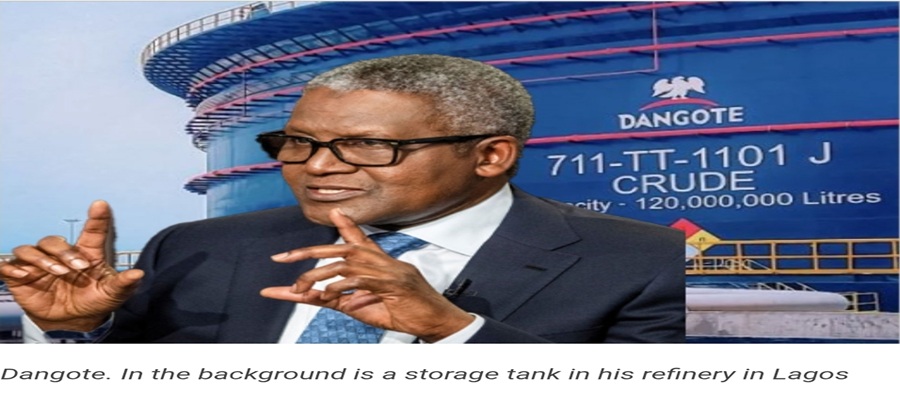
Dangote Petroleum Refinery is reportedly nearing completion of a $2.5 billion private placement that values the company at about $40 billion ahead of its planned public listing.

Private placement is the direct sale of company shares or bonds to pre-selected investors instead of the general public and it is used to raise money quickly while avoiding strict public reporting rules.
People familiar with the transaction said investors acquired as much as 6 per cent of the refinery, according to a BusinessDay report.
The reported terms would value the business at approximately $40 billion.
Neither Dangote Group nor the refinery has publicly announced the final amount raised, the identities of most subscribers or the precise percentage sold.

The figures should therefore be treated as transaction details supplied by unnamed sources rather than confirmed company disclosures.
The reported $2.5 billion total is nevertheless significant as it indicates strong demand for exposure to a privately controlled refinery that has rapidly become central to Nigeria’s fuel supply and an increasingly important exporter of petroleum products.
The placement was said to have attracted more demand than the available shares, allowing the company to secure substantially more than the amount initially associated with the fundraising exercise.
Femi Otedola, chairman, First HoldCo, is the only major participant publicly identified in the report.
He reportedly committed $100 million to the transaction and sold his investment in Geregu Power Plc to finance the acquisition.
Nigeria’s pension industry was also reportedly cleared to participate.
Access to more than $17 billion in retirement assets would broaden the refinery’s potential investor base beyond wealthy individuals and conventional institutional buyers.
Participation by Pension Fund Administrators would, however, require careful attention to valuation, liquidity and portfolio-concentration limits.
Retirement funds must balance the attraction of a large Nigerian industrial asset against their responsibility to protect contributors’ savings.
The implied $40 billion valuation represents investor expectations about the refinery’s future earnings rather than only the physical cost of constructing the facility.
Its ability to process 650,000 barrels of crude daily gives it a central role in supplying Nigeria and other markets, but its commercial performance remains connected to crude availability, product prices, exchange rates and regulation.
The refinery has struggled to obtain all the Nigerian crude it requires under the government’s naira-for-crude arrangement.
It has consequently purchased some feedstock internationally and recently moved local petroleum-product pricing into dollars to align sales revenue more closely with its foreign-currency expenses.
Those constraints will be important during any public offering.
Prospective shareholders will want greater clarity on crude-supply contracts, debt, operating margins, export revenue and the company’s relationship with Nigerian regulators.
It is also unclear whether the private placement involved newly issued shares, a sale by existing owners or a combination of both.
That distinction determines whether the reported $2.5 billion becomes fresh capital for the refinery or proceeds received by selling shareholders.
The transaction could provide a useful price reference for the planned initial public offering.

Federal government will next month launch Nigeria’s first national organized crime strategy to strengthen the country’s response to terrorism, cybercrime, human and drug trafficking, kidnapping, illicit financial flows, and other forms of organized crime.

Major General Adamu Laka, national coordinator of the National Counter Terrorism Centre under the Office of the National Security Adviser, disclosed this in Abuja during the validation of the strategy document.
He said the strategy provides a coordinated national framework for tackling organized crime through improved intelligence sharing, stronger collaboration among security agencies, and closer cooperation with the criminal justice system, civil society organizations, and international partners.
Major General Laka explained that the document was developed through a partnership involving the Federal Government, the United Nations Office on Drugs and Crime (UNODC), the United States Government, and other stakeholders.
Speaking at the event, Cheikh Toure, UNODC representative, said the strategy would strengthen Nigeria’s capacity to combat transnational crimes, including drug trafficking, cybercrime, human trafficking, kidnapping, and illicit financial flows.
Also speaking, Douglas Grane, acting director of the United States Department of State’s Bureau of International Narcotics and Law Enforcement Affairs, reaffirmed the U.S. government’s support for Nigeria’s efforts to tackle organized crime through stronger inter-agency and international cooperation.
Representatives of the National Institute for Strategic Studies, the Nigeria Financial Intelligence Unit, and the National Cyber Security Centre also endorsed the initiative, describing it as a major step towards improving Nigeria’s fight against organized crime.

Economic and Financial Crimes Commission (EFCC) has uncovered an alleged multi-billion-naira visa overstay racketeering network within the Nigerian Immigration Service (NIS), with at least five serving officers, including a deputy comptroller, grilled by investigators.

The investigation, which cuts across the administrations of several former comptrollers-general of Immigration, has reportedly uncovered about N700 million in the bank accounts of one of the suspects and several multi-billion-naira estates allegedly acquired by another suspect through proxies.
The alleged racket centres on the extortion of foreigners who overstayed their visas, with investigators probing how immigration officials allegedly diverted or illegally collected huge sums from affected foreigners.
The development comes against the backdrop of the Nigeria Visa Policy 2025, which introduced a penalty regime requiring foreigners who overstay their visas to pay $15 for every day spent in the country after the expiration of their visas.
A visa overstay occurs when you remain in a country past the authorized departure date stamped on your passport or travel document.
The EFCC investigation is reportedly focused on officers operating at the Murtala Muhammed International Airport, Lagos; Nnamdi Azikiwe International Airport, Abuja; and the NIS headquarters in Abuja.
Among those said to have been questioned are Assistant Superintendent of Immigration, Bashar Suleiman, serving at the Lagos airport; deputy superintendent of Immigration, Musa Abubakar, of the Abuja airport; principal staff officer to the comptroller-general of Immigration, chief Superintendent of Immigration Dotun Aridegbe; and two personal assistants to the comptroller-general, assistant comptroller of Immigration Emmanuel Imaekhai and assistant superintendent of Immigration O. Babatunde.
The investigation was reportedly triggered by information supplied by a female immigration officer who allegedly blew the whistle on the scheme.
A source familiar with the probe said the whistleblower’s allegations led investigators to examine the financial activities of several NIS officers and their associates.
“We opened an investigation into the visa overstay racket after a female immigration officer blew the lid on the racketeering,” the source said.
The source alleged that investigators had found links between the alleged racket and several aides of Kemi Nandap, current comptroller-general of Immigration.
“Several of her aides have indicted her directly and indirectly. Investigators are looking into whether she was a beneficiary of the multi-billion-naira extortion racket,” the source said.
The allegations against the Comptroller-General remain subject to investigation, and no formal charge has been announced against her.
The source said the investigation had revealed that the alleged extortion network may have operated for years, possibly under successive Comptrollers-General of Immigration.
“It is an interesting but damaging case because we found out that the extortion of overstayers has been going on for several years under past CGs, some of whom appeared to have benefitted from the scheme,” the source said.
Investigators have reportedly identified a Deputy Superintendent of Immigration who has served at the Nnamdi Azikiwe International Airport for more than 10 years, a posting described by investigators as unusual.
A search of the officer’s apartment allegedly uncovered immigration stamps associated with various international airports across Nigeria.
The officer is also said to have maintained close relationships with successive Comptrollers-General, a development now being examined as investigators attempt to unravel the alleged structure and longevity of the racket.
“He is known to relate directly with all serving CGs. His admissions have been illuminating as he is the linchpin of the operation,” the source said.
The EFCC is also investigating the alleged use of proxies to conceal the proceeds of the racket.
Some individuals whose names were allegedly used to operate multiple bank accounts and acquire landed properties have reportedly told investigators that they acted as fronts for the suspects.
The commission is expected to scrutinise the assets, bank accounts and financial transactions linked to the suspects as it traces the alleged proceeds of the racket.
The investigation may also be widened to include some former Comptrollers-General of Immigration, who could be invited to clarify findings and authenticate admissions allegedly contained in written statements obtained from the suspects.
The EFCC has yet to publicly announce charges against the officers, while the investigation is ongoing.
However, CSI O. Babatunde, one of the NIS officers, said to be linked to the alleged visa overstay racket has denied any involvement in the scheme.
The officer, in a brief response to the allegations, said he had no connection with visa fraud or any related racketeering.
“I am not involved in a scam and do not have any visa scam issue, please. I was never invited for visa scam,” the officer said.
Others who were asked of their involvement, Dotun Aridegbe, Emmanuel Imaekhai, Bashar Suleiman did not respond to messages sent to their mobile line.
The denial by Babatunde, comes as the EFCC continues its investigation into the alleged visa overstay extortion network.
The commission has not publicly disclosed the identities of all the officers being investigated, nor has it announced any charges in connection with the matter.
All allegations remain subject to investigation, and the suspects are presumed innocent unless proven guilty by a court of law.

Dangote Refinery’s Private Placement Reportedly Hits $2.5Bn

FG, UNODC Plan National Strategy against Organized Crime

EFCC Busts NIS Visa Overstay Racket, Uncovers N700m in an Account

CBN to Monitor Every Dollar with FXBT, Forex Tracker

NCC, NDLEA Partner to Fight Piracy and Drug Trafficking

NRC, Ponzi Scheme Collapses Resulting Loss of Billions of Naira

NASENI Moves to Digitize CCB’s 5m Assets Declaration and Operations

Lebara Nigeria Launches Lebara Play, Africa’s First Telecom-Owned Micro-Drama Platform

CANAL+ Partners Samsung to Pre-Load DStv Stream on New Samsung TVs In Nigeria, Other African Countries

Tokenization, Blockchain Technology will Transform Financial Institutions – IMF



 News1 day ago
EFCC Busts NIS Visa Overstay Racket, Uncovers N700m in an Account

 General News2 days ago
Nigeria Facing Rising Cybercrime Losses – Report

 Telecom2 days ago
ntel Plays Down Calls and Data Services, Moves to BET Agenda

 Telecom2 days ago
Airtel Delivers Free Employability Training to Young Nigerians @ World Youth Skills Day

 News2 days ago
FAAN to Replace Physical ID Check with V-Pass Biometric Verification

 General News2 days ago
TotalEnergies Inaugurates Africa’s Largest Hybrid Renewable Project

 News2 days ago
CAC Begins Removing 100,000 Companies from Register Over Regulatory Non-Compliance

 News2 days ago
CBN Introduces Digital Tracker to Monitor BDC Forex Transactions