

Telecom
Fresh Headaches for Rural Telephony Project

The inability of ministry of Communications Technology to secure certificate of concurrence from the Infrastructure Concession Regulatory Commission (ICRC) is delaying the conclusion of the National Rural Telephony Project (NRTP) meant to provide telecommunications services to the rural dwellers and communities, Nigeria CommunicationsWeek has learnt.
The certificate of concurrence or so-called certificate of no objection will mean that ICRC- the national governing body for public private partnership (PPP) processes is in agreement with the move to hand over the project to new investors.
Also, Bureau of Public Procurement (BPP) another government agency this time responsible for harmonizing the existing government policies and practices by regulating, setting standards and developing the legal framework and professional capacity for public procurement in Nigeria has also insisted on certificate of concurrence before it can seek approval from the federal executive council.
Engr. John Ayodele, director, Posts and Telecommunications in the ministry of Communications Technology, told Nigeria CommunicationsWeek, that the ministry is desirous to conclude the transaction.
Ayodele said that the delay in securing the certificate from ICRC was due to the recent change in the management of the commission.
He stated that with the inauguration a new board, the ministry hopes to secure the certificate from the ICRC soon.
Ayodele, said that ICRC had earlier refused to give the ministry certificate of concurrence, arguing that the transaction was carried out before the commission was established which makes it difficult to evaluate the project.
Nigeria CommunicationsWeek gathered that the National Rural Telephony Project, the little successful $200 million project was conceived in 2001 to take telephony services to the rural areas.
The project has however been caught in a web of confusion, claims and counter charges with fingers pointing left and right.
Apart from the certificate of no objection; paucity of funds as well as nonchalant attitude of government and her supervising agencies have also conspired to hobble the project.
The project, inaugurated under former President Obasanjo’s first term in office, was to cover 218 Local Government Areas (LGA) in the first phase and provide over 636,256 Code Division Multiple Access (CDMA), lines in the 774 LGAs and Federal Capital Territory (FCT) in the second phase to bridge the digital divide between the urban and rural areas.
Three Chinese companies– ZTE Corporation, Huawei and Shagai Bell – were awarded the contract at the sum of $200 million.
The Federal Government had borrowed the above amount from the China Export and Import (EXIM) Bank, while it provided 15 per cent counterpart funding of N5 billion for the execution of the project.
Nigeria CommunicationsWeek gathered that the Chinese companies failed to deliver on the project prompting the federal government to transfer the first phase of the project to five indigenous telecommunications companies namely: Key Communications Limited, Suburban Broadband Limited, Voicewares Network Limited, Gicell Wireless Limited and Hezonic Limited.
In the new arrangement, Key Communications won the Ibadan Zone with a $38 million bid, while Suburban Broadband bid with $140.5 million to manage the Federal Capital Territory and Kaduna zones.
Voiceware Networks bid with $30 million to manage the Enugu Zone, while Hezonic and Gicell Wireless bid with $30 million and $20 million to manage Enugu and Bauchi.
They were to build, operate and maintain (BOM) the project in different zones under the model of a Lease, Operate and Own (LOO) framework.
They were supposed to operate the networks for a period of 10 years within which they would pay a specified amount of money to the government.
But the contractors are yet to commence work some four years after the contract was awarded.
Irked by the development, the House of Representatives recently mandated its committee on Communications to find out issues delaying the full take of the project.
Engr. Gerry Ekesiani, chief executive officer, Voicewares Networks Limited, one of the operators of the project that won the contract to operate South-east and Benue exchange, said that stakeholders including: operators and ministry of Communications Technology have engaged in meetings in order to resolve outstanding issues that are delaying full take off of the project.
“We are working progressively. If all parties keep to our agreement, operators of NRTP will be able to roll out service this year,” he said.
Voicewares Networks boss stated that continued delay of the project is jeopardizing full realization of the project, adding that the 800MGH frequency allocated to them is no longer suitable for delivery of broadband and that had it being that the project has taken off the current plan by Nigerian Communications Commission (NCC) to license 2.3Ghz spectrum would have been an opportunity for them to upgrade to 2.3Ghz.
He explained that 2.3Ghz is robust for broadband service delivery which NRTP is designed for.
Ekesiani added that the continued delay in the rollout of services is causing Association of Rural Telephony Operators of Nigeria (ARTON) financial losses while the equipment have become object of vandals and thieves.
He also warned that the equipment may become obsolete by the time the final approval is obtained as CDMA 2000 1x technology installed for the project is a legacy.



MTN Nigeria has announced the temporary suspension of its airtime and data advance service, Xtratime, following new regulatory requirements introduced by the Federal Competition and Consumer Protection Commission (FCCPC).

The telecom giant disclosed the development in a filing to the Nigerian Exchange Limited (NGX) on Thursday, stating that the move is necessary to comply with the FCCPC’s Digital, Electronic, Online or Non-Traditional Consumer Lending Regulations, 2025.
Xtratime, widely used by prepaid subscribers, allows customers to borrow airtime or data and repay on their next recharge.
In the disclosure signed by Uto Ukpanah, company secretary, the firm confirmed the halt, noting, “MTN Nigeria Communications PLC hereby notifies the Nigerian Exchange Limited and the investing public that the company has temporarily suspended its airtime and data credit advance service (‘Xtratime’).”
The company explained that the service now falls within the scope of the FCCPC’s expanded regulatory framework, which mandates fresh licensing and stricter compliance procedures for digital credit providers.
“The suspension relates to the implementation of processes under the Digital, Electronic, Online or Non-Traditional Consumer Lending Regulations, 2025, which introduced a new compliance and licensing framework for entities providing digital or non-traditional consumer credit services,” the statement added.
Despite the suspension, MTN reassured subscribers that alternative channels for purchasing airtime and data remain fully operational. It also downplayed the financial impact of the move.
“Given the scale within the revenue mix, we do not expect the temporary suspension to have a material impact,” the company said, adding that it is closely monitoring customer behaviour and will provide further updates in its first-quarter 2026 results.
The FCCPC’s 2025 regulations significantly broaden oversight of Nigeria’s digital lending ecosystem, bringing telecom operators and other providers of short-term credit services under stricter scrutiny. Companies offering such services are now required to register and obtain regulatory approval to continue operations.
The Commission had initially introduced a framework for digital lending in 2022, but expanded it in 2025 amid rising concerns over consumer debt, data privacy and lending practices.

Nokia and Orange are co-developing new strategies to maximise spectral efficiency across existing and future mobile bands, including the upper 6 GHz range, as networks transition toward 6G.

This follows an announcement of a partnership with NVIDIA to develop and evaluate Artificial Intelligence Radio Access Network (AI-RAN) technologies.
The initiative will combine the anyRAN 5G software of Nokia with the AI infrastructure of NVIDIA to improve network performance and energy efficiency.
The collaboration aims to transform service delivery for Orange across Europe, the Middle East, and Africa, says Nokia.
Under a new structured co-innovation framework, the partners will explore how GPU-based radio processors can boost performance via advanced receivers.
The goal is to integrate artificial intelligence (AI) directly into the RAN to automate environments, support sensing services and drive resource utilisation.
“By collaborating with Nokia and NVIDIA, we can better understand how the AI-native architecture enabled by AI-RAN can improve the efficiency of key radio algorithms such as scheduling, beamforming, and power optimisation — enhancing both spectral efficiency and energy performance, while also enabling advanced capabilities like predictive optimisation and radio sensing. This collaboration is an important step in our long-term network strategy,” says Laurent Leboucher, group chief technology officer at Orange.
Pallavi Mahajan, chief technology and AI officer at Nokia, comments: “AI is reshaping how networks are designed, introducing new levels of intelligence and flexibility across the radio layer.
“Through this collaboration with Orange, we are exploring how Nokia and NVIDIA’s AI-RAN solution brings advanced AI and RAN functions together in a unified architecture. This will be instrumental in enabling the industry’s transition toward cognitive, AI native networks.”
Orange is currently the fourth-largest telecoms operator in Africa with 18 markets on the continent. The partnership marks a significant attempt to leverage AI to accelerate digital transformation as the first wave of 6G approaches.

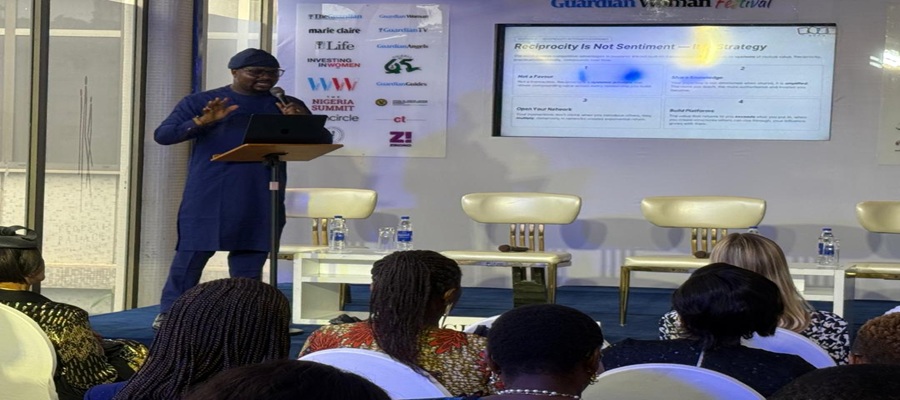
Zoho Nigeria partnered with Guardian Newspapers for the Guardian Woman Festival, a month-long initiative celebrating women’s contributions to business, governance, and social development while promoting digital empowerment for female entrepreneurs.

Kehinde Ogundare
Held at the Federal Palace Hotel in Victoria Island, Lagos, the festival focused on the theme “Reciprocity,” encouraging the exchange of value, networks, and digital innovation to strengthen women-led businesses and foster collaboration.
During the event, Kehinde Ogundare, Country Head of Zoho Nigeria, delivered a keynote address titled “Give Value, Gain Growth: Women Driving Reciprocal Innovation in the Digital Economy”. In his remarks, he highlighted the urgent need to bridge the digital gap for female entrepreneurs.
While Nigeria has the highest concentration of women-owned businesses in Africa, fewer than 30% currently use digital tools to manage or grow their operations. Ogundare noted that technology does not replace the strengths women already bring to business, such as relationship building and community engagement. Instead, it amplifies them, enabling entrepreneurs to reach wider audiences and scale more efficiently.
“The difference is not talent. Not capital. Not ambition. It is digital adoption,” said Ogundare during his keynote. “Smart tools create smart businesses. Smart businesses create strong economies. When women entrepreneurs and leaders have access to the right tools, the possibilities for growth are limitless.”
Zubaida Aliyu, Sales Manager at Zoho Nigeria, also brought her expertise to the festival’s panel session on ‘Women in the Business of Digital Innovation’. She highlighted how women are uniquely positioned to create shared value in digital spaces by building platforms that encourage knowledge sharing, mentorship, and collaboration.
Aliyu also challenged organisations that continue to view women’s digital inclusion primarily as corporate social responsibility rather than a strategic business priority.
“Tech creates a level playing field,” she said, noting that digital platforms remove limitations related to location and infrastructure size. Addressing organisations that overlook the economic value of inclusive digital strategies, she added, “They are leaving money on the table — they need to think of it as a strategy not charity”.
Through its participation in the Guardian Woman Festival, Zoho reaffirmed its commitment to providing affordable and accessible enterprise-grade technology to businesses of all sizes. By helping women transition from manual effort to digital efficiency, Zoho aims to support entrepreneurs build scalable enterprises and ensure their sustained success in Africa’s digital economy.

MTN Suspends Data, Airtime Borrowing Service over New FCCPC Lending Rules

Nigeria Customs Deploys AI to Cover Revenue Leaks

Top 7 Reliable Virtual Cards for Running Ads in Nigeria

Nokia, Orange Partner on AI-native 6G Networks

NDPC Issues Critical Advisory as Hackers Target Nigeria’s Key Digital Systems

Kuda MFB Increases Kuda for Her Business Grants to ₦10 Million

Canal+ to Cut Jobs as Part Sweeping Restructuring

Nigeria tops global rankings for USDT, USDC ownership

NBC Boss Urges Content Ceators to Participate in DSO

NITDA Takes Over National Digital Architecture System




 General News3 days ago
Guinness Nigeria Surpasses ₦1Trillion Market Capitalisation, Signalling Strong Investor Confidence and Sustained Value Creation

 News3 days ago
CISA Asks NDPC, Police to Act on Alleged Data Breach by NIPSS

 Telecom3 days ago
Amazon Satellite to Challenge Starlink in Africa with Globalstar Acquisition

 E-Financial3 days ago
FG Investigates ‘Sharp Sharp’ Loan Operators over Alleged Privacy Violations

 News2 days ago
Lagos Targets Vulnerable Residents in Expanded Social Register

 News3 days ago
Kaspersky Reports Online Scam Exposure Remains Widespread Despite High Levels of Self-assurance

 Broadcasting3 days ago
Fela Makes History as First African to be Inducted into Rock and Roll Hall of Fame

 E-Financial3 days ago
Ecobank Delivers Strong Results, Posts $801m in Pre-Tax Profit for 2025