

General News
GAIN and Afreximbank Empower Young African Entrepreneurs

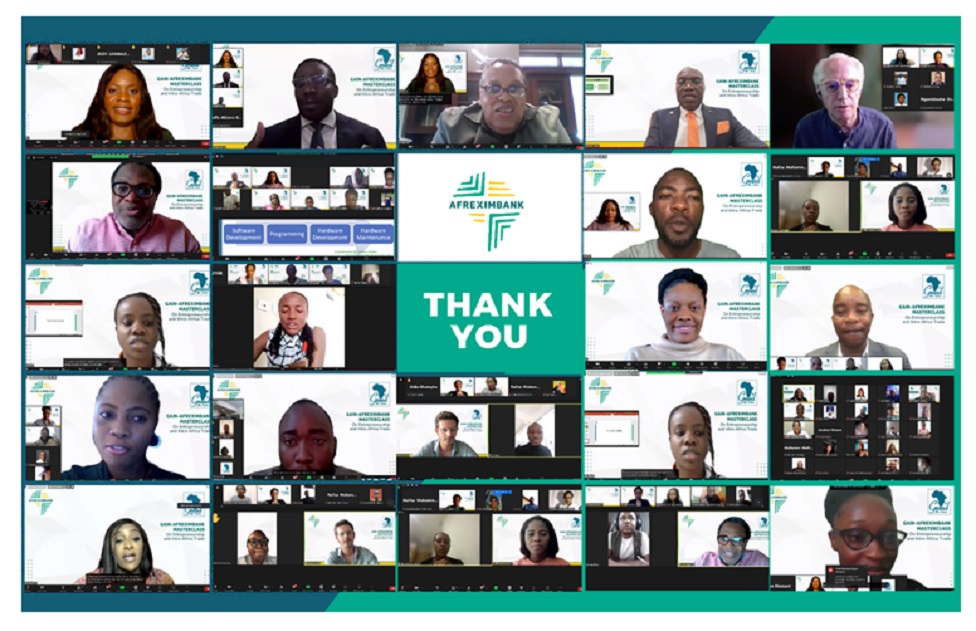
Grand Africa Initiative (GAIN) in collaboration with Africa Export-Import Bank (AFREXIMBANK) trained young African Entrepreneurs from across Africa.

The program GAIN-AFREXIMBANK Masterclass on Entrepreneurship and Intra-Africa Trade is an empowerment program.
This is part of the Africa Export-Import Bank’s effort to increase participation of African young entrepreneurs in cross border trade and expand trading activity under the African Continental Free Trade Agreement (AfCFTA) which is pivotal to the continent’s economic transformation.
Grand Africa Initiative (GAIN ) is a Pan-African Non-governmental organization helping African young men and women, between 15 and 35 years, develop and harness their unique ideas, talents and abilities for success in education, entrepreneurship, innovation and employment.
Training, empowering and providing technical support to African young men and women by equipping them with digital, leadership, employability, and entrepreneurial skills for self-sustenance.
The program was designed to equip young African entrepreneurs who were selected from across Africa with skills to build and scale their businesses across borders; learn key insights that will help them identify opportunities in various African Markets, expand their businesses, manage trade finance, form partnerships, grow their income, leverage the opportunities of the AfCFTA, attract foreign direct investment and create employment for more youths.
The program received applications from one thousand, three hundred and seventy-six (1,376) young African entrepreneurs from twenty-nine(29) African countries across the five(5) regions in Africa out of which two hundred (200) were selected. The participants were selected based on the set criteria.
The program kicked off on the August 8th, 2022 with a virtual opening ceremony which had the Executive Director Grand Africa Initiative-GAIN, Ms. Chinwe Okoli; the Senior Manager, AU/AFCFTA Relations and Trade Policy, African Export-Import Bank Mr Babajide Sodipo and the Keynote Speaker His Excellency Thami Mseleku, the High Commissioner of South Africa to Nigeria, selected participants and members of the public in attendance.
It was a 3 month program that had intensive live masterclass facilitated by global experts and leaders in various aspects of business who brought to class experience and mastery.
The participants learned from facilitators from Africa, America, and Europe who covered fifteen (15) broad topics, which was followed by mentorship and business advisory sessions with experienced mentors and experts in various business sectors.
Expected outcomes of the program include: Increase in the number of properly structured businesses, rise in international business partnership deals between young entrepreneurs to promote Intra-Africa trade, emergence of new breed of global entrepreneurs in Africa, creation of more job opportunities for Africa youths. Beneficiaries of the program have been equipped with skills and knowledge needed to beyond build globally competitive businesses, record higher trade volumes, position, and expand their businesses to take advantage of the AfCFTA and contribute to economic development of Africa.
The immediate impact of the program can be seen from the participant’s testimonials about the program:
“This program is top notch. It went beyond my imagination. I applied SWOT techniques to strategise my business which really helped out these 3 months”. Amina Onawo Mohammed, CEO Unique shis Green Products Ltd, Nigeria
“Before I joined this program, my ideas were not structured and I was blind to the possibilities out there and how I could benefit from ACFTA. This program has introduced the idea of networking and the importance of having a clearly defined strategy and branding”. Robert Chikuse, CEO Rowdach Enterprise, Malawi
“The program is an important step towards opening up African opportunities. Expanding the youths engagement in the International Trade and exports market”. Kevin Maino, CEO Regime CONSULTIUM ENTERPRISE, Kenya
“I want to deeply say thank you to Grand Africa Initiative-GAIN and AFREXIMBANK for this and life transforming Masterclass, I have learnt a lot from both the sessions as an Entrepreneur and I have been equipped with the relevant knowledge and information to excel in my business world. The class and mentorship sessions by GAIN professional mentors and other industry experts is highly commendable. The communication of the GAIN teams is also top-notch, And I recommend this Entrepreneurship Masterclass to other people. All thanks to Ms. Chinwe Okoli, God bless GAIN and team, God bless AFREXIMBANK”. Godswill Nnabugwu Alegu, CEO GOLDEN PRIMEGA ENTERPRISES NIG. SERVICES, Nigeria
“To be part of this program was needed in a time like this. I need to be challenged and see that my business is not about my small country. It opened my eyes to more African countries,more opportunities.It showed me mentors and business I can learn from”. Gaëlla Abizera Gahama, CEO Gaaga Hair and Makeup, Burundi
“The GAIN-Afreximbank Masterclass is what every African entrepreneur needs”. Augustine Sensie Bangura, CEO Sierra Agri foods, Sierra Leone
“This program is mind blowing and it has widened my knowledge on marketing and the facilitators were professionals”. Musisi Clement Isaiah, CEO Moruta Investment Co. Ltd, South Sudan
“I gleaned and absorbed so much from the program. I am ready to elevate my business and best prepared for trading in Africa ”. Sandiswa Mgolozeli, CEO Epitomely Interior Doctors, South Africa
“It has really been value packed as it expanded my boundary of thoughts to seeing possibilities”. Markus Matthew, CEO Macfeshi Technologies, Nigeria
“This training is extremely relevant for the African SME, it shifts one’s mindset from business for daily survival to lasting legacy”. Mkhudzo Hamoonga, CEO Nobility Accounting & Advisory, Zambia
“GAIN-AfreximBank, thank you for the opportunity to network and learn. The lessons were quite amazing. GAIN went all out to find key industry leaders and speakers who shared so much needed information, which is very impactful in my business operation. This has indeed been an amazing experience. I am confident that through the tools shared, my business will grow”. Mosebetsi Rapitso, CEO Iconics Pty Ltd, Lesotho
“I can say I have gained more than what I have expected from this training. Overall the training was so good that I have decided to suggest others to participate in similar future training organized by GAIN-AFREXIMBANK”. Tihtina Belamo, CEO TABOR CERAMIC, Ethiopia
“I have learned beyond what I expected. I have taken several master classes and GAIN-AFREXIMBANK master class is the best so far”. Ngwain Sih Elisabet, CEO Phoenix revival association, Cameroon
“During the course of this training, I have been able to generate more streams of income by expanding my business. This training surpassed my expectations”. Letsogile Serojane, CEO Magmr Holdings, Botswana
“Before I joined I had no mode of my business, I was just doing business just to keep myself busy and know that I’m doing business but after my masterclass it’s when I’m really a business woman. Now I see my sales getting into the numbers that I never expected, African Entrepreneurs need a masterclass such as this”. Jacqueline Kawishe, CEO BARRON GROUP OF COMPANIES, Tanzania
The role of youth entrepreneurs cannot be overemphasized in unlocking the economic potentials of Africa and building a strong economy in Africa and the world at large, hence, GAIN is focused on promoting youth development for empowerment by continually designing programs aimed on building the capacity and igniting the positive energy of the greater segment of Africa’s population – the youth.
—



Economic and Financial Crimes Commission (EFCC) has partnered with the National Space Research and Development Agency (NASRDA) to deploy advanced space and geospatial technologies in investigations and asset management.

Ola Olukoyede, executive chairman of the EFCC,
The move is expected to deepen transparency, strengthen asset recovery and curb economic sabotage according to a statement by Dele Oyewale, head, Media and Publicity, EFCC.
He said that the partnership was formalised through the signing of a Memorandum of Understanding (MoU) on Thursday in Abuja
The agreement is aimed at strengthening inter-agency collaboration, particularly in the areas of investigations, asset tracking and fraud risk assessment, marking a new phase of cooperation between the anti-graft agency and Nigeria’s space research and regulatory authority.
Speaking at the signing ceremony, Ola Olukoyede, executive chairman of the EFCC, described the agreement as a practical demonstration of the power of collaboration among government agencies.
He noted that closer cooperation would make it easier for institutions to effectively deliver on their statutory mandates.
According to Olukoyede, the MoU clearly defines the responsibilities of both agencies and establishes a framework for sustained cooperation.
He disclosed that a special monitoring and implementation team would be constituted to ensure the effective operationalisation of the agreement and to periodically review its impact.
“We will put a team together that will monitor the operationalisation of this MoU and also review the effectiveness of the platform from time to time.
“When agencies work together in the spirit of collaboration, it not only enhances efficiency but also encourages other ministries, departments and agencies to explore similar partnerships in the overall interest of national development”, he said.
Explaining the specifics of the partnership, the EFCC chairman said NASRDA would provide advanced technological tools to boost the Commission’s investigative capacity and asset tracking, while the EFCC would deploy its expertise to support the agency in fraud risk assessment.
“We will support you in the area of fraud risk assessment, and you will support us in promoting our investigative capacity.
“Where our eyes cannot get to, with the aid of your technology, we will be able to get there”, Olukoyede said.
He noted that the collaboration would be particularly beneficial to investigations into illegal mining activities, which have been linked to economic sabotage and rising insecurity in parts of the country.
“With the technology you are going to support us with, we will be able to identify some of these areas,” he added.
Olukoyede further expressed optimism that the partnership would significantly enhance the EFCC’s asset management processes, stressing that asset recovery remains one of the core pillars of the Commission’s mandate.
He explained that recovered assets are scattered across the country and exist under different legal statuses, including interim and final forfeiture.
“In some of these places, we may not have enough personnel to physically secure the assets. But with your support, we will be able to deploy geospatial technology and asset tagging devices to monitor both movable and immovable assets in a transparent and accountable manner”, he said
In his remarks, Matthew Adepoju, director-general and chief executive officer of NASRDA, welcomed the partnership, describing the MoU as a major milestone in the pursuit of justice and regulatory compliance within Nigeria’s space ecosystem.
Adepoju stressed that space-related activities are strictly regulated in developed economies and should be treated with similar seriousness in Nigeria, particularly in view of the potential misuse of satellite assets.
“You cannot go anywhere in Europe, continental America or the Far East and be doing business in the space ecosystem without the country ensuring that you are doing the right thing.
“We know for a fact that some satellite assets are being used negatively in driving insecurity in the country”, he said.
He also raised concerns over the use of satellite-mapped data on Nigeria’s natural resources to aid illegal activities, especially illegal mining, which he identified as one of the drivers of insecurity.


DalaHill Law Practice and the Bank of Agriculture (BoA) have signed a Mutual Accountability Framework (MAF), marking a milestone in the launch of a climate finance initiative funded by the African Climate Foundation (ACF) and valued at US$100,000.

According to a statement by the firm, the signing took place during a kickoff ceremony at the BoA headquarters in Abuja and formalised the roles, responsibilities and shared commitments of both institutions in delivering the project. The framework was signed by Ayo Sotinrin, BoA Managing Director, and Mohammed Hamza, Managing Associate at DalaHill.
The ACF-funded initiative is designed to support BoA’s institutional transition towards climate-aligned agricultural finance. Central to the programme is the establishment of a Clean Energy Delivery and Innovation Unit (CEDIU), a dedicated function that will integrate climate risk considerations, environmental data and sustainability principles into the bank’s strategy, operations and investment decision-making.
Under the initiative, BoA will also be supported to develop Clean Energy Access Systems and Climate Finance Development Frameworks, alongside a pipeline of bankable, climate-aligned agricultural projects.
These projects are expected to attract domestic and international capital into the sector, contributing to efforts to bridge Nigeria’s estimated $247.3 billion financing gap for its green energy transition.
Speaking on behalf of DalaHill, Mohammed Hamza described the initiative as a pivotal intervention in Nigeria’s agricultural and climate finance landscape. He said the firm is acting as a trusted adviser, working with institutions to deliver catalytic and transformative solutions.
According to him, DalaHill is deploying a multidisciplinary technical team to support BoA’s transition into a climate-aligned institution capable of attracting finance for scalable, investment-ready agricultural projects.
He highlighted the strategic importance of the project, noting that while ACF has traditionally focused on renewable energy, climate alignment within the agricultural sector is critical to driving Nigeria’s broader energy transition. He added that the initiative represents ACF’s first climate finance grant promoting agriculture in Nigeria.
In his remarks, Sotinrin expressed appreciation to the project partners and acknowledged longstanding gaps within Nigeria’s agricultural finance ecosystem. He reaffirmed BoA’s commitment to driving systemic change by attracting climate-aligned expertise, strategic funding and increased national and international attention to the sector.
Sotinrin also noted that the initiative aligns with the Federal Government’s climate and sustainability agenda, referencing Nigeria’s participation at an ongoing global climate sustainability conference in Abu Dhabi.
He further highlighted strong government backing for BoA’s transformation, including presidential approval in October 2024 of a US$1 billion recapitalisation plan aimed at strengthening the bank’s capacity to support national development.
DalaHill Law Practice is a full-service commercial law firm headquartered in Abuja, with a strong track record in advising on economically catalytic projects across sectors including energy, infrastructure, finance, trade and emerging markets.
The firm is known for structuring complex transactions, managing regulatory risk and supporting projects that promote sustainable growth and long-term economic impact in Nigeria and beyond.

Kaspersky’s new global research reveals that 65% of online shoppers believe they can detect fraud on their own, while only 42% actually use security software to protect their payments and block malicious links.

Experts consider this a major risk for online buyers. Over the past year Kaspersky identified nearly 6.7 million phishing attacks globally impersonating online stores, payment systems, and banks, with 55.6% targeting online shoppers.
As the post-holiday and summer sales season kicks off, Kaspersky conducted a survey to examine consumer cybersecurity practices employed during online shopping. The findings show that 97% of respondents demonstrate a substantial level of awareness of online security risks and implement at least some measures to safeguard their digital transactions.
However, the survey found that fewer than half the participants use dedicated security software to block phishing attempts and protect payment transactions. This concerning trend is particularly pronounced among the 55+ year old generation, with only 32% of respondents in this age group actually using security software when making online purchases.
The most commonly adopted security protocols include being vigilant about potential warning signs, such as suspicious hyperlinks or unusual website design (65%) and verifying seller authenticity (62%).
Kaspersky experts emphasise that while these practices are essential protective measures for online shopping, they constitute only foundational protection strategies rather than the comprehensive fraud prevention provided by a security solution.
Other steps that could protect online shoppers, like using a separate credit card for digital purchases or using a separate email address to register with unfamiliar online shops, were chosen by 33% and 26% of survey participants, respectively.
Meanwhile, 30% claimed to consult with friends and relatives before making a purchase. Interestingly, this option is highly popular among the younger generation, with 37% opting for it, while it is less common among older people (21%).
“Throughout the year, we’ve observed that online shoppers have consistently been one of the most desirable targets for scammers. During sales periods, their scams can become even more pervasive. Staying vigilant is crucial, but protecting yourself requires more than just awareness.
It is particularly concerning how scammers are now using AI to craft more sophisticated, targeted phishing attempts that are increasingly difficult for regular users to recognise,” comments Olga Altukhova, Senior Web Content Analyst at Kaspersky.
Sales seasons are peak times for scammers. To protect yourself against emerging threats, implement the following security practices:
– Don’t save your full credit card details on websites unless absolutely necessary.
– Consider using a separate debit card specifically for online purchases and set up transaction alerts on your bank and credit card accounts.
– Be extra cautious of “flash sales” that seem too good to be true. Watch out for websites that pressure you into making quick decisions, and be wary of sellers who refuse returns or exchanges.
– Use different passwords for each online account and enable two-factor authentication wherever possible.
– Apply a security solution with a strong anti-phishing component. For instance, Kaspersky Premium received the annual ‘Approved’ certification from the leading testing lab AV-Comparatives in 2025 for detecting 93% of phishing URLs, demonstrating outstanding anti-phishing capabilities, powered by AI technology.
– Scammers constantly evolve their methods, so staying informed about new phishing techniques can help you recognise and avoid them. The Kaspersky Security blog will help you keep your finger on the pulse of emerging cyberthreats.
The study was conducted by Kaspersky’s market research center in November 2025. A total of 3000 respondents from 15 countries (Argentina, Chile, China, Germany, India, Indonesia, Italy, Malaysia, Mexico, Saudi Arabia, South Africa, Spain, Turkey, the United Kingdom, and the United Arab Emirates) took part in the survey.

SEC Hikes Minimum Capital Requirements for Market Operators After a Decade

Study Shows Blocks in Telegram are Pushing the Underground Out

Galaxy Backbone Marks Two Decades of Powering Nigeria’s Digital Evolution

NGX Unveils Net-Zero Plan for Greener Capital Market

Galaxy Backbone Marks 20 Years, Tops FG Website Scorecard

Banks quietly move to enforce new ₦50 transfer levy from Jan. 1

FIRS says NIN, CAC Numbers to Serve as Tax IDs from 2026

FIRS Declares NIN, CAC Numbers as Tax IDs from 2026

US Begins Partial Visa Ban on Nigerians January 1

Galaxy Backbone Tops FG’s Website Performance Ranking




 E-Financial3 days ago
Paystack Expands Beyond Payments into Banking

 E-Financial3 days ago
SEC Partners Police in Nationwide Crackdown on Ponzi Schemes, Crypto Frauds

 General News3 days ago
EFCC to Use Space Technology to Boost Asset Tracking, Investigations

 E-Business3 days ago
Nigeria Targeted with 4,622 Cyber-attacks Per Week in December 2025

 E-Financial3 days ago
FG Halts Tax Guidelines Amid Uncertainty Over Final Laws – Oyedele

 E-Financial3 days ago
Paystack Buys Microfinance Bank, Enters Nigeria Banking Arena

 News3 days ago
FG Directs Banks, Fintechs to Remit VAT on Service Fees
 E-Financial2 days ago
SEC Hikes Minimum Capital Requirements for Market Operators After a Decade