

Telecom
Google.org Doles Out $25M to Organizations Creating Economic Opportunities for Women & Girls

Google.org on Monday announced the 34 funding recipients of the Google.org Impact Challenge for Women and Girls.

The $25M global philanthropy challenge was launched in March 2021 and called for gender equity focused organizations to submit their boldest and most innovative ideas to create a more equitable economic reality for women and girls.
Google.org partnered with a women-led panel of experts – including leaders like Rigoberta Menchu, Naomi Osaka, Shakira, Susan Wojcicki, and Phumzile Mlambo-Ngcuka – and gender equity-focused organizations Vital Voices and Project Everyone to evaluate proposals based on four key criteria: innovation, impact, feasibility, and scalability.
The selected organizations have outlined projects that will help women and girls, especially those in geographically, economically or socially marginalized populations, reach their full economic potential.
In addition to funding of up to $1 million each, recipients will participate in a four-month accelerator program led by Google’s Accelerator and Women Techmakers communities, in partnership with Vital Voices to move their projects forward.
Select organizations will also receive a Google.org Fellowship and dedicated Ad Grants to promote their mission.
“Globally, women have been nearly twice as likely to lose their jobs during COVID-19 as men.
“It’s vital that we elevate and support work that empowers women and girls to reach their full economic potential, especially in marginalized communities,” says Jacquelline Fuller, President of Google.org.
“The pandemic recovery must be an inclusive one, and we know that when we invest in women and girls, we all benefit.”
Google.org received 7,800 applications; the most ever received for a Google.org Impact Challenge.
An analysis of the application data, commissioned by Google.org and conducted by King’s College London’s Global Institute for Women’s Leadership, identified four main focus areas for organizations around the world proposing pathways to economic empowerment for women and girls. These focus areas, with recipient examples, include:
Education
SwaTaleem Foundation (India) will use funding to build an app, which doesn’t require an internet connection, that provides skills in math, science and financial awareness for young women and girls.
Entrepreneurship & Businesses
Asociación Colnodo (Colombia) will connect rural women entrepreneurs to the internet and each other through cohort programing and mentorship.
Financial Independence and Support
Girls Inc of New York City (US) will build a financial budgeting app for girls of color from low-income households.
Skills Development & Career Advancement
Project Akilah (Rwanda) will build a pipeline of formal economic career opportunities for rural women.
“The world is watching how quickly crises can roll back progress made toward gender equality. Women’s voices, participation, and leadership across every sector of society is more critical than ever,” says Alyse Nelson, President and CEO of Vital Voices Global Partnership.
“At Vital Voices, we are thrilled to partner with Google.org as they invest in projects with strong roots in community, bold ideas that bridge divides, and a strong commitment to paying it forward.”
“At Project Everyone we know that achieving gender equality is at the heart of achieving all 17 of the UN Sustainable Development Goals, so we were excited to partner with Google.org and Vital Voices on this powerful initiative,” says Kate Garvey, Co-founder at Project Everyone.
“The Impact Challenge is an example of how cross-sector collaborations can accelerate progress towards the Goals and demonstrates how we can all play our part in solving the world’s greatest problems.”
In addition to the Impact Challenge, Google.org will continue support through $15M in donated Google Search Ads for organizations focused on gender equity; including $10M to UN Women.
The donated ads will connect the public via Google Search with in-depth, authoritative information on gender equity and connect underserved women with the resources they need. Each funded organization will also receive full-time digital marketing support from a Google Ads expert for three months.
Find the selected organizations and their funded projects below:
Argentina
Incluyeme
As the largest job portal for people with disabilities in Latin America, Incluyeme.com will train and connect 600 women with disabilities to 500 multinational companies and freelancing opportunities in Workana. Incluyeme.com aims to address the 75% unemployment rate among girls with disabilities in Latin America.
Australia
First Australians Capital
Through an impact investment fund, First Australians Capital will support Indigenous and women-led businesses, especially in the food value chain, manufacturing, retail, arts, education, and fashion industries. They will review each business’s financial performance and provide recommendations to help the business grow.
Generation Australia
Generation Australia will offer skills training focused on tech, confidence building, and personal mapping exercises, and will provide mentors to help women build their personal resilience. To combat the low participation of women in tech, Generation Australia will work with employers to increase employment opportunities and support women in their new roles after placement.
Brazil
Reprograma
With a proven impact of 1,000+ women graduates, {reprograma} will expand operations in Brazil by offering an advanced program focused on JavaScript and Python. They will also launch a “Train the Trainers” program to equip alumni and female members of the IT community with the skills and knowledge to more effectively teach other women throughout Brazil.
Canada
Liard Aboriginal Women’s Society
The Centre for Indigenous Women in Leadership will train service providers in Northern Canada to provide culturally responsive support services, policies, and programs, while teaching Indigenous women job-readiness and leadership skills to build safe, meaningful, and long-lasting careers.
Colombia
Colnodo will bring internet access to 1,200 women and their families through 8 community networks in disconnected rural areas. This provides an environment to learn skills like digital marketing, social commerce, financial education, e-commerce and content creation, to boost their enterprises and improve their living conditions.
France
Force Femmes
Through personalized and group training and employment support, unemployed women over the age of 45 will be able to secure employment or create their own businesses. Force Femmes hopes to support 2,000 women per year, and have a network of 900 “expert” mentors.
Social Builder
The “Social Builder Academy” project is an app that allows users to customize content to support their transition to the digital sector (e.g., exploring interest in technology for girls or building skills to prepare women for jobs).
Germany
Founderland
Founderland is building a new, inclusive and intersectional standard for entrepreneurship in Europe, by supporting women of colour founders with business formation, growth and capitalization. They believe doing so creates new, diverse representations of entrepreneurship for the next generation of women.
Social Bee
Through customizable learning “tracks” with teacher and volunteer support and by creating a “qualified profile” on Social-Bee’s open job platform, refugee women will be guaranteed an interview with a Social-Bee partner company in industries such as warehousing logistics, food services, project management and marketing.
India
Collective Good Foundation
The “REVIVE Alliance” project aims to provide interest-free “returnable” grants to 10,000 women who do not have access to traditional finance support systems to invest in digitization and cover their business needs. If a woman pays back the grant, she “graduates” and gains access to The Collective Good’s banking and microfinance partners.
Pratham Education Foundation
Pratham will connect 15,000+ rural, unemployed young women to jobs in the beauty and health industry, and in the male-dominated automotive, mechanics, and electrical industries. Pratham will offer an all-expenses paid training of 300-500 hours to help women gain accreditation from India’s National Skills Development Council.
SwaTaleem Foundation
SwaTaleem and Humane Warriors will provide education to historically underrepresented 10-16 year old girls in India. Using audio files that can be played through speaker phones (no internet needed), girls will have access to skills in math, science and financial awareness, including topics such as opening a bank account. The app brings together parents, teachers, government, and the girls to create an ecosystem to support the girls’ education.
Indonesia
Asia Foundation
The “Women’s Forest Stewardship in Indonesia” project will empower 1,000 women across 15 villages to meaningfully participate in community forest management and to improve their economic livelihoods. The project will help women obtain government permits under the Social Forestry Program and develop successful businesses through the responsible use of forest resources. The Asia Foundation will facilitate training on the packaging, marketing, and selling of forest commodities, and build supportive networks of women entrepreneurs.
Japan
Noble
Nobel’s “Work-Parenting Balance for All” project will train 1,000 Community Parenting Helpers to provide flexible and affordable in-home childcare for 10,000 mothers in the Kansai region. This online training program will support the next generation of mothers and help beat the statistic that 50% of women in Japan leave their jobs after having their first child.
Waffle
The Young Women In Tech Leadership Program will make programming accessible to women outside of computer science majors via campus-based workshops, and develop a women’s tech conference to build community and expose women in tech to role models.
Jordan
I Dare for Sustainable Development
Through “The Creative Hub (The C-Hub),” 200 young women will develop skills in design thinking, product making, and machinery handling within creative industries, including sectors that are traditionally male-dominated (e.g., carpentry). The C-Hub is one of the only central and safe community centers for women in Jordan.
Kenya
Action Foundation
Girls with disabilities will access mentorship and after school STEM bootcamps. Program facilitators are rigorously trained in disability inclusion and STEM teaching methods by The Action Foundation and The STEM Impact Center Kenya. The Action Foundation will work with The Ministry of Education and promote inclusion in STEM education for girls with disabilities, and support transition to higher levels of learning.
Buildher
Through Buildher’s technical training and employment program and GiveDirectly’s cash-transfers, the project aims to improve the economic inclusion and workforce readiness of socioeconomically disadvantaged women, while promoting gender equality in Kenya’s male-dominated construction sector. The project will combine vocational and life skills training with unconditional cash that enables women to complete their training and access high-demand employment opportunities.
RefuSHE
RefuSHE and Konexio will provide digital skills training and connect young urban refugee women to safe and dignified livelihoods in the growing online freelance economy. RefuSHE will also provide services like counseling, day care, and a laptop buy-back program to help refugee women launch their careers and thrive after graduation.
Mexico
International Youth Foundation
The “Conectadas” project provides technical and life skills training to young women aged 16-29 to increase representation, retention and promotion in well-paid IT jobs.
Nigeria
ImpactHer
Through direct cash transfers, business and digital skills, marketing assistance, and mentorship in several languages (English, French, Swahili, Amharic, Portuguese), the “Re-CubateHER” project will support women-owned businesses to become technology-enabled. The curriculum will be deployed to women without internet access through interactive voice response technology to their phones.
Women’s World Banking
Women’s World Banking will provide access to digital wallets and digital credit/loans to women around the world who do not have access to formal financial services. Low-income women who are opening a bank account or asking for a loan for the first time will not need a smartphone to use the platform but can use prompts on mobile phones instead.
Rwanda
Project Akilah
Empowering women through opportunities in the formal economy by building a pipeline of formal economic career opportunities for rural women.
South Africa
Dream Factory Foundation
Through Project DoDigi’s 10-week curriculum, women entrepreneurs will learn digital and entrepreneurship skills, access mentorship, and participate in a pitch competition. They will then be onboarded onto Meeticks, a “smart” shop on WhatsApp that will allow businesses to easily connect to potential customers.
The Q Network
The “WomXnRaise” project is a 3-month business development program to help Queer womxn, trans, and non-binary entrepreneurs in South Africa to grow their businesses before accessing a specific fundraising platform catered to the LGBTQ+ community. Successful graduates of the program are required to connect their businesses back to the LGBTQ+ community, either through product offerings, services, or hiring LGBTQ+ employees.
South Korea
Bridge International
The Bridge International will provide North Korean female defectors with job training, psychological and emotional support, job placement assistance, and support via an online platform to address the 50% unemployment rate in this community.
Spain
Asociación Factoría F5
FemCoders_F5 is a free 6-month bootcamp that trains vulnerable women (refugees, low-income women, survivors of violence, ethnic minorities) to become full stack web developers. As part of their inclusive training, women will become role-models for girls and future cohorts.
United States
Black Girls CODE
Many coding videos reflect male hosts and are intimidating/inaccessible. Black Girls Code, in partnership with GoldieBlox aims to create an online platform hosting guided modules with interactive STEM content to provide girls with culturally responsive and representative curricula, user-generated content, and experts from whom girls can effectively learn and envision themselves becoming.
Eva Longoria Foundation
Eva Longoria Foundation will provide a 6-8 week internship & mentorship program for Latina girls to build leadership, critical thinking, and college readiness skills by working collaboratively on a social challenge. Through the internships, the girls will earn a $15/hour wage and connect them to entry level jobs.
Girls Inc of New York City
Girls Inc. is building off of their already established financial literacy and data analytics program to provide a financial budgeting app for high school and college girls. With customizable multicultural avatars, girls learn to save through cartoon curriculum and a playful “bot” that nudges them towards goals. Girls will see their progress towards their goals (e.g., saving for college) and participate in exercises to prepare themselves for emergencies (e.g., mom losing her job).
Montana Technology Enterprise Center
MonTEC (University of Montana startup incubator), in partnership with Salish Kootenai College, aims to create culturally relevant, tribally diverse, online courses focused on personal finance, business development, and leadership to increase the economic mobility of Native women. Courses would feature case studies of native women of diverse ages, tribes locations, and circumstances, and be distributed through tribal entities including colleges, economic development organizations, and libraries.
Start Small, Think Big
Start Small Think Big helps under-resourced women owned small businesses grow by providing free, individualized, legal, financial, and marketing, technical support via a nationwide network of skill based volunteers. Aiming to fill a gap in the entrepreneurial ecosystem, the organization focus on under-resourced women in the middle – those who have launched a business, but are still at early stage in need individualized support to grow.
Transtech Social Enterprises
Using peer-coaching and mentorship, TransTech’s GROW program will help participants create and achieve personal and professional objectives. Through this weekly initiative, transwomen, femme folkx, and those who identify as women will participate in lectures, discussions, and role-playing exercises to prepare to enter the job force, and receive financial support for success in their interviews. Through GROW, TransTech Social aims to support 1,500 beneficiaries.


Telecom
Digital Encode Sponsors PAFON 3.0 as CVO Prof. Adewale Set to Deliver Keynote on Cybersecurity and Trust
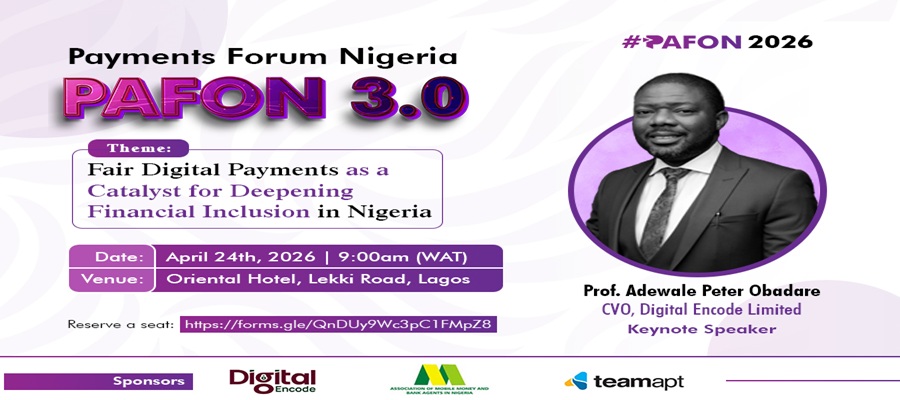
Digital Encode Limited has emerged the lead sponsor of the upcoming third edition of the forum (PAFON 3.0), the organisers have announced.

PAFON 3.0
PAFON 3.0 is scheduled to take place on Friday, April 24, 2026, at the Oriental Hotel, Lekki Road, Lagos, from 9:00 AM to 1:00 PM.
Themed “Fair Digital Payments as a Catalyst for Deepening Financial Inclusion in Nigeria,” PAFON 3.0 serves as a strategic platform for senior executives from banks, fintechs, regulatory agencies, and technology innovators to address the evolving digital payment landscape.
As Nigeria transitions toward a cash-light economy, the forum will focus on critical pillars of sustainability, including transparency, pricing integrity, and system resilience.
Bridging Cybersecurity and Financial Inclusion
Professor Adewale Peter Obadare, the Founder/chief visionary officer of Digital Encode will deliver a cybersecurity-focused keynote address that connects trust, resilience, fraud prevention, and consumer protection to financial inclusion.
His session will provide a specialized perspective on how information security serves as the bedrock of financial inclusion; exploring the vital links between building infrastructure that consumers can rely on, protecting the ecosystem to allow inclusion to scale, and ensuring equitable and secure access for all Nigerians.
Prof. Obadare is arguably the most Credentialed PAN-African Digital Trust Leader, CyberSecurity Strategist, GRC Thought Leader & Global Technopreneur.
He is a seasoned Multi-Award Cybersecurity & GRC expert with over 58 (Fifty-Eight) international professional certifications to his credit, Master of Science in Cybersecurity, Liverpool Unversity, UK, was awarded Honorarary Doctorate Degree in Cybersecurity from Trinity International University of Ambassadors Atlanta Georgia, United State of America and First Professor of Practice – Cybersecurity at Miva Open University, Abuja, Nigeria.
Prof. Obadare is a well-recognized subject matter expert with numerous successful engagements to his credit in Africa and the world. His skills and experience spans Data Privacy, Data Protection, CyberSecurity, Information Security, Vulnerability Management, Penetration Testing, Computer Forensics, Business Continuity, I T Governance, Risk Management and Compliance.
He is a Cybersecurity Advisory Board Member for Lagos State Government, a Platinum Team Member of Open-Source Security Testing Methodology Manual (OSSTMM), as well as a lifetime member of the Open Worldwide Application Security Project (OWASP). He is an alumnus of FATE Foundation and US Department of State Exchange program.
He is also a distinguished alumnus of executive education at Harvard Business School, Harvard School of Government, MIT Sloan School of Management, MIT Professional Education and Oxford University – Said Business School.
“Without trust in the security of digital payments, inclusion cannot scale. And we are happy to welcome Digital Encode as our Lead Sponsor this year. With what the company stands for and the personality of the CVO on a global scale, we have no doubt that attendees at this year’s PAFON will go home with lots of insights.”
“The theme for PAFON 3.0 was carefully selected because if digital payments are affordable, transparent, accessible, and trustworthy, more Nigerians, especially the underserved, will participate in the financial system”, Mr. Chike Onwuegbuchi, the co-convener of Payments Forum Nigeria, noted, highlighting Digital Encode distinguished leadership in Nigeria’s cybersecurity ecosystem.
Other Confirmed speakers: Dr. Jameelah Sharrieff-Ayedun, Vice President, Fintech Association of Nigeria (FintechNGR) & CEO, Credit Registry; Uche Uzoebo, MD/CEO, Shared Agent Network Expansion Facilities (SANEF Limited): Special Guest of Honour; Mojeed Abayomi Agboola, National President, Financial Inclusion Agents Multipurpose Cooperative Society (FIAMCS); Dr. Obioha Otti, National President, Association of Mobile Money and Bank Agents in Nigeria (AMMBAN); Chukwuemeka Enoch, Founder, Lagos Blockchain Week, and Sarafadeen Fasasi, National President, Association of Financial Inclusion Agents of Nigeria (AFiAN), amongst others.
The forum will feature speakers from across the financial spectrum, including mobile money operators, payment processors, and development institutions, to shape policy dialogue and industry standards.
PAFON is a premier industry gathering that aligns brand positioning with trust and innovation in Nigeria’s digital payments ecosystem. It provides a unique space for thought leadership, regulatory engagement, and market expansion within the payment infrastructure sector.

The era of treating cybersecurity as a mere IT problem is over. As AI-powered digital threats become more elusive and destructive, Nigeria is shifting its strategy toward “Total Resilience”—a multi-dimensional defense involving every level of society.

NITDA
At the 2026 GITEX Africa summit, NITDA DG, Kashifu Inuwa sounded the alarm on the changing nature of digital warfare, asserting that technology alone is no longer enough. Instead, Nigeria’s survival in the digital age now hinges on a strategic blend of policy, people, and proactive defense.
Speaking during a panel session on Cyber Resilience, Inuwa described the current global digital environment as being at a “critical turning point.”
He warned that emerging technologies are not only transforming industries and economies but are also reshaping the nature of cyber threats, demanding a proactive and multi-dimensional response from governments, institutions, and citizens alike.
“Cybersecurity is no longer just a technical issue. It is a strategic imperative for national development,” Inuwa stated. “We must think beyond technology alone and build resilience through people, processes, regulations, and infrastructure.”
Inuwa revealed that the focus of Nigeria’s cyber strategy is shifting from high-tech software to the people behind the screens. Pointing to data showing that 95% of all digital breaches stem from simple human mistakes, Inuwa argued that the world’s most advanced encryption is useless if the user is compromised.
“The most sophisticated technology cannot protect us if the human element is overlooked,” he noted. By prioritising human capacity and digital literacy, NITDA aims to turn every citizen into a “human firewall”, the first and most critical line of defense in a world where AI-driven attacks are the new normal.
In response, the Nigerian government has launched a comprehensive National Digital Literacy Programme aimed at achieving 95 percent digital literacy by 2030, with an interim target of 70 percent by 2027.
The programme emphasizes digital safety and cybersecurity awareness, equipping citizens with the knowledge to navigate an increasingly online world responsibly.
Inuwa highlighted initiatives such as the “3 Million Tech Talent” programme, designed to develop Nigerian expertise across key technology domains, including cybersecurity, data science, and AI.
The programme also leverages hackathons, innovation challenges, and mentorship schemes to channel young people’s skills into productive, lawful, and globally competitive ventures.
He argued that nurturing local talent is essential not just for national security but also for economic growth. “We want to create an environment where young Nigerians are innovators, not just consumers of technology,” he said.
Addressing concerns about Nigeria’s ranking in global cybercrime indices, Inuwa urged contextual understanding. “Countries with the most advanced digital economies also rank high in cybercrime because of the scale of their online activity,” he explained.
“Our focus is on redirecting talent towards innovation and solutions that protect our citizens while contributing to global digital advancement.”
On the legal and regulatory front, Nigeria continues to review and enhance the Cybercrime Act of 2015 to keep pace with the rapidly evolving threat landscape. The law underpins a structured National Cybersecurity Architecture coordinated by the Office of the National Security Adviser.
In addition, the country operates a 24-hour cybersecurity operations centre tasked with monitoring threats, issuing advisories, and providing real-time support to government institutions, businesses, and citizens. Advanced technologies, including dark web monitoring and AI-enabled threat detection, are being deployed to enhance situational awareness and improve response times.
Inuwa emphasized that effective cyber resilience requires collaboration between public and private sectors. NITDA is working closely with ministries, departments, agencies, and private sector stakeholders to secure critical infrastructure and strengthen national resilience.
“Cyber resilience is not a solo effort; it is a collective responsibility. By integrating people, technology, and regulation, we can build a secure, globally competitive digital economy,” he added.
As Nigeria navigates a digital-first future, initiatives such as the National Digital Literacy Programme, 3 Million Tech Talent, and strengthened legal frameworks underscore a commitment to turning cybersecurity challenges into opportunities for innovation and growth.
The country’s strategy reflects a broader understanding that in an era of AI-driven threats, preparedness is as much about people and processes as it is about technology.

Truecaller, the leading global communications platform, today announced the expansion of its Business Chat platform, making it accessible to global channel partners and enterprise solution providers. By “opening up” market access to its platform, Truecaller is empowering partners to transition their enterprise clients from legacy, low-trust SMS to a verified, smart, media-rich, and conversational communication experience.

Truecaller
Through this partner-led expansion, Truecaller empowers businesses to reclaim customer attention and establish immediate trust and credibility.
“The definition of success for modern enterprises has fundamentally evolved. It’s no longer just about delivery – it’s about earning attention, establishing credibility, and driving meaningful conversion,” said Priyam Bose, Global Head, GTM at Truecaller.
“By opening up market access to our global partners, we’ve created a powerful gateway for brands to engage with over 500 million active users where they already interact daily through communication that is contextual, trusted, free from clutter, and designed to initiate actions. For existing customers, the outreach opportunity extends to an additional high-impact channel, strengthening the overall customer experience journey.”
Truecaller Business Chat enables a clutter-free, high-trust conversational experience between businesses and consumers. The Business Chat platform equips partners with actionable insights, including real-time data and rich engagement metrics. This facilitates a more sophisticated, data-driven communication strategy that adapts at every stage of the customer journey.
Partners, including Gupshup and OneXtel, are already live in India along with Globe Teleservices, Cloudcom, and Sling Africa in other global markets, rapidly scaling the product in their respective regions. Global partners can now leverage Truecaller’s massive footprint to offer their clients a trustworthy engagement channel in an increasingly crowded digital world.

FG to Gift Nigerians over 100 Free TV Channels from May 15

FG New Approves Biometric Passenger Verification System for Airports Security

STBMAN, NBC Bicker over Alleged Due Process Breaches

CBN Dismisses Polaris Bank Liquidation Claim

AfDB Okays $200m for Nigeria’s Digital Backbone, Others

Spotify’s Loud & Clear Report Reveals Over ₦60Bn Revenue for Nigerian Artists in 2025

Kuda MFB Increases Kuda for Her Business Grants to ₦10 Million

Why JustMarkets Is a Strong Choice for Gold Trading

Canal+ to Cut Jobs as Part Sweeping Restructuring

Nigeria tops global rankings for USDT, USDC ownership




 E-Business3 days ago
Nigeria Demands Cloud Sovereignty to Anchor Africa’s Digital Independence

 Telecom3 days ago
Digital Encode Sponsors PAFON 3.0 as CVO Prof. Adewale Set to Deliver Keynote on Cybersecurity and Trust

 Telecom3 days ago
NITDA Boss Warns of AI Threat Shift @ GITEX Africa

 E-Business3 days ago
As Nigerians Struggle to Save, Mutual Benefits Highlights Power of Structured Financial Planning

 E-Financial3 days ago
Polaris Bank Targets Youth with Financial Literacy Drive
 Broadcasting2 days ago
FG to Gift Nigerians over 100 Free TV Channels from May 15

 Broadcasting3 days ago
What Adekunle Gold’s Support Means for ‘The Gathering on 100
 E-Financial2 days ago
AfDB Okays $200m for Nigeria’s Digital Backbone, Others