

Telecom
YouTube Supports Next Wave of Global Creative Entrepreneurs As It Announces New Ways for Creators to Make Money

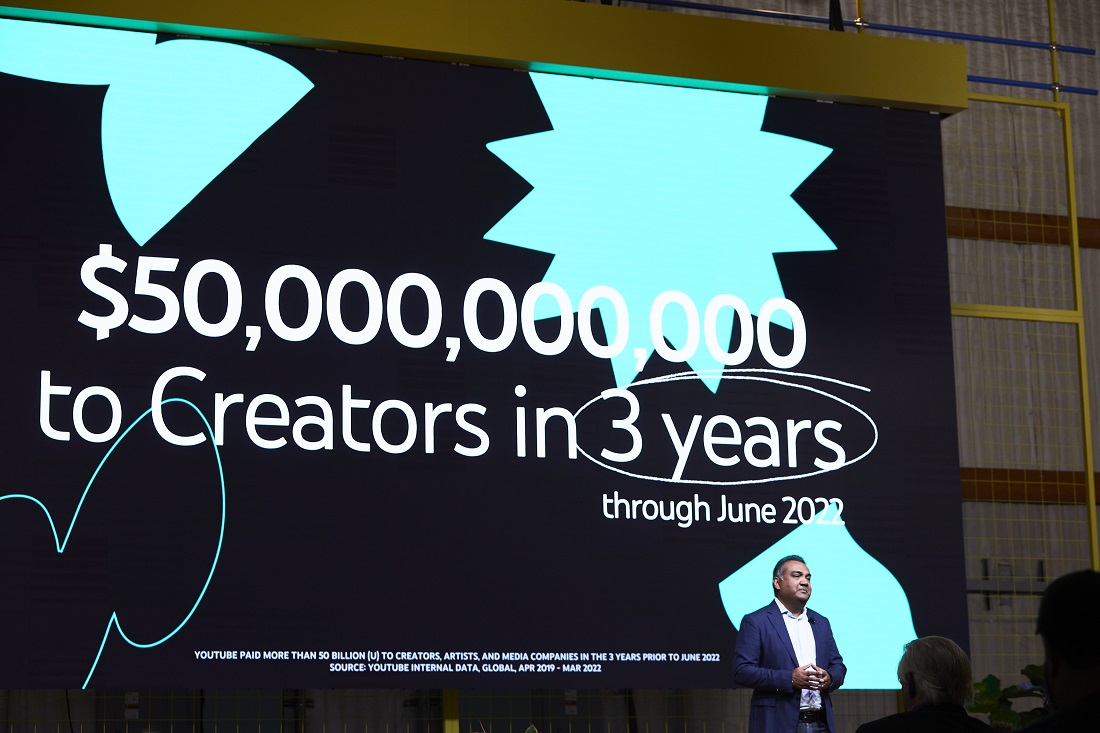
YouTube on Wednesday introduced the next chapter in rewarding creativity on the platform. At its inaugural Made on YouTube event, YouTube shared that it’s expanding the platform’s monetization system, the YouTube Partner Program (YPP), to allow more creators to join the program, introducing new ways for creators to earn revenue through Shorts, and re-imagining the music industry and creator dynamic by opening up ads monetization for those who feature music in their videos.

Today’s announcement reflects the diversity of the platform’s growing creator community and allows its over 2M monetizing creators to make money on YouTube across any creative format. Today’s key announcement includes:
Expanding access to YPP: Starting in early 2023, Shorts-focused creators can apply to YPP by meeting a threshold of 1K subscribers and 10M Shorts views over 90 days. These new partners will enjoy all the benefits YPP offers, including ads monetization across Shorts and long-form YouTube videos. This is in another option to the existing criteria where long-form creators can still apply to YPP when they reach 1,000 subscribers and 4,000 watch hours. Creators can choose the one option that best fits their channel while YouTube maintains the same level of brand safety for advertisers. To support creators who are early in their YouTube journey, YouTube will also introduce a new level of YPP with lower requirements that will offer earlier access to Fan Funding features like Super Thanks, Super Chat, Super Stickers and Channel Memberships.
Introducing a first-of-its-kind revenue sharing model for Shorts: With 30B+ daily views and 1.5B+ monthly logged-in users, Shorts are exploding around the world. To reward this new creative class, beginning in early 2023, we’ll be moving away from a fixed fund and doubling down on a unique revenue sharing model for Shorts for both current and future YPP creators. Because ads run between videos in the Shorts Feed, every month, revenue from these ads will be added together and used to reward Shorts creators and help cover costs of music licensing. From the overall amount allocated to creators, they will keep 45% of the revenue, distributed based on their share of total Shorts views. The revenue share remains the same, no matter if they use music or not.
Launching Creator Music: The complexities of music licensing has meant that most long-form videos that feature music don’t result in creators being paid. To build a bridge between the music industry and creators, YouTube is introducing Creator Music, a new destination that gives creators easy access to an ever-growing catalog of music for use in their videos, while providing artists and music rights holders with a new revenue stream for their music on YouTube. Creators can now buy affordable, high-quality music licenses that offer them full monetizing potential—they will keep the same revenue share they’d usually make on videos without any music. And for creators who don’t want to buy a license up front, they’ll be able to use songs and share revenue with the track’s artist and associated rights holders. Creator Music is currently in beta in the U.S. will expand to more countries in 2023.
Susan Wojcicki, CEO of YouTube, said: “The YouTube Partner Program was revolutionary when we launched it back in 2007, and it’s still revolutionary today. Over the last three years, YouTube has paid creators, artists, and media companies more than $50 billion dollars.
“That $50 billion dollars has changed the lives of creators around the world and enabled new voices and stories to be told. But we’re not done yet.
“When we introduced the YouTube Partner Program, we made a big bet: we succeed only when our creators succeed. And today, we’re doubling down.
“We’re introducing the next chapter in how we reward creativity on our platform by expanding access to our YouTube Partner program.”
Neal Mohan, YouTube’s Chief Product Officer, said: “YouTube’s first-of-its-kind, industry-leading Partner Program changed the game for long-form video.
“And now we’re changing the game again, this time by opening it up to Short-form creators and introducing revenue sharing to Shorts.
“This is the first time revenue sharing is being offered for short-form video on any platform at scale, adding to the 10 ways creators can already earn revenue on YouTube.
“It’ll be available to all of those in YPP — including the new, mobile-first creators, who will be joining the program for the first time.”
Lyor Cohen, YouTube’s Global Head of Music, said: “Creator Music is the future. We’re building the bridge between artists and creators on YouTube to elevate the soundtrack of the creator economy; it’s a win-win-win for artists, songwriters, creators and fans.
“With Creator Music, artists have a new way to get their music out into the world; fans can now discover music they love on their favorite creator’s channels, and both creators and artists will have new revenue opportunities.”
These creators and artists are using YouTube to lead the next wave of the creator economy and share how the announcements shared today will impact the broader ecosystem:
Producer/DJ, Marshmello said: “As an artist, Creator Music gives us an opportunity to tap into YouTube’s massive creator community and reach new fans.
“I’ve built an incredible global audience on YouTube and Creator Music feels like one of the latest evolutions that makes it such a valuable place for my music and more importantly, my fans.”
YouTube creators, Colin and Samir said: “Over the last three years, YouTube has paid out $50 billion to over 2 million creators, artists and media companies. through its Partner Program – more than any other platform.
“That’s $45 million a day. $1.9 million an hour, $528 a second. Every second. For the last three years. Today’s announcements prove that YouTube is continuing to lead the way in its commitment to creators everywhere.”
Multiformat creator, Kallmekris, said: “So many creators find themselves having to choose between video formats to best serve their unique goals. From a business perspective, the key benefit of Shorts for me is that they help me pull people into my community. Whereas for longform, it brings in a lot more revenue. That’s why this news about the partner program coming to Shorts is so great. My work will be supported in much the same way, no matter the format. That need for a strategic trade-off – weighing up the pros and cons – will disappear.”


Lebara Nigeria has become a member of the Global System for Mobile Communications Association (GSMA) as it expands operations in the West African country.

The membership places Lebara Nigeria within a global network of more than 1,000 mobile operators, device manufacturers, technology companies and digital service providers.
Through the GSMA, the company will have access to industry research, technical standards, policy engagement and industry initiatives.
Lebara Nigeria said the move reflects its participation in the wider telecommunications ecosystem as it develops its operations in Nigeria’s mobile market.
Nigeria’s telecommunications sector plays a central role in the country’s digital economy, with more than 170 million active mobile subscriptions supporting services such as digital payments, e-commerce, education and healthcare.
Industry analysts say participation in international bodies such as the GSMA supports knowledge sharing and the adoption of industry standards.
Lebara Nigeria said GSMA membership will support its engagement with industry developments and policy discussions in the telecommunications sector.
The company said it remains focused on operating in Nigeria’s mobile telecommunications market as demand for connectivity continues to grow.
GSM Association is the advocacy and lobbying organization for the mobile communications industry, representing more than 1,000 mobile operators as full members and a further 400 companies in the broader mobile ecosystem as associate members.

Management of Vitel Wireless, mobile virtual network operator (MVNO), has distanced the company from a fraudulent scheme operating under the name: “Vitel Shares Services.”

In an official statement, the management clarified that Vitel Wireless is not selling shares or running any investment schemes.
They warned that the operators of “Vitel Shares Services” are using unauthorised websites, mobile applications, social media promotions, and bank accounts falsely linked to Vitel Wireless to mislead the public.
The statement reads: “The attention of Vitel Wireless has been drawn to a fraudulent scheme operating under the name ‘Vitel Shares Services.’
“We wish to state clearly that Vitel Wireless has no affiliation with Vitel Shares Services, or any platform claiming to offer Vitel shares, investments, or financial products through unofficial channels.
“We do not solicit investments through agents, social media, websites, apps, or third parties. Any platform claiming to offer Vitel Wireless shares or investments outside our official channels is fraudulent and should be treated as such.
“We urge the general public to remain vigilant and verify all information through official Vitel Wireless communication channels before making any payments or sharing personal data.”

Airtel Nigeria has concluded its second Customer Forum in Abuja, bringing together a large section of customers including high-volume data subscribers, 5G customers, and key stakeholders in another landmark engagement aimed at addressing concerns around data usage, transparency, and customer experience.

The forum themed “Understanding Your Data and Taking Control 2.0.” aimed to strengthen trust in Nigeria’s rapidly evolving telecommunications landscape. The session also featured inputs from representatives of the Nigerian Communications Commission (NCC).
Delivering the Keynote remarks, Dinesh Balsingh, CEO of Airtel Nigeria, who was represented by Femi Adeniran, Director, Corporate Communications and CSR, emphasised that trust remains the most valuable currency in telecommunications, and Airtel remains committed to strengthening customer confidence through transparency and continuous engagement.
He explained that discussions around data consumption have become increasingly important as digital lifestyles evolve, with smartphones, cloud services, video streaming and emerging artificial intelligence applications significantly influencing data usage patterns.
According to him, Airtel recently introduced the Airtel Data Calculator, an innovative tool designed to help customers estimate their data needs based on online activities such as multimedia streaming, video calls, social media usage, and gaming.
“The purpose of the Airtel Data Calculator is to provide greater visibility, support informed decision-making and place more information directly in the hands of customers. Because transparency should never be viewed as a compliance exercise. Transparency is good business,” he stated.
He further reassured customers that Airtel has no incentive to shortchange subscribers through inaccurate billing, forced spending or unnecessary data depletion, stressing that the company’s growth depends on customer satisfaction, loyalty and trust.
Adeniran also highlighted Airtel’s continued investments in network infrastructure, fibre capacity, digital platforms, artificial intelligence capabilities, customer service systems and workforce development, noting that these investments are aimed at improving service quality and enhancing customer experiences.
Oladokun Oye, Director, Customer Experience, Airtel Nigeria, while welcoming participants to the event, said the forum was created to provide customers with an open platform for education, engagement and problem-solving, noting that the customer remains at the centre of Airtel’s business.
“Data has become central to everyday life, powering work, education, commerce, entertainment, healthcare and countless opportunities. As data usage grows, so too does the desire for greater visibility and understanding.
Today’s conversation is part of an ongoing journey. A journey toward greater transparency. A journey toward deeper understanding. And a journey toward a better customer experience for every Airtel subscriber,” he said.
The forum also featured practical demonstrations on data consumption management, device settings, and usage habits that impact data usage. It also included an interactive session by which Airtel teams provided clarifications and offered feedback to customers.
The Abuja event follows the successful maiden edition held earlier this year in Lagos and aligns with broader industry efforts led by the Nigerian Communications Commission (NCC) to improve consumer awareness, transparency, and confidence within the telecommunications sector.

Lebara Nigeria Becomes Member of GSMA Network

FG to Abolish JSS-SSS Separation Policy after 20m Pupils Drop Out

Vitel Wireless Warns Public, Says it Not Running any Investment Scheme

Army Says Terrorists Now Recruiting, Raising Funds Online

FG Mulls National Skills Database to Tackle Unemployment

Mobile Internet Gender Gap Widest in Africa – GSMA

London Strengthens Global Investment Ties with Africa @ First Ever London-Africa Business Summit

FG Targets Alleged N3tn Capital Flight, Opens Airtime Credit Market to Nigerian Fintechs

Japan, UNESCO Boost Digital Learning in 15 CoEs with Donation of ICT Equipment

Good News for DStv Users: Watch over 160 Channels Without Paying Extra




 E-Business2 days ago
LG Showcases AI-Powered Smart Living Innovations @ Africa Technology Expo 2026

 Telecom2 days ago
OADC Reaffirms Abundant Capacity in Data Centres in Nigeria to Host Financial Data

 E-Financial2 days ago
UBA mobilises employees across Africa for environmental clean-up, wellness campaign

 General News2 days ago
LASTMA Launches 3367 Toll-Free Hotline for Emergency Response, Traffic Management

 E-Financial2 days ago
PalmPay Calls for Trust, Infrastructure and Responsible AI to Drive Payment Ecosystem Innovation

 E-Business2 days ago
Want a Business Loan Without Interest? SMEDAN Launches N500m Fund

 Telecom2 days ago
ALTON Backs NCC’s Local Smartphone Manufacturing Drive to Widen Digital Access

 E-Financial2 days ago
ngCERT Raises Alarm over Surge in Banks’ ATM Cyberattacks