

News
Guinness Nigeria Signs MOU with NYSC on Innovative DRINKiQ Campaign

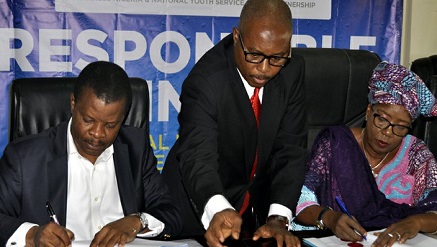
Guinness Nigeria Plc, has revved up its commitment to driving responsible drinking behaviour among Nigerian consumers by partnering with the National Youth Service Corps (NYSC), to deliver its innovative and trailblazing DRINKiQ training sessions to officials and corps members in a bid to take the responsible drinking message to every nook and cranny of the country.
At the signing of the Memorandum of Understanding between Guinness Nigeria and the NYSC which took place at the Gowon House, National Directorate Headquarters, NYSC in Abuja, Brigadier General Sule Kazaure, director general, NYSC, who was represented by Director, Community Development Service and Special Projects, Mrs. Rhoda Kaka Kwaki, appreciated the laudable hand of fellowship extended by Guinness Nigeria to help create a society where responsible drinking becomes engrained in the consciousness of many young adults and society at large.
Commending Guinness Nigeria for the intervention, she described the partnership as a clear demonstration of the company’s positive disposition towards the welfare and development of Nigerians, particularly the youth.
“This DRINKiQ campaign, a form of giving back to the society to be implemented by the Community Development Service and Special Projects is bound to impact positively on the entire society and it is my sincere hope that what we have sown today will blossom into enduring and sustainable entity for the benefit of our communities and environs,” Kwaki said.
Mr. Peter Ndegwa, managing director, Guinness Nigeria Plc, who was represented by Mr. Sesan Sobowale, company’s Corporate Relations Director, described the occasion as historic one and a momentous stride in the right direction with a view to curbing the irresponsible use of alcohol in society.

“We are committed to creating awareness about responsible drinking and promoting the enjoyment of alcohol and our brands as part of a healthy balanced lifestyle. We also believe that efforts to reduce the misuse of alcohol are most effective when governments, society, individuals, families as well as industry work together. Therefore, our approach is built around providing consumers with information promoting rigorous company and industry standards for responsible marketing, supporting effective programmes and partnerships as the one that we are signing today to promote alcohol education and to tackle misuse and advocating effective evidence-based policy,” Sobowale enthused.
Other dignitaries present at the occasion include Sustainable Development/ Alcohol in Society, AiS Manager, Guinness Nigeria, Osita Abana; Director, Legal Service, NYSC Directorate NHQ, Barrister Tijani Ibrahim; Director, Planning, Research and Statistics, Chief Anthony Ani;, Director, Press and Public Relations, Mrs Bose Aderibigbe; Director, Corp Welfare and Inspectorate, Mrs Victoria Obi Okaku; Director, Certfication, Alh Udu Taura; and Director, Corps Mobilization Chief Frank Ekpenobi.
On the scope of the partnership, Sobowale explained that the DRINKiQ programme is one of the training platforms that Guinness Nigeria, has used to leverage its responsible drinking agenda. The training aims to raise the public’s awareness about alcohol so that people can have a better understanding of the drinking choices that they make, including the decision not to drink, when to drink and how much to drink.
In view of this, the programme would start with Train-the-Trainers, ToT programme, that will equip NYSC officials (drawn from the 36 states of the federation) with information and knowledge about responsible drinking. These officials will then provide trainee corps members with practical tips, strategies and confidence they need to become champions for responsible drinking in their communities.
It would be recalled that last year, Guinness pioneered the use of breathalyzers by the Federal Road Safety Commission via its donation of breathalyzers to the safety agency to enable it check the incidence of drunk-driving on Nigerian roads during the ember months. Other initiatives include the Age Verification Programme, sponsorship of a radio programme, DRINK DIARIES, on Lagos Traffic radio 96.1 FM as well as advertorials and out-of-home messaging aimed at educating the general public on the dangers of drink-driving.


Union Bank of Nigeria has secured certification under the Payment Card Industry Data Security Standard (PCI DSS) version 4.0.1, a global standard for protecting payment card data.

The certification took effect on August 11, 2026, confirming that the bank’s systems for storing, processing and transmitting customers’ credit and debit card information meet stringent international security requirements.
PCI DSS certification is designed to reduce the risk of payment card data breaches and financial fraud while strengthening customer confidence in electronic payment systems.
The assessment covered key areas of Union Bank’s operations, including network infrastructure, card issuance, ATM and POS transactions, payment processing, reconciliation, settlement, chargebacks, dispute resolution and retail banking.
Union Bank was assessed and certified under the Service Provider category.
The certification process lasted a full year and involved quarterly assessments, with support from departmental, business and functional heads across the bank. Digital security firm Digital Encode supported the process, while the final independent audit was conducted by CyberCube, an accredited Qualified Security Assessor.
Yetunde B. Oni, Managing Director and Chief Executive Officer of Union Bank, said the certification demonstrates the bank’s commitment to protecting customer information.
“The security of our customers’ information is central to everything we do at Union Bank. This certification reaffirms that our payment systems and processes meet a rigorous global standard, and it reflects the discipline of colleagues across the Bank who work every day to keep customer data safe.”
The renewal also ensures that Union Bank maintains continuous PCI DSS certification, in line with the Central Bank of Nigeria’s requirement for banks to sustain compliance without interruption.
New data from CFA Society Nigeria is reshaping how the country’s financial sector thinks about talent development, with Access emerging as the single largest source of CFA candidates in Nigeria, distinction industry watchers say signals a deeper shift in how leading institutions are building investment expertise from within.

In its Where Nigeria’s Finance Professionals Work series, published in a national daily, CFA Society Nigeria placed Access first among employers of CFA candidates nationwide, with 82 candidates enrolled in the programme, more than double the 38 recorded at the next-placed institution and well ahead of every other bank or financial services firm on the list.
Access also ranked second among employers of CFA charterholders, with 11 professionals who have completed all three levels of the Programme and met its experience and ethics requirements.
For an industry that has long measured itself by balance sheet size and branch count, the rankings point to a different kind of competition: one over who is building the deepest bench of certified, globally credentialed talent.
CFA Society Nigeria compiled the data from its Salesforce Membership Database as at June 2026, and described the exercise as a way of recognising employers whose people “bring rigour, integrity and global best practices into the workplace every day.”
Analysts following the sector say the outcome is notable less for the ranking itself than for what it suggests about talent strategy across Africa’s financial services industry. A single institution developing more aspiring charterholders than the rest of the market combined raises the floor for professional standards nationally, not just within one balance sheet.
Every candidate who advances through the CFA Programme adds to a shared pool of ethics-trained, analytically rigorous professionals that Nigeria’s capital markets, pension funds and asset managers all eventually draw from.
Access Holdings Group Chief Executive Officer Innocent C. Ike, commenting on the rankings, framed the achievement in terms of institution-building rather than recruitment: “Every candidate on that list represents our commitment to building institutions and professionals that endure.”
The remark echoes a broader thesis increasingly voiced by market observers, that talent depth, not scale alone, is what will determine which African financial institutions earn lasting global credibility.
That distinction sits at the centre of Access’s stated ambition to become the World’s Most Respected African Financial Services Group. If the CFA numbers are any indication, the Group’s route to that goal runs less through square metres of branch network and more through the calibre of the people sitting inside it, a bet that Nigeria’s finance professionals, and the institutions that will one day hire them, are already placing alongside Access.


Nigeria Civil Aviation Authority (NCAA) has announced plans to introduce Radio Frequency Identification (RFID) baggage tracking technology across domestic and international airport terminals to tackle the growing problem of delayed, misrouted and missing luggages

Michael Achimugu, director, Public Affairs and Consumer Protection, NCAA, disclosed this at a stakeholder engagement forum in Lagos.
Achimugu said the RFID-enabled system would replace the traditional barcode-based baggage tracking framework and provide airlines and passengers with real-time visibility of checked luggage from check-in to final collection.
According to him, the technology would improve baggage traceability, reduce mishandling and strengthen accountability across the baggage-handling chain.
Unlike conventional barcode systems, RFID technology allows baggage to be automatically scanned at multiple points without requiring direct line of sight, enabling real-time tracking of luggage throughout its journey.
Achimugu said issues involving short-landed, missing, lost or damaged baggage had remained among the major complaints from air travellers, alongside flight delays.
He said the introduction of RFID technology was therefore aimed at improving baggage-handling standards and restoring passenger confidence in the aviation sector.
The NCAA said the initiative also aligns with IATA Resolution 753, which requires airlines to track baggage at key points during the passenger journey.
The authority expects the technology to provide more accurate information on the location of luggage, facilitate quicker resolution of baggage-related complaints and improve the overall passenger experience.
The NCAA said the initiative would also strengthen accountability among airlines and other stakeholders involved in baggage handling at Nigerian airports.

FG Seeks to Half Burkina Faso’s Internet Cost while Nigerians Pay more

Cyberthreat: New Malware, Turns Phones into Tools for Card Fraud- Report

SEC Clears Blockchain for Accelerated Regulatory Incubation Programme

Union Bank Secures Global Payment Data Security Certification

NLNG, NCDMB Boost Engineering Research with Innovation Centre

Fact-Check: Elon Musk’s “Tesla Pi Phone” is Internet Rumor

EFCC Busts NIS Visa Overstay Racket, Uncovers N700m in an Account

NBC Tasks Broadcasting Stations over 2028 DSO Global Deadline

Glo Sponsored African Voices to Feature Netflix’s “The Polygamist” Stars

Access Bank Debunks Shutdown Report, Vows Action against Perpetrators




 Telecom3 days ago
Airtel Nigeria Adds Over 1,000Cell Sites in Nationwide Expansion to Surpasses 17,000

 E-Financial3 days ago
Mastercard, TeamApt Collaborate to Expand Digital Payments Across Africa

 News3 days ago
Access Holdings Sets New Benchmark in Nigeria’s Finance Talent Pipeline

 E-Business3 days ago
MacOS Users Report More Cyber Threats than Windows Users – Survey Reveals

 Telecom3 days ago
Nigerian Startup Act: NITDA Calls for Stronger Inter-Agency Collaboration

 E-Financial3 days ago
SEC Orders Immediate Freeze of Assets Linked to Six Terrorism Financiers, Three Entities

 E-Business2 days ago
World Cup, AFCON, Blord saga top Nigeria’s Google searches in 2026

 General News2 days ago
NITDA Seals Strategic Deals with Goose FL and Fireflies AI to Power $1 Trillion Digital Economy Vision