

/home/kenneth/web/nigeriacommunicationsweek.com.ng/public_html/wp-content/themes/zox-news/parts/post-single.php on line 153
">
Warning: Undefined array key 0 in /home/kenneth/web/nigeriacommunicationsweek.com.ng/public_html/wp-content/themes/zox-news/parts/post-single.php on line 153
Warning: Attempt to read property "cat_name" on null in /home/kenneth/web/nigeriacommunicationsweek.com.ng/public_html/wp-content/themes/zox-news/parts/post-single.php on line 153
Harassment of Courier Operations by Local Governments

The courier business is a time sensitive one which does not need to be disturbed to be able to meet the urgent nature of the business. Unfortunately, in addition to other problems suffered by courier operators in Nigeria such as bad road network, poor condition of available roads, power problem, local government authorities in the country have also turned out to be a great hindrance to swift courier operations. This development has lingered for sometime now and all the efforts made by courier stakeholders have not realized any positive result. The Courier regulatory Department of the Nigerian postal service whose duty it is to regulate the postal and courier sector had in the bid to smoothen courier operations tried to handle the matter the top hierarchy of the Association of Local Governments of Nigeria (ALGON) but nothing much was achieved . Dr. Simon Emeje had in earlier interview with this correspondent on the matter said that they had been working on the matter as far back as three years now but lamented that the problem is more complicated than what the eyes can see. Emeje said that they took the matter up sometime ago as an organization by setting up a technical sub-committee from the Courier Consultative Forum in respect of courier activities even at the airport. The committee put up a paper and sent it to the Federal Airport Authority of Nigeria (FAAN) to address the issue of multiple charges from FAAN. Dr Emeje also said he was able to work with the postmaster general of the federation to put up a paper across to the then minister of communication as the problem had become more perennial defying every solution towards solving it. The effort was to have the matter discussed at the ministerial level by the communications minister with his colleagues in the aviation and other ministries and bodies that have to do something with the courier operations like the Nigeria Police Force, local government commissioners and others. In the process Emeje said they discovered that the problem was more social than just economic. This fact is corroborated by Toyin Adeojo, manager, Cross Country Courier. Adeojo said that even when you have discussed the matter with local government chairmen, they would not be on the road when the boys arte extorting money from their couriers. He said that a situation whereby all the documents obtained in Lagos State for example are not valid in other parts of the country especially in the eastern parts of Onitsha, Asaba and Orlu is quite unfortunate. Adeojo said the effect of those harassments is delayed delivery and breach of the trust because sometimes the miscreants tamper with their consignments. “No matter the kind of document you present, they will look for a loophole/ for instance, there are situations when they ask for waste basket sticker on a courier van that is not moving passengers. The situation is disturbing and alarming”, Adeojo lamented. The actually represents the agonies other courier companies pass through in carrying out their legitimate businesses.
Dr Emeje described the scenario as unfortunate whereby you have miscreants all over the place who come to you claiming they are from one local government or the other asking dispatch rider to pay for radio or things of that nature. Emeje asks “why would they ask a dispatch to do so. Is he supposed to mount radio on the motor-cycle?
With the problems the express industries are going through, Adeojo said achieving the Vision 2020 agenda of the federal government in leapfrogging the country to be a key player in the world economy will not be realized. He said parcels take just about eight hours or less to arrive the country from abroad but the same consignments spend days to get to their destinations on arrival into the country because of operational delays. He said such a development is not good for our economy. To him, it is important that ALGON addresses the matter as it is critical to service delivery.


Warning: Undefined array key 0 in /home/kenneth/web/nigeriacommunicationsweek.com.ng/public_html/wp-content/themes/zox-news/parts/post-single.php on line 493
Warning: Attempt to read property "cat_ID" on null in /home/kenneth/web/nigeriacommunicationsweek.com.ng/public_html/wp-content/themes/zox-news/parts/post-single.php on line 493


Kashifu Inuwa, the Director General of the National Information Technology Development Agency, has issued a decisive mandate for African nations to establish domestic cloud infrastructure and data sovereignty or risk permanent digital subservience.

Speaking during a high-level strategic session at the GITEX Africa 2026 summit in Morocco, Inuwa argued that the continent must move beyond being a passive consumer of foreign technology to becoming a primary architect of its own digital ecosystem.
He warned that the current state of continental fragmentation leaves Africa vulnerable to external disruptions and prevents the realization of a truly integrated digital economy.
Inuwa characterised the modern global landscape as an environment defined by high-velocity data processing and pervasive intelligent systems, noting that digital integration is now a non-negotiable prerequisite for national survival.
He grounded this technical reality in a striking analogy, describing the cloud as the fundamental life-support system of the modern world. “In today’s reality, digital is no longer optional; it is a way of life,” Inuwa stated. “And the cloud is the oxygen that sustains that life.
The question we must ask ourselves is: who controls that oxygen?”
The push for cloud sovereignty represents a move toward localised data residency and autonomous computational power. Inuwa stressed that without regional data centers and unified regulatory frameworks, African nations remain subject to the policy shifts and geopolitical priorities of overseas providers.
He advocated for a shift from fragmented, siloed efforts toward a federated regional approach that pools resources and expertise to build a robust, self-sustaining African cloud. This transition is essential for ensuring that the massive datasets generated by African users are utilized to train local artificial intelligence models and catalyse internal economic growth rather than being exported for external profit.
The NITDA boss expressed concern over Africa’s limited share of global digital infrastructure, noting that while the continent accounts for between 15 to 19 percent of the world’s population, it holds only about 0.6 percent of global data centre and computing capacity.
He described the imbalance as a structural disadvantage that exposes African countries to risks around data security, economic dependency, and limited participation in the global innovation ecosystem.
“This is not just a technology gap, it is a sovereignty gap,” Inuwa stated. “We are generating data, but we are not in control of how and where that data is stored, processed, or monetised.”
He warned that over reliance on foreign owned cloud platforms could have long term implications for national security, economic competitiveness, and policy autonomy, especially as data becomes a critical resource in the global economy.
Despite these challenges, Inuwa highlighted Africa’s immense potential, pointing to its youthful population, expanding internet penetration, and fast growing startup ecosystem as key drivers of digital growth.
He said the continent is uniquely positioned to leapfrog legacy systems and build modern, scalable infrastructure that can support innovation across sectors.
However, he stressed that achieving this vision would require coordinated action among African governments, private sector players, and regional institutions.
“There is no single country in Africa that can do this alone,” he said. “We must collaborate, integrate our efforts, and build shared infrastructure that benefits the entire continent.”
Central to his recommendation is the creation of a “cloud of clouds” a federated cloud ecosystem that connects multiple national and regional cloud platforms into a unified, interoperable network.
Such a system, he explained, would allow countries to maintain control over their data while benefiting from shared standards, scalability, and cross-border collaboration.
Inuwa pointed to Europe’s Gaia-X as a useful reference model, noting that while Africa’s context is different, the principle of building a trusted and interconnected cloud ecosystem remains relevant.
He emphasised that cloud sovereignty should not be misunderstood as protectionism or digital isolation, but rather as the capacity for self determination in the digital age.
“Sovereignty is about having the ability to make our own choices, to define our own standards, and to build systems that reflect our values and priorities,” he said.
Inuwa further noted that developing indigenous cloud capacity could unlock significant economic opportunities, including job creation, local innovation, improved digital services, and increased investor confidence.
It could also strengthen Africa’s position in emerging technologies such as artificial intelligence, big data analytics, and the Internet of Things, all of which depend heavily on robust cloud infrastructure.
The DG concluded by emphasising that the quest for digital sovereignty is not merely a technical objective but a strategic imperative for long-term stability. He asserted that for Africa to achieve meaningful autonomy in an increasingly digitised world, it must secure its own computational foundations.
By establishing indigenous control over data processing and storage, the continent can insulate its critical national infrastructure from external volatility while ensuring that its digital future is determined by its own policies and priorities. The message was clear: Africa must harmonise its infrastructure and localise its computational assets now or face an era of unprecedented digital marginalisation.
As global competition in the digital space intensifies, Africa’s ability to act collectively and strategically will determine whether it emerges as a major digital powerhouse or remains on the periphery of the digital revolution.
Telecom
Digital Encode Sponsors PAFON 3.0 as CVO Prof. Adewale Set to Deliver Keynote on Cybersecurity and Trust

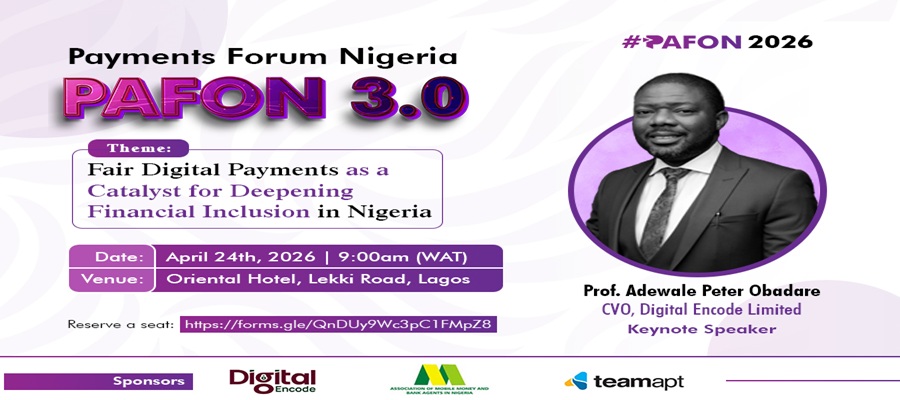
Digital Encode Limited has emerged the lead sponsor of the upcoming third edition of the forum (PAFON 3.0), the organisers have announced.

PAFON 3.0
PAFON 3.0 is scheduled to take place on Friday, April 24, 2026, at the Oriental Hotel, Lekki Road, Lagos, from 9:00 AM to 1:00 PM.
Themed “Fair Digital Payments as a Catalyst for Deepening Financial Inclusion in Nigeria,” PAFON 3.0 serves as a strategic platform for senior executives from banks, fintechs, regulatory agencies, and technology innovators to address the evolving digital payment landscape.
As Nigeria transitions toward a cash-light economy, the forum will focus on critical pillars of sustainability, including transparency, pricing integrity, and system resilience.
Bridging Cybersecurity and Financial Inclusion
Professor Adewale Peter Obadare, the Founder/chief visionary officer of Digital Encode will deliver a cybersecurity-focused keynote address that connects trust, resilience, fraud prevention, and consumer protection to financial inclusion.
His session will provide a specialized perspective on how information security serves as the bedrock of financial inclusion; exploring the vital links between building infrastructure that consumers can rely on, protecting the ecosystem to allow inclusion to scale, and ensuring equitable and secure access for all Nigerians.
Prof. Obadare is arguably the most Credentialed PAN-African Digital Trust Leader, CyberSecurity Strategist, GRC Thought Leader & Global Technopreneur.
He is a seasoned Multi-Award Cybersecurity & GRC expert with over 58 (Fifty-Eight) international professional certifications to his credit, Master of Science in Cybersecurity, Liverpool Unversity, UK, was awarded Honorarary Doctorate Degree in Cybersecurity from Trinity International University of Ambassadors Atlanta Georgia, United State of America and First Professor of Practice – Cybersecurity at Miva Open University, Abuja, Nigeria.
Prof. Obadare is a well-recognized subject matter expert with numerous successful engagements to his credit in Africa and the world. His skills and experience spans Data Privacy, Data Protection, CyberSecurity, Information Security, Vulnerability Management, Penetration Testing, Computer Forensics, Business Continuity, I T Governance, Risk Management and Compliance.
He is a Cybersecurity Advisory Board Member for Lagos State Government, a Platinum Team Member of Open-Source Security Testing Methodology Manual (OSSTMM), as well as a lifetime member of the Open Worldwide Application Security Project (OWASP). He is an alumnus of FATE Foundation and US Department of State Exchange program.
He is also a distinguished alumnus of executive education at Harvard Business School, Harvard School of Government, MIT Sloan School of Management, MIT Professional Education and Oxford University – Said Business School.
“Without trust in the security of digital payments, inclusion cannot scale. And we are happy to welcome Digital Encode as our Lead Sponsor this year. With what the company stands for and the personality of the CVO on a global scale, we have no doubt that attendees at this year’s PAFON will go home with lots of insights.”
“The theme for PAFON 3.0 was carefully selected because if digital payments are affordable, transparent, accessible, and trustworthy, more Nigerians, especially the underserved, will participate in the financial system”, Mr. Chike Onwuegbuchi, the co-convener of Payments Forum Nigeria, noted, highlighting Digital Encode distinguished leadership in Nigeria’s cybersecurity ecosystem.
Other Confirmed speakers: Dr. Jameelah Sharrieff-Ayedun, Vice President, Fintech Association of Nigeria (FintechNGR) & CEO, Credit Registry; Uche Uzoebo, MD/CEO, Shared Agent Network Expansion Facilities (SANEF Limited): Special Guest of Honour; Mojeed Abayomi Agboola, National President, Financial Inclusion Agents Multipurpose Cooperative Society (FIAMCS); Dr. Obioha Otti, National President, Association of Mobile Money and Bank Agents in Nigeria (AMMBAN); Chukwuemeka Enoch, Founder, Lagos Blockchain Week, and Sarafadeen Fasasi, National President, Association of Financial Inclusion Agents of Nigeria (AFiAN), amongst others.
The forum will feature speakers from across the financial spectrum, including mobile money operators, payment processors, and development institutions, to shape policy dialogue and industry standards.
PAFON is a premier industry gathering that aligns brand positioning with trust and innovation in Nigeria’s digital payments ecosystem. It provides a unique space for thought leadership, regulatory engagement, and market expansion within the payment infrastructure sector.

As conversations around money become more complex in a fast-evolving digital world, the need to Building Financially Smart Future and equip young people with the right financial knowledge, has never been more urgent.

Polaris Bank
From spending habits to saving culture, digital transactions, and entrepreneurial thinking, financial literacy is increasingly becoming a life skill, not just a nice-to-have.
It is against this backdrop that Polaris Bank is participating in this year’s Global Money Week (GMW), a global financial awareness campaign which kicked off from Tuesday, April 7 through Thursday, April 30, 2026.
Global Money Week is an annual initiative led by Child and Youth Finance International in collaboration with key stakeholders, including financial service providers and government institutions, to inspire children and young people to learn about money management, livelihoods, and entrepreneurship.
During the 2025 edition Polaris Bank reached and impacted directly 3,372 students, across 35 secondary schools in 36 states across Nigeria.
With the 2026 theme, “Smart Money Talks,” this year’s campaign shines a spotlight on the importance of making informed financial decisions in an increasingly digital environment. It also reinforces the value of critical thinking, emotional intelligence, and sound financial judgement in helping young people navigate today’s financial realities.
For Polaris Bank, participation in Global Money Week goes beyond fulfilling a statutory obligation. It reflects the Bank’s broader commitment to advancing financial literacy, promoting inclusion, and empowering the next generation with practical knowledge that can shape better financial behaviour and long-term economic wellbeing.
In line with the directive of the Central Bank of Nigeria (CBN) through the Financial Literacy Secretariat, Polaris Bank will conduct Financial Literacy Sessions in schools across states where it maintains branch presence. These sessions will provide students and young adults with useful insights into key areas such as; saving, budgeting, responsible use of financial products, digital financial services, and entrepreneurship.
The initiative also presents an important opportunity for the Bank to engage directly with young people at a formative stage in their lives, helping them build confidence in money matters and make more informed choices as they grow into financially active adults.
At a time when financial decisions are increasingly shaped by technology, peer influence, and instant access to digital tools, Polaris Bank believes that early education is critical to helping young people distinguish between impulse and intention, trend and truth, convenience and responsibility.
By taking financial literacy conversations into schools, the Bank is not only supporting a national mandate but also contributing to the development of a generation that is better informed, more financially aware, and more capable of making smart choices for the future.
Polaris Bank remains committed to initiatives that create meaningful impact, strengthen communities, and empower individuals through knowledge-driven engagement.

Nigeria Demands Cloud Sovereignty to Anchor Africa’s Digital Independence

Digital Encode Sponsors PAFON 3.0 as CVO Prof. Adewale Set to Deliver Keynote on Cybersecurity and Trust

Polaris Bank Targets Youth with Financial Literacy Drive

As Nigerians Struggle to Save, Mutual Benefits Highlights Power of Structured Financial Planning

NITDA Boss Warns of AI Threat Shift @ GITEX Africa

Spotify’s Loud & Clear Report Reveals Over ₦60Bn Revenue for Nigerian Artists in 2025

Why JustMarkets Is a Strong Choice for Gold Trading

Kuda MFB Increases Kuda for Her Business Grants to ₦10 Million

Canal+ to Cut Jobs as Part Sweeping Restructuring

Nigeria tops global rankings for USDT, USDC ownership




 Telecom2 days ago
From Import Dependency to Local Capacity: Nigeria’s Tech Manufacturing Journey

 E-Financial2 days ago
How Unethical Deals Triggered CBN Takeover of Union Bank -Forensic Report

 E-Business2 days ago
Kaspersky Warns of Digital Medicine Risks on the Occasion of World Health Day

 E-Financial2 days ago
BVN Database hits 68.6m – NIBSS

 Broadcasting2 days ago
Multichoice Bleeds Customers in South Africa, Loses 580,000 Subscribers

 E-Financial1 day ago
How Sterling Bank Is Empowering 1m Women with ₦500Bn

 Broadcasting2 days ago
Broadcast Station Owners Reject IBAN’s Threat to Boycott Wike’s Media Engagements

 General News2 days ago
FG Asks MDAs to Halt New Policies Until Full Compliance with RIA