

News
Heineken Unveils New Green Crown Cork


Heineken, the world’s premier international beer brand has unveiled new alluring all-green crown cork.
Emmanuel Oriakhi, Marketing Director, Nigerian Breweries Plc, speaking at the launch on Monday said that the “change presents the next subtle step in the evolution of the Heineken identity, expressing the clear, bright, fresh and natural character of the Heineken lager beer while retaining its same great taste.
“This new change maintains the brand’s contemporary and progressive identity, highlighting Heineken’s most iconic design elements.
“Heineken’s unique red star is bolder, its dominant green color is more prominent and the word “Quality” has also been replaced with “Original”, further referencing Heineken’s claim of being one of the most authentic brands in the world.
He noted that the new look is in line with Heineken’s green identity which takes effect this May.
“With this change, the old silver crown corks will be phased out gradually, leaving the same beer and same great taste”.
Commenting further on the reason for changing the design of the Heineken crown cork, Oriakhi, said “We at Heineken are very excited about this new modification to our crown cork.
“Just as with the limited edition bottles, we are very confident that our proud consumers will share in the euphoria of this new change.
“This year has been exciting for Heineken in Nigeria. Through our carefully thought out campaigns, we have reinforced strong connections with our loyal consumers by gifting them unique, remarkable and unforgettable experiences.
“As we strive to consistently raise the bar in our consumer experience, this new crown cork design re-establishes our resolve to stay prominent above other brands, all while maintaining that same originality and great taste”
This is not the first time Heineken will be changing its look, as the brand changed its crown cork in 2014.
This new launch comes hot on the heels of Heineken’s ongoing riveting UEFA Champions League Campaign.
This year with the UCL campaign, the premium viewing experiences, the UEFA Champions League tour, the unmissable match, a trip to the UCL semi-finals lucky consumers and now the limited edition UCL bottles, Heineken has continued to connect with its consumers with a commitment to continually reward them with more exciting encounters in the coming months.
With its presence in 192 countries worldwide, Heineken remains one of the world’s most consumed international beer brands, consistently upping the ante in providing fans with unique, remarkable, unmissable moments.


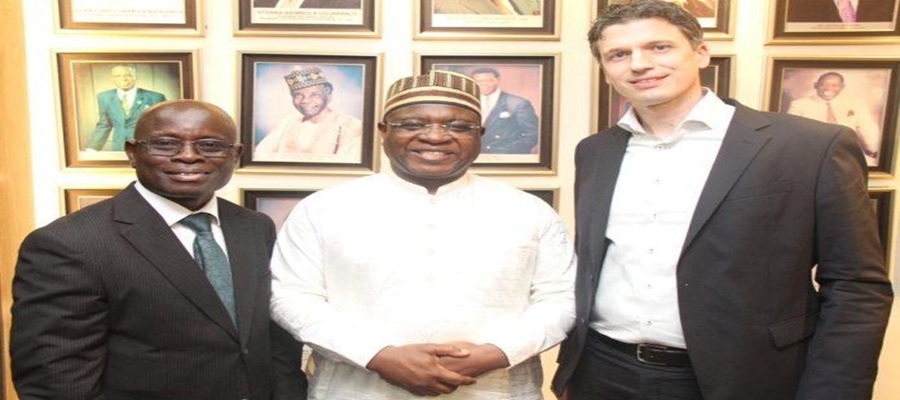
Nigerian Exchange Limited (NGX) has launched the NGX Net-Zero Programme to guide listed companies toward clear carbon reduction pathways and enhanced climate disclosures aligned with global investor standards.

NGX
The high-level launch engaged chief executives of quoted firms alongside development partners including German Investment Corporation KfW, DEG, and African Foresight Group (AFG), NGX’s implementation partner. Issuers and investors discussed financing decarbonisation, sustainability practices, and attracting climate-aligned capital.
NGX Group Chairman Dr Umaru Kwairanga described the initiative as concrete climate action, commending partners for two years of groundwork. “Today marks leadership and decisive action. Climate change has become a core business imperative, with capital markets mobilising capital and setting standards,” Kwairanga said.
He positioned NGX Net-Zero to support emissions measurement, disclosure, capacity building, and sustainable finance access, urging CEOs to embrace it strategically rather than as compliance. Kwairanga reaffirmed NGX’s goal to make Nigeria’s capital market Africa’s green finance hub.
Group CEO Temi Popoola called climate action a business imperative, noting sustainability-embedded firms attract capital, manage risks, and stay competitive. DEG Management Board Member Monika Beck highlighted partnerships scaling impactful, commercially viable climate solutions.
The event closed with a ceremonial gong marking the programme launch and send-off for outgoing DEG Regional Director Bernd Telemann.

Nigerian Financial Intelligence Unit (NFIU) has hailed Nigeria’s removal from the European Union’s list of high-risk third countries for Anti-Money Laundering and Countering the Financing of Terrorism (AML/CFT) as a landmark achievement endorsing the nation’s reform efforts.

Nigerian Financial Intelligence Unit (NFIU)
NFIU CEO Hafsat Abubakar Bakari said the delisting, contained in European Commission Delegated Regulation (EU) C (2025) 8460 adopted December 4, 2025 and effective January 29, 2026, affirms sustained AML/CFT and Counter Proliferation Financing (CPF) reforms.
The move follows Nigeria’s exit from the FATF Jurisdictions under Increased Monitoring after addressing strategic deficiencies, alongside Burkina Faso, Mali, Mozambique, South Africa and Tanzania.
Bakari noted the European Commission recognised Nigeria’s strengthened AML/CFT effectiveness, closed technical gaps, and fulfilled FATF Action Plan commitments leading to grey list removal in June and October 2025.
The delisting eliminates enhanced due diligence requirements for EU financial transactions, easing compliance, boosting cross-border flows, and enhancing Nigeria’s appeal for European trade, investment and partnerships.
The NFIU attributed success to President Bola Ahmed Tinubu’s political will and collaboration among National Assembly, law enforcement, regulators, judiciary, private sector and development partners.
The agency reaffirmed commitment to ongoing FATF, GIABA, EU engagement and domestic framework resilience to maintain international confidence in Nigeria’s financial system.


The Federal Government has directed all banks and fintechs to collect and remit 7.5 per cent value-added tax on certain electronic banking services, effective Monday, January 19, 2026, according to an email notice issued by payment platforms.

The VAT will apply to electronic banking charges, including mobile money transfers, USSD transaction fees, and card issuance fees, according to an email notice on Wednesday shared with customers by Moniepoint.
For example, if a bank charges N100 to make a transfer, the 7.5 per cent VAT will be applied to that service fee, not the money being sent.
“From Monday, January 19, 2026, we are required to collect a 7.5 per cent VAT, to be remitted to the Nigerian Revenue Service (formerly known as the Federal Inland Revenue Service).
“VAT will apply to certain banking services that include electronic banking charges such as mobile banking fees (transfers), USSD transaction fees, and card issuance fees,” the email read.
Other operators are expected to issue similar notices to their customers in the coming days. Services that will remain exempt include interest earned on deposits and savings, meaning customers will not pay tax on the returns from their accounts.
The NRS, formerly known as the Federal Inland Revenue Service, has set the deadline to ensure that all commercial banks, microfinance banks, and electronic money operators comply with the collection and remittance requirement.
Moniepoint stressed that this is not a price increase but a statutory obligation. “Moniepoint is required to collect and remit VAT to the Nigerian Revenue Service,” the company said in a statement.
The move is part of the government’s broader efforts to standardise VAT collection on digital financial services and expand revenue generation amid Nigeria’s growing digital economy. VAT on banking transactions is not entirely new; the NRS is now enforcing uniform collection rules across all platforms, ensuring compliance across the sector.
Customers have been assured that the new tax will be clearly itemised, with the VAT shown separately on transaction statements and reports.
In December, several commercial banks informed customers that the N50 stamp duty would be deducted on electronic transfers of N10,000 and above, following the commencement of provisions of the new Tax Act.
The charge, previously known as the EMTL, has now been formally reclassified as stamp duty and will be applied as a one-off fee on qualifying electronic transfers.

SEC Hikes Minimum Capital Requirements for Market Operators After a Decade

Study Shows Blocks in Telegram are Pushing the Underground Out

Galaxy Backbone Marks Two Decades of Powering Nigeria’s Digital Evolution

NGX Unveils Net-Zero Plan for Greener Capital Market

Galaxy Backbone Marks 20 Years, Tops FG Website Scorecard

Banks quietly move to enforce new ₦50 transfer levy from Jan. 1

FIRS says NIN, CAC Numbers to Serve as Tax IDs from 2026

Nigeria Police Arrest Okitipi, Nigerian Allegedly Linked to Microsoft 365 Hack

FIRS Declares NIN, CAC Numbers as Tax IDs from 2026

US Begins Partial Visa Ban on Nigerians January 1




 E-Financial3 days ago
Angst as FG Demands 7.5 Percent VAT on Mobile Bank Transfers, USSD

 News3 days ago
Moniepoint Launches Second Cohort of DreamDevs Initiative to Double Down on Africa’s Tech Talent Pipeline

 E-Financial3 days ago
NGX lists 3.156bn UBA shares, boosting capital to N513Bn

 E-Financial3 days ago
The Missing Pieces in Nigeria’s Banking Recapitalisation

 Telecom3 days ago
Glo Unveils Immersive Gaming Experience, Travel Saga

 E-Business3 days ago
Half of Global Companies Build SOCs to Enhance Cybersecurity, with a Focus on Human Expertise

 General News3 days ago
NITDA DG Reaffirms Nigeria–U.S. Partnership on Data Privacy, AI and Cybersecurity

 E-Financial2 days ago
Paystack Expands Beyond Payments into Banking