

E-Financial
Heritage Bank to Empower more MSMEs


Mr. Ifie Sekibo, group managing director, Heritage Bank, at the Round Table Discussion and MSME Success Stories, themed: ‘The Economic Outlook-What Future for MSMEs in Nigeria?, where other experts brain-stormed along with him to fashion ways forward for the Nigerian SMEs.
As part of the bank’s commitment to empower the SMEs, Sekibo said led to launching of SMEs Clinic that will help small businesses address challenges associated with setting up businesses while mitigating the effect of certain decisions that may be taken.
Represented by Mary Akpobome who spoke extempore during a panel discussion noted that the clinic was established as a result of the gap left by financial service providers in failing to provide fresh ideas, solution based strategies and specialized service packages to small businesses.
He said although small and medium scale enterprises (SMEs) have proved to be the crucial engines of industrial growth in developing economies like Nigeria, it is necessary to create strategies that can withstand the dynamics of the changing business environment rather than focusing on funds generation.
He said since the SMEs Clinic was established, many small businesses have sprung up and successfully on operation due to, not only the funding, but business advisory it freely offered, adding that financing is not the only problem SMEs face, but other necessary inputs.
He enumerated business built on enduring business platform, and business model among others stand the chance to get loan from the bank.
“Heritage Bank was established as part of the effort to fill the gap left by financial service providers in failing to provide fresh ideas, solution based strategies and specialized service packages to small businesses. We pay a lot of attention to SMEs
“Financing is not the problem, but the other business inputs. Heritage bank has raised a lot of small businesses with SME Clinic. With it, we have built a lot of enduring organisations; we have done more that advisory than money. For us to extend loan to you to finance your business, you must have good business model”, he said.
The industrial experts in the Micro, Small and Medium Enterprises (MSMEs) in the Nigeria’s real sector at occasion unanimously agreed that for the nation to have economic breakthrough as envisaged in the present dispensation of availability of investible funds from the government, the vision of sustainability in business should be taken as paramount by the operators.
The other experts from the financial institutions, business organisations and academia spoke in at the event in Lagos emphasised the relevance of booming SMEs to take the centre stage as a major driver of the economy as well as contributes immensely and filling the dollar drought gap being experienced in the country brought about by the fallen prices of crude in the international oil market.
A senior lecturer, Lagos Business School, Dr. Doyin Salami, who opened the floodgate of speeches in his tagged presentation: ‘2015 Economic Outlook’ said the SME operational strategies in 2015 would be three-pronged on Election, Transition and Normalcy.
Salami, said who wins the present presidential election is not the main issue but the outcome of the election. He maintained that the positive outcome would lead to the smooth transition and expected normalcy in the socio-economic of the country.
He said presently, the dream of running the economy on a private-driven platform is being threatened by insecurity, uncertainty in an election year and the widening threats in communal clashes across the country.
He caution against continued emphases placed on oil as major source of foreign exchange to Nigeria, but urged the government to embrace industrialization by creating policies that would help leapfrog the Nigeria’s SME sub-sector, identified as backbone of any nation, both the industrialized and unindustrialized.
Presently, there over 17 million SMEs in Nigeria
He expressed fear that Nigeria is under fiscal break-even threat with international crude price below $60, insisting that for “Nigeria to balance the economy and be able to pay salaries both at the federal and states levels, the price of crude should hover between $65 and $75 per barrel.”
According to him, “there is a fundamental problem in 2015 and beyond if the down south movement in crude oil persists caused by oil glut. The development has led to the 2015 budget proposal of which the recurrent expenditure must be maintained at the expense of capital expenditure. Even some states government currently cannot be able to pay their workers’ salaries.
“Nigerians should no more live life as they wish but as they see it.”
Lead Consult ThistlePraxix, Dr. (Mrs.) Ini Onuk who spoke on ‘MSMEs and Sustainability’ said any entrepreneur who wants to succeed must identify opportunity, be creative, daring, and risk taking.
She stated that, entrepreneurs are men and women of action who are courageous, alert and sensitive to environment and possess ability to create visions concerning the business environment. She asserted that, the present high mortality rate of small business is awful to contemplate and constitute danger to the entire economic system. She said such development represents serious financial pressure on the nation’s economy as well as a waste of valuable resources.
With the current lull in the business activities as a result of the 2015 election year the business owners should always consider challenging situations and be prepared to meet them pre-planned strategies.
She said the trend where ownership stems mainly from the fact that most SMEs are family businesses structured along sole-proprietorship or partnership is no more in vogue, but needed expansion in terms ownership and decision making.
As a consequence, she argued that managerial decisions here are usually at the mercy of the key owner who in most cases lacks basic managerial skills, qualities and culture to manage a business successfully.
This Onuk regretted also has effects on the management structure and employees-employer relationship.
SMEs should learn creative ways to manage difficult times, example the current condition occasioned by the forth coming 2015 general elections, adding that SMEs owners should always be prepared for unpredictable business situation.
She said also, SMEs should be surrounded by strong support network of trusted professional contact and close relations, especially the consultants for proper advise.
Lastly, she said the entrepreneur should always have a back up business plan for new products and services
She concluded that there is no doubt that SMEs can be a source of development and an engine of growth as the case with Asian countries and America. She maintained that SMEs should therefore take their place in the economic policy priority of government in Nigeria.
Mr. Waheed Olagunju, Executive Director, (SME) Bank of Industry who spoke impromptu as a panelist member on ‘Opportunity and Growth Strategies Available for MSME 2015’highlighted some of the hindrances to easy access to available government’s intervention funds
For him, it has become clear that the lack of trained manpower and management skills constitute major challenges to survival of MSMEs the banks observed before granting loans to borrowers.
He also added that inefficiency in overall business management and poor record keeping is also a major feature of most SMEs the bank put into consideration before granting loans.
According to him, the general requirements for accessing loans in the development bank include having a well-articulated business model, which should have about four sections. The first and second requirements require that the BoI know the business plan the applicant offers and his / her target market.
Third, the applicant must convince the bank of his/her value composition, that is, why people should buy his /her product(s). The applicant should be able to say how he/she intends to create the value proposition, Olagunju said.
Furthermore, the applicant must be able to articulate personnel requirements and identify markets for the products he/she wants to sell.


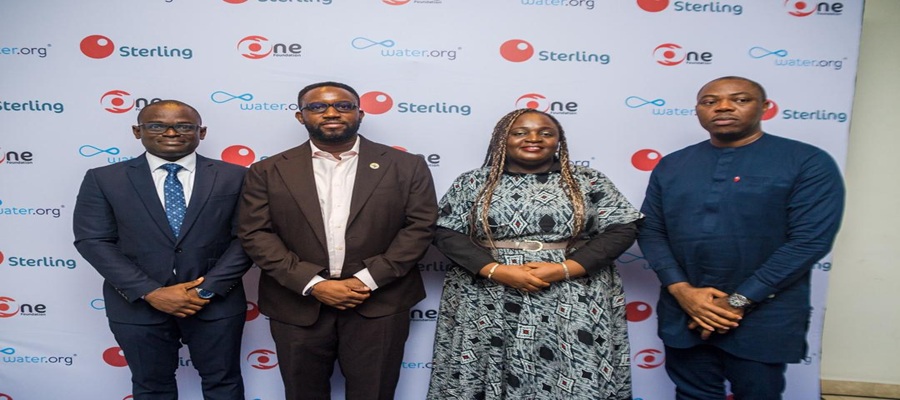
Sterling Bank, in partnership with nonprofit Water.org and Sterling One Foundation, has launched the Sterling WASH Business Loan to empower WASH businesses and scale sustainable access to safe water and sanitation for millions of Nigerians.

L-R: Gilbert Okpono, Snr. Partnership Account Manager, Water.org; Engr. Mukhtaar Temitope Tijani, Managing Director, Lagos State Water Corporation; Mrs. Olapeju Ibekwe, CEO, Sterling One Foundation; Akporee Idenedo, Divisional Head Commercial Banking, Sterling Bank, at the Sterling Bank Water Credit Proposition held in Lagos recently.
The catalytic financing solution addresses daily struggles with clean water and safe sanitation, which impact health, livelihoods, and well-being, while strengthening delivery systems for WASH solutions.
Launched on Monday, November 24, 2025, at The Wheatbaker Hotel, Ikoyi, Lagos, the initiative signals a shared commitment to tackling one of Nigeria’s most pressing development challenges.
Abubakar Suleiman, Managing Director of Sterling Bank, said sustainable development hinges on collaboration and targeted investment in frontline businesses and people.
“By providing accessible financing to entrepreneurs in this critical social sector, we ensure progress reaches communities that need it most. This product aligns with our HEART strategy and commitment to improving quality of life through impact-driven initiatives,” Suleiman stated.
Gilbert Okpono, Nigeria Senior Partnership Account Manager at Water.org, stressed the transformative power of financing WASH businesses.
“Financial inclusion is critical to solving the global water and sanitation crisis. By expanding access to affordable financing, we enable households and WASH entrepreneurs to improve services, reach more communities, and transform lives,” Okpono said.
He added that the partnership reflects a belief in rippling benefits across health, education, and economic opportunity, marking a major step toward sustainable scaling.
The loan supports WASH entrepreneurs, small business owners, and community service providers with flexible financing to expand operations, boost health, livelihoods, and educational outcomes.
Olapeju Ibekwe, CEO of Sterling One Foundation, linked the initiative to the foundation’s mission of catalysing lasting social impact across Africa.
“Our Foundation catalyses initiatives that deliver real, lasting change. Access to safe water and sanitation is one of the most powerful investments in community well-being. We are proud to partner with Water.org and Sterling Bank for inclusive, scalable, and sustainable solutions,” Ibekwe affirmed.
The launch event gathered development partners, WASH entrepreneurs, media, policymakers, and community organisations to discuss coordinated financing, supportive policies, and market-driven solutions to close Nigeria’s WASH access gap.
Interested beneficiaries can visit the initiative’s website for more details.


Access Holdings Plc has received the approval of its shareholders to raise additional capital of up to N40 billion or such other amount or their equivalent in foreign currencies, via private placement.

The shareholders gave the approval as part of the special resolutions at Access Holdings Plc Extraordinary General Meeting (EGM) held on Thursday December 18.
In a notice to the Nigerian Exchange Limited (NGX), Access Holdings said the new ordinary shares created in connection with the private placement, will be allotted at a price of N20.25 to one or more investors in such tranches and on such terms and conditions as shall be determined by the Board.
Access Holdings Plc Board of Directors is authorised to consider, negotiate, approve, and finalise the list of potential private placement investors; determine the structure, valuation, modalities, and timeline for the private placement.
The Board was also authorised to consider, negotiate, approve and finalise the list of potential private placement investors; determine the structure, valuation, modalities and timeline for the private placement.
The shareholders also approved for the issued share capital of Access Holdings Plc to be increased from N26 658 billion to N27.646 billion by the creation and addition of 1,975,308,641 ordinary shares of 50 kobo each ranking pari-passu with the existing ordinary shares of the Company.

Nigeria Customs Service (NCS) has imposed a three per cent surcharge on Deposit Money Banks (DMBs) over delays in the remittance of Customs revenue by designated banks.

The development was disclosed by Abdullahi Maiwada, national public relations officer of the Service, in a statement titled “Nigeria Customs Service Commences Enforcement of Penalties Against Designated Banks for Delayed Remittance of Customs Revenue.”
The agency stated that delays in remitting collected Customs revenue constitute a breach of remittance obligations and negatively impact the efficiency, transparency and integrity of government revenue administration.
Maiwada explained that any Designated Bank that fails to remit collected Customs revenue within the prescribed period will be liable to penalty interest, adding that affected banks will receive formal notifications detailing the delayed amount, applicable penalty and the timeline for settlement.
“The NCS has noted instances of delayed remittance of Customs revenue by some Designated Banks following reconciliation of collections processed through the B’Odogwu platform. Such delays constitute a breach of remittance obligations and negatively impact the efficiency, transparency and integrity of government revenue administration.
“In line with the provisions of the Service Level Agreement (SLA) executed between the Nigeria Customs Service and Designated Banks, the Service hereby notifies stakeholders of the commencement of enforcement actions against banks found to be in default of agreed remittance timelines.
“Accordingly, any Designated Bank that fails to remit collected Customs revenue within the prescribed period shall be liable to penalty interest calculated at three per cent above the prevailing Nigerian Interbank Offered Rate for the duration of the delay. Affected banks will receive formal notifications indicating the delayed amount, applicable penalty and the timeline for settlement.”
Maiwada further advised Designated Banks to strengthen their internal controls, ensure strict adherence to remittance timelines and comply fully with the provisions of the SLA.
He reiterated that the Service remains committed to enforcing accountability, safeguarding government revenue and promoting a transparent and predictable financial system in support of national economic development.
“The Service further notes that persistent or repeated non-compliance with the terms of the SLA may attract additional sanctions, including regulatory and administrative measures, as provided under the Agreement and relevant laws guiding Customs revenue collection.
“The NCS reiterates that prompt, accurate and complete remittance of Customs revenue is a fundamental obligation of Designated Banks. Any payment of collected revenue into unauthorised accounts, whether deliberate or erroneous, will be treated as a serious violation and addressed in accordance with the SLA and applicable legal frameworks.
“Designated Banks are therefore advised to strengthen internal controls, ensure strict adherence to remittance timelines and comply fully with the provisions of the SLA. The Service remains committed to enforcing accountability, safeguarding government revenue and promoting a transparent and predictable financial system in support of national economic development,” he added.

US Okays $2.1Bn for Christian Healthcare in Nigeria

Leo Stan Ekeh: A “Rare Avis”, an Unconquerable Entrepreneur

SERAP Asks Tinubu to Release CTC of Tax Bill

Tim Akano Recounts 20-Year Growth, Media Support at NITRA End-of-Year Meet

Sterling Bank, Water.org, Sterling One Foundation Partner on WASH Loan for Millions

Nigeria Records Highest Weekly Cyberattacks in Africa — Report

Cyber Tsunami Hits Nigeria as Breaches Surge 1,047%, esentry Q3 Report Reveals

Jumia’s Data Shows Nigerians Turning to Digital Retail to Navigate Inflation Pressures

GenAI Adoption Among African workers Outpace Global Peers

How Insecurity is Bleeding Nigeria about $15bn Annually and Destroying Its Economic Future




 General News2 days ago
Jumia Kicks Off December Holiday Sale, Bringing Festive Deals to Shoppers Nationwide

 E-Financial2 days ago
Access Holdings Shareholders Approved to Raise N40bn Capital Through Private Placement

 Broadcasting2 days ago
NIMC rolls out Pre-Enrolment Portal for seamless NIN registration

 General News2 days ago
Dangote, Monopoly Power, and Political Economy of Failure

 General News2 days ago
OAU, Baptist Day School Oluponna honour Akano with Distinguished Alumnus Awards

 General News7 hours ago
The Mood Market to Light Up Lagos with a Rooftop Gifting, Food & Lifestyle Fair this Christmas
 E-Financial1 hour ago
Sterling Bank, Water.org, Sterling One Foundation Partner on WASH Loan for Millions
 Broadcasting1 hour ago
Tim Akano Recounts 20-Year Growth, Media Support at NITRA End-of-Year Meet