

News
How INEC Innovations to Strengthen Electoral Process is Anchored on Technology


Over the years Nigeria’s electoral system has been faced with credibility issues rising from wide spread rigging and falsification of results, multiple registration of voters, intimidation of voters among other electoral offenses. These vices have persisted in spite of efforts by past chairmen of the umpire body Independent National Electoral Commission (INEC) to change the narrative.

However, things are beginning to change for the better for the country’s electoral system evident in the just concluded Anambra state governorship election held on November 6, 2021. There were innovations introduced by Inec during that election that help to improve the process and reassured confidence of the people in the process.
These innovations according to Prof. Mahmood Yakubu, chairman, Independent National Electoral Commission (INEC), at an interactive meeting with online publishers in Lagos are driven by technology.
He said: “Determined to deepen the use of technology and reduce human intervention in the critical stages of the electoral process, the Commission introduced new innovations.
“A few of them are identified as follows: Submission and Processing of Nominations Forms and Other Applications. The Commission has been discouraging human intervention in the electoral process. Since the 2019 General Election, the following activities are now conducted either partially or entirely online through dedicated portals: Voter pre-registration; Nomination of candidates for election by political parties; Submission of list of polling and collation agents by political parties; Accreditation of national and international observers for election; and Accreditation of media organisations for elections. Continuous Voter Registration (CVR) and Launch of Online
Registration Portal
“You will recall that the Commission often undertakes a fresh registration of eligible voters with every general election until 2010 when the first reliable biometric register of voters was compiled. Thereafter, the practice is to undertake intermittent registration of voters on the eve of major elections.
“However, in April 2017, this Commission for the first time began the implementation of the registration of voters on a continuous basis as provided in the Electoral Act.
“By the time the CVR was suspended in August 2018 to prepare for the 2019 General Election, a total of 14,283,734 new voters had been registered and added to the national register of voters, increasing the overall number to 84, 004 084.
“However, the CVR could not resume as planned after the general election due in part to the outbreak of the COVID-19 pandemic in the earlier part of 2020.
“In our determination to serve Nigerians better and in response to repeated calls by stakeholders, the Commission introduced a dedicated portal for online registration on 28th June 2021.
“This allows intending registrants to commence the process online by filling the forms, upload their pictures and required documents, and then make an appointment on the web portal for a date and time to visit an INEC State or Local Government Area (LGA) office to give their fingerprints and complete the registration. In addition, those who are already registered as voters can carry out all the other activities such as transfers, correction of personal details and replacement of damaged or defaced
Permanent Voters’ Cards (PVCs) Online
“Nigerians have fully embraced and are taking full advantage of the services available on the portal. The Commission has also been updating Nigerians every week on new development since the CVR started. As of 22nd November 2021, the CVR platform had recorded a total of 4,297,494 fresh registrants while 1,856,771 registrants have validated their application.
“The INEC Voter Enrolment Device (IVED) In June this year, INEC introduced a special gadget designed in-house by the Commission’s Engineers but fabricated abroad. It performs a variety of functions including physical registration of voters, fingerprint and facial authentication on election day and uploading of the polling unit result sheets to the INEC Result Viewing (IReV) portal.
“While the device was used as the INEC Voter Enrollment Device (IVED) at the resumption of the Continuous Voter Registration in June this year, it first was deployed for the Bimodal Voter Accreditation System (BVAS) in the Isoko South 1 State Constituency bye-election in Delta State on 11th September 2021 and later for the recently concluded Anambra Governorship election. In both elections, the equipment performed the functions of the Smart Card Readers (SCR) and the Z-Pad.
INEC Result Viewing Portal
“In our effort to engender transparency in the electoral process, the Commission unveiled the INEC Result Viewing (IReV) portal to make available for public view copies of the polling unit election result sheet, known as Form EC8A on Election Day. By Clicking on http://inecelectionresults.com and creating an account and password, any interested Nigerian can have access to the portal and view polling unit results are they are uploaded live.
“The Nasarawa Central Constituency bye election held on 8th August was the first to have its polling units’ results uploaded to the portal, followed by the Edo and Ondo Governorship elections.
“However, before the introduction of IReV, the Commission had, during the 2017 Anambra State Governorship election, introduced the pasting of Form EC 60E, also known as the “People’s Result Sheet” at Polling Units, where citizens could view the result of each polling unit.
Inclusivity
“The Commission recognizes that some members of the society need special attention to make it possible for them to participate actively in the electoral process.
“The Commission meets regularly with Civil Society Organisations (CSOs) representing Persons Living with Disability with a view to understanding their needs and bringing them up to speed on policies and actions that may affect them. In response to demands, the Commission now deploys assistive facilities such as the Braille Ballot
“Guide and magnifying glasses during elections to enable vision-impaired voters, persons living with Albinism and other individuals who may so require, to take advantage of the resources to vote unaided.
“Indeed, the Commission also cares about internally displaced Nigerians who were forced to flee their homes due to natural disasters, insurgency, activities of bandits and other criminals.
“In September 2018, the Commission developed the INEC Framework on Access and Participation of Persons with Disabilities, followed by the Regulations and Framework for Voting by Internally Displaced (IPDs) in December 2018.
“We also have the Gender Policy to take care of the needs of women in the electoral process and also recently created a Department of Gender and Inclusivity for the implementation of the gender policy in a coordinated manner.
Anambra Governorship Election 2021
“The Anambra Governorship election was held on 6th November 2021 under difficult circumstances. The Commission has declared a winner and the certificate of return has been issued. The election was peaceful and the outcome of the election has been universally adjudged to be credible.
“However, the Commission is not unaware of the issues raised about the performance of the new technology deployed for voter accreditation. The deployment of the
“BVAS in the Anambra Governorship election was the second pilot test. It was intended to achieve two objectives. First is voter accreditation to replace the Smart Card Reader. The second is the uploading of polling unit result on the IReV portal to replace the z-pad. The BVAS performed optimally in uploading results on the IReV but there were the usual challenges associated with the pilot of a new technology in a major election.
“From our assessment so far, much of the glitches encountered on Election Day in Anambra State had little to do with the machines but more with the operators of the system.
“The extraordinarily difficult circumstances under which the election was held meant that some of the better trained ad hoc staff withdrew at the 11th hour. Similarly, some critical service providers such vehicle owners also withdrew thereby severely affecting our plans for rapid response by our technicians – the Registration Area Technical (RATECH) staff.”
Technical issues relating to the performance of the BVAS will be addressed in the presentation by our Director ICT at this important meeting. Suffice it to say that in spite of the glitches, BVAS has justified our determination to deepen the deployment of technology in the electoral process.
Given the credible conclusion of the election, it has strengthened our belief that even the minimal introduction of technology in voter accreditation is better than the best manual process. We want to thank the voters in Anambra State for their patience and faith in the new technology. This has also justified the hope of citizens across the country that the deployment of more appropriate technology is essential to electoral integrity in Nigeria.
Our response to the glitches encountered started right from Anambra State. This explains there were no challenges reported during the supplementary election in Ihiala Local Government Area held on Tuesday 9th November 2022.
I want to reassure Nigerians that we have learnt vital lessons from the Anambra pilot. There will be remarkable improvement in the next major election which is the end-of-tenure Area Council election in the Federal Capital Territory (FCT) schedule to hold in three months on 12th February 2022.


News
Galaxy Backbone Confirms Over 150,000 Active Official Government Email Accounts, Clarifies Status of GOVMAIL

Galaxy Backbone Limited (GBB), Nigeria’s foremost ICT infrastructure and shared services provider to the Federal Government, wishes to reiterate and clarify the availability, maturity, and ongoing expansion of the Federal Government’s official email infrastructure, widely known as GOVMAIL.

GOVMAIL is a secure and centralized official email platform established for use by Ministries, Departments, and Agencies (MDAs) to facilitate professional, auditable, and efficient communication across all arms of government.
The platform was launched by the Office of the Head of the Civil Service of the Federation, Mrs, Didi Esther Walson-Jack as part of a broader digital transformation agenda aimed at modernizing public service workflows and reducing reliance on paper-based correspondence and fragmented, external email services.
Recent statements by the Head of the Civil Service of the Federation, Mrs. Didi Esther Walson-Jack, underscore the strategic importance of GOVMAIL in the wider push towards a paperless civil service.
In late 2025, she announced that over 100,000 official GOVMAIL accounts had been created for civil servants across federal MDAs under an expanding paperless policy and that the transformation reflects a clear shift away from traditional paper correspondence to secure digital communication at scale. Today, that number has grown to over 150,000 Official government email accounts, current in use by government workers across MDAs.
Galaxy Backbone also affirms that these email accounts operate within a protected sovereign government domain environment hosted on secure local infrastructure, supported by enterprise-grade cybersecurity architecture.
The platform underpins centralized identity management and ensures compliance with national data protection standards, reinforcing accountability, audit-trail visibility, and overall digital governance efficiency.
In addition to GOVMAIL, Galaxy Backbone operates secure national Tier III and Tier IV Data Centres, a robust National Fibre Backbone, a Security Operations Centre (SOC), and a Network Operations Centre (NOC) that jointly power mission-critical government digital services. This infrastructure is closely aligned with the Federal Government’s digital economy strategy and its efforts to deepen digital service delivery, transparency, and efficiency across MDAs.
To accelerate adoption and ensure that every government worker who is expected to have an official email has one, GBB is working collaboratively with MDAs to close existing gaps and onboard remaining staff within the shortest possible time. These coordinated efforts reflect the shared objective of equipping public servants with the digital tools necessary for responsive, efficient, and secure inter-agency communication.
Galaxy Backbone remains committed to working with stakeholders across the different arms of government to sustain and build on this progress. The company appreciates the emphasis placed on strengthening digital governance and remains ready to provide technical clarifications and support collaborative engagements that further advance Nigeria’s digital public service ecosystem.
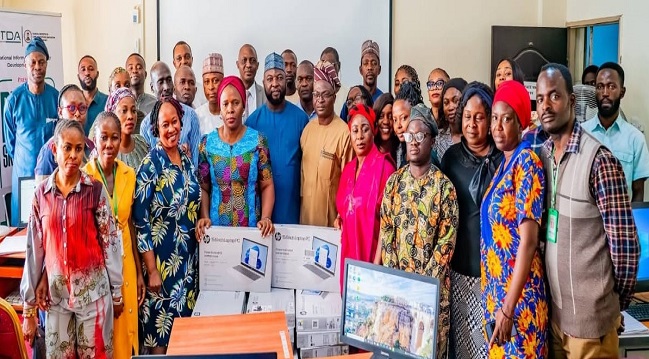
In a strategic move to modernise Nigeria’s public service, the National Information Technology Development Agency (NITDA) has concluded a specialised digital capacity-building programme for the Federal Character Commission (FCC).

The initiative, which included the donation of 35 laptops, aims to transition the Commission from manual processes to a data-driven oversight model, ensuring more transparent and equitable representation across all government MDAs.
In alignment with President Bola Ahmed Tinubu’s key priority area of reforming the economy for sustained and inclusive growth, as well as improving governance for effective service delivery, it forms part of NITDA’s Digital Literacy for All (DL4All) programme aimed at strengthening digital capacity across public sector institutions and building a workforce equipped to drive Nigeria’s digital transformation agenda.
The training, held at the Commission’s headquarters, focused on enhancing participants’ competencies in critical areas such as data analysis and data management, skills considered essential to improving institutional performance and service delivery.
Representing the Director General of NITDA, Kashifu Inuwa CCIE, the Acting Director of Digital Literacy and Capacity Building, Dr Ahmed Yusuf Tambour, explained the purpose of the intervention.
“We are here at the Federal Character Commission to carry out a training for staff of the Commission in the area of digital literacy to enhance their proficiency,” he stated.
He noted that the training was deliberately tailored to align with the Commission’s statutory responsibilities.
“We are particularly focusing on data analysis and data management, because this really aligns with the core mandate of the Commission,” he said.
The Federal Character Commission, which is responsible for monitoring and ensuring equitable representation in public service across Ministries, Departments and Agencies (MDAs), relies heavily on accurate and well-managed data to carry out its oversight functions.
By strengthening staff capacity in data handling and digital tools, NITDA aims to enhance the Commission’s ability to manage nationwide datasets efficiently and transparently.
Describing the programme as impactful and well-received by participants, Inuwa said, “So it’s been a great journey. We’ve trained 35 participants here, and the training has been very well received.”
As part of the intervention, NITDA donated 35 laptops to the Commission to facilitate continuous learning and enable staff to seamlessly integrate digital tools into their daily operations.
The gesture is expected to reinforce the sustainability of the training outcomes and improve workflow efficiency within the Commission.
Expressing optimism about the long-term benefits of the initiative, Inuwa added, “We are hoping that this will help the Commission to manage the very, very important data that they collect across all MDAs.”
The intervention reflects NITDA’s sustained commitment to deepening digital inclusion within government institutions under the Renewed Hope Agenda. By equipping public servants with practical digital skills and the necessary tools, the Agency is advancing institutional efficiency, strengthening data-driven decision-making, and supporting the Federal Government’s vision of a modern public service capable of driving inclusive national development and economic reform.

Nigeria and the European Union have inked a scientific and technology deal that grants access to about €100 billion in research and innovation funding for scientists, start-ups, and public institutions.

The agreement is a significant boost to the country’s tech environment, providing new prospects for research, innovation, and start-up growth.
The arrangement was signed in Abuja by Gautier Mignot, head of the EU delegation to Nigeria and ECOWAS, and Kingsley Udeh, Nigeria’s minister of innovation, research, and technology.
After more than two decades without a formal framework, the agreement transfers cooperation from informal to structured, large-scale collaboration.
The European Commission’s Horizon Europe programme, the world’s largest public research budget, is at the heart of the deal, which will bring together Nigerian researchers and firms to work on cross-border projects in health, agriculture, climate, food systems, and new technologies.
Udeh stated that the relationship puts Nigeria as a continental powerhouse for science and enterprise, with an emphasis on translating research into commercially viable products and assisting startups in scaling into global players.
Gautier Mignot noted that Nigerian organisations are already active in several Horizon-backed and global health research projects, but the new pact provides a legal and political framework to significantly expand participation, funding access and visibility.
To ensure delivery, both parties created a Joint Science and Technical Cooperation Committee to drive implementation and track measurable outcomes.
Beyond academia, the agreement aims to support innovators, boost university–industry collaboration, and help more Nigerian tech firms compete globally, strengthening Nigeria’s position as a leading startup hub in Africa.

Galaxy Backbone Confirms Over 150,000 Active Official Government Email Accounts, Clarifies Status of GOVMAIL

More 14m Farmers to Benefit from AfDB-backed Initiative

Dimension Data Nigeria Secures ₦20Billion Funding to Strengthen Digital Infrastructure

Newmark Webinar Explores How AI Could Transform Healthcare in Africa

Alerzo Liquidates Delivery Fleet as N4.38bn Moniepoint Loan Row Deepens

Accidental Billionaire Opts for Jail Instead of Returning Money Credited Him by Mistake

New Horizons Nigeria Breaks Ground: First to Fuse Mandarin into ICT Curriculum

Kaspersky Brings more Transparency to Threat Detection with New Hunt Hub

NDPC Commits to Balancing Data Privacy, Protection Information

OADC Lagos Reinforces Commitment to Local Data Hosting and Digital Transformation @ NDPC’s National Privacy Week Summit




 Telecom3 days ago
Telecom Giant MTN Injects N1.0 Trillion CAPEX into Network Expansion

 E-Financial3 days ago
History is Watching: Tinubu’s Moment to Rescue Nigeria’s Stolen Future

 News3 days ago
NITDA Equips Federal Character Commission with Data Tools to Drive Public Sector Reform

 E-Business3 days ago
Kaspersky Discovers New Phishing Campaign Exploiting Google Tasks Notifications to Steal Corporate Credentials
- Telecom2 days ago
MTN Nigeria Posts Record N1.70 Trillion Pre‑Tax Profit, Declares N20 Dividend for 2025
 General News2 days ago
More 14m Farmers to Benefit from AfDB-backed Initiative
 Telecom2 days ago
Dimension Data Nigeria Secures ₦20Billion Funding to Strengthen Digital Infrastructure
 Telecom2 days ago
Alerzo Liquidates Delivery Fleet as N4.38bn Moniepoint Loan Row Deepens