

E-Financial
How Organisations Can Prevent Financial Losses via Innovative Email Protection


By peter oluka
Many business organisations and public institutions are faced one way or the other with challenges of their corporation email been compromised. This to a large extent has brought loss of businesses or embarrassment.
Those who have not been able to successfully manage it by being on top of the situation are those whose knowledge and technology partnership need to be upgraded.
In the technology parlance, the Business e-mail compromise (BEC) is when an attacker hacks into a corporate e-mail account and impersonates the real owner to defraud the company, its customers, partners, and/or employees into sending money or sensitive data to the attacker’s account.
BEC is also known as a “man-in-the-email” attack. This is derived from the “man-in-the-middle” attack where two parties think that they are talking to each other directly, but in reality, an attacker is listening in and possibly altering the communication.
This is how it works. A BEC scam starts with research. An attacker will sift through publicly available information about your company from your website, press releases, and even social media posts.
He/she might look for the names and official titles of company executives, your corporate hierarchy, and even travel plans from email auto-replies.
The attacker will then try to gain access to an executive’s e-mail account. To remain undetected, he/she might use inbox rules or change the reply-to address so that when the scam is executed, the executive will not be alerted.
Another trick is to create an e-mail with a spoofed domain. For example, the attacker might use [email protected]instead of [email protected], or [email protected] instead of [email protected]. If you do not pay close attention, it is easy to get fooled by these slight differences. One of the most famous spoofed domain tricks ever was the “PayPa1.com” – a scam site imitating money transfer website Paypal.com.
After scouting corporate communications for some time, the attacker will probably have a good idea of scam scenarios that might work. For instance, if the company has a lot of suppliers, he/she can send invoices to account for the rush payment of materials. The attacker would know who is responsible for wire transfers and be able to craft a convincing scenario that would require the immediate transfer of funds.
Some of the most prevalent examples of BEC scams are:
- The fraudulent invoice scamis when a cybercriminal uses an employee’s e-mail to send notifications to customers and suppliers asking for payment to the cybercriminal’s account.
- The fake boss scamis when a fraudulent email is sent from a business executive’s account to employees instructing them to urgently transfer money from the corporate account to the criminal’s account.
- The fake attorney scamis when a lawyer’s e-mail address is used to contact clients, asking that they pay money immediately to keep things confidential.
However, business e-mail compromise attacks do not only involve money; sometimes, attackers seek PII or trade secrets.
One high-profile BEC case involved a Lithuanian cybercriminal that used the e-mail addresses of suppliers. Companies that were targeted include Apple and Facebook. By impersonating suppliers, the hacker was able to steal $100 million in two years. In another case, the FACC Ag CEO was fired after such an attack cost the company $54 million.
In 2016, there were at least 40,000 incidents of business e-mail compromise or other incidents that involve e-mails—an increase of around 2,370% since January 2015. In the second half of 2016 alone, the FBI reported more than 3,044 victims in the United States, with a combined loss of around $346 million. Where does most of the money go?
Most of the victims are told to send the money to an Asian bank, usually in Hong Kong or China, or a bank in the United Kingdom.
But you can protect your business or organisation from all these challenges!
Business e-mail compromise attacks are successful for three main reasons:
- Insufficient security protocols
- Social engineering
- Lack of employee awareness
Multi-factor authentication should be implemented as an IT security policy. This will help prevent unauthorized access to e-mails, especially if an attacker attempts to login from a new location. In addition to stronger security protocols, employee education is also important.
Employees should be trained on identifying fraudulent e-mails. Always be skeptical of urgent and rush money transfer requests, especially from C-level executives, and verify those requests, either by phone or in person.
According to Victor Ugwu, Signal Alliance, technical security consultant, the company offers a robust and adaptive email security solution on- premise and in the cloud. Beyond email security, they also provide a tested and trusted Cybersecurity solutions ranging from; Perimeter Security, Infrastructure Security, Cloud, Mobile Security and Managed Security Service.


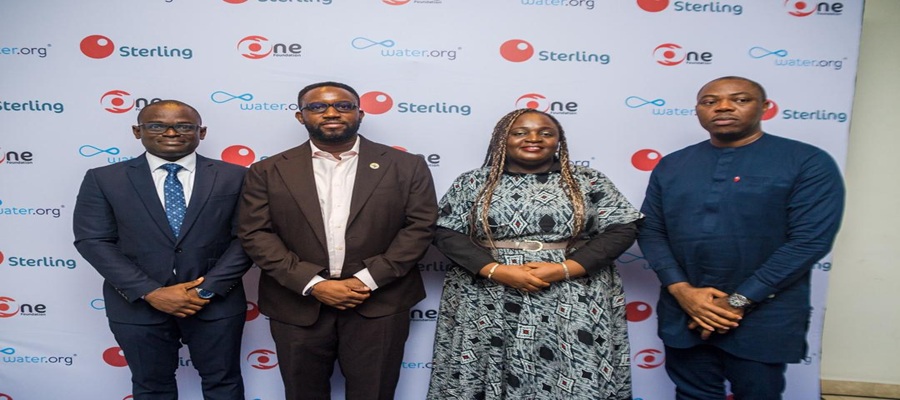
Sterling Bank, in partnership with nonprofit Water.org and Sterling One Foundation, has launched the Sterling WASH Business Loan to empower WASH businesses and scale sustainable access to safe water and sanitation for millions of Nigerians.

L-R: Gilbert Okpono, Snr. Partnership Account Manager, Water.org; Engr. Mukhtaar Temitope Tijani, Managing Director, Lagos State Water Corporation; Mrs. Olapeju Ibekwe, CEO, Sterling One Foundation; Akporee Idenedo, Divisional Head Commercial Banking, Sterling Bank, at the Sterling Bank Water Credit Proposition held in Lagos recently.
The catalytic financing solution addresses daily struggles with clean water and safe sanitation, which impact health, livelihoods, and well-being, while strengthening delivery systems for WASH solutions.
Launched on Monday, November 24, 2025, at The Wheatbaker Hotel, Ikoyi, Lagos, the initiative signals a shared commitment to tackling one of Nigeria’s most pressing development challenges.
Abubakar Suleiman, Managing Director of Sterling Bank, said sustainable development hinges on collaboration and targeted investment in frontline businesses and people.
“By providing accessible financing to entrepreneurs in this critical social sector, we ensure progress reaches communities that need it most. This product aligns with our HEART strategy and commitment to improving quality of life through impact-driven initiatives,” Suleiman stated.
Gilbert Okpono, Nigeria Senior Partnership Account Manager at Water.org, stressed the transformative power of financing WASH businesses.
“Financial inclusion is critical to solving the global water and sanitation crisis. By expanding access to affordable financing, we enable households and WASH entrepreneurs to improve services, reach more communities, and transform lives,” Okpono said.
He added that the partnership reflects a belief in rippling benefits across health, education, and economic opportunity, marking a major step toward sustainable scaling.
The loan supports WASH entrepreneurs, small business owners, and community service providers with flexible financing to expand operations, boost health, livelihoods, and educational outcomes.
Olapeju Ibekwe, CEO of Sterling One Foundation, linked the initiative to the foundation’s mission of catalysing lasting social impact across Africa.
“Our Foundation catalyses initiatives that deliver real, lasting change. Access to safe water and sanitation is one of the most powerful investments in community well-being. We are proud to partner with Water.org and Sterling Bank for inclusive, scalable, and sustainable solutions,” Ibekwe affirmed.
The launch event gathered development partners, WASH entrepreneurs, media, policymakers, and community organisations to discuss coordinated financing, supportive policies, and market-driven solutions to close Nigeria’s WASH access gap.
Interested beneficiaries can visit the initiative’s website for more details.


Access Holdings Plc has received the approval of its shareholders to raise additional capital of up to N40 billion or such other amount or their equivalent in foreign currencies, via private placement.

The shareholders gave the approval as part of the special resolutions at Access Holdings Plc Extraordinary General Meeting (EGM) held on Thursday December 18.
In a notice to the Nigerian Exchange Limited (NGX), Access Holdings said the new ordinary shares created in connection with the private placement, will be allotted at a price of N20.25 to one or more investors in such tranches and on such terms and conditions as shall be determined by the Board.
Access Holdings Plc Board of Directors is authorised to consider, negotiate, approve, and finalise the list of potential private placement investors; determine the structure, valuation, modalities, and timeline for the private placement.
The Board was also authorised to consider, negotiate, approve and finalise the list of potential private placement investors; determine the structure, valuation, modalities and timeline for the private placement.
The shareholders also approved for the issued share capital of Access Holdings Plc to be increased from N26 658 billion to N27.646 billion by the creation and addition of 1,975,308,641 ordinary shares of 50 kobo each ranking pari-passu with the existing ordinary shares of the Company.

Nigeria Customs Service (NCS) has imposed a three per cent surcharge on Deposit Money Banks (DMBs) over delays in the remittance of Customs revenue by designated banks.

The development was disclosed by Abdullahi Maiwada, national public relations officer of the Service, in a statement titled “Nigeria Customs Service Commences Enforcement of Penalties Against Designated Banks for Delayed Remittance of Customs Revenue.”
The agency stated that delays in remitting collected Customs revenue constitute a breach of remittance obligations and negatively impact the efficiency, transparency and integrity of government revenue administration.
Maiwada explained that any Designated Bank that fails to remit collected Customs revenue within the prescribed period will be liable to penalty interest, adding that affected banks will receive formal notifications detailing the delayed amount, applicable penalty and the timeline for settlement.
“The NCS has noted instances of delayed remittance of Customs revenue by some Designated Banks following reconciliation of collections processed through the B’Odogwu platform. Such delays constitute a breach of remittance obligations and negatively impact the efficiency, transparency and integrity of government revenue administration.
“In line with the provisions of the Service Level Agreement (SLA) executed between the Nigeria Customs Service and Designated Banks, the Service hereby notifies stakeholders of the commencement of enforcement actions against banks found to be in default of agreed remittance timelines.
“Accordingly, any Designated Bank that fails to remit collected Customs revenue within the prescribed period shall be liable to penalty interest calculated at three per cent above the prevailing Nigerian Interbank Offered Rate for the duration of the delay. Affected banks will receive formal notifications indicating the delayed amount, applicable penalty and the timeline for settlement.”
Maiwada further advised Designated Banks to strengthen their internal controls, ensure strict adherence to remittance timelines and comply fully with the provisions of the SLA.
He reiterated that the Service remains committed to enforcing accountability, safeguarding government revenue and promoting a transparent and predictable financial system in support of national economic development.
“The Service further notes that persistent or repeated non-compliance with the terms of the SLA may attract additional sanctions, including regulatory and administrative measures, as provided under the Agreement and relevant laws guiding Customs revenue collection.
“The NCS reiterates that prompt, accurate and complete remittance of Customs revenue is a fundamental obligation of Designated Banks. Any payment of collected revenue into unauthorised accounts, whether deliberate or erroneous, will be treated as a serious violation and addressed in accordance with the SLA and applicable legal frameworks.
“Designated Banks are therefore advised to strengthen internal controls, ensure strict adherence to remittance timelines and comply fully with the provisions of the SLA. The Service remains committed to enforcing accountability, safeguarding government revenue and promoting a transparent and predictable financial system in support of national economic development,” he added.

US Okays $2.1Bn for Christian Healthcare in Nigeria

Leo Stan Ekeh: A “Rare Avis”, an Unconquerable Entrepreneur

SERAP Asks Tinubu to Release CTC of Tax Bill

Tim Akano Recounts 20-Year Growth, Media Support at NITRA End-of-Year Meet

Sterling Bank, Water.org, Sterling One Foundation Partner on WASH Loan for Millions

Nigeria Records Highest Weekly Cyberattacks in Africa — Report

Cyber Tsunami Hits Nigeria as Breaches Surge 1,047%, esentry Q3 Report Reveals

GenAI Adoption Among African workers Outpace Global Peers

Jumia’s Data Shows Nigerians Turning to Digital Retail to Navigate Inflation Pressures

Minister Claims Bandits Exploit Poor Network, Bounce Calls Off Multiple Towers




 General News3 days ago
Jumia Kicks Off December Holiday Sale, Bringing Festive Deals to Shoppers Nationwide

 E-Financial3 days ago
Access Holdings Shareholders Approved to Raise N40bn Capital Through Private Placement

 Broadcasting3 days ago
NIMC rolls out Pre-Enrolment Portal for seamless NIN registration

 General News3 days ago
Dangote, Monopoly Power, and Political Economy of Failure

 General News3 days ago
OAU, Baptist Day School Oluponna honour Akano with Distinguished Alumnus Awards

 General News21 hours ago
The Mood Market to Light Up Lagos with a Rooftop Gifting, Food & Lifestyle Fair this Christmas
 News15 hours ago
US Okays $2.1Bn for Christian Healthcare in Nigeria
 E-Financial15 hours ago
Sterling Bank, Water.org, Sterling One Foundation Partner on WASH Loan for Millions