

Telecom
ISPON Announces 2021 Edition of Simon Agu prize for Best Software Entrepreneur of the Year Award

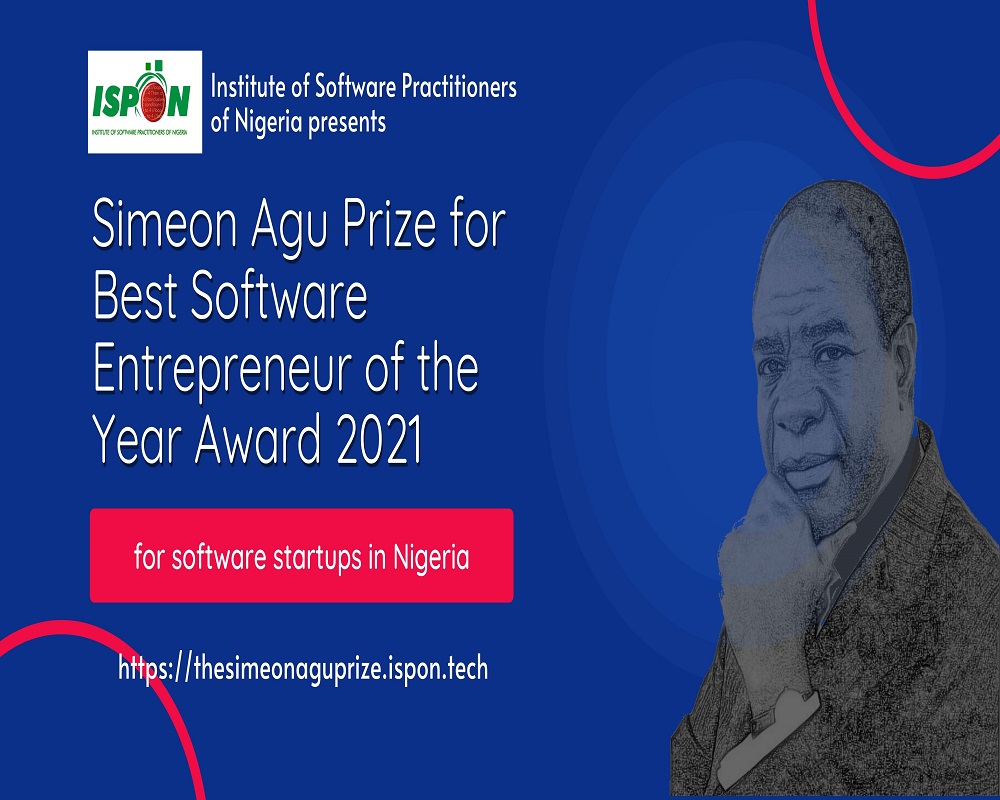
The Institute of Software Practitioners of Nigeria ISPON has announced readiness for the 2021 edition of the Simeon Agu Prize for the Best Software Entrepreneur of the Year.

Established in 2012 in collaboration with the family of Late Engr. Simeon Agu to keep alive his excellent contributions to the software profession and industry, the award is presented annually at the National Information Technology Merit Awards NITMA of the Nigeria Computer Society.
The award is targeted at software startups to recognize their entrepreneurship as they build a fledgling software business.
This year’s award seeks to reward startups for work done from September 2020 – September 2021.
Consideration of the award would be made based on the following criteria:
1. Idea: what is the general idea behind the startup, how good is it and how does it make the startup rank better than other existing solutions
2. Innovation: how innovative is the idea, how much of a disruption has it caused and what new trend has it led to
3. Impact: how much impact does it have on the users, businesses and the industry (where applicable)
4. Business model: how good is the business model, how scalable is it
5. Funding: how has the company thrived financially, how much has the company been able to raise and what was the financial turnover. Do note that for consideration, all investor funding must be local.
Per selection of the winner of the award this year, there will be an open process where you can nominate a startup you feel deserves the award and has fulfilled the set criteria.
The panel of judges would shortlist 3 finalists who would be voted for by the general public.
A combination of the number of votes garnered as well as points scored from the technical review of the startup by the judges would determine the winner.
For more information on the process and to make your nomination, do visit https://thesimeonaguprize.ispon.tech
Engr. Simeon Agu, who the prize is instituted in honour of, was the founding President of ISPON.
He started his career in information technology at Shell Petroleum Development Company in 1971.
He later moved to the National Electric Power Authority in 1977 as Manager, Systems Development and eventually rose to the position of Director, Computer Services.
He was founder and Chairman of Computer Systems Associates (Nigeria) Limited which metamorphosed into Neptune Software Limited, a foremost international software outfit, growing it from 3 to over 100 staff with the headquarters in Great Britain and offices in Nigeria, India, Kenya, Uganda, Zimbabwe and South Africa.
Simeon Agu was a distinguished IT practitioner, software industry pioneer, founding President of ISPON, Fellow of Nigeria Computer Society, NCS and a member of the Computer Professionals Registration Council of Nigeria CPN


MTN Group delivered impressive financial and operational achievements for 2025, boosted by strong performances in MTN Nigeria and MTN Ghana, as well as solid earnings from MTN South Africa.

The three core markets of Africa’s largest mobile provider enhanced profitability, free cash flow, and shareholder dividends by 45%.
IT Web Africa reported that Ralph Mupita, group CEO and president, MTN, highlighted that the telecoms giant’s robust commercial momentum across key markets capped the final year of its Ambition 2025 strategy, while laying the foundation for a new long-term growth phase under Ambition 2030.
“The Group’s overall performance in 2025 was excellent. In the final year of our Ambition 2025 strategy, we were proud to have exceeded the 300 million customers milestone,” he said.
MTN revealed that it now serves more than 307 million voice subscribers, 172 million data users, and 70 million Mobile Money customers across 16 African markets, reflecting the continent’s growing demand for digital connectivity and financial services.
The operator credited its results to disciplined commercial execution and sustained investment in network infrastructure, with R38 billion spent during the year to expand capacity, improve coverage and enhance service quality.
The group reported that data traffic surged 27%, while average monthly data consumption per user climbed to 12.5GB, up from 10.8GB a year earlier, reflecting Africa’s fast-growing appetite for digital services.
Financially, the performance was driven by MTN’s largest markets.
In constant currency terms, MTN Nigeria grew service revenue by 54.9%, while MTN Ghana increased service revenue by 35.9%.
Meanwhile, MTN South Africa recorded 2% growth, demonstrating operational resilience in one of the continent’s most mature and competitive telecom markets.
MTN Group service revenue rose nearly a quarter to R218 billion, while earnings before interest, tax, depreciation and amortisation climbed to R98.5 billion, supported by R3.6 billion in expense efficiencies.
Mupita stressed that the strong results translated into robust free cash flow and improved return generation, allowing the board to declare a dividend of 500 cents per share, up from 345 cents the previous year.
“This comfortably exceeds the minimum dividend of 370 cents we had previously guided,” he said.
The group also announced a R6 billion share buyback programme as part of an enhanced shareholder remuneration framework aimed at delivering stronger long-term returns.
Alongside its results, MTN unveiled Ambition 2030, a strategy centred on three platforms, connectivity, fintech and digital infrastructure, as it seeks to capture the next wave of growth driven by data adoption and financial inclusion across Africa.
“We are hugely excited about Africa’s potential. We are well positioned to leverage our scale, footprint and brand leadership to capture the significant structural growth opportunities identified,” said Mupita.
Source: IT Web Africa

Association of Telephone, Cable TV, and Internet Subscribers of Nigeria (ATCIS) non-profit consumer rights group dedicated to protecting the rights, interests, and welfare of telecommunications subscribers, has urged the Federal Government to ensure safety of telecom consumers’ data hosted by government agencies.

Dr Sina Bilesanmi, president of the body stated this World Consumers Day in Lagos.
He alleged that said subscribers” data are being jeopardised by some of its agencies.
Bilesanmi urged government to ensure that every subscriber in Nigeria can use digital service without fear of physical, financial, or data-related harm.
The ACTIS president said safety in the telecommunication sector extends beyond physical hardware to include data privacy and protection from cyber fraud.
“We call for stricter enforcement by the Standard organization of Nigeria (SON) to eliminate substandard mobile devices and Cable Tv equipment that pose fire or electric hazards.
“We also want safe services from telecoms that are transparent – free from hidden charges and misleading advertisements”, he said.
He urged subscribers to utilize platforms like ACTIS as well as NCC and even FCCPC web portal when they encounter service failures.
He also tasked FG on hosting Nigerian Data Privacy in the country.
He said: “We ask for more robust surveillance and swifter penalties for entities that violate consumer safety standards. We admonish the subscribers to be aware and speak out, a vigilant consumer is a protected consumer.”

In a major boost to technology education and digital innovation in Nigeria, New Horizons Systems Solutions Limited, a subsidiary of the US-based global ICT training organization, New Horizons Worldwide, has commissioned a state-of-the-art ICT facility at Adeleke University, Ede, Osun State.

New Horizons Nigeria
The facility, named the Elder (Dr.) I.C. Egbuta ICT Centre, was constructed and donated to the university by New Horizons Nigeria as part of its commitment to equipping Nigerian universities with modern infrastructure capable of preparing students for global competitiveness in the digital economy.
The commissioning ceremony which held on Tuesday March 3rd, 2026 drew dignitaries from the university community, industry, and academia.
The event began on a vibrant note as cultural dancers from the university’s Theatre Arts Department entertained arriving guests with lively traditional performances.
The new ICT center represents another milestone in the long-standing partnership between New Horizons and Adeleke University, a collaboration that has spanned more than a decade.
Through the partnership, the institution has delivered project-based and certification-based ICT training programs, producing thousands of students with globally recognized digital skills and professional certifications across diverse technology disciplines.
Also, the Elder (Dr.) I.C. Egbuta ICT Centre features four fully equipped ICT studios with high-end computer systems, full air-conditioning, and seating capacity for over 750 users. The facility also includes modern conveniences intended to enhance digital learning and professional certification training.
The building was officially commissioned by Chief (Mrs) Modupe Adeleke Sanni, who represented the Chairman of the University Council, Chief Adedeji Adeleke.
In her remarks, she commended New Horizons Nigeria for its sustained investment in the university and reaffirmed the council’s commitment to strengthening the partnership in the years ahead.
Also speaking at the event was the Vice Chancellor of Adeleke University, Professor Solomon A. Adebola, who praised the organization for its consistent contributions to the technological advancement of the institution and the empowerment of Nigerian youths through practical digital training.
Furthermore, the Managing Director and Chief Executive Officer of New Horizons Nigeria, Mr. Tim Akano expressed appreciation to the university’s leadership and governing council for their support and enduring collaboration.
He reiterated the organization’s vision of equipping Nigerian universities with facilities and training that will enable students to compete effectively in the global technology ecosystem.
Mr. Akano further noted that New Horizons remains committed to driving innovation within Nigerian universities, with the long-term goal of enabling institutions like Adeleke University to generate research-driven technological solutions capable of attracting patent rights and global recognition.
New Horizons Nigeria, widely recognized as Africa’s largest ICT training organization, continues to strengthen its footprint in Nigeria’s digital education sector. In 2025, the institution received the prestigious Best ICT Training Company award from CompTIA in South Africa.
This further reinforce its leadership position within the continent’s technology training ecosystem. Also, as a franchise of New Horizons International, which operates in over 90 countries across six continents, the organization has consistently aligned with global best practices while addressing local capacity gaps. The organization currently provides ICT training services to more than 30 universities and nearly 200 high schools nationwide.
The center would be used for the training of high-end technical courses like Cyber Security, Web Development, Artificial intelligence, Full Stack, Graphics and CompTIA courses like Hardware, Network and Security Plus.
New Horizons have won about 350 national and international awards in the last 20 years of its operation and it trains over 100,000 students yearly across 27 universities and 150 secondary schools, as well as corporate organizations, government agencies and retail offices.
Students trained by New Horizons Nigeria are always well-sought after in the labour market after graduation and the certificate they obtain are recognized in all the 90 countries where New Horizons have offices.
In conclusion, the ceremony ended with an energetic cultural performance by the university’s theatre group from the Theatre Arts Department, which drew enthusiastic applause from the audience.
The commissioning of the Elder (Dr.) I.C. Egbuta ICT Centre further strengthens the collaboration between New Horizons and Adeleke University and is expected to deepen efforts toward producing highly skilled ICT professionals and innovators capable of contributing to Nigeria’s growing digital economy.

SEC Shuts Over 400 Fraudulent Investment Schemes, Arrests Operators

NigComSat-1R, Nigeria’s Only Satellite to Expire this Year

Nigeria, Ghana Trigger Stunning 45 Percent Surge in MTN Dividends

Banks, Offices to Close for Thursday and Friday for Eid-el-Fitr

ATCIS Urges FG to Ensure Safety of Consumers Data

Kaspersky Discovers New Phishing Campaign Exploiting Google Tasks Notifications to Steal Corporate Credentials

esentry 2025 Report Shows Healthcare, Financial Services and Telecoms as Staging Grounds for Increased Cyberattacks in Africa

AfDB, UNDP Launch $10Bn AI Initiative for Africa

Mutual Benefits Assurance Settles ₦5.9bn Claims in January 2026

MultiChoice Suspends Yearly DStv Price Hike as Canal+ Pushes Growth




 E-Financial3 days ago
CBN Rolls Out New Rules for Safer Instant Payments, More Customer Control

 News3 days ago
NIMMME Inaugurates Engr. Michael Orekyeh as 13th National Chairman in Abuja

 E-Financial3 days ago
CBN Tightens BVN Rules to Curb Fraudulent Banking Transactions

 Telecom3 days ago
MTN Nigeria Races Ahead in Fibre Broadband Market

 Broadcasting2 days ago
Spotify’s Loud & Clear Report Reveals Over ₦60Bn Revenue for Nigerian Artists in 2025

 E-Financial3 days ago
Nova Bank Appoints Jude Anele as Managing Director/CEO

 E-Business3 days ago
Tech Expert Unveils BAT-BOT AI App to Curb Fake News ahead of 2027 Elections

 Telecom2 days ago
PwC Warns Nigeria Telcos of AI Fraud Risks