

Telecom
Mastercard’s Girls4Tech Hits 1 Million Milestone

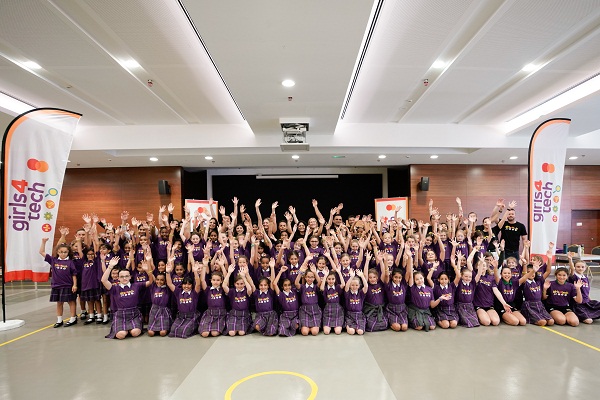
Mastercard’s signature STEM program, Girls4Tech has reached its initial milestone goal of educating one million girls.
The Company also announced a new and inspiring goal to reach five million girls by 2025 with signature STEM program.
The technology company’s signature program, which launched in 2014, offers activities and curriculum built on global science and math standards – and incorporates Mastercard’s deep expertise in technology and innovation – to enable children to discover a range of STEM careers, such as fraud detective, data scientist and software engineer.
The Girls4Tech workshops hosted across Kenya and Nigeria have inspired numerous young girls to build the skills they need for STEM careers.
Ifeoma Dozie, director, Marketing and Communications, Sub-Saharan Africa at Mastercard, said “Through the Girls4Tech programme, we’re extending our commitment to Africa’s next generation of women leaders by equipping them with valuable skills that ensure more women have a voice in the development of the products and services of the future”.
Starting as a hands-on, in-person session run by employee volunteers, the program has reached more children by expanding into new topics such as AI and Cybersecurity, and extending access of their STEM curriculum through online resources on Girls4Tech Connect which has been translated into fourteen languages.
Susan Warner, vice president of community engagement and founder of Mastercard’s Girls4Tech program said, “Our goal is to build foundational STEM knowledge and develop critical 21stcentury skills girls need for their studies and career success.
“Our program sparks their curiosity in STEM and teaches them real-world applications of those skills.”
How Girls4Tech reaches future STEMinists
Announced a new partnership to create a Girls4Tech digital curriculum with Discovery Education — the global leader in standards-aligned digital curriculum resources, engaging content, and professional learning for K-12 classrooms — to reach 1.6 million girls by 2023.
Partnering with scalable organizations such as AIF, Be Better China, Discovery Education, Major League Baseball, Network for Teaching Entrepreneurship (NFTE), R&A, Scholastic and YCAB in Indonesia to further scale the program and offer STEM skills in unique ways to girls ages 8-16.
Adding new curriculum to give students deeper exposure to the growing fields of cybersecurity and AI.
Extending programs, Girls4Tech 2.0 for girls aged 13-16, as well as a 20-week coding program, Girls4Tech & Code for girls 8-10.
Moving the needle for Girls in STEM
In 2019, Mastercard commissioned a study seeking to understand gender and generational differences surrounding perceptions and attitudes of science, technology, engineering and mathematics (STEM). In addition to STEM-based topics, the survey investigated challenges and motivations to pursing college majors and careers path.
The study showed that females are less confident, receive less encouragement and need more mentors in STEM. Mastercard’s Girls4Tech program provides each of those elements to young women.


Nigerian Communications Commission (NCC) and Central Bank of Nigeria (CBN) have finalized a consumer protection framework to swiftly resolve complaints from failed airtime and data purchases caused by network outages, system errors, or user mistakes.

NCC, CBN
Developed after months of consultations with Mobile Network Operators (MNOs), Value Added Service (VAS) providers, Deposit Money Banks (DMBs), and other stakeholders, the framework responds to surging reports of debits without service delivery and prolonged resolution delays.
It unites telecom and financial sectors by pinpointing root causes—like debits without service credits—and enforces a Service Level Agreement (SLA) defining roles for all parties in transactions and refunds.
Key provisions include refunds within 30 seconds for debited but undelivered airtime or data (extendable to 24 hours for pending cases), mandatory SMS notifications on transaction status, and remedies for errors such as recharges to ported numbers, wrong purchases, or misdirected transactions.
NCC Consumer Affairs Director, Mrs. Freda Bruce-Bennett, highlighted a new Central Monitoring Dashboard, co-hosted by NCC and CBN, for real-time tracking of failures, culprits, refunds, and SLA violations.
“Failed top-ups are among the top three consumer complaints. True to our mandate, we prioritized a rapid solution,” she stated.
Bruce-Bennett thanked stakeholders, especially CBN leadership, noting that MNOs and banks have already refunded over N10 billion pending formal approval.
Implementation begins March 1, 2026, following regulator approvals and technical integrations by MNOs, VAS providers, and DMBs.
National Agency for Science and Engineering Infrastructure (NASENI) has announced the launch of an Inter-Agency Innovation Competition and Awards to stimulate creativity and technological advancement among Ministries, Departments and Agencies (MDAs) of the Federal Government.

NASENI
In a statement issued on Wednesday in Abuja, NASENI said the initiative was designed to harness innovative ideas from public servants that can drive indigenous industrialization, job creation and national progress.
According to the agency, the competition will provide a platform for MDAs to propose solutions in critical sectors such as health, agriculture, education and infrastructure, leveraging science and technology to improve public service delivery and enhance the quality of life for Nigerians.
“The competition seeks to promote collaboration and creativity among MDAs while addressing pressing national challenges through innovation,” the statement said.
NASENI urged interested MDAs to submit their entries through its innovation portal at naseni.gov.ng/innovation.
The agency reiterated its statutory mission “to develop and maintain a dynamic infrastructure to drive Nigeria’s indigenous industrialization, job creation and national progress,” adding that the competition would further strengthen efforts to unlock the nation’s potential through science and technology.

Users of satellite internet service provider Starlink in Nigeria are being required to complete a biometric Know Your Customer (KYC) process as a precondition to continue enjoying their services, according to .biometricupdate.

According to local reports, more than 66,000 Starlink subscribers in the country had a December 31 ultimatum from the Nigerian Communications Commission (NCC) to complete the biometric verification or have their connection discontinued.
The process essentially entails linking a Starlkink account with the subscriber’s national digital ID.
The NCC, which is Nigeria’s telecoms industry regulator, is said to have first issued the directive in August last year, setting a three-month deadline which was to elapse on November 19, TechCabal reports.
The body however later extended it to December 31 after consultations with industry stakeholders. The internet account-NIN linkage, the NCC said, is to enhance identity verification and strengthen security within the country’s telecoms space.
Just a few days to the December 31 deadline, Starlink’s Nigeria office sent an email to its subscribers reminding them of the KYC requirement, and warned that all those who fail to comply would be disconnected.
And that once disconnected, reconnection would depend on network capacity in the concerned area.
The service provider said in its email that the process takes less than two minutes and users can complete it by logging in to their account via an app.
One user, quoted by TechCabal, said one needs to upload their selfie biometrics, provide their national identification number (NIN) and then give their consent for the account to be linked to their ID information.
Starlink’s internet service is present in about 155 countries with nine million users, as of 2025. Its growth in Nigeria is said to be rapid, making it the second largest internet service provider in the country, according to The Traffic.
Biometric identification for Starlink subscribers could become a continent-wide trend given that some countries have expressed reservations in opening up their internet space to the company over security concerns.
There’ve been fears that jihadists in countries like Mali and Nigeria may have exploited Starlink terminals to coordinate terror operations, and cybersecurity experts have also warned of risks related to weak regulation, digital sovereignty and data breaches.
The requirement for Starlink internet users to have their accounts linked with the NIN is similar to the SIM-NIN linkage policy which the Nigerian government battled to implement for many years, with many deadline extensions.
In October last year, the NCC, which is was at the forefront of the policy implementation, announced that all active SIM cards across all network providers had complied with the directive which was issued in 2020.
The idea, the federal government argued, was to strengthen security and curb criminality such as kidnappings which are aided and abetted by improperly identified mobile phone numbers.

BVN Enrollment Up 6.87 Percent to 67.84m in 2025 – NIBSS

Trump Threatens More Strikes in Nigeria

OpenAI Launches ChatGPT Health

Pawnith Appoints Martina Ogbebor as Managing Director to Lead Strategic Launch into Nigeria’s Fintech Ecosystem

Study Reveals Majority of IT Professionals Show Openness to Cyber Immunity

Banks quietly move to enforce new ₦50 transfer levy from Jan. 1

FIRS says NIN, CAC Numbers to Serve as Tax IDs from 2026

PalmPay Launches N400 Million World Travel Carnival, Rewarding Users with Free Global Trips

Check Point Reveals Nigeria as Second Most Targeted African Country for Cyberattacks in November

Nigeria Takes the Lead in the Global WSIS+20 Digital Agenda




 Telecom3 days ago
NITDA DG Charts Bold Path for Innovation-Led Digital Boom in North

 News3 days ago
INEC Warns of Fake Ad-hoc Staff Recruitment Portal

 News2 days ago
Kaspersky Shares AI Cybersecurity Predictions for 2026

 News3 days ago
NRS Boss Dismisses Fears of Political Weaponisation in Tax Reforms

 General News2 days ago
PalmPay Deepens Its Long-Term Commitment in Nigeria with New Office @ Yaba

 Telecom3 days ago
Mandatory Biometric Verification for Starlink Users in Nigeria Begins

 Broadcasting2 days ago
Youth Talent Takes Center Stage as T2 Ignites High-Octane Rap Battles @ Carnival Calabar

 E-Financial2 days ago
Wema Bank Launches SAW AI Voice Assistant for Seamless Banking on ALAT 2.0