

News
Microsoft Showcases 25 #Insiders4Good Entrepreneurs at Graduation Ceremony

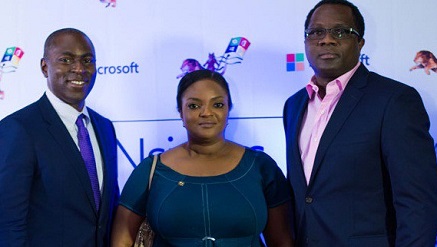
Microsoft honored the achievements of 25 Nigerian entrepreneurs who graduated from the #Insiders4Good Fellowship, a program launched by Microsoft in partnership with Co-Creation Hub.
The entrepreneurs were recognized at a ceremony held at the InterContinental Hotel in Lagos, where they also pitched their business ideas to Microsoft executives and potential local partners and investors.
In his welcome address at the graduation ceremony, Shina Oyetoso, developer experience director, Microsoft Nigeria, reiterated Microsoft’s commitment to supporting enterpreneursin the Country leveraging technology.
He said, “At Microsoft, our mission is to empower every person and every organization on the planet to achieve More. Delivering on this mission starts with great technology, but great technology alone is not enough.
Despite global expansion, increased access, and democratisation of technology, too many of technology’s benefits have yet to reach the people who need them due to poverty, lack of education and accessibility. Microsoft has challenged itself to address the question of how we can truly bring to life the promise of technology for everyone and part of the answer requires a recognition that empowerment begins with inclusion”.
In his keynote speech, Bambo Sofola, Microsoft director of Software Engineering, said, “Last year, we were excited to launch the first #Insiders4Good Fellowship in Nigeria, where so many exceptional entrepreneurs are using technology to create positive change in their communities. By supporting the growth of the Nigerian #Insiders4Good Fellows, we’ve learned valuable insights about the challenges they face in their unique contexts and how Microsoft products can grow and evolve to support them best. Today, we are thrilled to showcase their extraordinary ideas and celebrate their achievements.”
Selected last September from a pool of 5,000 applicants, the 25 Nigerian #Insiders4Good Fellows are advancing extraordinary ideas to create positive change in Nigeria, Africa, and the world. With creativity and hard work, their products and services are tackling entrenched problems like illiteracy, kidnapping, agricultural waste, healthcare access, and much more.
As part of the Fellowship, the entrepreneurs attended an intensive “bootcamp”—a series of group workshops led by Microsoft staff during which they identified needs, set goals, and created road maps for taking their businesses to the next level. Each Fellow received a suite of Microsoft hardware and software and six months of tailored technical and strategic mentorship from local and international leaders.
“The #Insiders4Good Fellowship has been incredibly helpful,” Kido Chukwunweike and Kelechi Odoemena said prior to the event.
Their startup, Dillish Instant Foods, was one of seven businesses invited by the Microsoft team to present at a private pitch session before the ceremony. “The Fellowship motivated us to prove that there is real demand for our product and pushed us to launch our ‘MVP’ product. We’ve started to see the challenges we face as individual hurdles to overcome, rather than a single huge obstacle. We learned to set smart interim goals. We feel very positive and proud of our progress.”
The program culminated with today’s graduation event, during which Bambo Sofola recognized each Fellow onstage with a plaque of distinction.
Paula Aliu, who has launched an online platform for mental health services called Cogno-Aid, looked back on her journey as a Fellow. “My experience with the fellowship program has being greatly rewarding whilst challenging in a positive way,” Aliu said. “Over the course of the past six months plus, I have had the honor of meeting and interacting with a solid group of individuals comprising both Fellows and mentors from Microsoft and Co-Creation Hub. These wonderful people aided in fleshing out and building Cogno-Aid from an idea to what it is today. For this, I am forever grateful for the guidance given to me courtesy of the #Insiders4Good Fellowship.”
The Microsoft team and Co-Creation Hub will continue to foster connections between the Nigerian Fellows and Windows Insiders, a global community of over10 million Windows users.



EFCC


The African Development Bank Group last week approved an investment of €6.5 million in the Saviu II fund in order to support technology start-ups through their seed phase and first institutional fundraising, mainly in French-speaking Central and West Africa.

The Bank will invest €4.5 million as equity and €2 million as a first-loss hedging tranche on behalf of the European Commission, under the Boost Africa Programme.
This participation of the Bank Group will enable the Saviu II fund to give priority to companies with a strong technological or digital component.
Saviu II, the second investment vehicle of Saviu Partners, plans to invest between €500,000 and €3 million in about 20 technology or technology-oriented business-to-business start-ups in the seed phase or carrying out first institutional fundraising.
The Saviu II venture capital fund aims to make at least 60% of its commitments in the French-speaking countries of West and Central Africa: Côte d ‘Ivoire, Cameroon, Benin, Senegal, Togo, Burkina Faso and Mali.
The fund can also co-invest in promising technology companies in East Africa that have a strong team and business model, and whose strategy includes entering the market in French-speaking West African countries and establishing a strong presence there.
In addition, the fund will devote a dedicated envelope to pre-seed investments, focusing on minority equity investments, usually in co-investment with studios, incubators or other ecosystem partners.

Nigerian Government has signed a $1.3 billion Memorandum of Understanding (MoU) with Africa Finance Corporation (AFC) via the Solid Minerals Development Fund (SMDF) to fund an alumina refinery, national geoscience mapping, and a strategic investment vehicle for mining growth.

Special Assistant to the Minister of Solid Minerals Development, Segun Tomori, said the refinery will process one million tonnes of bauxite yearly using a modern Bayer process, powered by an on-site gas-fired cogeneration plant.
Minister Dele Alake called it a transformative milestone boosting GDP, aligning with reforms that improve investment climate, regulations, and licensing to attract private capital. He directed agencies to fast-track permits.
The 20-year project at 95% utilization eyes 19 million tonnes total output, $1.2 billion annual GDP addition, $25 billion economic impact, and $8 billion forex earnings, per feasibility studies.
SMDF Executive Secretary Fatima Shinkafi termed it the agency’s biggest funding deal, supporting value-addition policy.
The partnership extends to geoscience mapping for mineral data, de-risking exploration, and a joint vehicle for mining assets.
Permanent Secretary Engr. Farouk Yabo praised the reforms. Shinkafi signed for government; AFC’s Franklin Edochie for the corporation, witnessed by AFC CEO Samaila Zubairu.
Tomori positioned it as Nigeria’s largest private mining investment and FDI magnet.

SEC Revokes Registration of Kensington Agro Trading Limited

NCDC Raises Alarm over Lassa Fever Ravaging 18 States in Nigeria

Lagos Deploys Drones, AI to Boost Traffic Response

Purple Woman 3.0 Is Back, to Empower Women in Tech this IWD 2026

NRS Targets N40trillion in Tax, Royalty Revenue in 2026

Accidental Billionaire Opts for Jail Instead of Returning Money Credited Him by Mistake

Kaspersky Brings more Transparency to Threat Detection with New Hunt Hub

Dr. Cairo Ojougboh Foundation Bolsters Nigeria’s Education Drive with ₦2.7m Student Support

NDPC Commits to Balancing Data Privacy, Protection Information

OADC Lagos Reinforces Commitment to Local Data Hosting and Digital Transformation @ NDPC’s National Privacy Week Summit




 E-Financial2 days ago
Iran-Israel-US Conflict and CBN’s FX Gains: A Stress Test for Nigeria’s Monetary Stability

 E-Financial2 days ago
Mutual Benefits Assurance Reaffirms Full Regulatory Compliance, Enhanced Governance

 General News2 days ago
JAMB Uncovers AI-Driven Fraud Targeting UTME Candidates, Warns Parents

 General News2 days ago
SERAP Asks FCCPC to Investigate Google, Meta, Others over Alleged Rights Abuses

 News2 days ago
TeamApt, Awabah Partner to Boost Pension Drive for Nigerians

 News2 days ago
FlashChange CEO, Bidemi Oke, Urges Startups to Build Strong Governance Structures Early

 Telecom1 day ago
Why Digital Trust Matters: Secure, Responsible AI for African SMEs?

 Telecom1 day ago
Sunil Bharti Mittal Conferred GSMA Lifetime Achievement Award for Transforming Global Telecommunications