

General News
MobiLotto is a Wealth Distributor- Humber-Osofisan


Andrew Humber-Osofisan is the president and chief executive of Humber Group, a boutique firm that specializes in a diverse range of business disciplines.
Through its technology partner, Humber Technologies, the company recently developed a unique Unstructured Supplementary Service Data (USSD) based lottery gaming that promises to transform lives of ordinary Nigerians and enrich the country called MobilottoAfrica.
Humber-Osofisan spoke to peter ugwu on the objectives of the operation revolves around
Information and Communication Technology (ICT) Solutions and Financial and Business Consulting and Advisory Services.
Humber’s Interest in Africa
Since I came back to Nigeria, after 32 years of sojourning in America, I saw gaps that must be closed and needs to be fulfilled, not just in Nigeria, but Africa in general.
One thing is that Nigerians are very smart people, and they make things happen abroad, then why can’t we replicate those achievements abroad here in Nigeria.
That formed the main interest for us investing in African.
Lottery Business and Abuses
First of all, Nigeria is the only country where an individual or corporate organization actually obtains lottery license; elsewhere it is either the lottery is owned by the Federal Government or the State Government.

But in a situation whereby an individual is licensed to operate a lottery, it becomes a problem, because it takes a lot of resources to actually establish a solid lottery operation.
If you look at places like Canada, UK, among others, it takes a lot of structure to put this in place.
I think that is one of the reasons it has not really been grounded in Nigeria. However, we have agencies that can regulatory the industry in Nigeria.
But when you have so many people getting lottery licenses, coming up with several schemes, at the end, some of them close shop due to lack of sustainable structure in place.
They lack the capacity to make the lottery scheme favour the community, the players and the government.
They use the proceeds to enrich themselves, and not necessarily to add value to the players themselves.
MobilottoAfrica Distinguishing Characteristics
The lottery of MobiLottoAfrica is a lottery that is like the ones played in the United States of America, the jackpot goes up to $500 million.
It is the same kind of Lottery we play in Toronto, Canada, or like the Euromillion.
Here, we have developed it into mobile applications, because Nigerians are used to their mobile phones, which has become the easiest way to reach people.
We have application for that. And mobile lottery cuts across religious and ethnic beliefs.
So, we are bringing a global perspective to the process, which will make a lot of difference.
What we have done in essence is that every cell-phone, in the hands of the player, becomes the lottery terminal, which is expected to be operational 24 hours of the day.
So, we are going to build agencies or physical terminals, which cuts down cost.
Every individual carries his own lottery terminal in his hand and will not be subjected to locate any physical terminal before he plays.
MobilottoAfrica and Fight against Unemployment
I would like to take this from the report that government can make about $300 billion annually from an organized lottery industry.
The thing is that when a lottery is played, the Government gets 20 per cent share.
Imagine a situation where we have 98 million adults (of 18 years and above), who are legally qualified to play the lottery, even if only 10 per cent of that participate; that is 9.8 million people playing either on daily, weekly or monthly basis.
Now, our lottery is a daily one, so if 10 per cent of our adult population plays N100 per play, that is N900,080 million, so if the government is taking 20 per cent of that every day, by the time it gets to months, we should be talking about billions of naira coming into government’s coffers.
More so, I would like us to take into consideration that an individual plays once. Our statistics show that an average player plays four times.
By the time, government gets this revenue it will plough the fund back into education, health, agriculture, youths empowerment, among other, and employment is created.
How about the players? 50 per cent of all the money that comes goes to them.
Therefore, when you have N900, 080 million and you divide it into two, money goes out to somebody every day, they are being empowered, entrepreneurial spirit is created and standard of living is improved.
That is what lottery does in every other country that genuinely bought into it.
Penetrating the Skeptical Market
Humber group has already penetrated the market, because our booth is in everybody’s hand.
The second thing is that Nigerians are used to lottery-promos. So, it is not like they are not aware.
And with the recent ban of lotteries and promos by NCC, we are giving Nigerians another option, because ours is different and there are a lot of transparencies with what we are doing.
When you play the lottery today, the draws are done on a national television, so that the whole world can see; whoever has won, the public will see the result.
And within 20 minutes of the draw we shall send out an alert congratulating the winner. So, trying to penetrate the market will be simple, as the equipment required to push this is already in the market.
Strategies for Sustainability
On my part, the project will sustain itself for ever. However, there are extenuating circumstances and forces like what just happened (NCC’s ban on promos and lotteries); assuming we have been running ours and NCC says stop.
That is a disruption and will not sustain it. If the telecoms base stations go down, probably for vandalism or technical hitches, because everything runs on networks, that will affect the players also.
But all things being equal, it will run smoothly. The results are announced on daily basis and
people are empowered.
Sustaining Platform through Software Applications
Well, taking into cognizance of what happens in Nigeria, especially due to infrastructure; electricity, network congestion, etc, we developed a solution called Unstructured Supplementary Service Data (USSD).
What that does is that it acts like an SMS and WAP application.
With our technology one does not require to download or subscribe to anything. It’s just to embrace the USSD platform and when you finish playing you sign out.
So, it does not have congestion issue. It does not use the same channel that voice uses or SMS. With this USSD platform, assuming we have a million people that play at once, the system will not take a million and one.
Once one person finishes a new player gets on. The maximum time one can spend on a session is 40 minutes.
And it takes 20 to 28 seconds to kick off play.
Unlike SMS, if you make a wrong play our system will send and invalid response to you. You are never charged until you make a right play.
Therefore, there are no arbitrary charges or surcharging of the players.
Remitting of Prizes to the Winners
When I came back to Nigeria, what I heard was that no body will believe in this lottery; there are so much fraud.
People cited cases of multi-million naira lottery schemes that came up and people believed them, only for them to be duped, and I answered that the way we do ours is that when a player wins, he gets a congratulatory SMS within 20 minutes.
Then the ticket will be announced, because for every play there is a ticket attached to it.
Then, every individual has a pass code given to him. In essence we have created file for every player using the telephone number, so for everything you do, you are easily recognized.
Then the player will initiate claims by pressing ‘winning’ that will redirect him to Mobilotto platform. And what we have done is that we have partnered major banks in Nigeria.
So, the winner chooses the banks he wants to use and we forward the transaction code to the bank. All of this happens within seconds.
That is the technology we are bringing to bring sanity and transparency into the industry.
It’s either the person withdraws with his ATM card or it becomes a mobile money.
In other words, there will be no cash transaction, thereby bringing the industry to comply with the CBN’s cashless policy. In essence we have created the largest mobile money eco-system in Nigeria.
Ombudsman
We have a customer care programme. At the same time, this is automated. So we try to minimize the contact.
There is an Interactive Voice Response (IVR) system that we have created which is on the same USSD platform where the player partakes in the process.
And you don’t get charged for any of these, except when you play and it is valid.
But in a situation whereby a player could not get satisfactory answer or he needs more explanations, there is a toll-free line to call.
Regulators’ Backing
When we started, we spoke to the authorities; of course anybody can be skeptical about a new thing.
Unfortunately, some people believe that when a Nigerian is coming up with a technology it doesn’t make sense; it must come from China, America or India.
We had worked with the America Government, developed applications they used in this sector, so all we need is for the Nigerian government to give this a trial and believe in Nigerians.
Even as we didn’t get much support, but we had the confidence and now they are beginning to accept the platform after some demos.
We have completed the technology, but the delay has been with connecting the telecos. In spite of the ban, NCC is doing a great job.
I have seen them change a lot of things. On the recent ban of promos and lotteries, I think there is a misunderstanding in some place.
A blanket ban on lottery, I think it is misinformed. They would have said that lottery licensees should have been exempted because there is a regulatory body for that.
And I don’t think there is a lottery licencee in the country that is doing full mobile lottery like ours, they are mainly on SMS platforms and that is where the problems come in. NCC should look at that too.



Nigeria is experiencing a complex cybersecurity landscape where reported fraud incidents have decreased by nearly 46 percent over the past four years, yet financial losses from cybercrime are on the rise, according to Check Point Software.

This trend is attributed to sophisticated schemes developed by cybercriminals who are increasingly targeting the nation’s rapidly digitizing economy, with further coverage provided by Dark Reading.
Nigeria’s digital transformation has made it a prime target for cybercriminals.
In June 2026, organizations in the country faced an average of 4,361 attempted attacks weekly, ranking it second in Africa for cyber threats.
While the volume of detected threats fluctuates, it consistently remains elevated, often double the global average.
The Nigerian government is developing a new cybersecurity framework, expected later this year, which will mandate incident reporting, set minimum cybersecurity investment levels, and foster public-private collaboration.
Despite a decrease in the number of reported fraud incidents, financial losses have escalated, with digital payment fraud reaching ₦25.85 billion (US$18.7 million) in 2025.
Insider threats, including SIM swap fraud and account compromise, are significant contributors to these losses. Many organizations, particularly smaller businesses, lack adequate training and resources, making them more vulnerable.
The country’s cybersecurity maturity is ranked at a moderate level, and effective enforcement of existing regulations, such as the Data Protection Act, will be crucial to combatting the growing financial impact of cyberattacks.
TotalEnergies, together with its partners Hydra Storage Holding and Reatile Renewables, inaugurates Hydra project, the largest hybrid renewable energy project in Africa, located in South Africa’s Northern Cape province.

The project combines a 216 MW solar photovoltaic plant with a 500 MWh battery energy storage system, marking a significant contribution to the country’s Just Energy Transition program that aims to decarbonise the economy thanks to renewable energy sources.
The facility will supply 75 MW of dispatchable renewable electricity to the national grid continuously between 5:00 a.m. and 9:30 p.m., under a 20-year power purchase agreement signed with Eskom. This represents more than 400 GWh of electricity per year, equivalent to the consumption of approximately 200,000 South African households.
“We are delighted, together with our partners Reatile Renewables and Hydra Storage Holding, to bring the Hydra project into operation. It enables us to supply dispatchable renewable power to the South African grid, thereby strengthening the country’s energy security while decarbonising its electricity generation.
This project reinforces our renewable production capacity in South Africa, the continent’s largest power market in terms of electricity consumption”, said Magali Pailhé, Managing Director of TotalEnergies Southern Africa.
Hydra project has been developed by a consortium composed of TotalEnergies (35%), Hydra Storage Holding (35%) and Reatile Renewables (30%). It is part of the South Africa’s Risk Mitigation Independent Power Producer Procurement Programme launched by the Department of Mineral Resources and Energy.
General News
BOI Pledges to Drive Nigeria’s Cocoa and Dairy Sectors with 70% of its €85m EIB Facility

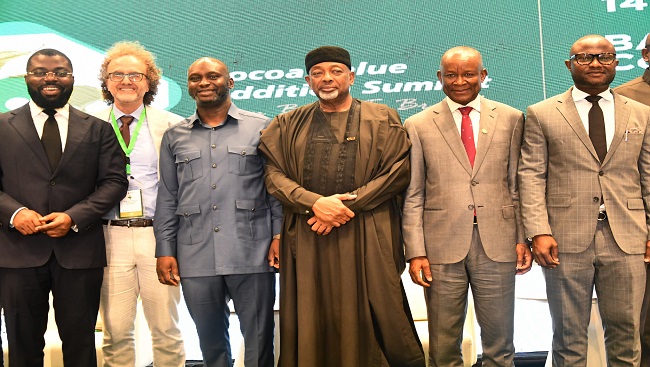
Bank of Industry (BOI) has secured a €60 million credit facility from the European Investment Bank to fund Nigeria’s cocoa and dairy value addition drive, with a focus on processing, ingredients and chocolate manufacturing.

Dr. Olasupo Olusi, Managing Director/CEO of BOI, disclosed this on Tuesday, during the Africa Cocoa Summit convened in Abuja by the Federal Ministry of Industry, Trade and Investment with the aim of transitioning Africa from exporting raw beans to local processing and branding.
Also known as the Cocoa Value Addition Summit with the theme: ‘From Bean to Brand,’ it was attended by leaders and stakeholders from Nigeria, Ghana, Côte d’Ivoire, and Cameroon who signed the Abuja Declaration to establish the Cocoa Value Addition Alliance (CVAA).
According to Olusi, the €60 million forms part of the €85 million EIB–BOI facility, backed by the European Union under the Global Gateway initiative, and designed specifically to strengthen these critical sectors in Nigeria.
“This agreement reinforces the Bank of Industry’s commitment to unlocking long-term, affordable finance for priority sectors that drive inclusive growth. Approximately 70% of the €85 million financing facility will be channeled to Nigeria’s cocoa and dairy sectors, which BOI considers among the industries with the greatest potential to create jobs and retain foreign exchange earnings.”
“We are particularly focused on cocoa value chains, which provide livelihoods for thousands of Nigerians. Through this initiative, we aim to enhance productivity, value addition, and market linkages that will directly improve the incomes of farmers and processors,” he said.
The BOI MD said that the bank would prioritise lending to processors, cooperatives, and MSMEs that add value locally, rather than only to traders exporting raw beans, adding that the era of celebrating volume of raw exports must end, as Nigeria loses billions by shipping beans and importing finished chocolate. According to him, the goal is to create factories around cocoa communities so that value, jobs, and taxes remain in Nigeria.
However, Olusi noted that financing alone is not enough, and as such, BOI will complement the loans with technical assistance on compliance, climate standards, and access to the EU market. BOI, he said, will also support farmers and processors to meet the EU Deforestation Regulation and other international environmental and social standards.
Citing BOI’s track record, Olusi said the bank disbursed over ₦164 billion in 2025 to more than 3,500 agro and food-processing businesses. The support financed factories, mills, packhouses, and cold chains, and linked nearly 48,000 smallholder farmers into industrial value chains.
He said the new financing would target the entire ecosystem, from nurseries and farmer cooperatives to grinding plants, ingredient factories, packaging lines, and chocolate manufacturers.
Speaking also at the summit, President Bola Tinubu called for a decisive shift from Africa’s long-standing dependence on exporting raw cocoa beans, urging producing countries to prioritise value addition and capture a larger share of the global chocolate industry’s wealth.
The President who was represented by the Minister of Agriculture and Food Security, Senator Abubakar Kyari, noted that although Africa accounts for about 70 per cent of global cocoa production, the continent retains only six cents of every dollar generated by the global chocolate industry.
He stressed that Nigeria was committed to processing more of its cocoa locally, expanding chocolate manufacturing, building indigenous brands and competing more effectively in international markets, rather than continuing to export raw cocoa beans.
According to the President, cocoa value addition remains a key component of the Renewed Hope Agenda and the country’s broader industrialisation strategy, and disclosed that investors are developing a 70,000-tonne cocoa processing facility in Shagamu, Ogun State, while Nigeria’s cocoa grinding capacity has already surpassed 120,000 tonnes annually.
Earlier, the Minister of Industry, Trade and Investment, Dr. Jumoke Oduwole, said the summit aligns with the Federal Government’s ambition of building a one-trillion-dollar economy by 2030.
She observed that despite Nigeria’s significant contribution to global cocoa production, the country continues to earn only a small fraction of the value created across the cocoa value chain.
According to Oduwole, the Federal Government is promoting greater value addition through manufacturing incentives, investment promotion and stronger collaboration among relevant institutions.
She added that the government would also deepen market access by leveraging existing trade partnerships and opportunities under the African Continental Free Trade Area (AfCFTA), while encouraging investors to take advantage of regional and global value chains to unlock the sector’s full economic potential.
Also speaking, the Minister of State for Industry, Senator John Owan Enoh, described the summit as another milestone in implementing Nigeria’s Industrial Policy, and announced plans for the establishment of the Cocoa Value Addition Alliance, bringing together Nigeria, Ghana, Côte d’Ivoire and Cameroon, countries that collectively account for about 75 percent of global cocoa production.
According to Enoh, the alliance is designed to strengthen regional cooperation, promote local processing, and enable producing countries to capture greater value from the global cocoa market.
“We are not here to disrupt existing partnerships but to expand them,” he said.
Enoh urged African cocoa-producing nations to move beyond exporting raw beans and instead focus on developing branded cocoa products capable of competing successfully in global markets.
On his part, the Chief Executive of the Ghana Cocoa Board (COCOBOD), Dr. Ransford Abbey, urged African cocoa-producing countries to deepen domestic processing.
“I am here to support the effort and commit to a joint effort towards increasing value for our hardworking cocoa farmers and our respective economies,” Abbey said.
He said Africa produced about 75 per cent of the world’s cocoa but earned less than 10 per cent of the global chocolate industry’s wealth.
“This system cannot continue. We must shift the paradigm from exporting raw poverty to creating refined wealth right here on the African continent,” he said, adding that stronger regional collaboration, investment and technology transfer will help African countries capture greater value from the global cocoa economy.
The Head of Cooperation of the European Union Delegation to Nigeria and ECOWAS, Mr. Massimo De Luca, reiterated the importance of value addition in the cocoa value chain. While expressing the support of the EU, he called on governments of the various countries to ensure they play their part in ensuring that proper framework necessary for the success of the initiative was established and clarified.

FAAN to Replace Physical ID Check with V-Pass Biometric Verification

World Bank Says 79 Percent of Nigerians Still Trapped in Poverty despite Reforms

SEC Begins Drive to Recover Unclaimed Dividends

ntel Plays Down Calls and Data Services, Moves to BET Agenda

Nigeria Facing Rising Cybercrime Losses – Report

NRC, Ponzi Scheme Collapses Resulting Loss of Billions of Naira

Nigeria Launches FreeTV Nationwide

NASENI Moves to Digitize CCB’s 5m Assets Declaration and Operations

Lebara Nigeria Launches Lebara Play, Africa’s First Telecom-Owned Micro-Drama Platform

CANAL+ Partners Samsung to Pre-Load DStv Stream on New Samsung TVs In Nigeria, Other African Countries




 E-Business2 days ago
TD Africa Sponsors Check Point Secure 360 Summit to Boost Cybersecurity in Nigeria

 Telecom2 days ago
MTN Foundation, MUSON Celebrate Emerging Music Talents at 2026 Graduation Ceremony

 Telecom2 days ago
NITDA Calls for Digital Infrastructure Expansion to Drive Nigeria’s Industrialisation

 E-Financial2 days ago
Next Currency Crisis May Turn $300Bn in Stablecoins into National Currencies

 News2 days ago
Guinness Rolls Out Nationwide Consumer Rewards Promotion

 General News2 days ago
First Trustees Advocates Estate Planning as an Essential Tool in Every Wealth Creation Strategy

 E-Financial2 days ago
Gigbanc Nigerian Fintech Startup Closes Shop after 3 Years

 Broadcasting2 days ago
Mbunabo, Nigerian Filmmaker Accuses Ghana TV Stations of Pirating Nollywood Films