

News
MTN Group Chairman, Togolese Minister Cena Lawson, and GSMA’s John Giusti Address Digital Access Inequalities at Semafor’s UNGA Event

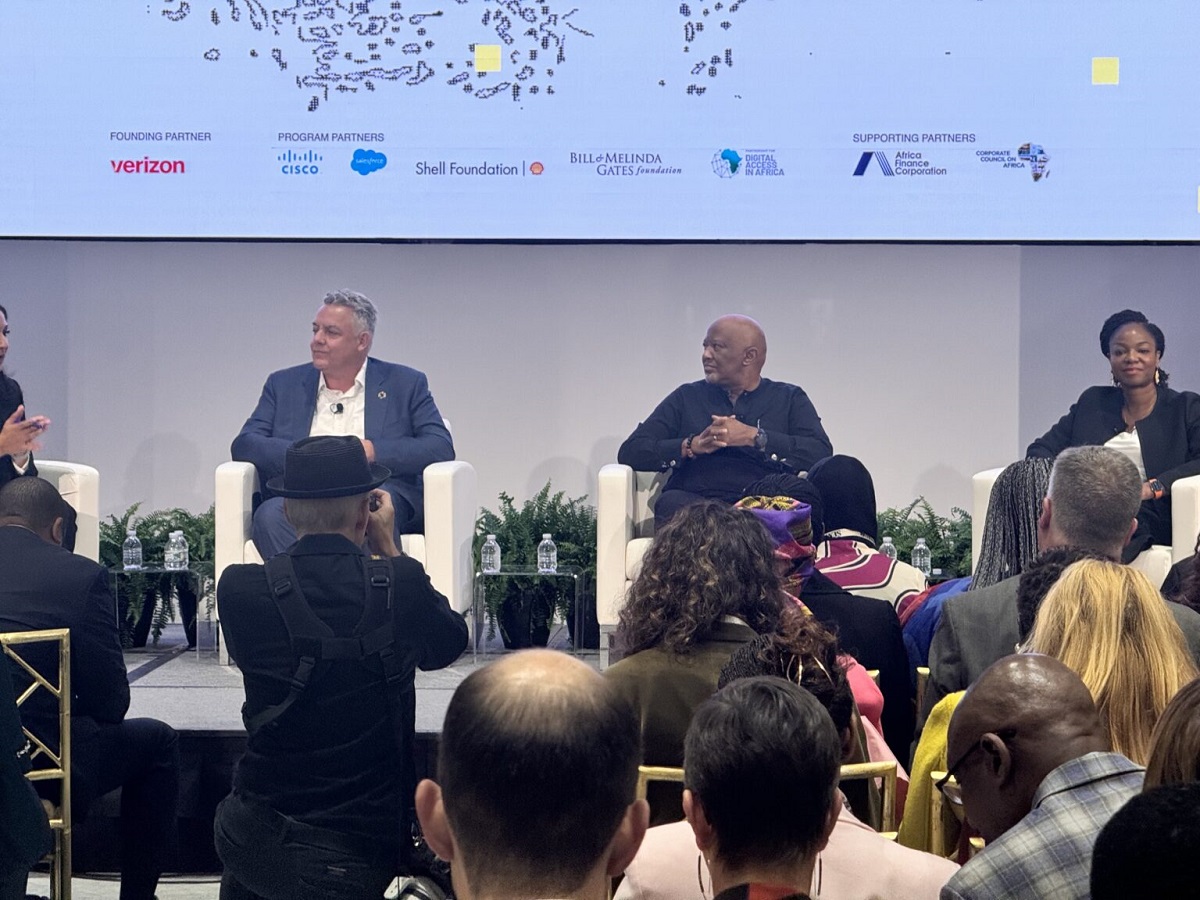
At the 79th United Nations General Assembly (UNGA) in New York, key stakeholders gathered at Semafor’s “The Next 3 Billion” summit to address pressing digital access inequalities affecting millions globally.

L-R: John Giusti; Mcebisi Jonas; Cena Lawson
MTN Group Chairman Mcebisi Jonas, Togolese Minister of Digital Economy and Transformation Cena Lawson, and GSMA Foundation President John Giusti participated in a panel discussion moderated by PBS NewsHour’s Amna Nawaz.
Jonas emphasised the gender gap in digital connectivity as a significant challenge, noting that while advancements have been made in areas like health and financial services, inconsistent policy frameworks across African nations hinder equitable access. “There is no one Africa,” he stated, highlighting the diverse challenges faced by different countries despite shared issues.
He also called for public-private partnerships to combat disparities in affordability and digital literacy; Proposing that collaboration among governments, private sector organisations, and international bodies is essential for addressing device affordability.
“Solving the issue of device affordability requires more than just telco efforts—it also depends on what governments contribute,” he asserted.
Giusti echoed these sentiments by identifying affordability and digital skills as the primary barriers to inclusion. He urged for innovative solutions to expand broadband access and enhance digital skills across Africa.
On her part, Minister Lawson highlighted Togo’s initiatives to improve connectivity through fixed broadband investments, emphasising the importance of international partnerships in making internet services more affordable.
The discussion underscored the urgency of addressing digital inequalities, with approximately 40% of the global population lacking mobile internet access, a staggering 58% of whom are in Africa.
The panellists agreed that closing this gap is vital for enhancing participation in economic and political processes, ultimately benefiting marginalised communities.
Semafor’s “The Next 3 Billion” summit also featured discussions with global leaders, including Nigeria’s Dr. Ngozi Okonjo-Iweala, Director-General of the World Trade Organization; Nigeria’s Akinwunmi Adesina, President of the African Development Bank Group; Olugbenga Agbo/ CEO of Flutterwave; Dr. Bosun Tijani, Nigeria’s Minister of Communications, Innovation, and Digital Economy; Sim Tshabalala, CEO of Standard Bank; Mark Suzman, CEO of Bill & Melinda Gates Foundation, and Brad Smith, President and Vice Chair of Microsoft.



The African Development Bank Group last week approved an investment of €6.5 million in the Saviu II fund in order to support technology start-ups through their seed phase and first institutional fundraising, mainly in French-speaking Central and West Africa.

The Bank will invest €4.5 million as equity and €2 million as a first-loss hedging tranche on behalf of the European Commission, under the Boost Africa Programme.
This participation of the Bank Group will enable the Saviu II fund to give priority to companies with a strong technological or digital component.
Saviu II, the second investment vehicle of Saviu Partners, plans to invest between €500,000 and €3 million in about 20 technology or technology-oriented business-to-business start-ups in the seed phase or carrying out first institutional fundraising.
The Saviu II venture capital fund aims to make at least 60% of its commitments in the French-speaking countries of West and Central Africa: Côte d ‘Ivoire, Cameroon, Benin, Senegal, Togo, Burkina Faso and Mali.
The fund can also co-invest in promising technology companies in East Africa that have a strong team and business model, and whose strategy includes entering the market in French-speaking West African countries and establishing a strong presence there.
In addition, the fund will devote a dedicated envelope to pre-seed investments, focusing on minority equity investments, usually in co-investment with studios, incubators or other ecosystem partners.

Nigerian Government has signed a $1.3 billion Memorandum of Understanding (MoU) with Africa Finance Corporation (AFC) via the Solid Minerals Development Fund (SMDF) to fund an alumina refinery, national geoscience mapping, and a strategic investment vehicle for mining growth.

Special Assistant to the Minister of Solid Minerals Development, Segun Tomori, said the refinery will process one million tonnes of bauxite yearly using a modern Bayer process, powered by an on-site gas-fired cogeneration plant.
Minister Dele Alake called it a transformative milestone boosting GDP, aligning with reforms that improve investment climate, regulations, and licensing to attract private capital. He directed agencies to fast-track permits.
The 20-year project at 95% utilization eyes 19 million tonnes total output, $1.2 billion annual GDP addition, $25 billion economic impact, and $8 billion forex earnings, per feasibility studies.
SMDF Executive Secretary Fatima Shinkafi termed it the agency’s biggest funding deal, supporting value-addition policy.
The partnership extends to geoscience mapping for mineral data, de-risking exploration, and a joint vehicle for mining assets.
Permanent Secretary Engr. Farouk Yabo praised the reforms. Shinkafi signed for government; AFC’s Franklin Edochie for the corporation, witnessed by AFC CEO Samaila Zubairu.
Tomori positioned it as Nigeria’s largest private mining investment and FDI magnet.

TeamApt Ltd., a subsidiary of Moniepoint Inc. and a leading financial infrastructure provider, has partnered with Awabah, the National Pension Commission’s first licensed Accredited Pension Agent, to expand pension access for millions of Nigerians in the informal economy.

The partnership was unveiled in Abuja at the launch of Awabah’s agent licence, themed “Building Financial Resilience: Securing the Future with Personal Pensions.”
At the event, PenCom Director-General Omolola Oloworaran underscored a major imbalance in Nigeria’s pension system, noting that while pension assets have grown to over ₦27 trillion, the benefits remain largely concentrated among formal-sector workers. She observed that most informal-sector workers—who make up the majority of Nigeria’s workforce—still retire without any form of savings.
This challenge is further highlighted in Moniepoint’s 2025 Informal Economy Report, which reveals that although 65 per cent of informal businesses recorded revenue growth, most lack the structural resilience required for long-term sustainability and succession.
Through the partnership, TeamApt—a Central Bank of Nigeria–licensed switching and processing company—will enable seamless pension registration and contributions for Awabah users via its Direct Debit service on Point of Sale (POS) terminals nationwide. Informal workers can enrol for personal pensions, tokenize their cards, and automate periodic contributions in just a few steps.
The initiative simplifies pension savings by turning what was once a complex, bureaucratic process into a routine transaction, enabling business owners and workers to build financial security beyond their productive years.
“When we started Awabah, we were driven by one core belief—that no African worker should be one accident or crisis away from poverty,” said Tunji Andrews, Chief Executive Officer of Awabah.
“This partnership with TeamApt allows us to scale that vision. By leveraging their Direct Debit service and extensive POS network, we are meeting informal workers where they already operate—markets, workshops, kiosks, and roadside businesses. With small, regular contributions, workers can now access personal pensions bundled with health, accident, and life insurance,” he added.
TeamApt CEO Dennis Ajalie said the collaboration aligns with the company’s long-standing mission to power Nigeria’s informal economy.
“At TeamApt and Moniepoint Inc., our focus has always been on enabling the informal sector,” Ajalie said. “Today, working within our licence framework and alongside our co-subsidiary, Moniepoint Microfinance Bank, we operate across all 774 local government areas, serving millions of Nigerians who drive economic activity.”
He described the partnership as a critical step toward pension inclusion, adding that it demonstrates how financial infrastructure can deliver real, long-term value to everyday Nigerians.
Ajalie also praised PenCom’s leadership for creating an enabling environment for innovation, noting that Oloworaran’s reforms have opened the door for partnerships capable of delivering sustainable pension coverage for informal workers.
The initiative is powered by TeamApt’s robust financial technology ecosystem, which has supported banks, fintechs, and financial institutions for more than a decade. Its omni-channel Direct Debit service allows automated recurring collections—such as pension contributions, subscriptions, and repayments—directly from customers’ bank accounts with their consent.
Beyond pensions, the platform enables informal workers to automate investments in the capital market, access healthcare through HMOs, and secure insurance coverage for themselves and their families—extending financial security far beyond retirement.

Sunil Bharti Mittal Conferred GSMA Lifetime Achievement Award for Transforming Global Telecommunications

Jumia Tech Week 2026 Begins with Tech Deals on Smartphones, Electronics, and Everyday Technology

AfDB Supports Francophone Africa Start-ups with €6.5M

Krishnan Exits Africa Data Centre to Embark on Professional Chapter

House Probes Fintech Regulation via Public Hearing on New Commission Bill

Accidental Billionaire Opts for Jail Instead of Returning Money Credited Him by Mistake

New Horizons Nigeria Breaks Ground: First to Fuse Mandarin into ICT Curriculum

Kaspersky Brings more Transparency to Threat Detection with New Hunt Hub

NDPC Commits to Balancing Data Privacy, Protection Information

Dr. Cairo Ojougboh Foundation Bolsters Nigeria’s Education Drive with ₦2.7m Student Support




 E-Financial1 day ago
Iran-Israel-US Conflict and CBN’s FX Gains: A Stress Test for Nigeria’s Monetary Stability

 E-Financial1 day ago
Mutual Benefits Assurance Reaffirms Full Regulatory Compliance, Enhanced Governance

 General News1 day ago
JAMB Uncovers AI-Driven Fraud Targeting UTME Candidates, Warns Parents

 General News1 day ago
SERAP Asks FCCPC to Investigate Google, Meta, Others over Alleged Rights Abuses

 News1 day ago
FlashChange CEO, Bidemi Oke, Urges Startups to Build Strong Governance Structures Early

 News1 day ago
TeamApt, Awabah Partner to Boost Pension Drive for Nigerians

 General News1 day ago
Capelli Institute Commits to Advancing Trichology in Nigeria

 E-Financial1 day ago
Reps Mull Commission to Regulate Fintech Operations