

General News
MultiChoice Here to Stay– John Ugbe

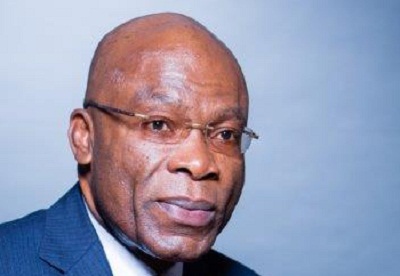
John Ugbe, managing director and chief executive of Nigeria’s leading payTV provider, MultiChoice believes the country has the market to take in as many providers as possible. Having served previously as MD of MWEB (subsidiary of MultiChoice), Ugbe in this encounter with Nigeria CommunicationsWeek’s Miebi Senge, says MultiChoice is even prepared to invests more in the country to remain dominant. Excepts:
Transformation Agenda for MultiChoice
I came in at a point when the company is transforming and is moving forward. The company has a lot of human capital here in Nigeria and right now we are harnessing all our human and capital resources to move the company forward with a lot of local input. Good enough we have developed contents (locally) and will continue to develop local contents to drive our growth vision. Our vision is to surround our customers with entertainment and that is exactly what we are going to do; to entertain our subscribers even more.
Challenges
Every business in operation (not just in Nigeria) in what ever country encounters challenges uniquely related to that environment. MultiChoice has its businesses spread around quite a few countries across the continent and we can really say there are challenges in every business environment. Of course, there are definitely challenges in Nigeria but like every business our objective is to surmount these challenges and forge ahead. As a matter of fact, we work very closely with our regulator (Nigerian Broadcast Commission, NBC), our publics/stakeholders; and by building those relationships we can surmount any obstacles.
The infrastructure in Nigeria is still evolving and as they develop we also have to build our business taking into consideration those challenges that exist. It is very important that we offer world class service to our highly valued customers even if our operational environment isn’t as it ought to be.
The issue of public power supply comes up very often in our discussions, but such challenges are not just peculiar to us, every other enterprise are also faced with it, and so MultiChoice would take it as one of those challenges that we have to surmount in other to thrive in our operational environment. We do not consider power challenge as insurmountable and it is not by any means peculiar to our business. Other infrastructural challenges are also what every business in the country face.
Local content
We are very proud with the Nigerian Premier League on our SuperSport bouquet. We hope to build and grow on that. We have got a good relationship with other sports in the country as well. Right now, we have a deal with the basketball federation and have actually put the DStv Basketball League on the SuperSport channel. Not only do we sponsor by putting money into the league, we also put the matches on TV and this is a big push for the local basketball league. It has never happened before but it is being watched everywhere now across the continent.
Yes, we have also made quite some investments in this country as our way of providing quality service to our customers. Recently, we added another High Definition (HD) Outside Broadcasting (OB) van. We have built two HD studios to support the local league so you will see more matches live. More simultaneous telecast of matches – we can take matches from even more venues.
On the (local) movie and the sitcoms, we are expanding that and you will see a lot coming from there. Africa Magic channels will grow, so you will see a lot of growth in contents. We have been a partner with the Nollywood industry right from inception.
Local Sponsorship
We would see more from the broadcast perspective and I think one of our sister companies is active in that area so we would see certain sponsorship from local organizations on our platform and we have been able to expose those plans to an international audience. Definitely you will see improvement in that.
Programmes
We will continue to search for best contents out there and we will make sure the contents are available on our platform. We have got America’s Got Talents, Fear Factor and a lot of programmes that are being watched internationally to ensure that our audience does not lag behind.
Value Proposition
We have actually never been a monopoly in this business. What makes us unique is our way of doing business, a very long term business proposition. We are not here for the short haul so we are not a company that is trying to invest today and reap tomorrow. Like the local league we are putting up, we have spent a lot of money to put that content on air. We have been patient, we will continue to find out what our customers want and what we try to do is to provide what our subscribers want and give to them. We’ll continue to make value added investments in this market and perhaps, that is the secret of our continual growth and dominance.
Killing Competition
Our business model is not to kill off competition. In fact, competition is good for the industry. However, in every sphere of human endeavour only the fittest survives. As the media can attest to, there are several payTV operators in the country, but your growth and survival also depends on what you are offering your consumers. This is a payTV so it also means business in the real sense. If you must measure up to international standards, then you have to measure your business with international best practices. The world has contrasted into one global-village, so what takes place say in Europe doesn’t have to take ages (as in the past) to get to Africa. Events are seen real time across the globe as they happen, so if what you’re offering does not measure up to the taste bud of the customers, they would simply switch-off and tune to someone else who is more serious in the business.
Yes, we want to see others grow, but it is up to them to grow their business according to their module. We are working to constantly to keep pace with global standards, because that is what our customers want. The Nigerian customer is highly informed and would not take less value for higher cost.
High cost of MultiChoice
Our costing is relative. Lately, we have developed high-value segmented bouquets to meet family budgets. If you cannot afford the premium bouquet, there is a special one that meets your budget and it comes with same MultiChoice high quality treatment. We are constantly working to meet our customers’ requests to serve them better.
Would Multichoice be listed on the Nigerian Stock Exchange?
We work with regulators and stakeholders all the time to see how feasible this is and we work with even the capital market. We must also not forget that even before this discussion our sister company, Mnet was once listed on the Nigerian Stock Exchange. There are lots of things to think about when it comes to listing on the stock exchange. Obviously companies would always work with regulators to see what strategy fits that business at that time because it is not every company in the country that will be listed on the stock exchange.
On Corporate Social Investment (CSI)
The plank of our major CSI project is built around education and so we have undertaken to establish MultiChoice Resource Centres, (MRC) and we have rolled out in 201 schools in 21 States across the country.
We have also trained quite a few teachers and I think it is a project that we have been able to see results from and we have also taken a decision to see results from and we have also taken a decision on our own to increase roll out of these resource centres so we can feel more of their impact in the society.
In terms of education, we also try to see how much value we could add in terms of content development. Content is really important, especially concerning what kids are learning? When you teach a kid lets say about tsunami, what does it mean to him? It is not something you go out on the street and see so we have managed and designed a programme working with the ministry of education to build MultiChoice Resource Centres in schools across the country. That gives an opportunity for these kids to see what they are learning and to learn with some of our channels like Discovery which has a lot of contents that actually gives the kids a better experience.
Tackling Unemployment Challenges
First we employ quite a few people directly by ourselves and we also have our supply chains. Our Super Dealer is a strong chain which is a structure we have set up to encourage entrepreneurship. We have people that have built businesses that are supported by our business. We work with them and very closely with banks for funding and these businesses however hire over 2,000 Nigerians to work on business that are driven by our products and services. These are wholly owned Nigerian businesses which we have helped to start up.
Impact of MultiChoice on Local Movie Industry
We have supported Nollywood through training over the years. We have another training scheduled for the first quarter of 2012 where we are going to take people through script writing and production training. This is not something we are just starting; it is something we have always done. We have always had that partnership with the movie industry here. We are also partnering with the Nigeria Copyright Commission (NCC) to create awareness on intellectual property rights because we must be careful. I think the biggest challenge the entire entertainment industry is facing is piracy and that is what is stopping the growth of even our movie industry. So we hold workshops in trying to educate people that intellectual property needs to be respected because that is how the new Nigeria music industry and the movie would be sustained. If piracy is not controlled, that industry would collapse and that industry has quite a lot of people but we have not probably gotten a good feel of the impact and it is a growth industry. It is big everywhere in the world and I think we have the capacity for it to be very big here. For it to succeed here, intellectual property right has to be respected.
Customer Service
We have a well staffed call centre here with very high traffic level that is measured against that of other countries. We consistently come out public. However, customer service is what we continually improve on. We have a lot more dealer designation nationwide so we have taken the service closer to subscribers.



Justice Mojisola Dada of the Lagos State Special Offences Court in Ikeja has remanded, Andrew Odekina, an alleged hacker, who is part of a fraud syndicate that stole N3.09 billion from First City Monument Bank (FCMB).

Justice Dada ordered that Odekina be kept behind bars after he was arraigned before her by the Economic and Financial Crimes Commission (EFCC).
The EFCC informed the judge that the defendant was among the suspects who allegedly carried out a major cyber-enabled fraud that resulted in over N3 billion being siphoned from the bank’s customer accounts.
The anti-graft agency also accused the defendant of retaining proceeds linked to the large-scale hacking operation that targeted some FCMB customers.
The Commission stated that its investigation found cybercriminals had unlawfully accessed the bank’s applications, allowing them to transfer N3.09 billion from various accounts.
Odekina was specifically charged with receiving and retaining N9.87 million, believed to be part of the stolen N3.09 billion, in his FCMB account in 2025.
The offence, according to the EFCC, contravenes the provisions of the EFCC (Establishment) Act, 2004.
The charge states that the defendant, alongside accomplices still at large, knowingly retained control of funds traced to fraudulent digital transactions carried out on the bank’s platform.
The defendant, however, pleaded not guilty to the charge.
Based on his plea, Babatunde Sonoiki, prosecutor, urged the court to fix a trial date and remand the defendant in the custody of the Nigerian Correctional Service pending the conclusion of the trial.
The defendant appeared in court without legal representation.
After listening to the lawyer, Justice Dada adjourned the case to May 11 for trial and ordered that Odekina be remanded to the Kirikiri Correctional Facility.
South East Development Commission (SEDC) has launched the South East Venture Capital Programme (SEVCP), to expand access to capital for startups and strengthen Nigeria’s investment landscape.

The Commission said the programme represents a direct institutional response to the federal government’s commitment to expand access to local funding and attract sustained investment into high- growth sectors across South East Nigeria.
It also said that it is part of the developmental initiative by the SEDC as contained in the road map for the region that was presented to the House of Representatives Committee on South East Development.
A statement issued by the commission says the SEVCP is a funded, coordinated, and time- bound intervention designed to catalyse the region’s digital, innovation, and technology ecosystem.
“As part of its initial rollout, the first phase of the program, the South East Pitch Competition, is now officially open for applications. At the core of the program is the South East Venture Capital Fund, a blended finance vehicle designed to mobilise up to $50 million in public, institutional, development finance, diaspora, and private capital into the region.
“SEDC anchors the Fund through the South East Investment Company, its wholly owned investment vehicle, which participates as a Limited Partner. This structure ensures professional fund management, institutional accountability, and alignment with global investment standards,” the statement said.
The commission also said that SEVCP is built as an integrated platform comprising five interlinked workstreams: fund operationalisation, a flagship Pitch Competition, a structured incubation and acceleration programme, a financing partnerships strategy to complete the fund raise, and a network of implementing partners across the region.
“Each component is designed to reinforce the others and ensure continuity from deal sourcing to investment and growth.The South East Pitch Competition serves as the primary entry point into the Fund’s investment pipeline. Thirty startups will be selected across the five states, with twenty placed in the Accelerator Track and ten in the Incubation Track.
“These startups will receive SAFE investments totalling 450,000 dollars in the first cohort. Accelerator participants will receive 20,000 dollars each, while incubation participants will receive 5,000 dollars each. Investments will be milestone-based and structured to balance founder flexibility with investor protection.
“The Pitch Competition Finals is scheduled to take place on 13 May 2026, followed by an Investment Ceremony on 14 May 2026. Selected startups will participate in a structured hybrid incubation and acceleration programme delivered across key locations in the region.
“The South East has long demonstrated strong entrepreneurial capacity, commercial depth, and human capital, the statement indicated. It noted that what has been missing is a coordinated system to channel capital into that capacity at scale, with the structure and governance required by serious investors. The SEVCP provides that system, and the Pitch Competition establishes the first layer of access,” it said.
According the tstatement, applications opened on 13 March 2026 and were originally scheduled to close on 27 March 2026.
“It indicated that the deadline has now been extended to 3 April 2026 to enable broader participation across the region, adding that this will be the final extension.
“The Accelerator Track is open to startups with demonstrable product market fit, active users, and revenue traction. The Incubation Track is open to founders with validated ideas and a minimum viable product. Eligible startups must be based in, operating in, or delivering clear impact within the South East, or be founded by individuals of South East origin with a defined regional focus. All applications must demonstrate a meaningful technology component,” it said.
The commission said that SEVCP represents a long-term commitment to building a structured and investable startup ecosystem in the South East.
“The inaugural cohort will form the foundation of a pipeline that the Commission intends to scale over successive cycles. Founders building within the region, and those looking to build within it, are encouraged to apply before the deadline,” the statement added.
General News
PIAFo Drives Urgent Call for National Dig-Once Policy to Boost Nigeria’s 125,000km Fibre Network

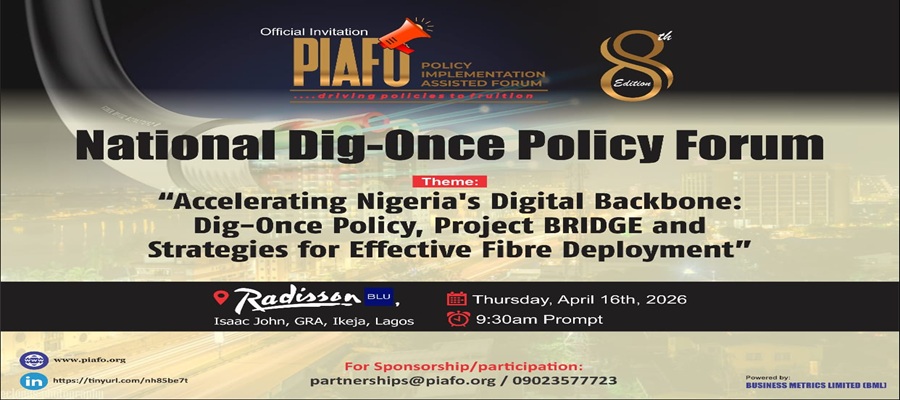
Key players across Nigeria’s digital economy, telecommunications, and infrastructure ecosystem are set for the National Dig-Once Policy Forum to champion a new course towards increasing Nigeria’s digital backbone network to 125,000km of fibre-optic infrastructure.

PIAFo
The event, which marks the 8th edition of Policy Implementation Assisted Forum (PIAFo), is a high-level industry dialogue aimed at accelerating the formulation and adoption of a National Dig-Once Policy as a critical enabler of safe, coordinated and cost-effective fibre infrastructure deployment in the country.
The forum, themed “Accelerating Nigeria’s Digital Backbone: Dig Once Policy, Project BRIDGE and Strategies for Effective Fibre Deployment,” is slated for Thursday April 16, 2026 at Radisson Blu Hotel, Ikeja GRA, Lagos.
According to the organisers, Business Metrics Limited (BML), the introduction of $2 billion Project BRIDGE initiative by the Federal Government to expand fibre infrastructure by additional 90,000km from 35,000km to 125,000km by 2030 requires some new measures to ensure successful implementation of the ambitious target and avoid mistakes of the past.
Industry stakeholders have identified that the success of a national connectivity backbone rollout depends largely on institutionalising a Dig Once Policy framework, which encourages the installation of fibre ducts and conduits whenever roads, railways, and other major public infrastructure are being constructed or rehabilitated.
According to industry data shared by the Nigerian Communications Commission, lack of such a framework is taking a toll on the telecoms sector and broadband drive as operators recorded over 50,000 fibre cut incidents across the country in 2024, with more than 60 per cent occurring during road construction and rehabilitation activities. These disruptions have resulted in billions of naira in repair costs, network outages, and service degradation.
Telecom operators in Lagos State alone said they spent over N5 billion in 2024 to repair and replace damaged fibre infrastructure in the state, while lamenting that the development continues to slow down network upgrade and expansion drive.
Beyond infrastructure damage, telecom operators also face challenges such as high Right of Way (RoW) charges, uncoordinated civil works, and repeated excavation of roads for fibre deployment.
PIAFo 8.0 aims to address these challenges by fostering collaboration among stakeholders responsible for planning, financing, constructing, and maintaining Nigeria’s digital infrastructure.
Specifically, the forum seeks to align federal, state, and local infrastructure planning around a unified Dig-Once framework; strengthen collaboration between telecom operators, infrastructure companies, and public works authorities; translate policy intentions into actionable guidelines and implementation timelines; and build stakeholder support for Project BRIDGE and complementary national fibre initiatives.
Speaking about the event, Team Lead at Business Metrics Limited, Omobayo Azeez, said Nigeria is being denied access to robust connectivity it should derive from up to eight high-capacity undersea cable networks landed on its shores because of difficulties around terrestrial fibre infrastructure expansion.
“The Project BRIDGE initiative should excite everyone because of ambitious targets. But for those who understand the operating terrain, and why it took the industry over 20 years to achieve around 35,000km of fibre network that the country currently operates for broadband connectivity, the project calls for a major shift in execution approach with the adoption of a National Dig-Once Policy as the starting point.
“PIAFo, now in its 8th edition, is again serving as the viable platform for representatives from government ministries and agencies, senior telecom executives, infrastructure companies, data centre operators, equipment manufacturers, state governments, and industry associations to chart the way forward.”
The forum will feature keynote addresses, expert panel discussions, and strategic networking sessions designed to drive pragmatic outcomes that will accelerate Nigeria’s journey toward a resilient and inclusive digital economy.

Court Remands Hacker for Allegedly Stealing N3.09Bn from FCMB

CBN Directs IMTOs to Open Naira Settlement Accounts

Nigerians Lose N12.5Bn to AI-Driven Scams- PwC

SEDC Launches SEVCP to Expand Access to Capital for Startups

Kaspersky, AFRIPOL Conduct Joint Cybersecurity Training for African law Enforcement

Kaspersky Discovers New Phishing Campaign Exploiting Google Tasks Notifications to Steal Corporate Credentials

esentry 2025 Report Shows Healthcare, Financial Services and Telecoms as Staging Grounds for Increased Cyberattacks in Africa

AfDB, UNDP Launch $10Bn AI Initiative for Africa

MultiChoice Suspends Yearly DStv Price Hike as Canal+ Pushes Growth

MTN Nigeria Posts Record N1.70 Trillion Pre‑Tax Profit, Declares N20 Dividend for 2025




 E-Financial2 days ago
DLM SPV PLC Lists ₦9.00bn AAA-Rated Medium-Term Notes on FMDQ Exchange, Sets Benchmark in Corporate Bond Market

 E-Financial3 days ago
CBN Wins Central Bank of the Year Title @13th Global Awards

 General News3 days ago
Tech Firms Sack over 45,000 so Far in 2026

 News2 days ago
Metaverse Collapses, Horizon Worlds Shuts Down on Quest

 News3 days ago
Morney Launches in Nigeria as E-invoicing Drives Finance Digitisation

 Telecom3 days ago
FG Taps Quest Merchant Bank for Advisory on 90,000km Fibre Project

 General News3 days ago
Jury Finds Elon Musk Liable for Misleading Twitter Investors

 News3 days ago
TEF-Backed Entrepreneurs Generate $4.2Bn, Create 1.5m Jobs across Africa