

General News
NEPZA Seeks Export Accelerator Programme for SMEs


Prof. Adesoji Adesugba, managing director, Nigeria Export Processing Zones Authority (NEPZA), has expressed his readiness to canvass for the adoption of export business accelerator programme to speedily integrate the country’s small and medium scale enterprises (SMEs) into the Special Economic Zones (SEZ) scheme for the benefit of the country.

Speaking while delivering a keynote address during the 2021 World Intellectual Property Day Symposium held virtually, Adesugba, also said a new SEZ model could be developed to allow the SMEs undertake ancillary activities within the established zones.
He said: “With more than 60 million Nigerians engaged in SMEs, the federal government will do good to consider the adoption of programs similar to Kenya’s to boost growth for these smaller companies.
“The management of NEPZA is willing to canvass the support and approval of Mr. President for definite and sustainable initiatives that can help in the growth and development of national economy through the robust participation of the SMEs.
“In line with our plans to develop sectorial SEZs for different industries such as Medical SEZ, Agro-allied, Textile, etc. We may seek a strategic alliance with SMEDAN and the Nigerian Export Promotion Council (NEPC) to develop a joint SEZ program for SMEs.”
He said Nigeria could draw a good example from Kenya where SMEs have been deliberately integrated into the SEZ scheme through the export business accelerator programme where SMEs are allowed to take up smaller spaces in incubator buildings located within SEZs.
The NEPZA MD pointed out that with the outbreak of the COVID-19 pandemic and its grave economic consequences on countries and individuals, there was no better time to seek for emergence of geniuses and ideas that can help transform common loss to sustainable gains in all field of human endeavours especially in the health and economic sectors among others.
He said one of the strategies and measures to be adopted for export and industrial decentralisation was increasing exports of manufactured goods through the promotion of economic zones with fiscal and financial incentives to industrial production.
Adesugba, reiterated that the federal government’s commitment to ensuring the sustenance of the zones scheme, adding that President Muhammadu Buhari’s special attention to the scheme rose from his conviction that the scheme had capacity to speed up the country’s industrialisation process.
He said: “The national objectives for the adoption of the export processing zones scheme include promotion of job and wealth creation; foreign direct investment; technology transfer; foreign exchange earnings; backward integration/ linkages, and the government and NEPZA are fully committed to achieving this onerous mission.
“Since inception many other zones have been established. As of December 2020, a total number of 43 zones has been established and now at different stages of development and operation.”
In a statement by Mr. Martins Odeh, Adesugba, Head, Corporate Communications, NEPZA, said, “It is now possible to have an SEZ where all kinds of economic activities can take place including but not limited to manufacturing, processing, trading, services, educational, health and other kind of ancillary business activities.
“The choice of the theme for this year, IP and SMEs: Taking Your Ideas to Market, is not only timely, but also reflective of the global aspirations for every available solution to the various challenges facing the global communities.”


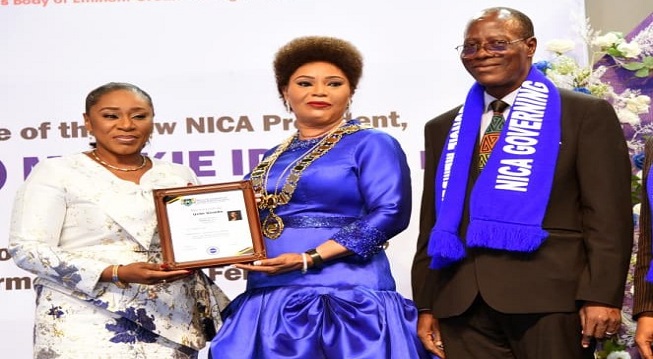
The National Institute of Credit Administration (NICA) has conferred its Professional Fellowship on Mrs. Uche Uzoebo, Managing Director of Shared Agent Network Expansion Facilities (SANEF).

The recognition was announced in Lagos during the investiture of Dr. (Mrs.) Markie Idowu as the Institute’s new President.
In his welcome address, Prof. Chris Onalo, Registrar/CEO of NICA, noted that the National Institute of Credit Administration distinguishes itself from other professional bodies through its unwavering commitment to advancing credit management, promoting professionalism, and empowering Nigerians with credit literacy.
“Unlike many other institutes, NICA recognizes that credit management is a lifeline of commerce, influencing every aspect of business, social, and economic life. Through this commitment, the Institute continues to shape Nigeria’s economic future towards sustainable growth,” he stated.
The Fellowship represents the Institute’s highest professional distinction and is conferred on individuals whose leadership has significantly strengthened Nigeria’s credit environment, institutional governance frameworks, and the integrity of the financial system.
This recognition also comes at a significant moment globally as the world commemorates International Women’s Day, underscoring the growing recognition of women’s leadership and contributions across industries, particularly in finance, governance, and economic development.
The ceremony brought together senior financial sector executives, policymakers, regulators, and distinguished guests to celebrate excellence in credit administration and professional practice.
The Institute described Mrs. Uche Uzoebo as a seasoned business executive and financial services leader with over two decades of professional experience spanning banking, digital payments, and financial services.
A proven change agent, she brings deep expertise across digital payments, financial inclusion, agency banking, product and business development, merchant acquiring, as well as corporate, commercial, and retail banking.
Her leadership has been instrumental in advancing secure and inclusive digital financial services, strengthening payment systems, and expanding last-mile access to financial services across underserved communities in Nigeria.
Through SANEF and related initiatives, she has supported economic empowerment and financial inclusion by expanding agent networks, promoting financial literacy, and championing innovative technology-enabled solutions.
Passionate about gender inclusion and women’s economic empowerment, Uzoebo is also a gender specialist and advocate with a strong focus on supporting women entrepreneurs and breaking structural economic barriers.
As a certified trainer, she designs and delivers high-impact capacity-building programmes for individuals, youth, women, and organizations, enabling sustainable growth and improved performance.


Zedvance Finance Limited, a leading provider of consumer and business financing solutions in Nigeria, has disbursed over ₦96 billion in funding to support commercial businesses across the country, establishing its strong positioning beyond retail lending and reinforcing its commitment to bridging the gap between enterprise growth and access to timely financing solutions.

Zedvance
Leveraging its 11-year legacy, Zedvance’s Commercial Solutions business, launched in 2025, has in just one year become a major driver of credit expansion, achieving one of the highest loan disbursement rates among financial institutions, empowering thousands of local enterprises and boosting economic growth.
The business has consistently supported enterprises across key sectors of the economy, including oil & gas, automotive, logistics, renewable energy, fintech, e-commerce, trade distribution value chains, agri-businesses and others.
Through offerings such as working capital, invoice/PO financing, equipment and trade finance, and ecosystem-based solutions, Zedvance enables access to liquidity for buy-now-pay-later providers, asset acquisition, and cross-border credit lines for imports & exports, aiding business expansion and strengthening operational resilience in a dynamic economic environment.
Speaking on the importance of flexible and tailored financing, Group Managing Director of Zedcrest Group, Adedayo Amzat, CFA, noted that Zedvance Finance, operates a model that is specifically purpose-built to bridge financing gaps and support business growth.
“We are proud of our accomplishments so far, especially the impact we’ve made in sectors that are critical to economic development. For instance, through solar and asset on-lending, we have helped to expand energy access and improve income opportunities for gig workers by financing mobility asset platforms across Nigeria.
“Because our customers are at the heart of our business, we were intentional about designing our flagship product, ‘Liquidity Solutions’ to allow businesses unlock faster credit delivery across all high-growth sectors. This has proven impactful as we continue to witness our clients record great successes,” Amzat said.
Highlighting the unique value of the offering, Amzat added that Liquidity Solutions provides tailored financing structures such as inventory purchase, invoice financing, and import financing, which empower businesses to optimise cash flow, accelerate turnover, and scale with confidence.
Commenting, Ayooluwa Oladimeji, Ag. Executive Director, Commercial Solutions, explained that Zedvance leverages technology, product innovation, deep sector expertise and risk-moderated structures to deploy diverse funding solutions, including multi-currency credit lines, BNPL facilities, and equipment financing across automotive, renewable energy, manufacturing, fintech, and trade distribution sectors.
“In 2025 alone, Zedvance Commercial Solution business recorded tremendous growth, driven by strong partnerships and a rapidly expanding portfolio.
“We are proud to have supported a range of businesses including; Shekel Mobility, Tradegrid, Sapphire, CredPal and other ecosystem partners.
“Beyond these successes, our focus remains on strengthening credit access across Africa’s commercial ecosystems to enable businesses scale with confidence and resilience”, he said
Building on its strong momentum, Zedvance is poised to expand its reach further in 2026, targeting over ₦250 billion in funding across key economic sectors including off-grid power, smart devices and home equipment, vehicle dealerships and mobility platforms, agribusiness and manufacturing, consumer and industrial goods distribution and hospitality.
This expansion reinforces its mission to accelerate enterprise growth by providing faster and broader access to credit across Africa.

As the world marks International Women’s Day, Mojisola Sayo-Kazeem, Head of Finance, Jumia Nigeria & Ghana, reflects on how giving opportunity, mentorship, and support helps women thrive and strengthens organisations.

The future of work is digital, and for women it presents immense opportunities to innovate, lead, and shape the global economy. Yet thriving in a fast-paced, data-driven environment requires more than ambition or technical expertise. It requires opportunity and leadership that intentionally creates space for people to grow.
Reflecting on my own journey, I am reminded of how powerful those opportunities can be. I joined Jumia in 2012 as an accountant and, over time, grew into my current role as Head of Finance for Nigeria and Ghana.
Each stage of that journey came with new responsibilities and lessons that shaped my leadership perspective. One thing has become clear: growth rarely happens in isolation. It flourishes in environments where people are trusted, challenged, and supported to reach their full potential.
One of the most defining pillars of my career has been working within an organisation that invests in talent and encourages merit-based growth. At Jumia, a guiding principle is simple: let the best people and ideas grow. When organisations prioritise capability and innovation rather than bias, they create environments where individuals can thrive, and leadership potential can emerge naturally.
Leadership plays a crucial role in making this possible. Good leadership sharpens growth and experience, not only for the leader but for the teams they support. I have benefitted from leaders who shared knowledge, offered guidance, and entrusted me with meaningful responsibilities. Those opportunities challenged me to expand my skills, strengthen my judgement, and grow into larger leadership roles.
One experience that stands out was leading my team through the launch of a new business line under the guidance of our CFO. It demanded greater accountability, transparency, and strategic thinking. Looking back, it was more than a professional milestone, it was an opportunity to deepen my expertise and strengthen my leadership capacity.
Moments like these remind me that opportunity is one of the most powerful investments leaders can make in people. I also recognise and commend the many leaders who are already creating pathways for women to grow, lead, and contribute meaningfully. Their commitment to fairness, mentorship, and inclusion continues to open doors for others.
But there is still more to be done. As we mark International Women’s Day, this year’s theme, “Give to Gain,” invites leaders to reflect and to act. It challenges us to go beyond good intentions and intentionally create opportunities for women to grow and thrive based on merit, not favouritism or bias. This means sharing knowledge, investing in development, offering mentorship, and trusting capable women with meaningful responsibilities.
When we do this, we strengthen the people and institutions around us. Teams become more confident and capable, organisations become more resilient, and leadership pipelines become stronger and more diverse.
This year’s International Women’s Day theme, Give to Gain, reminds us that generosity is not subtraction, it is multiplication. When people, organisations, and communities give time, knowledge, visibility, advocacy, and support, opportunities for women expand. And when women thrive, industries, economies, and societies thrive with them.
When we give, we gain. The question for all of us is simple: What will you give to gain gender equality?

Africa Startups Raised $272m in Funding in February

First Asset Management Secures Ratings Upgrade

NICA Confers Professional Fellowship on Uche Uzoebo

Starlink Rolls Out V2 Satellites for Direct 5G Connectivity to Smartphones, Eyes Nigeria’s Rural Gaps

Madonna University Taps Tech Guru Adote for Strategic Board Role

Dr. Cairo Ojougboh Foundation Bolsters Nigeria’s Education Drive with ₦2.7m Student Support

Kaspersky Brings more Transparency to Threat Detection with New Hunt Hub

Kaspersky Discovers New Phishing Campaign Exploiting Google Tasks Notifications to Steal Corporate Credentials

esentry 2025 Report Shows Healthcare, Financial Services and Telecoms as Staging Grounds for Increased Cyberattacks in Africa

AfDB, UNDP Launch $10Bn AI Initiative for Africa




 Telecom2 days ago
Dimension Data Nigeria Seals N20bn Bond Deal to Bridge Digital Infrastructure Gap

 Telecom2 days ago
First Batch of Nigerian Undergraduates Emerged in Airtel Africa Foundation Scholarships Programme

 E-Business2 days ago
CBN Affirms Alpha Morgan Bank’s Capitalisation

 E-Financial2 days ago
Polaris Bank Marks IWD2026 with Renewed Pledge to Women’s Empowerment

 General News2 days ago
Mojisola Sayo-Kazeem Reflects on Leadership, Opportunity, Women in Tech @ IWD

 General News2 days ago
Experts Weigh Blockchain Option for Nigeria’s Elections Process

 News2 days ago
EFCC Seals Anti-Corruption Alliance with Anambra Security Chiefs, Traditional Rulers

 General News13 hours ago
Zedvance Hits ₦96bn Lending Milestone, Eyes ₦250bn Target in 2026