

Broadcasting
Nigeria’s DSO: Fresh Missteps Loom

By Dominic Omuedi
Heartwarming, it was for me, to read reports of the press conference addressed on Tuesday by Alhaji Lai Mohammed, Minister of Information and Culture, on the country’s Digital Switchover (DSO) process, which seemed to have been interred under the rubble of poor conception, mismanagement and corruption.

The cheer brought by the government’s announced intention to reboot the process, positive as appears, has shown nothing beyond the fact that the DSO process is not completely forgotten. No more. No less.
At the press conference, Mohammed unveiled a 13-member Ministerial Task Force to take charge of the DSO process which, for years, has proceeded in staccato fashion and left the country trailing many others, including in Africa.
Members of the task force, to be chaired by Mohammed, include Armstrong Idachaba, Joe Mutah of the Federal Ministry of Information and Culture (Secretary), Dr Armstrong Idachaba, acting Director-General of the National Broadcasting Commission (NBC); Olusegun Yakubu of Pinnacle Communications and Toyin Zubair, promoter of the defunct HiTV and now of In view.
At the press conference, Mohammed announced that the Federal Executive Council (FEC) has approved outstanding payments to key DSO stakeholders, a development he said will remove all the hindrances to the entire process in the past three years. The funding source for the DSO, broadcast industry experts reckon, is from the N34billion paid by MTN for broadcast frequency.
“With the payment approval by FEC, and with 31 states to cover, we have our work cut out for us. We have no more excuses for not rapidly rolling out the DSO across the country, hence my decision to set up a 13-member Ministerial Task Force, which I will personally chair, to take charge of the rollout,” the minister said excitedly.
He added that the government took a decision last year, on account of the financial difficulties induced by Covid-19, that the DSO process will be private sector-driven, effectively cancelling the plan to provide subsidies for Set-Top-Boxes (STBs) or signal carriage.
What followed, typical of pronouncements on the DSO, was a raft of big-sounding and dreamy projections. The DSO, said the minister, will deliver over one million jobs in the next three years, with 50,000 of such coming via local production of 24 million STBs and Smart TVs.
“Not even 20 Set-Top-Box manufacturers can comfortably produce the initial requirements to feed the market. Furthermore, our position in West Africa, coupled with our size, makes us the definite source of these products for the whole sub-region,” he said.
Television production, he said, will create 200,000 jobs, as digitization will lead to “180 state channels, 30 regional channels and at least 10 national channels”. Digitization, he added, will boost local content propagation and draw many more Nigerians into the business. This, he said will create 400,000 jobs in film production and nudge Nollywood towards subscription Video-On-Demand on STBs and online, thereby providing cheaper distribution means, helping producers to make more money.
The envisaged boom in production, added the minister, will create an additional 200,000 jobs via increase in foreign demand for fully indigenous content and fetch the country in excess of $100 million.
“I have no doubt in my mind that a successful DSO is not just a job spinner, creating over one million jobs in three years, but also a money spinner,” said the minister.
Anyone familiar with the country’s DSO journey will not just doubt the minister’s projections, but dismiss them as drunkenly optimistic, especially given how squalidly it has been managed.
Undoubtedly, poor funding has inhibited the process. But more than that, squalid leadership and ill-conceived strategy are greater inhibitors. For instance, despite the pilot project, with the last roll-out three years ago in Osogbo, Osun State, there is no sustainable Digital Terrestrial Television (DTT) coverage even in Plateau, Enugu, Osun, Kwara, and Kaduna states as well as the Federal Capital Territory, which were pilot states. Free Tv signals limited to state capitals.
This implies inhabitants outside state capitals are excluded and shows that the broadcast signal carriers selected for the DSO have inadequate technical and financial capacity for effective DTT coverage, the first step in the DSO.
The minister’s near-orgasmic projections on STBs, which convert analogue signals to digital, ignore the fact that the country, for strange reasons, chose a process that builds conditional access (CA) on top of the STBs instead of a standard affordable STB process. This means that the STBs process adopted for Nigeria’s for DSO will be out of the financial reach of most Nigerians. The standard STBs for DSO are supposed to receive free-to-air signal and affordable. Those with conditional access built onto them are similar to pay television STBs and are much pricier. Inview, the company providing the TV system/ conditional access, has already been paid N1billion for running the TV system only in Abuja and Jos.
The company and others involved in the process are understood to have filed invoices for additional sums.
The cancellation of subsidy for STBs, forced on the government by the inclement economic climate, is certain to ensure that the prices of the boxes will stretch users to breaking point. Prior to the devaluation of the naira, for instance, the recommended price STB ranged between N20,000 and N30,000. The boxes used in the roll-out at pilot locations were all imported, with the Federal Government giving the alleged STB manufacturers guarantees to fund the importation to the tune of N5billion.
The inordinately ambitious projection that Nigeria will, within three years, be heaving with locally manufactured STBs is something akin to a boxer’s boast-full of sound and fury.
According to experts, there are only three companies claiming to have STB assembly lines in the country and not a single one is manufacturing.
How the few companies, even operating at full capacity, can assemble 24 million STBs over five years has something that has eluded experts, who reckon that it will take a minimum of five years to meet the demand of 24million users- if all the companies function at full capacity. Importantly, not one of those claiming to have assembly/manufacturing capacities are in operation, meaning that they are engaged in no economic activities and employ nobody, thereby bilking the country through government contracts.
But they are not alone and are actually encouraged by the disposition of government officials, who view funding for the DSO process as “serve yourself,” the local parlance for buffet.
In a 21 March 2019 report published by The Guardian, experts interviewed identified corruption as the main obstacle to the country’s transition from analogue to digital broadcasting. A Director-General of the National Broadcasting Commission (NBC) is on suspension from office and facing prosecution by the Independent and Corrupt Practices Commission (ICPC) over allegedly fraudulent release of N2.5billion to a private company. The matter, which is before the Federal High Court, Abuja, relates to the 2016 release of N10 billion to the Ministry of Information and Culture for the DSO.
The ICPC is accusing the suspended D-G of using his position to confer a corrupt advantage on his associates in two private companies.
The suspended D-G is alleged to have asked the Information Minister to approve payment of N2.5 billion to Pinnacle Communications Limited, a private signal distribution operator, as “seed grant” for the DSO for which it was ineligible. Mohammed, who was listed as a witness in the trial, claimed he approved the payment based on expert advice given by the suspended D-G. The DSO guidelines, provided by a Federal Government Whitepaper, directed that the process be exclusively managed by companies affiliated to the Federal Government. Based on the guidelines, two companies were nominated for the purpose. One of these was ITS, an affiliate to the Nigerian Television Authority (NTA), which has no infrastructure of its own and is relying on the one owned by another private operator. It got also go N1.7billion as seed grant.
The assumption that our wonky DSO system will boost local content production because it will serve as distribution platform is also one without basis, as International Telecommunications Union (ITU) DSO policy is simply transiting free-to-air analogue signals to digital signal. Thus, Nigeria’s system, with its in-built conditional access system, will rob Nigerians of the constitutionally-guaranteed right to receive information in view of the fact that most free-to-air broadcaster are government-owned. In effect, 90 million Nigerians already living in poverty will be required to buy STBs, movies online and unlimited internet service to access such.
The claim that Nollywood output will benefit from better distribution is also a ruse. Nigerians are already using smart devices through which they access Nigerian creative content online.
Many have also blamed ministerial interference for the corrugated DSO process, arguing that worldwide, the DSO process is driven by the regulator and the industry.
What I have observed since 2015 is a lot of ministerial interference which, in addition to other factors, will leave the country panting to achieve DTT coverage by the time the rest of the world would have moved on a more modern platform, the OTT
-Omuedi, a retired broadcast engineer, writes from Ughelli


MultiChoice Talent Factory (MTF), a Pan-African film and television training institution, has announced the opening of applications for its 2026 intake.

MultiChoice
The fully funded programme is open to African graduates aspiring to become directors, filmmakers, scriptwriters, producers and storytellers.
According to MultiChoice, the nine-month accredited curriculum combines online learning with intensive in-person training, and is designed to balance theoretical knowledge with practical immersion.
MTF academies are located in Kenya, Nigeria and Zambia, and serve aspiring filmmakers from 14 African countries. Since its inception in 2018, the initiative has trained 296 filmmakers, with graduates producing more than 42 movies aired on DStv, GOtv and Showmax platforms.
Organisers said alumni of the programme have gone on to establish over 50 production companies, while many continue to work within the MultiChoice ecosystem.
Graduates have also won accolades at the Africa Magic Viewers’ Choice Awards, Kalasha Awards, Uganda Film Festival and Women in Film Awards.
Applications for the 2026 intake close on Feb. 27, 2026. Interested candidates can visit https://apo-opa.co/3XW53oE for programme requirements.
Broadcasting
Davido, Babajide Sanwo-Olu, Karl Toriola, Others To Be Honoured At The Most Influential People of African Descent Awards In Lagos

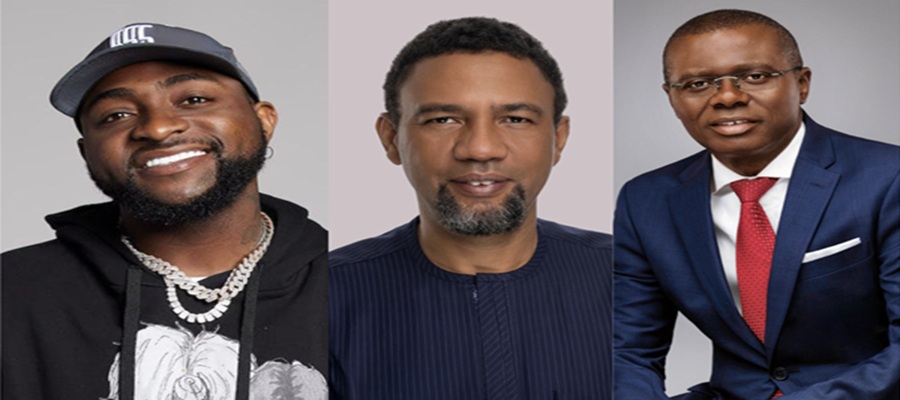
Most Influential People of African Descent (MIPAD) is excited to announce the Lagos Diaspora Experience 2025, a week-long celebration of African art, culture, innovation, and connection, culminating in the End of the Year Awards & Celebration on Sunday, December 21st, 2025, in Lagos, Nigeria.

The Most Influential People of African Descent Awards
This historic occasion marks the first time the world-famous Most Influential 100 Recognition & Awards Ceremony—traditionally held in New York on the sidelines of the United Nations General Assembly (UNGA)—will be hosted in Lagos, Nigeria.
The week will feature events such as Diaspora Day at the Fela Exhibition (Afrobeat Meets Diaspora), Cultural Heritage Day, and Business Leadership Luncheons, all culminating in the awards celebration.
The evening will honor the Best & Brightest of the Year, recognizing exceptional individuals and institutions whose work has advanced Global African Achievement and Black Excellence across business, government, media, culture, and technology.
Key Recognitions for 2025
– Governor of the Year & City of the Year: His Excellency Babajide Sanwo-Olu, Governor of Lagos State, honored alongside Lagos as City of the Year for its global leadership in culture, innovation, tourism, and diaspora engagement.
– Her Excellency Hannatu Musa Musawa, Minister of Art, Culture, Tourism and Creative Economy, will be honoured as Minister of the Year for her contribution to the creative economy’s role in nation branding and cultural diplomacy.
– Most Influential Woman of the Year: Olorì Atúwàtse III, Queen Consort of the Warri Kingdom
– Most Influential Man of the Year: Adewale Tinubu, Group Chief Executive, OANDO
– CEO of the Year: Karl Toriola, Chief Executive Officer of MTN Nigeria; who will deliver a keynote address, recognized for his transformative leadership and impact on Nigeria’s telecommunications and digital economy.
Others include; Karl Toriola of MTN as CEO of the year, Uche Pedro of Bella Naija as Lifestyle Personality Of The Year, Ojy Okpe of Artise News as Most Influential News Anchor Of The Year, Stephanie Busari as Media Executive of the Year, Kayode Okikiolu as Pressman of the year, Davido as Artist of the year and several others.
In celebrating this year’s honorees, Michael Ehindero, Managing Director, Pernod Ricard Nigeria, owners of Martell Cognac, who emerged as Brand Of The Year expressed deep appreciation for the brand’s continued global recognition, saying: “It’s a great reward for the team who’s delivered Martell excellently in Nigeria over the years.
“We say thank you to the teams, we say thank you to our consumers and we say thank you to MIPAD.
“Martell has a lot of promising experiences in the years to come in Nigeria and with this we invite you over to Nigeria to experience Detty December”.
The ceremony will also celebrate the achievements of the Class of 2025 Honorees, alongside past Nigerian honorees who were unable to attend their year of recognition in New York.
“For the first time, we’re bringing our world-famous recognition platform home to celebrate excellence within the Global Africa Family — right here in Lagos,” said Kamil Olufowobi, Founder & Chairman of MIPAD. “This is more than an event; it’s a movement uniting the best of us — connecting, collaborating, and working together to change the world.”
Event Details
📍 Lagos, Nigeria
– Friday, Dec 19 – #DettyDec Diaspora Day at Fela Exhibition FREE
– Sunday, Dec 21 – End of Year Recognition & Award Ceremony STRICTLY BY INVITATION
🎟️ RSVP: https://rsvp.oakenevents.com/mipad


Nigerian Copyright Commission (NCC) has called for urgent adoption of advanced digital protections after blocking seven piracy sites amid escalating online threats to Nollywood content.

The call was made during a webinar hosted by Greychapel Legal titled “Clicks, Streams, and Copyright: Who Owns Nollywood’s Digital Future?”, which brought together filmmakers, regulators, entertainment lawyers and media strategists to examine how content ownership and copyright enforcement are being reshaped by the digital age.
Lynda Alphaeus, director and head of the NCC Lagos Office, said the Commission has intensified its efforts to combat piracy across digital channels and is upgrading its operations to meet emerging threats.
According to her, Nigeria’s new Copyright Act was deliberately updated to strengthen creators’ rights amid the explosion of online distribution.
“NCC has worked, and is still working tirelessly to adapt Nigeria’s legal framework to cope with digital distribution challenges. We now have the power to block networks publishing illegal content, and we have already blocked seven websites distributing pirated Nigerian works,” Alphaeus said.
She revealed that the Commission has established a special taskforce known as the STOP Unit to coordinate anti-piracy operations online, alongside new awareness campaigns targeting local markets and schools to educate content creators and the public on copyright obligations.
Alphaeus urged filmmakers and producers to take ownership of their digital safety by deploying available technological protections to safeguard their intellectual property.
She explained that tools such as encryption help prevent unauthorised copying, blockchain technology offers immutable proof of ownership, digital watermarking allows creators to trace illegal uploads, while cloud security and regular offline backups protect creative files before they reach the market.
While noting that copyright in Nigeria does not legally require registration, she stressed that registering one’s work strengthens protection and provides legal presumptions that can be vital in enforcement.
“Whatever you register is presumed to be yours until proven otherwise,” she said, urging creators to invest in copyright knowledge as part of their business strategy.
Other speakers at the webinar reinforced the urgency of protecting Nollywood’s digital assets.
James Omokwe, film director, noted that while streaming platforms have created unprecedented opportunities for visibility and monetisation, they have also opened new vectors for intellectual property theft and unauthorised redistribution.
Solafunmi Laelle, media strategist, added that audience data, which streaming platforms rely heavily on, will increasingly determine leverage and value in film licensing negotiations.
According to her, creators who lose control of their intellectual property, whether through piracy or unfavourable contracts, also lose access to valuable data that could shape their long-term earnings.
Nky Ofeimun, entertainment lawyer, emphasised the need for creators to understand the contractual implications of ownership, platform exclusivity, and reversion rights.
She noted that many filmmakers still underestimate how quickly digital copies can be illegally duplicated or uploaded once control is lost.
The panelists agreed that as Nollywood deepens its digital footprint, piracy will continue to evolve and become more sophisticated.
They stressed that the industry must respond with equally sophisticated tools, stronger contract negotiation, and improved education around copyright.

PalmPay Launches N400 Million World Travel Carnival, Rewarding Users with Free Global Trips

Nigeria Takes the Lead in the Global WSIS+20 Digital Agenda

Qualcomm Completes Third Edition of Make in Africa Startup Mentorship Program

FirstCap Acts as Joint Issuing House on Veritasi Homes & Properties Plc’s ₦30 Billion Bond Programme

Fynd Expands Global Footprint, Adds Africa With Surtee Group Partnership

Nigeria Records Highest Weekly Cyberattacks in Africa — Report

Hackers Breach Phones of Dangote and Otedola, Demand Ransom

Cyber Tsunami Hits Nigeria as Breaches Surge 1,047%, esentry Q3 Report Reveals

MTN Nigeria Has Invested Over ₦32.23 Billion in National Priorities Through Its Foundation

Group Deepens Digital Rights Advocacy in Ghana Through Judicial Training and Policy Dialogue




 News2 days ago
SiBAN New Executive Council to Champion Vision for Nigeria’s Digital Economy

 Broadcasting3 days ago
Davido, Babajide Sanwo-Olu, Karl Toriola, Others To Be Honoured At The Most Influential People of African Descent Awards In Lagos

 General News2 days ago
NITDA DG Calls for Innovation-Led Economic Rebirth @ Kano Startup Weekend

 E-Financial2 days ago
Tax Reform or Financial Exclusion? The Trouble with Mandatory TINs

 Telecom2 days ago
NCC Blames NOGASA for Abuja Outage

 Telecom1 day ago
Airtel Africa Partners Starlink to Launch Direct-to-cell Service in 14 Markets

 News2 days ago
APC National Chairman Appoints Mr. Abimbola Tooki as Special Adviser on Media

 E-Business1 day ago
Check Point Reveals Nigeria as Second Most Targeted African Country for Cyberattacks in November