

E-Business
NIMC Says Over 100m Nigerians Have no Form of ID

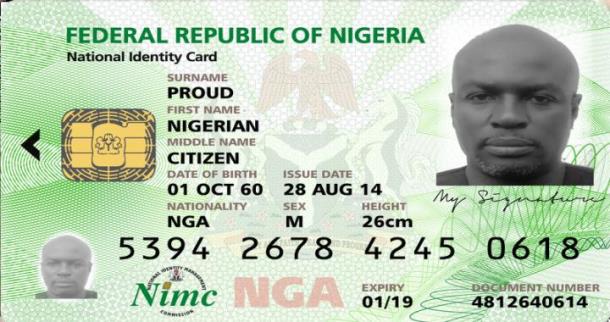
Over 100 million Nigerians have no identity, according to Mr Aliyu Aziz, director-general, National Identity Management Commission (NIMC).

Aziz, who made the disclosure during a zoom meeting with editors, said that “These include the poorest and the most vulnerable groups, such as the marginalised – women and girls, the less-educated people, migrants, refugees, asylum seekers, stateless persons, people with disabilities and people living in rural and remote areas”
Aziz spoke on the topic: “Strategic Roadmap for ID Development’’, adding that “The estimated population of Nigeria stands at 200 million. Only about 38 percent of the population have any form of ID,’’.
According to the NIMC boss, the commission has enrolled and issued 41.5 million unique identifiers, known as National Identification Numbers (NIN), since the commencement of identity registration and enrolment in 2012.
According to him, the commission registers all Nigerian citizens physically present and those outside Nigeria as well as the legal residents
“Between 2012 till date, only 41.5 million citizens and legal residents have been enrolled into the National Identity Database (NIDB) and issued unique NIN, an average of 5.2 million enrollments per annum.
“At this rate, it will take a long time to enroll the remainder of the people currently living in the country today, and by that time, about 292 million more people would have been added.
“Hence the need for a strategy to enroll the backlog within the shortest possible time. And that is the reason for the idea of strategic roadmap and the birth of the ecosystem approach,’’ he said.
Aziz said that while the identity card could expire, the National Identification Numbers (NIN) issued was for a lifetime.
He stressed the need for people to be registered for documented identity, saying it mattered a lot, especially for development.
“Identity matters a lot for development, as inclusive and trusted ID systems can help achieve the goals of empowering individuals and enhancing their access to rights, services and the formal economy.
“It helps in strengthening transparency, promoting efficiency and effectiveness in governance, service delivery and accountability.
“It also supports private sector development and service delivery, grows digital economy as well as regional and global integration as well as generates reliable data.
“Good ID system supports development goals, including access to finance, gender and equality, empowerment, access to basic health and education services, child protection, migration and labour market opportunities, improved access and quality of social protection as well as governance,’’ he said.
Aziz said that people were registering more in Lagos, Abuja, Kaduna and Kano compared with other cities, while residents in states in the South-East appeared to show little interest in the identity capturing.
The NIMC director-general said that the commission had entered strategic partnerships with the News Agency of Nigeria (NAN), National Orientation Agency (NOA), Nigerian Television Authority (NTA) and other media agencies to sensitise Nigerians on the importance of identity registration.


E-Business
Offset Communications Slams N50m Suit against Qore Technologies for Alleged Copyright Infringement


Offset Communications Advisory Ltd has dragged Qore Technologies Ltd before a Federal High Court in Lagos, demanding the sum of N50 million as damages for the alleged infringement of its copyright.

Pic credit….https://copyrightalliance.org
Offset, in the suit marked: FHC/L/CS/1994/2025, is claiming that Qore used content from a proposal it submitted in December 2022, without formal engagement, attribution, or a licensing agreement.
“The Defendant’s execution of the content of the proposal submitted to it by the Plaintiff without any formal engagement, attribution or a licensing arrangement… amounts to an infringement of the Plaintiff’s copyright,” Offset stated in its writ of summon.
The suit filed on September 29, 2025, by Jimoh Bamigbola and Omobolaji Idris, on behalf of the plaintiff has Qore as sole defendant.
Plaintiff, a Lagos-based communications firm, in its statement of claim said it a had previously worked with Qore on Public Relations (PR) projects and was later asked to prepare a communications strategy for the company, adding that the said proposal contained ideas on employee engagement, branding, and stakeholder management.
Offset however, alleged that Qore implemented elements of the proposal, including internal communication initiatives and branding concepts, without payment or agreement.
“The Defendant executed and integrated the propositions into its Public Relations and Communication Strategy without any formal engagement… with the Plaintiff,” the statement of claim read.
The plaintiff said it discovered the alleged infringement in April 2025 and subsequently notified the defendant, but efforts to resolve the dispute failed.
It is seeking, among other reliefs, a declaration that the defendant’s actions amount to copyright infringement, N50 million in general damages, N5 million in litigation costs, 29 percent post-judgment interest, and “an order of perpetual injunction, restraining the Defendant… from further infringing on the Plaintiff’s copyright.”
Qore Technologies, however, denied the allegations in its statement of defence, arguing that the plaintiff was only engaged for limited Public Relations support services on a project basis and was paid for those services.
“The Plaintiff merely provided routine and secondary Public Relations support services… for which the Plaintiff was remunerated,” the defendant stated.
Qore further argued that the ideas referenced by the plaintiff are not protected under copyright law.
“The alleged ‘ideas’… consist of generic corporate communication practices widely used by companies… and cannot constitute original copyrightable works under Nigerian law,” it said.
The company also maintained that no binding agreement existed regarding the proposal and that its branding and communication strategies were developed internally and by its consultants.
In addition, Qore challenged the competence of the suit, stating that “the Statement of Claim discloses no reasonable cause of action” and that the court lacks jurisdiction to entertain the matter.
The defendant also filed a counterclaim, seeking N6.35 million as reimbursement for legal fees incurred in defending the suit, as well as N2 million in costs.
At the hearing on March 23, 2026, counsel to the parties identified their processes, and the court adjourned the matter to June 22, 2026, for further proceedings.
The case is expected to test the boundaries of copyright protection in Nigeria’s Communications and Public Relations industry, particularly regarding the ownership of proposals and business ideas.

Nigeria Data Protection Commission (NDPC) said it is carrying out an investigation into alleged data breaches involving Remita Payment Services Ltd., Sterling Bank and other entities.

A statement on Sunday issued by Babatunde Bamigboye, head, Legal, Enforcement & Regulations, NDPC, said in line with the Commission’s procedure, Notice of Investigation was duly served on the 1st of April, 2026.
Bamigboye said relevant parties and individuals have been providing information for the purpose of addressing the incident.
“The aim of the investigation is to ensure that data subjects are protected with appropriate technical and organisational measures.
“The investigation by NDPC covers, among others, the types of personal data involved, the nature and scope of the alleged breach, the risk to data subjects and the mitigation measures carried out where a breach is confirmed,” he explained.
Vincent Olatunji, Commission’s National Commissioner/CEO, has directed that organisations that employ digital payment systems without putting in place appropriate technical and organisational measures as mandated under the Nigeria Data Protection Act, 2023 (NDP Act), will also be examined as part of a wider effort to ensure the integrity of the ecosystem.


Federal Government has unveiled plans to establish a National Cybersecurity Coordination Council, signaling a shift toward a more unified, intelligence-driven approach to defending the country’s rapidly expanding digital economy.

Conceived as a non-statutory, multi-stakeholder body, the proposed Council will enhance coordination, enable trusted information sharing, and guide government strategy on cybersecurity, risk management, and national response amid increasingly complex cyber threats.
The initiative, championed by Bosun Tijani, minister of communications, innovation and digital economy, is designed to bring together government institutions, private sector players and technical experts into a single collaborative platform to strengthen the country’s cyber resilience.
Tijani noted that this initiative comes in response to a wave of recent cyber incidents that have disrupted operations across key private institutions and public sector.
In recent times, Nigeria’s financial system has faced mounting cyber pressure, reflecting global trends as cybercrime is projected to cost the world over $10.5 trillion annually, according to Cybersecurity Ventures.
Analysts say these attacks are increasingly coordinated and sophisticated, prompting the government to recognise that fragmented, institution-specific approaches can no longer manage systemic cyber risks effectively.
Under the new framework, the government aims to promote a “collective defence” model, an approach widely adopted in advanced digital economies where threat intelligence is shared in real time across institutions.
The Council is expected to include chief information security officers, cybersecurity associations, the Nigerian Computer Society, global technology providers, researchers, law enforcement agencies and civil society groups, ensuring a broad-based and technically grounded response architecture.
Key priorities will include developing national threat intelligence-sharing systems, harmonised cyber defence protocols, and coordinated incident response, while strengthening capacity to close Nigeria’s cybersecurity talent gap.

Offset Communications Slams N50m Suit against Qore Technologies for Alleged Copyright Infringement

Compensation for Poor Service Quality is Automatic- NCC

SERAP Sues CCB over Electoral Act, New Tax law

Tinubu Approves N3.3 Trillion Payment Plan to Boost Power Supply

NDPC Investigates Remita, Others over Alleged Data Breaches

Spotify’s Loud & Clear Report Reveals Over ₦60Bn Revenue for Nigerian Artists in 2025

Madonna University Taps Tech Guru Adote for Strategic Board Role

China Threatens to Shut Nigeria’s Satellite Over $11.44m Unpaid Debt

Healthcare Under Attack: Why Cybersecurity is Now Critical Care

Why JustMarkets Is a Strong Choice for Gold Trading




 General News2 days ago
FG, Others Say Nigeria Wastes 38m Tonnes of Food Annually

 E-Financial2 days ago
CBN, Banks, Fintechs Launch PSPC to Boost Nigeria’s Payment System

 News2 days ago
NITDA Strengthens Collaboration with NIPSS to Drive Digital Innovation, Orange Economy Growth

 E-Financial2 days ago
CycleFlow, IFC Launch Supply Chain Finance Platform in Nigeria

 E-Financial2 days ago
Anchor Gets Nigerian, Canadian Licences as Transactions Crosses $2.5Bn

 E-Financial2 days ago
Ecobank Assures of Seamless Easter Banking Services

 News2 days ago
NRS Takes Over Mineral Royalties Collection Under New Tax Laws

 E-Financial2 days ago
N4.65 Trillion in the Vault, but is the Real Economy Locked Out?