

Telecom
NITDA Collaborates With Nigeria Police on NPDR Enforcement

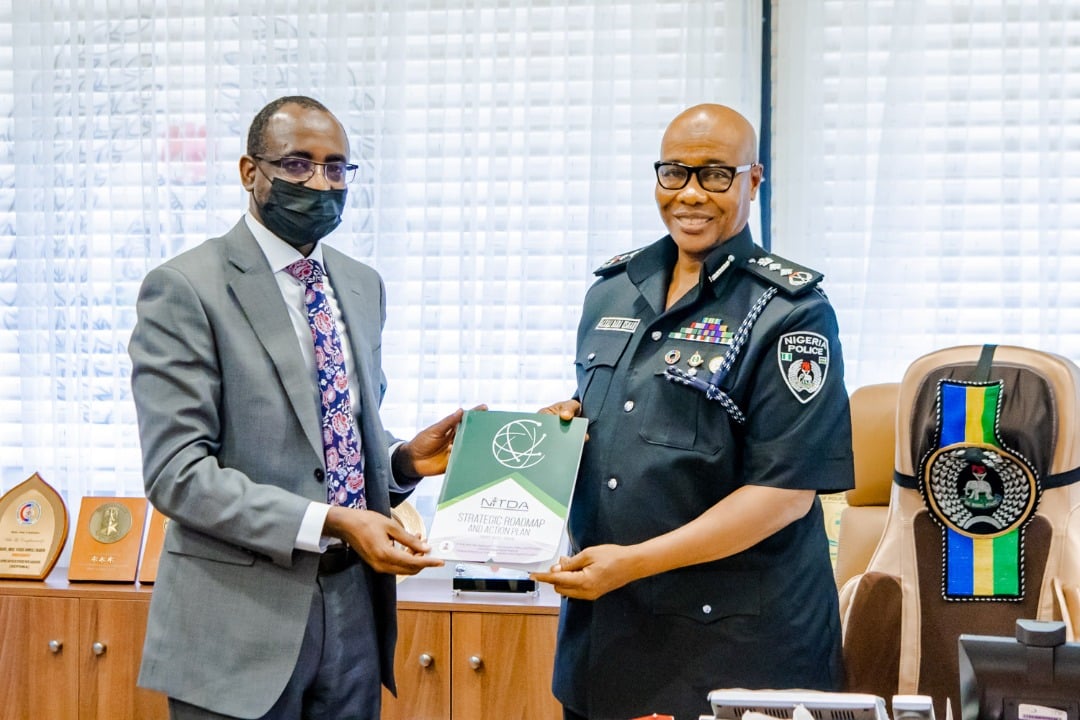
The National Information Technology Development Agency (NITDA), expressed willingness to collaborate with the Nigeria Police Force to ensure that public and private organizations comply with the Nigeria Data Protection Regulation (NDPR), to protect citizens’ personal information, tackle the menace of cybercrimes, and encourage safer use of Internet amongst individuals, public, and private organisations in the country.

L-R: Mallam Kashifu Inuwa Abdullahi, Director General, NITDA and Usman Alkali Baba, Inspector General of Police, IGP during a courtesy visit at Louis Edet House, Force Headquarters, Abuja.
Kashifu Inuwa Abdullahi, director general, NITDA, hinted this when he led his management team to a courtesy visit on the Inspector General of Police, IGP Usman Alkali Baba, yesterday at Louis Edet House, Force Headquarters, Abuja.
Abdullahi said cybersecurity has become very essential in today’s world where society is more reliant on digital technology than ever before, and the sophistication and relentless attacks of cybercriminals are incomparable.
According to him, there is apparently no sign that this trend will slow down anytime soon. Therefore, there is a need for the collaboration between NITDA and the Force to tackle the menace by ensuring that organizations protect the personal information of all citizens at their disposal.
The DG lamented that in recent times, private individuals, private organisations, government establishments, and even military and paramilitary have all been targets of these acts, mostly because there is a high rate of data leakage on the internet.
“Reports from our cybersecurity monitoring platforms have indicated that activities of cybercriminals have increased exponentially; data leakage that can lead to identity theft is now being posted on social media and even auctioned for sale on the dark web.
“It is important to note that this is a global phenomenon, nations around the world are reporting increasing numbers of cyber espionage, BEC Scams, Identity theft, amongst numerous other cybercrimes,” he noted.
Abdullahi added that the borderless nature of cyberspace has necessitated NITDA to be a step ahead of these cybercriminals, especially as the country begins to adopt a digital economy, hence it is important that Nigeria build resilience against these threats to ensure trust in the system.
While commenting on laws that empower the Agency, particularly NITDA Act 2007, Abdullahi stated that NITDA is increasingly paying attention to cybercrime and cybersecurity, and this led establishment of NITDA’s Computer Emergency Readiness and Response Team (CERRT) to provide support for MDAs in tackling cybersecurity incidents through prompt awareness, cybersecurity tips, monitoring intrusion, leveraging trusted resources, and implementing a response plan for MDAs.
He further stated that the Agency publishes Information Assurance Guidelines for MDAs towards ensuring that MDAs implement the minimum controls required to safeguard their information assets; and the enactment of Nigeria Data Protection Regulation (NDPR) that ensures that personal data of data subjects are protected. Also, that mechanisms are set in place to ensure that violations to NDPR provisions are appropriately investigated and appropriate sanctions applied.
He appreciated the support offered by the Force by attaching Officers to the NITDA Regulations Compliance Monitoring Team.
Explaining NITDA’s mandate on IT Project Clearance, the DG stated that the Federal Government Circular issued on 18th April 2006 specifically directed all MDAs planning to embark on IT projects to obtain clearance from NITDA. This was subsequently reinforced by another Circular issued on the 31st August 2018.
To reiterate the importance of NITDA’s role in IT Procurements in Government, during his speech at the e-Nigeria International Conference, Exhibition and Awards 2018, Muhammadu Buhari directed all Federal Public Institutions (FPIs) to ensure that their IT projects are duly cleared by NITDA, and directed that defaulters should be reported to the government for sanctioning.
Abdullahi also sought for the Force’s support towards ensuring that young Nigerians with genuine IT businesses are allowed to operate and, where necessary, adequately support in carrying out their lawful businesses.
“The critical role of Startups in our journey towards a Digital Nigeria cannot be overemphasized. However, some Tech startups have reported being harassed by some Law Enforcement Agencies, with some having their IT systems confiscated.
“This has negatively impacted their business operations as well as the economy. NITDA maintains a database of genuine Startups with verifiable business ventures and duly registered with the Agency. Access to such a database can be granted to the Force when the need arises,” he explained.
The IGP Usman Alkali Baba, appreciated NITDA’s visit to the corporate Headquarters of NPF and assured DG of the Force’s support towards realising the Agency’s mandate.
He also reiterated the need for synergy and collaboration with NITDA, stating that no organisation can effectively operate without leveraging digital technologies and NITDA being the IT regulator in the country, is central to the activities of the Force.


Lebara Nigeria has launched the Agent Registration Portal (ARP), a new digital onboarding platform designed to accelerate the expansion of its retail and point-of-sale (POS) network nationwide.

Through the Agent Registration Portal, Lebara aims to create awareness, build trust and credibility within the retail channel, create opportunities for Nigerians to register and become Lebara partners, and position the brand as a modern, digitally driven, and opportunity – focused telecom operator.
With the introduction of the Agent Registration Portal, alongside its earlier customer-focused digital tools, Lebara Nigeria is designed to empower SMEs, independent distributors, SIM sellers, and retailers nationwide by removing traditional barriers to entry and enabling compliant, digital-first onboarding at scale.
Also, positioning itself as a digitally driven telecom entrant, focused on speed, compliance, and nationwide reach as it prepares for full-scale operations across the country.
The rollout comes as part of a national onboarding campaign running from January to March, 2026, targeting both low-scale retail agents and high-scale distributors.
Through the portal, Lebara aims to rapidly grow its digital and physical presence across Nigeria while ensuring all partners meet required compliance and verification standards
The Agent Registration Portal is accessible via the Lebara Nigeria website and allows prospective agents and distributors to complete the entire onboarding process online.
Once approved, partner locations are activated as Lebara POS outlets, trained and authorized to sell Lebara starter packs, data bundles, vouchers and other Lebara Nigeria products and services.
The launch builds on Lebara Nigeria’s earlier digital initiatives ahead of its full market entry.
Prior to the Agent Registration Portal rollout, the company introduced a Number Registration Portal, enabling prospective customers to select and reserve preferred phone numbers before the network goes live.
The service allows users to secure personalised numbers such as memorable dates, culturally significant digits, or easy-to-recall patterns through a simple online process, giving customers early control over their mobile identity.
The Agent Registration Portal onboarding process follows a structured flow from account creation and document upload to compliance checks, verification, approval, and activation. Applicants are required to submit details such as National Identification Number (NIN), valid government-issued ID, Tax Identification Number (TIN), and address information. Where all documentation is complete, onboarding can be completed within 30 minutes, after which applicants receive email confirmation and next steps.
Commenting on the launch, Mary O. Akin-Adesokan, Chief Operating Officer of Lebara Nigeria, said the portal is central to the company’s operational and growth strategy in the country.
“The Agent Registration Portal is a key part of our strategy to scale Lebara’s retail presence nationwide. It allows us to onboard partners faster, ensure full compliance, and provide both small retailers and large distributors with a transparent and reliable way to do business with Lebara.
“Together with our earlier Number Reservation Portal, it demonstrates our commitment to using digital innovation to simplify access, empower partners, and enhance the overall telecom experience,” she said.

MTN Nigeria CEO Karl Toriola has declared that the era of outsiders telling Africa’s story is over, positioning the continent as a global powerhouse of authors, architects, and innovators.

MTN Nigeria
Toriola made the remarks while accepting the ‘CEO of the Year’ award at the 2025 Most Influential People of African Descent (MIPAD) Recognition Ceremony in Lagos.
“For decades, stories about Africa were told about us, but rarely by us,” he said, rejecting outdated narratives of conflict and need. “We are no longer the subjects of the story; we are the authors. Africa’s time is now.”
He spotlighted African talent now leading global organisations, alongside Afrobeats and art reshaping world culture, drawing the Diaspora home with investments, not just emotions.
Toriola anchored his vision in MTN Nigeria’s journey, recalling a time when Nigeria’s 120 million people shared fewer than 500,000 telephone lines. “When MTN entered in 2001, analysts said Nigerians were too poor for mobile phones. They were wrong. They underestimated the Nigerian spirit,” he said.
From that first call in May 2001, MTN has connected over 84 million subscribers, building Nigeria’s “digital nervous system.”
He described Nigeria as uniquely investable due to its resilience and scalability, dedicating the award to MTN’s “real heroes”—engineers scaling masts and frontline customer service staff.
As MTN marks 25 years in 2026, Toriola pledged: “We are going nowhere. We are rooted in the soil of Nigeria and Africa.” He urged global elites to become the continent’s “Most Impactful Builders.”


Modern messengers, such as WhatsApp, Telegram, Signal and others, are often used for illicit purposes. Kaspersky Digital Footprint Intelligence has conducted an in-depth monitoring of over 800 blocked cybercriminal Telegram channels between 2021 and 2024.

While a range of illegal activities continues to be hosted on the platform, its environment has become noticeably more challenging for sustained underground operations.
Telegram’s bot framework and other built-in features make for a low-effort ecosystem for the underworld.
A single bot can simultaneously manage queries, process cryptocurrency payments, and instantly deliver stolen bank cards, info-stealer logs, phishing kits, or DDoS attacks to hundreds of buyers per day, often without operator involvement.
Unlimited, non-expiring file storage eliminates the need for external hosting when distributing multi-gigabyte database dumps or stolen corporate documents. This frictionless automation naturally favours high-volume, low-price, low-skill offerings, such as leaked bank cards or other data, hosting malware, etc.
High-value, trust-dependent deals (for instance, zero-day vulnerability information) still remain on reputation-gated dark-web forums.
Kaspersky researchers found two clear trends related to illegal activities on Telegram. The average lifespan of shadow channels has increased, with the proportion of channels surviving over nine months more than tripling in 2023-2024 compared to 2021–2022. At the same time, Telegram’s blocking activity has risen significantly.
Monthly takedown figures recorded since October 2024 – even at their lowest – are comparable to the peak levels seen throughout 2023, and the overall pace continued to accelerate in 2025. This impedes malicious activities.
Other disadvantages of Telegram for cybercriminals include the lack of default end-to-end (E2E) encryption for chats, the inability to use their own servers for communication (due to the messenger’s centralised infrastructure), and closed server-side code, which makes it impossible to verify its functionality.
As a result, several established underground communities, including the nearly 9,000-member BFRepo group and the Angel Drainer malware-as-a-service operation, have already begun shifting primary activity to other platforms or proprietary messengers, citing repeated disruptions of their activities on Telegram.
“Fraudsters find Telegram a convenient tool for many malicious activities, but the risk-reward balance is clearly shifting. Channels are managing to stay online longer than a couple of years ago, yet the dramatically higher volume of blocks means operators can no longer count on long-term stability.
“When a storefront or service disappears overnight – and sometimes reappears only to be removed again weeks later – building a reliable business becomes much harder. We’re starting to see the early stages of migration as a direct consequence,” comments Vladislav Belousov, Digital Footprint Analyst at Kaspersky.

How Crypto Criminals Stole $700m from People – often Using Age-Old Tricks

Lebara Launches Agent Registration Portal

Nigeria Processed $92.1Bn Crypto Transactions in 12 Months — PwC

Tax Ombudsman will Save Nigerians Money, Time – CEO

Elon Musk Seeks $134Bn from OpenAI, Microsoft for ‘Wrongful Gains’

Banks quietly move to enforce new ₦50 transfer levy from Jan. 1

FIRS says NIN, CAC Numbers to Serve as Tax IDs from 2026

FIRS Declares NIN, CAC Numbers as Tax IDs from 2026

US Begins Partial Visa Ban on Nigerians January 1

Galaxy Backbone Tops FG’s Website Performance Ranking




 E-Financial3 days ago
SEC Hikes Minimum Capital Requirements for Market Operators After a Decade

 Telecom3 days ago
Study Shows Blocks in Telegram are Pushing the Underground Out

 News3 days ago
Nigeria Off EU High-Risk Money Laundering List in Major Financial Win

 News3 days ago
NGX Unveils Net-Zero Plan for Greener Capital Market

 Telecom3 days ago
Vodacom Crowned Africa’s Top Employer 3rd Year Running on Innovation, Ethical AI

 Telecom3 days ago
Galaxy Backbone Marks Two Decades of Powering Nigeria’s Digital Evolution

 Telecom3 days ago
Galaxy Backbone Marks 20 Years, Tops FG Website Scorecard

 E-Financial12 hours ago
Here Are Nigerian Banks That Have Secured Their Licences