

General News
Pantami Takes Digital Economic Agenda to Minna

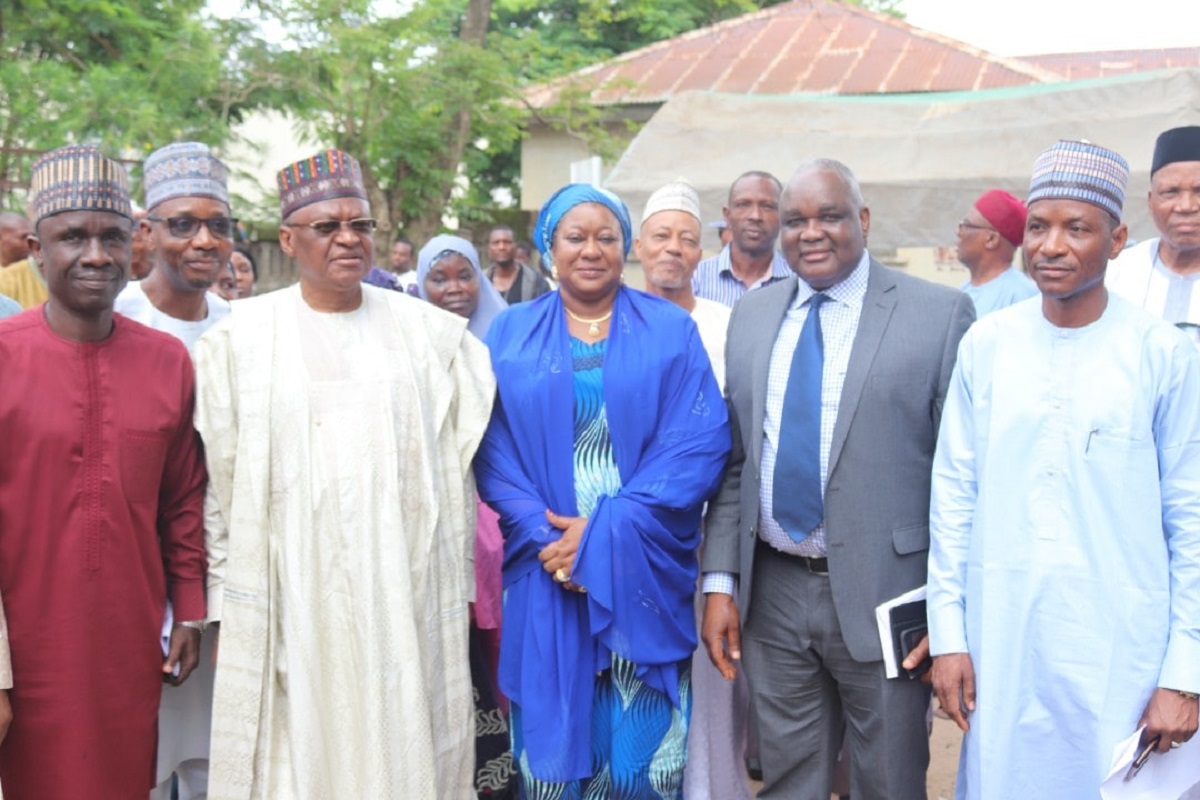
The Federal Government’s agenda to transform the country to a robust digital economy, became the focal point in the message of Prof. Isa Ibrahim Pantami, minister of Communications and Digital Economy, who was the special guest at the weekend commissioning of a ‘Digital Nigeria Centre’ at the Father O’Connel Science College, Minna, Niger State.

Hosted at the occasion by the college community led by its old student and Minister of State for Foreign Affairs, Ambassador Zubairu Dada who facilitated the project executed by the Universal Service Provision Fund, USPF, Pantami said through diligent implementation of the digital economy agenda, Nigeria has the potential of critical mass of ‘digital natives’ that can transform the country into a regional and global digital powerhouse.
“With the tools being provided through the DNC, creative Nigerians can play a key role in the creation of digital jobs across all sectors of the country. Such jobs are either based on or are dependent upon Information and Communications Technologies (ICTs),” he said.
The Minister who spoke through Mr. Reuben Muoka, director of Public Affairs of the Nigerian Communications Commission, NCC, said the current implementation of Nigeria’s National Digital Economy Policy and Strategy (NDEPS), 2020-2030, emphasizes the importance of innovation and startup ecosystem to the development of Nigerian indigenous digital economy.
He said the DNC commissioned at the college targets students and youths among others, for skills acquisition in order to increase ICT literacy among school teachers and students; provide a platform for accessing online educational resources; equip students with ICT skills; facilitate ICT adoption in teaching and learning; and increase the pass rates in mathematics, English language and other science subjects.
Pantami who spoke to an audience that included Niger State’s Commissioner for Education, Hajiya Hanatu Jibrin Salihu, who represented the Governor of Niger State, advised the school to effectively utilize the DNC whose four components include ICT Tool component (made up of 40 desktop computers with embedded operating systems, server, printer, remote-controlled projector, high resolution scanner, and e-learning software) as well as the power structure, consisting of an inverter that comes with its charger, solar panels, batteries and automatic changeover.
“There is also a connectivity component, made up of routers, switches, and firewall for network protection, modem, fibre/microwave radio or Very Small Aperture Terminal (VSAT) and bandwidth for internet connectivity. Lastly, there is a non-ICT component constitutive of the furniture, cabinet, cooling systems, and allied appliances” he said.
The DNC, formerly known as School Knowledge Centre (SKC), has an overarching objective to carry out the Commission’s statutory mandate of expanding the frontiers of universal access and universal service by ensuring service provision to unserved and under-served areas of the Nigerian economy.
Since the modification of the project from SKC to DNC, the Minna project became the second to be commissioned after the first DNC located at Ijesa Muslim Grammar School, Ilesa, Osun State, was inaugurated in January, 2022.



Federal government of Nigeria has announced plans to connect schools across the country to reliable internet services as part of a major initiative aimed at strengthening digital learning and expanding access to modern educational tools.

The government said the programme will help equip students with the digital skills needed to thrive in a technology-driven global economy while ensuring that every Nigerian child has access to quality education comparable to global standards.
The development was disclosed in a statement issued on Wednesday in Abuja by Folasade Boriowo, director of Press and Public Relations at the Federal Ministry of Education Nigeria.
According to the statement President Bola Ahmed Tinubu directed Tunji Alausa, minister of Education, and Bosun Tijani, minister of Communications, Innovation and Digital Economy, to work together to implement the nationwide connectivity project.
Speaking during a high level meeting with stakeholders in Abuja, Alausa explained that the initiative builds on earlier connectivity efforts through the Nigerian Research and Education Network (NgREN), which previously supported broadband connectivity for tertiary institutions under a World Bank-funded project.
He noted that although the programme initially recorded significant progress in connecting universities and other tertiary institutions, the momentum slowed after the initial funding cycle ended, making a renewed and expanded strategy necessary.
The minister said the new effort aims to revive and strengthen the programme while extending connectivity across all levels of the education sector.
“Connectivity is not limited to broadband fibre alone. It also involves telecommunications towers, satellite systems and other digital infrastructure required to provide reliable internet access across the country,” Alausa said.
He revealed that the government is implementing major connectivity projects, including the deployment of about 90,000 kilometres of fibre optic broadband infrastructure, the installation of 3,700 telecommunications towers, especially in rural and underserved communities, and the expansion of satellite capacity to improve nationwide coverage.
According to him, the goal is to ensure that schools from primary to tertiary institutions are deliberately connected as broadband cables are deployed and towers installed across the country.
Alausa also said the meeting produced several concrete steps to accelerate connectivity within the education sector, including the expansion of the NgREN governing council to include representatives responsible for foundational and secondary education.
Two technical working groups have also been established to drive implementation one focusing on connectivity for tertiary institutions and another dedicated to foundational and secondary schools.
He expressed optimism that the first phase of the initiative would begin to deliver visible improvements within the next three months.
The minister added that improved connectivity would enable students and teachers to access digital learning platforms, global knowledge resources, and emerging technologies such as Artificial Intelligence (AI).
He further disclosed that the project would support the gradual transition of major national examinations to Computer-Based Testing (CBT), with plans for exams conducted by West African Examinations Council (WAEC) and National Examinations Council (NECO) to fully adopt CBT within the next two to three years, similar to the system currently used by the Joint Admissions and Matriculation Board (JAMB).
Also speaking, Tijani emphasized that technology-driven education cannot succeed without reliable internet connectivity.
He noted that although Nigeria hosts about eight international submarine internet cables the highest number in Africa the challenge lies in distributing that capacity inland through fibre networks capable of reaching communities nationwide.
“Most of the internet capacity enters Nigeria through submarine cables landing in Lagos, but without sufficient inland fibre infrastructure, that capacity cannot effectively reach schools and communities across the country,” he said.
Both ministers reaffirmed the government’s commitment to collaboration between the education and communications sectors to ensure that investments in digital infrastructure translate into improved learning outcomes for Nigerian students.


WhatsApp said yesterday it would allow parents to create accounts for pre-teens, restricted to messaging and calling, amid rising global concerns about the impact of social media and chat apps on children.

A number of countries around the world are now seeking to follow Australia, which last year became the first country to adopt a social media ban for teenagers because of mental health worries.
Messaging apps have also triggered concerns following hacking incidents where users were persuaded to divulge security verification and pin codes giving malicious actors access to personal accounts and group chats.
WhatsApp said the idea of parent-managed accounts came after feedback from parents, who wanted a messaging service tailored for under-13s.
“These accounts come with strict new default settings, parental controls and options for parents to guide their pre-teens’ (under 13s) first messaging experiences,” the messaging app said in a blog post.
“Once set up, these accounts are controlled by the parent or guardian who will be able to decide who can contact the account and which groups they can join. In addition, parents can review message requests from unknown contacts and manage the account’s privacy settings,” it said.

House of Representatives Committee on Finance has given the Federal Airports Authority of Nigeria (FAAN) two weeks to recover N18.98 billion owed to the Federal Government by foreign airlines operating in the country.

The directive was issued on Tuesday by the Committee Chairman, Rep. James Faleke, during an interactive session with FAAN officials led by the Managing Director, Mrs Olubunmi Kuku, as part of the committee’s ongoing revenue monitoring exercise.
Lawmakers expressed displeasure over what they described as the growing debt profile of international airlines, insisting that the situation was unacceptable in the face of government’s revenue needs.
Faleke said the accumulation of liabilities, despite clearly defined payment timelines for airport service charges, raised serious concerns about enforcement and compliance in the aviation sector.
In her presentation, Kuku explained that airlines using Nigerian airports are required to settle their service charges within two weeks.
She, however, disclosed that several operators had exceeded this window, with some liabilities ageing beyond 30 days, 90 days and, in certain instances, more than a year.
She put the total outstanding indebtedness of foreign airlines to FAAN at N18.98 billion.
According to her, the debts relate to statutory charges for services provided by FAAN and are largely processed through the International Air Transport Association’s (IATA) global settlement platform.
Airlines listed in the debt profile include Qatar Airways, Lufthansa, British Airways, Virgin Atlantic, KLM, EgyptAir, Ethiopian Airlines, Air France, Royal Air Maroc, Turkish Airlines and Africa World Airlines.
She said Qatar Airways and Lufthansa each owe about N1.5 billion, Virgin Atlantic about N1.35 billion, while KLM, EgyptAir and Ethiopian Airlines each owe over N1 billion.
Other carriers, including Air France, Royal Air Maroc, Turkish Airlines and Africa World Airlines, carry liabilities ranging between N700 million and N1 billion.
Committee members queried why FAAN allowed the debts to accumulate beyond the stipulated two-week payment period.
One lawmaker asked why airlines that defaulted were neither sanctioned nor barred from operating at Nigerian airports, and whether late payments attracted interest charges.
Members warned that persistent delays in settling obligations could amount to negligence and undermine the integrity of government revenue collection.
Responding, Kuku said international airline payments often pass through IATA’s central clearing system used globally for ticketing and financial settlements, which can create delays beyond FAAN’s direct control.
She stressed that FAAN closely monitors ageing of debts, steps up engagements with airlines once liabilities exceed 30 days and applies stronger enforcement measures when debts cross 90 days.
She added that the authority had, in some instances, grounded defaulting airlines, particularly domestic operators that do not operate under the same global credit structure as foreign carriers.
Unsatisfied, the committee directed FAAN to furnish it with detailed addresses and documentation of all indebted airlines and warned that the affected carriers would be invited to appear before the House if they failed to clear their debts within the two-week deadline. “We need every kobo that belongs to this country,” Faleke said, adding that any airline found violating its financial obligations to Nigeria would be held accountable.
Foreign airlines operating in Nigeria are required to pay passenger service charges, landing and parking fees, aeronautical charges and other operational levies for the use of airport facilities and services.
Lawmakers have repeatedly argued that while the IATA settlement structure is global, it should not be used as justification for prolonged delays in remitting monies owed to Nigerian agencies.
The latest directive by the House Committee on Finance forms part of wider National Assembly efforts to strengthen revenue collection, block leakages and shore up government income, especially from strategic sectors such as aviation.

How Africa Can Turn the AI Wave into Inclusive Growth

CBN Directs Banks to Activate Anti-Money Laundering Systems

FG to Connect Schools Nationwide to Internet – Education Minister

FG Moves to Strengthen Children’s Online Safety

WhatsApp Launches Parent-managed Accounts for Pre-teens Amid Safety Concerns

Dr. Cairo Ojougboh Foundation Bolsters Nigeria’s Education Drive with ₦2.7m Student Support

Kaspersky Brings more Transparency to Threat Detection with New Hunt Hub

Kaspersky Discovers New Phishing Campaign Exploiting Google Tasks Notifications to Steal Corporate Credentials

esentry 2025 Report Shows Healthcare, Financial Services and Telecoms as Staging Grounds for Increased Cyberattacks in Africa

AfDB, UNDP Launch $10Bn AI Initiative for Africa




 General News3 days ago
Zedvance Hits ₦96bn Lending Milestone, Eyes ₦250bn Target in 2026

 Broadcasting3 days ago
Madonna University Taps Tech Guru Adote for Strategic Board Role

 News3 days ago
Another Oil Boom: Will Nigeria’s Government Turn Windfall into Growth or Squander it?

 Telecom3 days ago
Starlink Rolls Out V2 Satellites for Direct 5G Connectivity to Smartphones, Eyes Nigeria’s Rural Gaps

 Telecom3 days ago
Education Priorities to Help Young People Shape Africa’s Future

 E-Financial3 days ago
First Asset Management Secures Ratings Upgrade

 Telecom2 days ago
US Court Dismisses All Claims Against Binance in Major Anti-Terrorism Lawsuit Victory

 Broadcasting3 days ago
Healthcare Under Attack: Why Cybersecurity is Now Critical Care