

Broadcasting
Pinnacle, GatesAir Ink Pact on Expanded Digital TV Switch Over

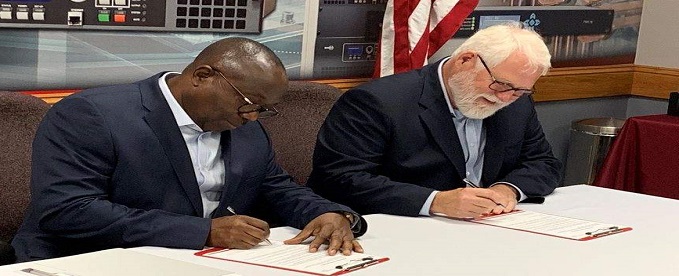
Pinnacle Communications, Nigeria’s leading digital broadcast technology company has signed an agreement with GatesAir, top American firm, to continue the digital TV build-out across the nation.
The agreement with GatesAir, which produces wireless, over-the-air content delivery solutions for radio and TV broadcasters, will allow the expansion of new digital TV services and the Digital Switch-Over initiative.
The expansion is expected to reach more than 50 million homes and 170 million residents.
The licensed signal distributor for the DSO in Nigeria, Pinnacle Communications, brought a delegation to the GatesAir’s Quincy’s manufacturing facility in the US last Friday to see the next-generation product designs and readiness to complete greenfield build-outs.
GatesAir has had a relationship with Pinnacle Communications since 1998 to launch TV and FM radio systems across Nigeria.
Sir Lucky Omoluwa, chairman and CEO of Pinnacle Communications, highlighted his company’s long relationship with Gates-Air, especially the quality.
“Sometime in 2016, we had 12 weeks to deliver a station,” Omoluwa said.
“All the transmitters were from here. We didn’t do any site testing. We just plugged them in, and they’re still on.”
Bruce Swail, GatesAir CEO said half of the products GatesAir produces are for international customers.
“The broadcasting technology created and built here in Quincy has a huge transformative impact across the globe, and as a result, a lot of people around the world are grateful to Quincy.”
Andy McClelland, Gates Air’s managing director for the Europe/Middle East/Africa Region, said GatesAir has been on the digital path with Pinnacle for a short time, but will be on it for years to come.
“A state-of-the-art, digital, terrestrial television platform being rolled out in the heart of Africa that can by the envy of not only Africa but of Europe,” McClelland said.
Quincy Mayor Kyle Moore told the group that he was proud to see GateAir’s partnerships around the globe.
“They have the ability to deliver on very large programs with the upmost integrity,” Moore said. “With 97 years of history in our community, you have chosen the right partner to support your efforts of the digital switch over in Nigeria.”



MultiChoice has said that it will not implement its customary yearly price increase on DStv and GOtv subscriptions.

This is the first time the Pay-TV company will not be adjusting its price in April, as it has in previous years, signalling a clear shift in direction under its new owner, Canal+.
The decision, confirmed by David Mignot, group chief executive,MultiChoice in an interview with TechCentral, comes as the pay television operator grapples with steep subscriber losses across its markets.
For many households accustomed to annual April tariff adjustments, the announcement will be a welcome break.
Responding to questions about whether DStv prices would rise in April as they have in previous years, Mignot gave a firm response: there will be no increase.
He explained that the company’s immediate focus is on rebuilding its subscriber base, making this an unsuitable period to adjust prices upward.
He added that while there are no current plans for a price hike, the company has not completely ruled out adjustments later in the year, especially if economic conditions demand it, such as significant currency movements.
MultiChoice has historically reviewed and raised DStv subscription fees in April, often citing inflationary pressures and rising content costs. As recently as April 2025, bouquet prices were adjusted upwards by between 2.1 per cent and 7.9 per cent.
The DStv Premium package rose from R929 to R979 per month, while DStv Access, the entry-level satellite package, recorded one of the steepest increases.
This year’s pause represents a break from that pattern and forms part of a broader reset following Canal+’s acquisition of MultiChoice in September 2025.
Mignot, who brings three decades of experience in the pay television industry, summed up his mission in simple terms: halt subscriber losses and return the business to growth.
The urgency behind the move is evident in MultiChoice’s recent performance.
The group has lost 2.8 million linear broadcasting subscribers in the two years ended 31 March 2025, with roughly half of those losses occurring in South Africa.
In the financial year to end-March 2025 alone, MultiChoice shed 1.2 million subscribers, representing an eight per cent year-on-year decline and leaving the group with 14.5 million active customers.
The previous year saw an even steeper drop of 1.6 million subscribers. By June 2025, Canal+ indicated that the pace of decline had intensified further.
The financial impact has been significant. Revenue for the year ended 31 March 2025 declined by R4 billion to R52 billion, while trading profit fell sharply by 49 per cent to R4 billion.
According to Mignot, the company’s difficulties stem less from its programming slate and more from weaknesses in its commercial execution.
He argued that in subscription businesses, a churn rate of between 12 and 15 per cent annually is inevitable as customers relocate, experience job losses, adjust household budgets, or change priorities. Without attracting a comparable number of new subscribers each year, losses accumulate.
Mignot maintained that the content offering remains strong, particularly in sport and general entertainment. He cited flagship brands such as SuperSport, M-Net and Africa Magic as evidence of sustained investment in programming. However, he stressed that content strength alone cannot offset a weakening subscriber acquisition engine.
He noted that MultiChoice’s commercial machinery had performed robustly across Africa until around 2022, describing the current challenges as relatively recent.
Drawing on Canal+’s experience in French-speaking African markets, Mignot pointed out that pricing there has remained largely unchanged for close to 14 years, supported by a volume-driven approach. He described his strategy as one focused on growing subscriber numbers while maintaining profitability.
While he did not dismiss the possibility of reviewing prices downward in future, he indicated that no such decision has been taken.


Spotify marked five years in Nigeria since its February 2021 launch with dramatic year-on-year listening growth averaging 163.5% through 2025, featuring triple-digit surges early on and sustained momentum, propelled by Afrobeats streams rocketing +5,022% alongside booming genres like Amapiano (+10,330%), Gospel/Praise (+5,499%), Hip-hop/Rap (+3,020%), and R&B (+2,602%).

Spotify
Indigenous language music listening surged +554% in Nigeria in 2024 and +87% in 2025, with global growth at +141% and +41% respectively, underscoring rising demand for local storytelling sounds.
The platform’s Nigerian artist roster expanded +158%, fueling a discovery boom where average listeners (aged 26) streamed 150 different artists recently; users created over 25 million playlists, logged 1.4 million play hours in 2025 alone, and streamed 59 billion podcast hours total.
Top Artists (2021-2025): Asake, Wizkid, Seyi Vibez, Burna Boy, Davido.
Top Songs: “Remember” (Asake), “Dealer” (Ayo Maff & Fireboy DML), “Awolowo” (Fido), “Kese (Dance)” (Wizkid), “Lonely At The Top” (Asake), “Joy is Coming” (Fido), “With You” (Davido feat. Omah Lay), “Terminator” (Asake), “MMS” (Asake feat. Wizkid), “Doha” (Seyi Vibez).
Nigeria’s debut stream was Shiga Lin’s Cantopop epitomizing borderless discovery from day one.

Nigerian singer, songwriter and producer Pheelz (Phillips Kayode Moses) is set to feature this weekend on African Voices Changemakers, the flagship magazine programme on CNN International.

The 30-minute episode, sponsored by digital solutions company Globacom, premieres on Saturday, February 21, 2026. In a candid sit-down with host Larry Madowo, Pheelz opens up about his journey from church musician to global hitmaker, reflecting on the intersections of faith, fame and the expanding influence of Afrobeats on the world stage.
Now 31, Pheelz began his musical path as a multi-instrumentalist in church before earning widespread acclaim in 2012 as the producer behind the hit tracks “First of All” and “Fucking with the Devil” on Olamide’s YBNL album. His rapid rise saw him named among NotJustOk’s Top 10 Hottest Producers in Nigeria in 2013.
He further solidified his reputation by producing nearly every track on Olamide’s Baddest Guy Ever Liveth, earning nominations at The Headies 2013 and in the Producer of the Year category at both The Headies 2014 and the Nigeria Entertainment Awards. In 2020, he clinched The Headies Producer of the Year award, and in 2021 secured the Soundcity MVP Award for Best Collaboration for “Finesse,” his smash hit with Bnxn (formerly Buju).
On the programme, Pheelz reflects on the experiences that shaped his sound and creative philosophy, discusses landmark collaborations, shares his perspective on artificial intelligence and artistry, and explains why sound, storytelling and culture remain central to African music’s global resonance.
The show airs on DSTV Channel 401 at 8:30 a.m. (WAT) on Saturday, with repeat broadcasts at 12:00 noon the same day; Sunday at 4:30 a.m. and 7:00 p.m.; Monday at 4:00 a.m. and 6:45 p.m.; and Tuesday at 6:45 p.m. The broadcast schedule continues through Monday of the following week.

Galaxy Backbone Confirms Over 150,000 Active Official Government Email Accounts, Clarifies Status of GOVMAIL

More 14m Farmers to Benefit from AfDB-backed Initiative

Dimension Data Nigeria Secures ₦20Billion Funding to Strengthen Digital Infrastructure

Newmark Webinar Explores How AI Could Transform Healthcare in Africa

Alerzo Liquidates Delivery Fleet as N4.38bn Moniepoint Loan Row Deepens

Accidental Billionaire Opts for Jail Instead of Returning Money Credited Him by Mistake

New Horizons Nigeria Breaks Ground: First to Fuse Mandarin into ICT Curriculum

Kaspersky Brings more Transparency to Threat Detection with New Hunt Hub

NDPC Commits to Balancing Data Privacy, Protection Information

OADC Lagos Reinforces Commitment to Local Data Hosting and Digital Transformation @ NDPC’s National Privacy Week Summit




 Telecom3 days ago
Telecom Giant MTN Injects N1.0 Trillion CAPEX into Network Expansion

 E-Financial3 days ago
History is Watching: Tinubu’s Moment to Rescue Nigeria’s Stolen Future

 News3 days ago
NITDA Equips Federal Character Commission with Data Tools to Drive Public Sector Reform

 E-Business3 days ago
Kaspersky Discovers New Phishing Campaign Exploiting Google Tasks Notifications to Steal Corporate Credentials
- Telecom2 days ago
MTN Nigeria Posts Record N1.70 Trillion Pre‑Tax Profit, Declares N20 Dividend for 2025
 General News2 days ago
More 14m Farmers to Benefit from AfDB-backed Initiative
 Telecom2 days ago
Dimension Data Nigeria Secures ₦20Billion Funding to Strengthen Digital Infrastructure
 Telecom2 days ago
Alerzo Liquidates Delivery Fleet as N4.38bn Moniepoint Loan Row Deepens