

General News
PKI Will Authenticate Data from Nigeria-Omotoso

Bolanle Omotoso, country managing director/founder, Data Recovery Specialist Limited is is an experienced and highly skilled business technology consultant with specializations covering data availability, disaster recovery and prevention, digital forensic investigation services and consultancies, protection of information assets, and corporate fraud control.
Omotoso has led several turnkey ICT projects in Nigeria while heading the ICT department of his employers and as an entrepreneur.
He founded Data Recovery Specialist Limited in 2006 as the first professional data loss recovery company in Nigeria.
Omotoso spoke to peter ugwu on stakeholders’ expectations on Public Key Infrastructure (PKI) scheme campaigned for by the National Information Technology Development Agency (NiTDA).
Data Recovery Specialist Limited
Data Recovery Specialist Limited was established in 2006. What we have been doing centers on information security consultancy.
We are the West African foremost data recovery and computer forensic service company with accreditation to exclusively operate and carry on professional services as part of the Globally Networked Business offices of the world renowned, World-Best Repair & Service Company; Myung Information Technologies Company Limited, Korea.
I will make bold to say that with our state-of-the-art recovery laboratory in Lagos and the latest advanced recovery techniques, experienced technicians and the reliability clients would expect from a world class leader in recovery technology, we are the best in the industry.
We have been doing that through extensive research and development program; maintaining leading-edge expertise in all areas of recovery and computer forensics.
Developed Solutions
Data Recovery Specialist is internationally affiliated with other world renowned data recovery companies in USA, UK, India, South Africa & Russia.
We have live access to engineers in Korea every day, along with high-speed secured data communications link deployed for USA & European technical backup.
This allows us to tap into international resources and expertise 24 hours a day to effectively handle any data recovery, no matter the size or complexity.
Today, people talk about public key infrastructure (PKI), although it has been developed in Nigeria, but in our little way, we have been developing on that, helping companies achieve secured transaction processes.
PKI Concept and National Agenda
First of all, it is important that stakeholders support the National Information Technology Development Agency (NITDA), in the effort to have a national PKI blueprint.
When operational, PKI will register Nigeria’s presence in the comity of digital economies, drawing attention to Nigeria’s readiness to tackle security threats associated with cyberspace. Everything is digitally done now.
So, as a country, if you fail to do your homework to secure your space, the international community will blacklist you from performing certain transactions that incorporate cyberspace.
But when the PKI is operational, nobody will make gag of Nigeria again. It will seal the mouth of critics, because most companies at the international arena actually view their Nigeria counterparts’ processes as porous to attack and compromise.
PKI Implementation Channels
Anybody that does transaction, especially with international partners or a third party, needs PKI to move forward, achieve maximum authentication and security.
Whether you are in financial, telecom, oil and gas, shipping among other sectors, you need PKI.
The present Nigerian society is such that everything is going online; not just online, but on mobile, because the internet penetration is growing; the mobile money is there, cashless economy policy and host of other developmental agenda driven by information communications Technology (ICT).
All these things pass through certain levels of authentication. The reason sometimes somebody would want to send money to another person and it get diverted is because initially there was no authentication.
National Security Using PKI
National security management is all about identity management. It starts with being assured that the person you are dealing with at the other end is the right person.
For an instance, while leaving your home in the morning, right there at the gate you informed your younger brother that someone is coming to pick up a particular item. Probably, someone was eavesdropping and approaches your brother later requesting for the item.
If there were no concrete mode of identifying the real person, your brother is likely to make mistake of giving out the item to the wrong person.
So, what PKI does is to confirm or authenticate people or parties involved in a transaction; it will curtail certain outrageous claims and legal tussles that ensue, especially after financial transactions.
Data security is paramount in whatever process we found ourselves, PKI will also help in ensuring confidentiality of data or information.
Meanwhile, none of the parties will feel surcharged, because the process would have been done in a transparent manner.
If parties agreed on one percent I can turn around tomorrow to say that was never our agreement, but because right from the initiation of the transaction everything was protected, there would be nothing to hold unto, unless for people with dubious minds.
Outsourcing of National Data Capturing Projects to Foreign Companies
Frankly speaking, when you want to improve on any project you have embarked upon, one of the things you cannot avoid is talking to people who have the expertise, those who have done such thing in the past and can tell of their experiences.
The essence is for you to learn from them-the pains and gains.
Through that knowledge you can then perfect your system.
When you asked outsourcing national data capturing processes to foreign companies, maybe you were referring to the National Identity Management Commission (NIMC) project outsourced to MasterCard, whether we like it or not, we need to learn from others. Also, the people (Nigerians) working at the NIMC are professionals.
Those things you believe they have outsourced are based on the fact that they want the staff to learn from MasterCard. Not just that the company’s tools to carry out the project are based in Nigeria.
The systems they are using are made in Nigeria. That goes to show we believe in ourselves and products.
Even software, what you do not have, get it from whoever has it.
The lesson is for us now to focus our strengths on the developmental agenda that would grow innovations in the industry.
Today, we have an incubation centre for software developers; in the recent past there was nothing like that.
The country is on the right path to information development just that we need to speed up the process to meet with others. We have to learn how to develop our own.
Securing Nigeria
To secure Nigeria by way of making people become security conscious is very simple. If we take mobilization and advocacy attached to the HIV/AIDS scourge, one will discover that although it does not kill easily yet government at international and local fora harped on it.
Several NGOs came up as a result of the need to create HIV/AIDS awareness. Today, we have National Action Committee on AIDS and States have equivalent bodies, why not replicate that gesture in the issue of security consciousness.
We have to make such noise to enlighten people on security tips.
Some sectors are trying, but we need a national course on that. Banks are trying; they issue you with a Personal Information Number (PIN) code and warn you not to disclose it to another person.
There are nasty mistakes people make that can be corrected by way of security tips.
There is no message you get from banks without attached warning that you should not make available your PIN or password available to anybody.
Exiting Challenges
As we speak today, a lot of companies are rejecting data coming from Nigeria, just because they do not trust us.
The reason is not far-fetched; some of the data or mail that emanate from Nigeria are transferred in an unencrypted format and it gives the foreign partners concern.
Transferring information to that partner in an unencrypted format may reveal the data or information to the third party.
Those foreign companies are cautious about how their data are shared or circulated and would not permit any process that will compromise them.
Opening the channel to ‘unauthorized’ or ‘unwarranted’ party can lead to financial loss. Nigeria currently loses money to international organizations.
Why? During computer transactions you have to adopt solutions made abroad, even when such can be developed in Nigeria, which points to the none-existence of authorities that will regulate that in our country.
Solutions
What can be done is what NITDA is doing now, by coming up with a blueprint. I have gone through the document and it is a well elucidated document that makes bare how PKI operates.
The essential part of the project implementation should be on proper sensitization of stakeholders comprising users, businesses, organizations and others that will benefit from PKI scheme.
The next thing is for NITDA to table the document before the National Assembly for proper legislation.
Once the NASS is convinced that the business class has accepted it, it will receive accelerated hearing, because this is tied to the success of majority of the nation’s economic agenda, like the vision 20:2020.



Senate on Tuesday approved the fresh $6 billion loan request forwarded to the lawmakers by President Bola Tinubu.

Lawmakers approved the fresh loan on the same date the request letter was read by Godswill Akpabio, senate president.
The Senate approved the loans following the presentation and consideration of the report by Senator Aliyu Wamakko, chairman, Senate Committee on Local and Foreign Debts.
President Tinubu had written to the Senate seeking approval to borrow a total of $6 billion to finance key government projects and address budgetary gaps.
The requests were contained in two separate letters addressed to Godswill Akpabio, president of the Senate, and read during Tuesday’s plenary.
In the first letter, the President requested approval to obtain a $5 billion loan from Abu Dhabi Bank.
According to the President, the facility will be used to cover the nation’s budget deficit and support debt financing, among other fiscal obligations.
The request forms part of the Federal Government’s efforts to stabilise public finances and sustain ongoing government programmes.
In a separate communication, Tinubu also sought approval to secure a $1 billion UK Export Finance loan facility from London Citi Bank.
The loan is intended for the rehabilitation of key port infrastructure, including the Lagos Port Complex and Tin Can Island Port.
The President said the project aims to address critical infrastructure deficiencies in the country’s maritime sector
According to him, the rehabilitation will help improve efficiency, enhance safety standards, and support Nigeria’s efforts to diversify its economy beyond oil.
He added that the initiative would also strengthen Nigeria’s position as a regional trade hub.
Both requests have now been considered and approved by the Upper Legislative Chamber.
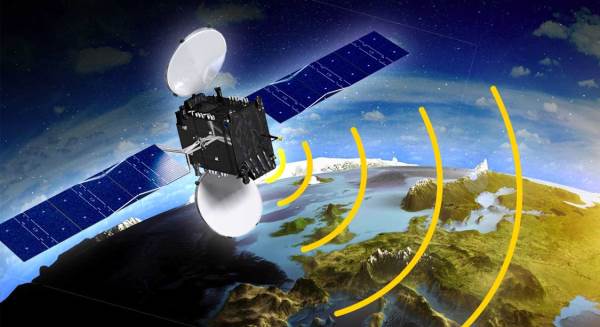
Federal government has fixed 2028 and 2029 for the launch of two communication satellites, NIGCOMSAT-2A and NIGCOMSAT-2B, as part of efforts to strengthen security and expand digital connectivity.

The government will be committing over $22 billion on the ambitious space-led growth agenda focused on new satellite launches, increased industry revenue and expanded broadband access in underserved communities.
At the opening of the 2026 Nigerian Satellite Week in Abuja, Dr Bosun Tijani, minister of Communications, Innovation and Digital Economy, confirmed the government’s approval for the acquisition of two new satellites—NigComSat 2A and 2B, describing the move as a “defining commitment” to national development, digital sovereignty and economic competitiveness.
Also, Mrs Jane Nkechi Egerton-Idehen, managing director of Nigerian Communications Satellite Limited (NigComSat), noted that the projects have moved beyond procurement to the execution stage.
She said the satellites are designed to enhance intelligence gathering, surveillance, and connectivity across Nigeria and neighbouring countries, particularly in support of security operations.
“For 2A and 2B, we have started the process. We have closed the tender and are now back into the financing and implementation stage. 2A is built to come up in 2028, and 2B for 2029.
“When they are up and running, they are expected to provide security within the borders and neighbouring countries. They will support the security agencies because data collection and intelligence in real time is important. Satellites like communication satellites allow that, irrespective of where they are,” she said.
On his part, Tijani, said the satellite programme forms part of a broader government strategy to deepen digital infrastructure nationwide.
According to him, the initiative complements ongoing investments in fibre-optic expansion and telecommunications infrastructure, while extending connectivity beyond Nigeria’s borders.
“The President’s approval of NIGCOMSAT-2A and 2B demonstrates a clear commitment to building the future. These satellites will enhance security, connect remote communities, and extend our fibre-optic network into neighbouring countries.
“Some of these neighbouring countries pay up to ten times more for internet capacity than Lagos. Extending our fibre network will not only improve connectivity but also enhance border security and regional collaboration.
“Satellite technology affects everything, from how a child in a rural community accesses the internet to how farmers make critical decisions and how businesses operate across distance,” he said.
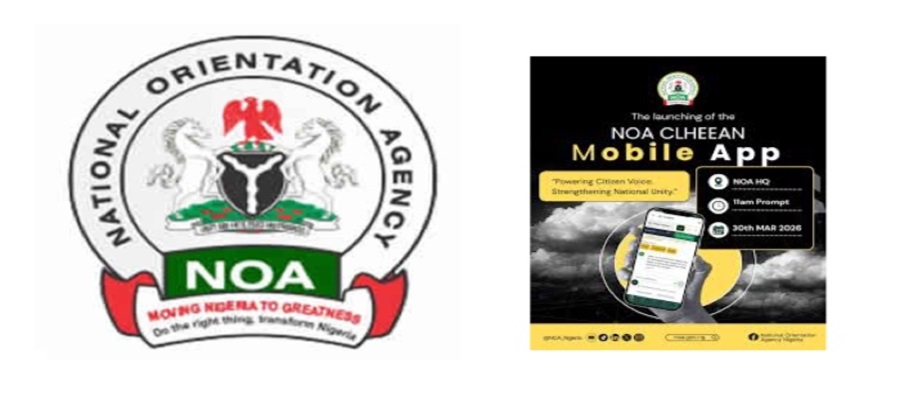
Federal government has announced the launch of CLHEEAN, an artificial intelligence-powered mobile application designed to improve interactions between citizens and public institutions.

It is also a civic education and community engagement app.
Developed under the National Orientation Agency (NOA), the platform functions as a virtual assistant accessible via mobile devices.
It allows users to access information on public policies, ask questions, and interact directly with government services.
The app includes features such as instant messaging, voice recognition, and multilingual support, including several local languages, to reach a wider audience.
With CLHEEAN, users can also submit feedback, report concerns, and take part in discussions on public policies. The approach is intended to strengthen citizen participation and improve communication between the government and the public.
Lanre Issa-Onilu, director general of the NOA, said the initiative addresses a long-standing gap between citizens seeking to be heard and systems that do not always respond effectively, adding that the platform marks a step toward closing that gap.
The launch comes as Nigeria continues to face challenges in citizen engagement and the dissemination of public information.
By leveraging artificial intelligence, authorities aim to make public services more accessible while improving transparency and responsiveness.
The initiative also reflects a broader trend across Africa, where governments are increasingly exploring the use of AI to modernize public services and strengthen ties with citizens.

How Recycled SIM Card Linked to N50m Kidnapping Nearly Landed me in Jail – Businesswoman

Senate Gives Tinubu Nod to Borrow Fresh $6Bn

FG Earmarks $2Bn to Launch 2 Satellites in 2028, 2029

CBN Directs Banks, Fintechs to Complete Cybersecurity Audit Tool

FG Launches CLHEEAN to Streamline Access to Government Services

Spotify’s Loud & Clear Report Reveals Over ₦60Bn Revenue for Nigerian Artists in 2025

Madonna University Taps Tech Guru Adote for Strategic Board Role

China Threatens to Shut Nigeria’s Satellite Over $11.44m Unpaid Debt

Jumia Tech Week 2026 Begins with Tech Deals on Smartphones, Electronics, and Everyday Technology

FCCPC Bans Lagos ‘No Refund’ Policy, Vows Fines and Shutdowns for Traders




 E-Financial2 days ago
CBN bars large‑ticket loan defaulters from banking services in tough new crackdown

 General News2 days ago
ARN Rejects Medical Bill over Attempt to ‘Scrap’ Profession

 Telecom2 days ago
NIGCOMSAT Supports Startups Growth with the Launch of Accelerator 3.0

 News2 days ago
Meningitis Kills a Quarter Million People a Year -Study

 Telecom2 days ago
FG Unveils Digital Economy Research Fund Scheme

 News2 days ago
Stakeholder says AI is Crucial to Nigerian Data Centres Amid Persistent Grid Collapse
- General News2 days ago
Nigeria Advances Digital Governance as NITDA takes over NGEA Portal

 News1 day ago
Dangote Refinery Debunks Speculations on IPO