

General News
Price Vs Quality: The Nigerian e-commerce shopper’s dilemma


By Terry Ibinabo,
By nature, Nigerians are predominantly traditional in their approach to shopping.
This is hardly surprising when you consider that online shopping or e-commerce, as it is more popularly known, is a fairly recent phenomenon, one that is still catching on here in Nigeria but undoubtedly growing in leaps and bounds.

Indeed, e-commerce, or at the very least, the structured version of it that we experience today, is barely a decade old in Nigeria. More on this later.
The predilection to readily embrace an opportunity to see, touch or experience a product (a classic case of what you see is what you get) before parting with hard-earned money is deeply ingrained here.
This is undeniably tied to the skepticism and natural sense of caution an average Nigerian possesses, particularly in situations that involve spending money.
Another important factor is a chance to haggle over price and the satisfaction of walking away with a perceived good deal, especially when the buyer succeeds in convincing the seller to shift ground. This is not to rule out the warm, human interaction that shopping in such traditional retail formats engender.
Perhaps, this is why open-air markets, corner shops or mom and pop stores remain popular and have continued to command a dominant share of retail spending in Nigeria and many other African countries.
The foregoing finds expression in a recent study by the Boston Consulting Group (BCG). Specifically, the report, published in June 2022 , submits that more than 600,000 small shops and open-air markets dominate the retail landscape in Nigeria, accounting for an overwhelming 97% of national sales of food, beverages, and personal care products.
The study adds that these traditional retailers consist of small kiosks and open-air markets. Even more eye-opening is the fact that the report reveals that the dominance has remained, despite the considerable challenges posed to traditional retail by the expansion of modern retail, the nascent rise of e-commerce and changes in consumer behaviour accelerated by the COVID-19 pandemic.
Titled ‘The Future of Traditional Retail in Africa’, the report holds that despite the advance in supermarkets, convenience stores, and other modern formats, including e-commerce, African consumers on average continue to buy more than 70% of their food, beverages, and personal care products from the continent’s more than 2.5 million small, independent shops.
In addition to some of the earlier listed factors which encourage traditional shopping, the BCG study highlighted other prevailing reasons.
‘‘Several factors make traditional retailers remarkably resilient. Small shops offer the proximity, flexibility, and convenient operating hours needed to serve their communities. They also often allow customers with limited incomes to purchase small quantities on credit,’’ the report suggests.
The BCG report is bolstered by another research conducted by the Oxford Business Group which attests to the power of traditional retail. The study noted that Nigerian shopping is still heavily dominated by the world of neighbourhood stores, street vendors and open markets. Although the study predicts that this will change with time, it insists that traditional retailers will continue to dominate for the following reasons.
‘‘One is taste: even of those who can afford to shop in malls or supermarkets, many prefer more traditional ways. Another is a tendency to shop frequently rather than stock up.
And deficient public transport means that malls are not very accessible to those without cars. Yet another edge may be cost-related, as pointed out to the local Business Day in April 2012 by sector analyst Cedric Bra.
Using informal labour, often selling goods bought illegally, and frequently operating unregistered and therefore untaxed, smaller shops can keep costs low. Contrast the modern retailers, which have high fixed costs and visibility, having to obey the rules in respect of tax and sourcing.
Taken together, noted Bra, this means that modern grocery retailers’ prices are on average 10-20% higher than those found in unregistered outlets.’’
Nevertheless, one can no longer deny the growing influence of e-commerce or online shopping, as a useful and convenient alternative for a growing band of savvy shoppers. This can be attributed to the rise in internet connectivity, greater exposure among the younger members of the population, the impact of the COVID-19 pandemic which brought the power of online shopping to the fore, as well as the ease and convenience that accompanies digital shopping.
Also worth mentioning is the growing awareness and appetite for e-commerce among Nigerian shoppers. A survey conducted by Philip Consulting in 2016 in Lagos, Abuja, Oyo, Delta, Kaduna and Rivers States revealed that at least 51% of respondents sampled still prefer to shop in-store, while 49 preferred online shopping. But between 2014 and 2016, 97% disclosed that they have currently shopped online, at least once per year.
E-commerce is also being embraced by a growing segment of the population because they do not face some of the structural challenges that confront traditional retailers.
One of this is inefficient distribution systems that often force retailers to close their shops for several hours so they can go purchase goods from wholesalers, making it hard to obtain or retain sufficient inventory – a pain-point that tech-driven platforms such as TDiLife, a major FCMG and lifestyle products distribution giant headquartered in Lagos, are helping these small businesses overcome.
Further boosting the popularity of e-commerce is the range of options afforded the shopper. From the comfort of one’s living room, bedroom or office, you can check out an array of products from the biggest brands on the platform of competing players at the click of a few buttons on your device – smartphone or laptop.
Also closely related to this is the fact that one can do this at any time of the day. In other words, e-commerce is a 24-hour operation, one that allows shoppers access to preferred items round the clock, without having to worry if the market is closed or whether the seller is yet to open or has locked up their kiosks to go to church/mosque or attend to other pressing personal issues, as may be the case with traditional retail.
But more importantly, e-commerce has the beneficial attribute of enabling Nigerians live out their price-sensitive proclivities.
Here is the catch. The average Nigerian is a price-conscious freak. We get unusually emotional or irritable at the prospect of being made to pay a higher price when we can avoid it. In the same way, we are often triumphant, giddy with excitement and fulfilled when we succeed in extracting a discount, a deal, a better price than stated for a product or item.
Certainly, e-commerce is best placed to sate this thrifty appetite.
A 2019 GE Shopper Research Study revealed that a growing number of consumers extensively research and compare prices and offers before making major purchases. According to the study, 81% of consumers go online before shopping and spend an average of 79 days gathering information before making a major purchase.
Further, the study disclosed that the availability of financing options continues to be a key factor in a shopper’s choice of retailer, with nearly half of all shoppers researching payment options online before visiting a store.
The above aligns with a 2017 Retail Dive Consumer survey.
The findings show that 56% of shoppers say they visit stores — at least occasionally — to first see, touch and feel products before buying them online. Additionally, one-third of shoppers say they make this practice a habit, reporting that they always or frequently go to stores to see or try out items before buying on the web. One in 10 shoppers say they always visit a store to see items they then buy online.
Here in Nigeria, it is common for shoppers to explore and compare prices among the major e-commerce firms before making up their minds, thereby affirming the primacy of price in the decision-making process. But where does product quality stand in the mix? Given a choice, would you sacrifice quality on the altar of cheaper pricing? This is the dilemma that confronts many online shoppers in Nigeria today.
Nevertheless, several studies point to the fact that quality remains key for most consumers, even ahead of price.
This takes us back to the recent emergence of e-commerce and its rise as a tool for price comparison. Hardly can one discuss e-commerce in Nigeria today without a mention of Jumia and Konga, unarguably two of the market leaders, but both of which have only been in operation here for 10 years.
Predating this, however, the only other claim Nigeria can lay to anything resembling e-commerce was BuyRight Africa, a platform founded over 13 years ago by Leo Stan Ekeh, one of Africa’s leading techpreneurs and which was way ahead of its time, but reportedly collapsed due to the absence of credit/debit cards at the time, paving the way for the latter-day players.
Still, many would be hard pressed when choosing between price and product quality.
But in the view of Durogba Arogundade, an e-commerce researcher based in the UK, the decision ought to be a simple one for shoppers.
‘‘As a Nigerian, I understand the huge attention paid to price. However, a shopper would only be getting the short end of the stick if they prioritized a sweet price at the expense of a low-quality product. It is a decision that often ends badly.
“The key is finding a balance. This is where brands such as Konga come in, by leveraging their combination of the traditional retail approach represented by strategically located physical stores accessible to the shopper and modern retail, as represented by their online platform.
“You can never go wrong here as research indicates that many shoppers often visit retail stores when comparing prices before buying online and vice-versa.’’
Arogundade’s submission is further supported by insights gleaned from George Nkem, a self-professed avid online shopper.
‘‘I have been shopping online actively for the past six years. I have experienced all the e-commerce firms we have. Today, I can confidently tell you Konga has the best price. Yes. Things are cheaper at Konga across board. But that is not where it ends for me. Quality is also very important.
“So, I would rather choose a place where I can get both. So, I often walk into a Konga store most times as it enables me confirm product quality and compare prices with other platforms online before I pay.’’
In conclusion, the controversy surrounding price and quality can be said to have been laid to rest bby findings from the Retail Dive Consumer Survey.
‘‘Because a majority of shoppers are still visiting stores before buying products online, it remains critical for retailers to provide a high-touch in-store experience.
“Turning physical retail space into showrooms — where customers can try and test products and generally get to know the product better before making the final purchase online — may be the logical next step for retailing,’’ the study asserts.
Terry Ibinabo, an academic, researcher and varsity lecturer, writes from Abuja



As Nigeria enters a new phase of tax administration, a locally developed technology platform, Kaanta AI, has been launched to help Nigerians have a better understanding of their tax obligations.

Kaanta AI is a WhatsApp-based, AI-powered tax assistant designed to provide simplified tax guidance to traders, small and medium-sized businesses, professionals, and individuals.
The platform arrives at a time when tax reforms and compliance requirements are becoming more prominent in public discourse.
Rather than relying on complex online portals or technical language, Founder and Chief Technology Officer, Oluwaferanmi Oladepo, at the launch of the innovation, explained that Kaanta AI operates entirely on WhatsApp, allowing users to ask tax-related questions, receive explanations, calculate taxes, and understand available reliefs using text, voice, or handwritten notes.
The service also supports local languages, including Yoruba, Igbo, Hausa, and Pidgin, expanding access beyond English-speaking users.
With the new tax law taking effect on January 1, 2026, analysts expect increased public confusion and misinformation. However, Oladepo assured Nigerians that Kaanta AI positions itself as a verification and guidance tool, offering instant responses to tax-related questions and concerns.
He described the platform as a response to a long-standing gap in tax education, sayin,: “Tax should not feel scary or confusing. Kaanta AI is built to help Nigerians understand what applies to them and make informed decisions, using clear and accessible language.”
According to the tech guru, in addition to basic explanations, the platform provides tax calculations and insights on tax reliefs, noting that the company also plans to introduce professional tax services, including filing support for small businesses and larger organisations. Kaanta AI operates a freemium model, with basic guidance available at no cost and advanced services offered through paid plans.
According to Tobiloba Olanipekun, Product and Growth Lead, the platform was designed around how Nigerians already communicate.
Olanipekun said: “WhatsApp is where people naturally ask questions and seek help. We wanted Kaanta AI to feel like a conversation, not a lecture. Anyone from a market trader to a young professional can ask questions freely and get clear answers.”
He added that the long-term goal is to improve tax education and compliance culture across the country, adding that: “With tax becoming part of everyday conversation in Nigeria, we aim to guide people with clarity rather than confusion.”
Kaanta AI is now available to users nationwide. As tax reforms take centre stage in 2026, the platform is expected to play a role in helping Nigerians navigate the changing tax landscape.
By Blaise Udunze
Millions of Nigerian citizens are watching with cautious anticipation as the federal government begins implementing its far-reaching 2026 tax reforms. This is to say that the official assurances that the new tax regime will be fairer, simpler, and more humane, as relished by the proponents of the reforms, are being listened to by both low-income workers, small business owners, professionals, and informal sector participants.

Tax
Still, behind the optimism is a familiar worry shaped by past experience that reminds us that taxation without accountability undermines both governance credibility and the legitimacy of the tax system, thereby making it hard to believe in.
For many Nigerians, the question is not whether taxes should be paid, but whether the state has earned the moral authority to demand them, judging by the lack of accountability over the years.
The Nigerian Tax Act and the Nigerian Tax Administration Act, two of the four pillars of the 2026 reforms, came into force on January 1, reshaping how individuals and businesses are taxed. According to proponents of the reforms, particularly the Chairman of the Presidential Committee on Fiscal Policy and Tax Reforms, Dr. Taiwo Oyedele, the changes are deliberately pro-poor and pro-growth. Workers earning below N800,000 annually are exempted from personal income tax. Basic food items, healthcare, education, and public transportation have been removed from the VAT net. Small companies with turnovers of N100 million or less are exempt from corporate income tax, capital gains tax, and the new development levy. Multiple tax laws have been consolidated into a unified code to reduce duplication, confusion, and harassment.
On paper, these reforms acknowledge Nigeria’s economic distress and signal a genuine attempt to lighten the burden on the majority of citizens. However, Nigeria’s tax crisis has never been about tax rates alone.
Nigerians have lived through decades of taxation that did not translate into visible development, social welfare, or improved quality of life, as this has succinctly shown that it is fundamentally about trust. No matter how progressive, for this singular reason, Nigerians see the announcement of the reforms via a long memory of disappointment and failure, while Nigerians have increasingly become vocal in demanding accountability from government at all levels, and social media has played a powerful role in amplifying public scrutiny in recent years.
Images and videos of the alleged lavish lifestyles of public office holders and their families are alarming and circulate widely, reinforcing the perception that public funds are misused or siphoned for private gain. While not all such claims are verified, the damage lies in the perception itself since governance credibility suffers when citizens believe that those entrusted with public resources live far above the realities of the people they govern.
The Nigerian Constitution, while not explicitly mandating accountability in narrow terms, establishes in Section 14 that the security and welfare of the people shall be the primary purpose of government. The state is expected to manage the economy in a manner that ensures maximum welfare, freedom, and happiness of citizens on the basis of social justice and equality. The provisions made in Section 22 further empower the media and arm it to the teeth to hold the government accountable to the people and beyond constitutional provisions, Nigeria voluntarily signed up to global transparency initiatives such as the Extractive Industries Transparency Initiative, domesticated through the NEITI Act of 2007. Over the period, NEITI has helped improve disclosure in the extractive sector, as its mandate does not extend to tracking how revenues are spent, leaving a critical accountability gap.
This gap is most evident in the lived experience of Nigerian taxpayers. Intrinsically, the average Nigerian does not experience taxation as a collective investment in shared prosperity. Instead, taxation feels like an added burden layered on top of already crushing personal responsibilities. Nigerians generate their own electricity through generators, source water privately, pay for security, indirectly fund road maintenance through vehicle repairs, and bear healthcare and education costs out of pocket. When citizens pay taxes and still bear the full cost of survival, taxation begins to resemble organized extraction rather than civic contribution.
For instance, the stories of Mr. George and Mr. Kunle reflect this reality. Mr. George, is an earned salary worker who has personal income tax deducted monthly through PAYE. Meanwhile, George also pays for electricity, security, water, road repairs, and private schooling. What about Mr. Kunle, who is a small business owner and chooses not to pay taxes voluntarily with the belief that the government has failed to meet its obligations and other rights? Their frustration is widely shared. According to the IMF, only about 10 million Nigerians out of a labour force of 77 million are registered taxpayers. This low compliance is not a product of ignorance alone, but of a deeply broken social contract.
Over the years, successive governments have attempted to address low compliance through amnesty schemes such as the Voluntary Asset and Income Declaration Scheme. Though these initiatives temporarily expanded the tax base, their long-term impact remains questionable because compliance driven by fear of penalties or temporary incentives does not endure where trust is absent. In Nigeria, tax compliance is often compelled rather than voluntary, just as we are about to experience in this new regime, enforcement tends to replace persuasion. This approach may generate short-term revenue, but it weakens legitimacy and fuels resistance.
Academic studies on taxation and accountability in Nigeria reinforce this conclusion. While global literature suggests a strong relationship between government accountability and voluntary tax compliance, Nigeria’s experience has been distorted by weak institutions and limited political legitimacy. This should be noted by the policymakers that where citizens perceive government as unaccountable, coercion increases, collection costs rise, and evasion becomes normalized. Hence while, the result is a vicious cycle in which low trust breeds low compliance, prompting harsher enforcement that further erodes trust.
Other jurisdictions offer valuable lessons. For instance, today, a country like Sweden has one of the highest tax-to-GDP ratios in the world with remarkably high compliance rates, and this has been the norm despite imposing steep personal income taxes. The reason is simple, in the sense that transparency and visible benefits are not far-fetched. Citizens know how their taxes are spent and experience the returns through quality education, healthcare, social security, and public services. Taxation is viewed not as punishment but as a shared investment. In China, targeted tax deductions for healthcare and education similarly align taxation with social needs, reinforcing compliance through perceived fairness.
Nigeria’s challenge is not to replicate these systems mechanically, but to internalize their core principle that enables the people to comply willingly when they believe the system works and that everyone is treated fairly.
This principle is being tested anew by the recent controversy surrounding the Federal Inland Revenue Service’s (now branded as Nigeria Revenue Service) appointment of Xpress Payments Solutions Limited as a Treasury Single Account collecting agent. Though framed as a technical step toward modernizing digital tax infrastructure, the quiet nature of the appointment, coupled with limited public disclosure, has reignited fears of revenue capture and cartelization. Critics have drawn parallels with past private-sector dominance over state revenue systems, warning against concentrating sensitive national revenue functions in private hands without clear safeguards.
Former Vice President Atiku Abubakar’s reaction captured the broader public unease. He raised an alarm while warning against what he described as the nationalization of a revenue collection model that had previously raised serious transparency concerns and the Nigeria Revenue Service (NRS) has insisted that Xpress Payments is merely an additional option and not an exclusive gatekeeper, the controversy highlights a deeper issue, which authenticates the fact that in a climate of low trust, silence, and lack of clarity, suspicion. Even well-intentioned reforms can falter if citizens feel excluded from the process.
With broader concerns about governance, accountability, and democratic integrity in society, this moment coincides with it. Even the recent calls by leaders such as Rotimi Amaechi and civil society organizations like ActionAid Nigeria underscore the growing demand for responsible, transparent and people-oriented leadership as being raised from different quarters. Governance indices consistently rank Nigeria poorly on accountability, while poverty, unemployment and insecurity remain widespread. That is what, in such a context, asking citizens to trust the tax system without first restoring confidence in governance is unrealistic and unattainable.
At the core of the debate lies a fundamental moral question: when does a government have the right to tax its citizens? Taxation is not charity and it is not magic. It is a contract. Citizens surrender a portion of their income so the state can provide security, infrastructure, justice, and essential services that individuals cannot efficiently provide on their own. When this exchange functions, taxation feels legitimate. When it fails, taxation feels coercive.
No doubt, legally, the Nigerian state retains the power to tax, but morally, legitimacy depends on performance. Security is foundational. Infrastructure enables productivity. The government must understand that healthcare and education protect human capital, while transparency ensures fairness. And, when these pillars are weak, taxation loses its ethical grounding. All that Nigerians demand is not perfection; they demand evidence that their sacrifices matter.
As the implementation of the new tax reforms takes root, Nigeria stands at a defining moment. The reforms offer an opportunity to reset the social contract around taxation, broaden the tax base, and reduce dependence on dwindling oil revenues. But the point being flagged is that reform without accountability will only reproduce old failures in new forms. To buttress this further, taxation without accountability, as being practiced in the past, will invariably undermine governance credibility and erode the legitimacy of the tax system.
And, as the scripture says, you cannot put “old wine in a new wineskin.” Failure to adhere to this instruction will lead to combustion. Yesterday’s methods or mindsets on taxation will rupture new strategies, which cannot thrive or survive because of a lack of accountability.
If the government is serious about improving voluntary compliance, it must go beyond policy announcements. Hence, must demonstrate transparent use of tax revenues, strengthen oversight institutions, limit monopolistic control over revenue collection, and communicate clearly and consistently with citizens. Most importantly, it must deliver tangible improvements in the daily lives of all Nigerians.
When citizens see roads fixed, hospitals working, schools improving, and security strengthened, compliance will follow. Voluntary tax compliance is not an act of generosity; it is a rational response to trust. Fix the system, restore confidence, and Nigerians will pay, not because they are forced, but because the contract finally makes sense.
Blaise, a journalist and PR professional, writes from Lagos and can be reached via: [email protected]
General News
Ministry of Finance Leads FG-Backed Deal to Deliver Quality Homes and Boost Agriculture in Niger State

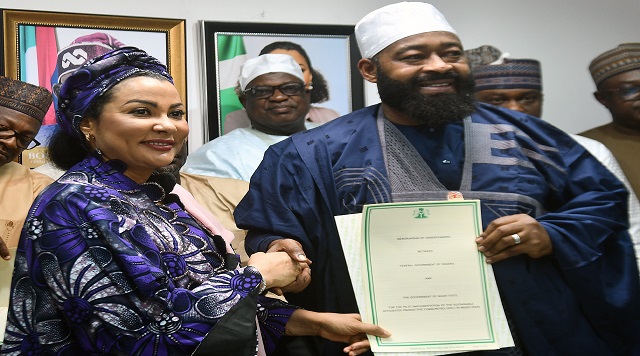
The Federal Ministry of Finance has anchored the signing of a Memorandum of Understanding (MoU) between the Niger State Government and the Ministry of Finance Incorporated (MOFI) for the implementation of a Mass Housing and Agricultural Settlement Project in Niger State.

Speaking at the MoU signing ceremony, Dr. Doris Nkiruka Uzoka-Anite, the Honourable Minister of State for Finance, described the agreement as a landmark initiative that underscores the Federal Government’s commitment to cooperative federalism, inclusive economic growth, and strategic alignment in line with President Bola Ahmed Tinubu’s Renewed Hope Agenda.
With the Federal Ministry of Finance serving as the anchor institution, the project benefits from strong policy coordination, financial credibility, and institutional oversight. The initiative is designed to integrate housing delivery with agricultural productivity, rural stability, and economic empowerment.
“Housing is a fundamental pillar of development. In Niger State, housing also intersects directly with agriculture, food security, and rural livelihoods. This project is therefore structured not merely as a housing intervention, but as a settlement framework for farmers aimed at strengthening agricultural value chains,” the Minister stated.
Niger State, one of Nigeria’s most agriculturally endowed states, continues to face challenges, including insecure settlements, rural-urban migration, and limited rural infrastructure. The project seeks to address these constraints by providing secure, well-planned housing settlements for farmers, strategically located to support agricultural production, storage, processing, and access to markets.
The Honourable Minister emphasized that anchoring farmers in stable communities with access to basic infrastructure will improve productivity, reduce post-harvest losses, enhance security, and encourage youth participation in agriculture, making farming more efficient, attractive, and profitable.
Sustainability and affordability are core pillars of the initiative, with integrated renewable energy solutions—including solar-powered homes and community facilities, designed to ensure reliable power, reduce energy costs, and support agro-processing and storage activities. The project also prioritises efficient land use, access roads, water infrastructure, and environmentally responsible building practices.
Reacting to the sustainability focus of the project, the Governor of Niger State, His Excellency Mohammed Umaru Bago, expressed strong optimism about its transformative impact on the state.
“When you say sustainability, affordability is very important. When I heard that a mini-grid has been deployed in Jos, it’s because it’s affordable. Diesel is not sustainable because it’s not affordable. For considering the factor of affordability in this project, we’re grateful,” the Governor said.
He further announced the state’s commitment to the project, adding, “So, Honourable Minister, Niger State is bringing forward 100,000 hectares of land for this project. I want to assure you that with this initiative, you have solved 80 percent of our problems.”
Drawing a direct link to the Federal Government’s development agenda, Governor Bago noted, “We’ve gone across the world and seen how people transit from poverty to prosperity. And I think the goal of the President, my father, is for us to transition our people out of poverty in the next four years, by the grace of God.”
The Managing Director and Chief Executive Officer of the Ministry of Finance Incorporated (MOFI), Dr. Armstrong Ume Takang (Ph.D.), who attended the ceremony alongside other critical stakeholders, including the building contractor, reaffirmed MOFI’s commitment to quality delivery and agricultural productivity.
Dr. Takang assured the Niger State Government of the contractor’s proven competence and credibility in delivering mass housing projects, stressing that affordability would not come at the expense of quality.
“We want affordable and decent houses. The fact that they are located in rural communities does not mean the quality should be compromised,” he said.
Beyond housing, Dr. Takang highlighted MOFI’s broader role in strengthening the agricultural component of the settlements through strategic partnerships.
“We have partners who will supply affordable fertilisers imported in large quantities. We will also work with other partners to ensure access to key agricultural inputs, not only fertilisers, but also pesticides, high-quality seeds, and elements of mechanisation,” he added.
The project adopts an innovative financing model that blends public assets with private investment, ensuring sustainability, transparency, and shared risk. Through this approach, the government focuses on policy direction and oversight while leveraging private sector efficiency and capital.
Beyond improving food security, the Mass Housing and Agricultural Settlement Project will stimulate broad-based economic activity and generate employment across construction, agriculture, Agro-processing, renewable energy, logistics, and community services. The initiative will support local industries such as cement, steel, transportation, and agro-allied enterprises, while strengthening rural economies and increasing Niger State’s internally generated revenue.
Affordability and inclusiveness remain central to the project’s design. The settlements are tailored to the income realities of farmers and low- to middle-income earners, supported by transparent allocation mechanisms and strong governance structures to ensure benefits reach the intended beneficiaries.
The MoU sends a clear signal to the investment community that Niger State, working in alignment with the Federal Ministry of Finance and MOFI, is open to credible, well-structured, and impact-driven investment. Developers, financial institutions, pension funds, real estate investors, and agribusiness operators are invited to view the project as a scalable and replicable model.
Reaffirming the Federal Ministry of Finance’s commitment, the Honourable Minister assured stakeholders of continued coordination, fiscal discipline, and policy support to ensure the project moves swiftly from signing to execution and delivery.
Commending the leadership of MOFI and the Executive Governor of Niger State, the Minister concluded that the initiative reflects a shared vision for integrated development.
“Through this partnership, we are not just building houses; we are creating stable farming communities, strengthening food security, and laying the foundation for sustained prosperity in Niger State,” she said.

Nigeria, Others Lag Behind as Egypt Tops Africa in AI Readiness

Wema Bank Upgrades ALAT Banking App

Firm Launches AI-powered Platform to Simplify New Tax Laws

Study Reveals 88.5% of Phishing Attacks Focus on Stealing Account Credentials

X Suspends Twitter Account for Rules Violation

Banks quietly move to enforce new ₦50 transfer levy from Jan. 1

FIRS says NIN, CAC Numbers to Serve as Tax IDs from 2026

Nigeria Takes the Lead in the Global WSIS+20 Digital Agenda

PalmPay Launches N400 Million World Travel Carnival, Rewarding Users with Free Global Trips

Check Point Reveals Nigeria as Second Most Targeted African Country for Cyberattacks in November




 General News1 day ago
Ministry of Finance Leads FG-Backed Deal to Deliver Quality Homes and Boost Agriculture in Niger State

 News1 day ago
SERAP Sues INEC Over Alleged ₦55.9Bn Election Funds Diversion

 Telecom1 day ago
FG Plans to Invest $460m World Bank Loan in Fibre Infrastructure

 News1 day ago
AI Founders and Developers to Converge in Lagos for AI in Action 2026 conference

 E-Financial1 day ago
NDIC Declares Second Liquidation Dividend for Heritage Bank Depositors

 News1 day ago
FG Inaugurates N40Bn CCTV Control Centre for Third Mainland Bridge

 General News1 day ago
Tax Reforms Panel Rejects KPMG’s Critique of New Laws

 General News1 day ago
Indonesia Blocks Elon Musk’s Grok Over Deepfake Concerns