

General News
Q2 outlook for Oil & What it means for the Nigerian Economy


Q2 Outlook – WTI Oil: Near 30% rally in Oil so far this year unjustifiable
The near 30% rally in WTI Oil during the first quarter of 2019 is difficult to justify when taking into account the progressive concerns that are mounting regarding a global economic downturn. The rally has been supported by improved market confidence that efforts from OPEC+ have tightened the supply in the market, but whether this encouraging sentiment can continue would likely depend on whether Russia continues to support production cuts.
As such, a result to an unprecedented 30% rally over the last quarter, the commodity is going to enter the new quarter as a prime contender to suffer from a market correction. The probability is high that fears over a deceleration in world economic momentum will only get louder as the year progresses, meaning Oil investors will need to re-assess into expectations what impact a global slowdown will have on future demand. A plethora of evidence through data releases from different economies across the globe has already pointed out that a downturn in growth is impending – if the slowdown hasn’t already arrived.
Market perception is that OPEC cuts are working but demand outlook at risk
One of the major risks for the price of Oil in the second quarter is the increased probability that world economic forecasts for 2019 will be revised lower. While a great volume of noise in the Oil atmosphere is created around headlines involving production, OPEC or even more recently OPEC+, it often gets underlooked just how important Oil demand is for its valuation. Reduced demand is a negative for Oil price and the prospect of further lower demand on global economic health fears will risk re-igniting oversupply concerns that have dominated headlines since the spectacular price crash first occurred in 2014, despite repeated measures and attempts by OPEC and co to rebalance the market.

Iran waivers a wildcard, Saudi Arabia to remain committed to output cuts
If you were to take the contrarian view, there are a few reasons to remain optimistic that Oil can resume its price rebound in Q2. This would however, include some unpredictable risk elements around politics for a commodity that has historically behaved with an extreme level of sensitivity to politics.
Waivers on Iranian sanctions are set to expire over the coming months and if President Trump adopts a hardline approach that results in the taps for Iranian Oil supply being turned off, the subsequent change in the production outlook would prove tempting for potential buyers. Venezuela is another market that has come under the threat of sanctions following recent domestic unrest, while suspicions remain that Saudi Arabia will maintain its underlying commitment towards tightening the available supply of Oil to achieve stronger valuations to help the Kingdom achieve its fiscal targets.
Do not underestimate risk Trump speaking against Oil rally will have on future outlook
Another factor that needs to be taken into account when factoring in potential risks that can swing the hammer of the Oil price in either direction is President Trump.
The President of the United States has made it perfectly clear on numerous occasions that his desire is for Oil prices to return to lower levels for a prolonged period. He has already commented via social media feeds that the Oil price is too high and while he might not be President of a nation that is either a traditional member of OPEC nor OPEC+, he carries the ability to influence world financial markets. When it comes to President Trump’s influence on financial markets it is never an occasion that investors can prepare for when it will happen, but Trump has proven in office that he has a tendency of getting his way in the end, and I would personally not want to be on the wrong side of the trade when the President of the United States is demanding for lower Oil valuations.
What does this all mean for the Nigerian economy?
Although Nigeria remains on a quest to diversify away from Oil reliance, a handsome chunk of the nation’s export earnings is from Oil sales. While rising Oil prices will boost government revenues, provide foreign exchange stability and support economic growth, it leaves the country vulnerable to external shocks. With robust production from US Shale stimulating oversupply concerns and fears around slowing global growth potentially impacting demand, Oil’s upside seems limited. If Oil prices end up depreciating back below $60 in Q2, this will not only impact growth prospects but also Nigeria’s efforts to support its 2019 budget. The ramifications of such a development will most likely complicate the Central Bank of Nigeria’s efforts to cut rates further in an effort to boost economic growth. However, further signs of Nigeria breaking away from Oil reliance to other sustainable sources of growth such as agriculture have the potential to limit shocks created from Oil volatility.
WTI knocking on the door at $60, but is anyone home?
Focusing on the technical picture, WTI Crude has reached tough resistance on the monthly charts with $60 acting as a barrier for bulls preventing prices by being pushed higher. The $60 level ironically also reflects the 50% Fibonacci retracement level of the October – December 2018 downtrend, which helps explain why we are noticing a trend of selling pressure jumping back in the market close to $60.
Until Oil is able to secure a decisive monthly close above $60, it looks like a ceiling is in place for Oil bulls and selling rallies below this level is going to remain as a tempting strategy for bearish investors. A weekly close below $56 will act as a signal for further downside with $52, $50 and $47.80 acting as key points of interest.
If prices are able to conquer $60, Oil has scope to challenge $65.



Federal government has launched Credit for Laptops, Internet, Connectivity and Knowledge Digital Devices (C.L.I.C.K.D.), a new consumer credit initiative, to provide affordable financing for locally assembled laptops and other digital devices.

L-R: Mr Uzoma Nwagba, managing director and chief executive officer, CREDICORP, and Dr Bosun Tijani, minister of Communications, Innovation and Digital Economy, at the launch
The initiative by the Nigerian Consumer Credit Corporation (CREDICORP) and the Federal Ministry of Communications, Innovation and Digital Economy, is aimed at equipping Nigerians with the tools needed to participate in the country’s growing digital economy.
During the launch, Dr Bosun Tijani, minister of Communications, Innovation and Digital Economy, described access to credit as critical to improving productivity and driving economic growth.
Dr Tijani said no nation could achieve sustainable development without a strong credit system that enables individuals and businesses to access resources needed to become more productive.
He noted that in today’s digital age, technology has become indispensable for education, innovation and wealth creation.
The minister explained that many talented young Nigerians possess the skills required to succeed in the digital economy but remain constrained by their inability to own computers and other digital tools.
Drawing from his personal experience, Dr Tijani recalled how his first laptop as a student in the university opened doors to international opportunities and eventually inspired him to establish one of Nigeria’s pioneering technology hubs.
He said the new programme would ensure that more young Nigerians are not denied similar opportunities because of financial barriers.
According to him, the initiative aligns with President Bola Tinubu’s vision of building a one-trillion-dollar economy by expanding access to technology, boosting productivity and supporting local manufacturing.
Mr Uzoma Nwagba, managing director and chief executive officer, CREDICORP, described the programme as a strategic investment in Nigeria’s future workforce and digital transformation.
Mr Nwagba said that while improvements in internet connectivity and digital skills training have positioned Nigeria for the Fourth Industrial Revolution, access to devices remains a major challenge preventing many young people from fully participating in the digital economy.
He explained that C.L.I.C.K.D. would bridge that gap by providing affordable consumer credit that enables beneficiaries to acquire laptops and other internet-enabled devices while they develop in-demand digital skills
Federal government has launched a N482.4 million investment fund to support 12 tech-enabled Nigerian startups.

The initiative under the federal government of Nigeria’s Investment in Digital and Creative Enterprises (iDICE) Programme was implemented by the Bank of Industry (BoI).
The initiative in a statement said applications have been opened for Growth Lab, a 12-week acceleration programme that will select the 12 tech-enabled Nigerian startups, from the six geopolitical zones, for intensive growth support, investment readiness training, and access to up to $350,000 in funding.
According to Ife Adebayo, national coordinator of the Programme, growth lab was designed to support startups that have achieved early traction and are seeking the expertise, networks, and investment required to scale following the implementation of Founders Lab.
“Growth Lab is the Startup Bridge accelerator programme, designed for startups that have developed an MVP and require structured support to scale. The programme focuses on strengthening venture fundamentals and preparing companies for external investment.
“The programme targets startup founders who are seeking the support, networks, expertise, and investment readiness required to accelerate growth and strengthen their position within the Nigerian innovation ecosystem,” he said.
He added that selected founders will gain access to structured growth support, investment readiness preparation, access to industry experts, market expansion pathways, a $100,000 cash investment (or Naira equivalent) for 7.5% equity upon entering the programme (terms and conditions apply), and up to $250,000 in potential follow-on investment should certain growth conditions be met.
“Eligible startups must be at the post-MVP stage, demonstrate evidence of market validation through users, customers, pilots, partnerships, waitlists or any other demand signals, and be willing to participate fully in the hybrid programme,” he said.
The programme will run as an intensive 12-week hybrid experience, including virtual engagements and two physical weeks in Lagos focused on collaboration, learning, and business growth.
The statement said applications opened on July 15, 2026, and will close on August 19, 2026.
According to him, female founders are strongly encouraged to apply. Selection will be conducted through a clearly defined, merit-based evaluation process aligned with published criteria.
iDICE is a $618 million federal government initiative backed by international lenders to boost the technology and creative sectors.
It provides young entrepreneurs with business skills training, mentorship, and access to capital through funds and accelerator programs like the iDICE Startup Bridge.

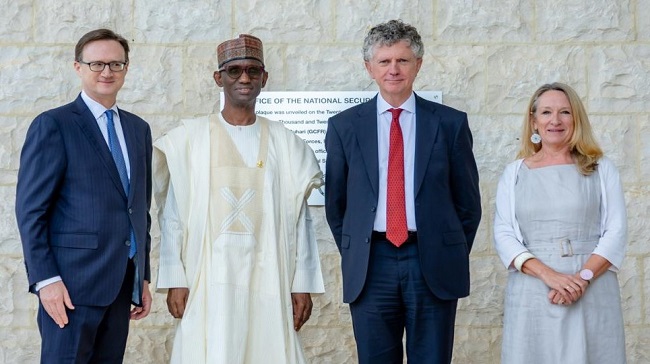
Nigeria and The United Kingdom held the fourth Security and Defence Partnership (SDP) Dialogue at the Office of the National Security Adviser (ONSA) in Abuja, recently. The dialogue, an important pillar of the bilateral Strategic Partnership, was opened by the National Security Adviser to the Federal Government of Nigeria, Nuhu Ribadu, and the United Kingdom’s National Security Adviser, Jonathan Powell.

Building on the third dialogue hosted in London in July 2025, the fourth SDP dialogue included inter alia, regional and domestic security challenges, human rights and non-kinetic solutions, defence staff talks, cyber and hybrid threats, as well as cross-government discussions on strategic trends, counter terrorism, fraud and illicit finance. Senior representatives from across the Governments of Nigeria and the United Kingdom participated, reflecting the breadth and extent of the partnership.
Nigeria and the United Kingdom agreed to deepen cooperation based on mutual accountability and delivery of commitments while working in a spirit of partnership.
Defence co-operation
The United Kingdom and Nigeria’s defence partnership continues to strengthen in the support of peace and stability in the region. Following on from the successes of previous SDP dialogues, the United Kingdom renewed its long-term commitment to Nigeria’s Armed Forces, including through efforts to counter the threat from Uncrewed Air Systems (UAS) and Improvised Explosive Devices (IED), via joint doctrine, training, technical advice and lessons learning, as well as exploring the development of Special Operations Forces.
The United Kingdom reaffirmed its support for Nigeria’s Joint Doctrine and Warfare Centre, and for strengthening Nigeria’s Maritime Domain Awareness capability. Both parties recognised the success of the hydrography partnership. The United Kingdom committed to continue supporting the National Hydrographic Agency to enhance autonomy and regional influence.
Both governments underscored their shared commitment to deepening cooperation on maritime security in the Gulf of Guinea. Recognising the critical importance of regional stability and secure trade routes, both governments committed to aligning efforts to combat illicit maritime activities, and transnational threats. Nigeria and the United Kingdom also agreed to explore opportunities to strengthen their defence trade relationship.
Countering hybrid threats
Nigeria and the United Kingdom reaffirmed their cooperation on countering hybrid threats, including cyber security and Foreign Information Manipulation and Interference (FIMI). Both sides welcomed progress under the existing Cyber Memorandum of Understanding [2024 to 2027] and agreed to further collaboration on threat intelligence sharing and a new phase of targeted programme partnership.
In this context, the United Kingdom and Nigeria recognised the challenged posed to open societies by hybrid threat actors and our shared assessment. Both countries committed to advancing a new structured framework for cooperation on countering hybrid threats.
This will include the advancement of concrete cyber resilience initiatives, a formalised intelligence-sharing mechanism, robust joint capability-building programmes, and cooperation on counter-hybrid threat strategies, in order to effectively counter mis/disinformation, cyber-attacks, transnational organised crime, and other hybrid threats, whilst upholding human rights and the rules-based international order. Both sides will seek to widen the conversation on hybrid threats.
Joint efforts will continue to build national capabilities, including through programme delivery and targeted support, while addressing developing risks, including from emerging technologies, and supporting Nigeria’s efforts to enhance its role in promoting regional resilience across West Africa.
Countering terrorism and violent extremism
Building on commitments agreed at the third dialogue, Nigeria and the United Kingdom agreed to deepen their partnership on counter terrorism and countering violent extremism. Both sides identified shared priority areas, including strengthening multi-agency coordination, enhancing intelligence and information exchange, as well as reinforcing crisis preparedness and protective security.
Both sides appreciated their continued collaboration on aviation security. The United Kingdom reinforced its support for capacity development efforts at Lagos and Abuja airports to build on progress made to date. Both sides agreed to continue working together in support of Nigeria’s efforts to roll-out the Multi-Agency Anti Kidnap Fusion Cell at the State level.
Continued cooperation will support the operationalisation of Nigeria’s counter terrorism architecture, particularly the National Counter Terrorism Centre, alongside efforts to build capabilities in investigations, forensics and strategic communications. Both sides agreed to renew their support to Nigeria Police Force’s Counter Terrorism Unit with a technical needs assessment planned for late 2026.
Nigeria and the United Kingdom have renewed their commitment to preventing violent extremism through non-kinetic approaches including Disarmament, Demobilisation and Reintegration (DDR) and implementing a comprehensive, whole-of-society approach to building sustainable peace under Nigeria’s national security framework. They welcomed the development of a national policy framework on DDR, and the United Kingdom committed to continuing support to implement the framework at national and state levels following formal sign-off.
Recognising the importance of justice in effective responses to terrorism, the United Kingdom welcomed the commitment and concrete actions by Nigeria to expedite terrorism cases through remote court proceedings, alongside other latest efforts to counter terrorism.
This includes the ongoing phases of mass trials at the Federal High Court, demonstrating Nigeria’s determination to deliver timely, effective, and human rights-compliant investigations and prosecutions of terrorism crimes. Both countries also committed to work together on human rights compliance and recognised the importance of transparency, accountability and respect for human rights as integral to effective counter terrorism cooperation.
Human rights and non-kinetic solutions
Nigeria and the United Kingdom reaffirmed the central role of human rights and non‑kinetic approaches in achieving sustainable security outcomes. Both sides welcomed progress since the third SDP dialogue and agreed to deepen cooperation on civilian protection, accountability, conflict prevention, and the Women, Peace and Security (WPS) agenda.
Both sides reviewed ongoing efforts, including Nigerian Armed Forces’ civilian harm mitigation measures, and underscored the importance of strengthening practices, ensuring transparent investigation of incidents, and embedding lessons learned to reduce harm and maintain public confidence. On accountability, both sides emphasised the need for robust mechanisms to investigate violations by both state and non-state actors.
The United Kingdom welcomed the involvement of the National Human Rights Commission with the Nigerian Air Force’s investigations into recent air strikes. The United Kingdom offered support to strengthen the National Human Rights Commission’s capacity to document and investigate abuses by non-state actors.
Recognising the importance of Nigeria’s upcoming national elections, both sides noted the importance of effective election security before, during and after polls, including efforts to protect voters and institutions, public order management in line with international standards, and reducing the risk of violence.
On preventing conflicts and violent extremism, both sides highlighted the importance of strengthening early warning and early response systems, improving coordination, and strengthening ability of peacebuilding agencies to ensure timely preventive action. On WPS, both sides welcomed progress on Nigeria’s third National Action Plan and committed to advancing participation, protection, and prevention, with the United Kingdom’s continued support for implementation. The United Kingdom offered continued technical assistance in support of Nigeria’s relevant national and state-level strategies in these areas.
Both sides agreed to explore a National Counter Terrorism Centre led quarterly working-level mechanism, with the National Human Rights Commission, to track progress on session agreements and reaffirmed their shared commitment to accountability, transparency, and civilian protection.
Fraud and illicit finance
Building on commitments agreed at the third Security and Defence Partnership dialogue and the State Visit of President Bola Ahmed Tinubu to London thereafter, the United Kingdom and Nigeria reiterated their shared ambition to tackle fraud and illicit finance.
Both sides welcomed progress on strengthening cooperation, including efforts to enhance public–private partnerships, increase capabilities to jointly tackle fraud, improve asset recovery processes and oversight of virtual assets and cryptocurrencies, as well as recognised the growing relationship between illicit financial networks and hybrid threats.
Further collaboration will focus on enhancing mechanisms to support informal bilateral and international cooperation, including timely operational engagements on relevant requests, while addressing evolving fraud threats through strengthened intelligence exchange, joint analysis and coordinated enforcement action. A joint action plan will advance delivery against shared priorities.
Both countries also committed to continued capacity building to support investigation, prosecution and judicial responses, reinforcing a coordinated approach to protect the members of the public in Nigeria and the United Kingdom from serious and organised fraud and financial crimes. Nigeria and the United Kingdom committed to continuing efforts to embody regional and global leadership on the issue of fraud.
Regional security co-operation
Nigeria and the United Kingdom exchanged views on the evolving regional and domestic security environment, noting the deteriorating situation in the Sahel and its impact across West Africa. Both sides reaffirmed Nigeria’s prominence and role as a key factor in promoting peace and stability across Africa over the years.
To this end, both sides agreed upon the importance of Nigeria leveraging its regional relationships and its participation in significant regional platform including through the Economic Community of West African States (ECOWAS) and emphasised the importance of continued outreach and collaboration with countries in the Alliance of Sahel States (AES).
The United Kingdom and Nigeria welcomed the analytical exchange on security and hybrid threats held in advance of the Forth SDP and committed to continuing these as part of future dialogues. Against this backdrop, both countries reaffirmed their intention to deepen cooperation on regional security.
The United Kingdom welcomed the efforts of Nigeria on progress made towards transitioning the National Counter Terrorism Centre to a Regional Centre of Excellence. The United Kingdom expressed its continued support to Nigeria’s regional counter terrorism efforts and welcomed Nigeria’s decision to join the International CT Academy in Ivory Coast (AILCT) to share its expertise across West Africa and the Sahel. The importance of strengthening coordination, information sharing and burden-sharing between regional initiatives were recognised.
Both sides acknowledged the increasing cross-border nature of threats, alongside the impact of hybrid challenges on regional stability, and agreed to work together to support effective regional leadership and partnership.
Implementation and accountability
Finally, Nigeria and the United Kingdom emphasised the importance of sustained delivery and structured engagement to ensure progress on agreed priorities. Both sides agreed to maintain close coordination, through ongoing monitoring of implementation and continued cross-government collaboration.
To support this, officials were tasked to take forward agreed actions and to review progress ahead of the next Security and Defence Partnership Dialogue, to be hosted by the United Kingdom in 2027. It was agreed the Dialogue will continue to support delivery of the United Kingdom–Nigeria Strategic Partnership as well as provide a platform to strengthen cooperation across shared security and defence priorities.

NPC Opens Nationwide Digital Birth, Death Registration Platform

FG Launches C.L.I.C.K.D., Consumer Credit Scheme for Tech Devices

Airtel Nigeria Expands Retail Footprint to Strengthen Customer Access Nationwide

Ovaloop Technologies Unveils Digital Tools to Formalize SMEs Operations Across Africa

Kaspersky Survey Highlights the Need for Smartphone Security

NRC, Ponzi Scheme Collapses Resulting Loss of Billions of Naira

NASENI Moves to Digitize CCB’s 5m Assets Declaration and Operations

Lebara Nigeria Launches Lebara Play, Africa’s First Telecom-Owned Micro-Drama Platform

CANAL+ Partners Samsung to Pre-Load DStv Stream on New Samsung TVs In Nigeria, Other African Countries

Tokenization, Blockchain Technology will Transform Financial Institutions – IMF




 News2 days ago
Adebutu, PDP Chieftain Accuses Nigerian Governors of Embezzling LG Allocations

 E-Financial2 days ago
Access Holdings Sells 7.44% Stake in Ghana Unit

 E-Financial2 days ago
NDIC Urges Youths to Shun Ponzi Schemes, Embrace Savings

 News2 days ago
NIMASA Unveils Accelerator Scheme to Drive Innovation, Sustainable Growth

 E-Business2 days ago
SERAP to Sue NASS over Bill Empowering NDPC to Regulate Social Media

 E-Financial2 days ago
NRS Issues July 31 Deadline for e-Invoicing Compliance

 News2 days ago
ICPC Secures Final Forfeiture of N941m Linked to IPPIS Fraud

 News2 days ago
eBusinessLife Advocates Greater Support for Girls in ICT as Students Showcase AI Innovations